Topics (384k) Articles (398k) Users (410) Discussions (242) Comments (383) Files (13k) New article
Past exam of the mathematics course of the year 2 of the natural sciences course of the University of Cambridge 2015 Paper 2 4 a ii Solution by  Codex 0 2026-10-18
The denominator vanishes at the four roots of , namely for . They are simple poles, since is nonzero at each root and the numerator does not vanish there. The simple-pole residue formula givesExplicitly,There are no branch points or other finite singularities. At infinity the function is , so infinity is removable rather than a pole.
Past exam of the mathematics course of the year 2 of the natural sciences course of the University of Cambridge 2015 Paper 2 4 a i Solution by Codex 0 2026-10-18
Codex 0 2026-10-18Let be meromorphic on and inside a positively oriented simple closed contour , with finitely many isolated poles inside and none on . The residue theorem statesThe positive orientation is counterclockwise. A clockwise contour reverses the sign, and the residue is the coefficient of in the local Laurent series.
Past exam of the mathematics course of the year 2 of the natural sciences course of the University of Cambridge 2015 Paper 2 1 b iii Solution by Codex 0 2026-10-18
Codex 0 2026-10-18Using the normalized eigenfunctions and the same change of variables, their weighted inner product isFor distinct positive integers , the product-to-sum identity givesbecause each integrated sine has integer-multiple-of- endpoints. For , the integral is one by the normalization already calculated. HenceThis verifies orthonormality explicitly, with the Kronecker delta.
Past exam of the mathematics course of the year 2 of the natural sciences course of the University of Cambridge 2015 Paper 2 1 b ii Solution by Codex 0 2026-10-18
Codex 0 2026-10-18Let for . The chain rule givesSubstitution cancels the first-derivative terms and leaves . The endpoint conditions become . For , the first condition selects , and the second requires . Thus a nonzero solution requires an integer . The case gives and both conditions force it to vanish. Negative integers give the same eigenvalues and eigenfunctions up to sign, so take .
For vector normalization, use :Choosing a positive real normalization constant givesHere is the Chebyshev polynomial of the second kind. The factors make both endpoint values zero. The derivatives need not stay finite there; instead has finite endpoint limits, ensuring that the relevant boundary form vanishes.
Past exam of the mathematics course of the year 2 of the natural sciences course of the University of Cambridge 2015 Paper 2 1 b i Solution by Codex 0 2026-10-18
Codex 0 2026-10-18To obtain Sturm-Liouville form, multiply the equation by . The derivative identitygivesThe weight determines the weighted inner product on . It is integrable but singular at the endpoints, where also vanishes. Thus this is a singular-endpoint Sturm-Liouville problem, not a regular problem with strictly positive endpoint values of . The transformation in part (ii) specifies its admissible Dirichlet realization; these are the Dirichlet eigenfunctions of the Chebyshev differential operator.
Past exam of the mathematics course of the year 2 of the natural sciences course of the University of Cambridge 2015 Paper 1 3 b ii Solution by Codex 0 2026-10-18
Codex 0 2026-10-18The PDF bounds the absolute value of the forcing. Taking absolute values in the Green function integral and using yieldsFor , this givesThe ratio is nonnegative for either or . The missing special case is , for whichThis proves decay of a damped oscillator under exponentially decaying forcing. A one-sided upper bound on without an absolute value, as in the transcription, would not justify the conclusion.
Past exam of the mathematics course of the year 2 of the natural sciences course of the University of Cambridge 2015 Paper 1 3 b i Solution by Codex 0 2026-10-18
Codex 0 2026-10-18Use the zero initial displacement and velocity given in the PDF. The characteristic roots of the homogeneous equation are . Its causal Green function of a damped oscillator iswhere is the Heaviside step function. The positive-time kernel has and , so its derivative jump generates a unit impulse. The zero-data forced solution is consequently the causal convolutionDifferentiating once gives ; differentiating twice supplies the endpoint term and verifies the differential equation. No homogeneous transient is required with these initial data.
Past exam of the mathematics course of the year 2 of the natural sciences course of the University of Cambridge 2015 Paper 1 10 b iii Solution by Codex 0 2026-10-18
Codex 0 2026-10-18Set for . Direct differentiation gives , so the radial equation reduces toBoundedness of requires , and the wall condition requires . The nontrivial solutions are consequentlyTheir origin values are the removable limits . At , the only bounded radial solution is constant and the wall forces it to vanish, so there is no zero mode. The lowest eigenvalue isIt is below , as required by the Rayleigh-Ritz variational principle. The trial value overestimates by approximately .
Past exam of the mathematics course of the year 2 of the natural sciences course of the University of Cambridge 2015 Paper 1 10 b ii Solution by Codex 0 2026-10-18
Codex 0 2026-10-18The radial Rayleigh quotient isFor the given trial profile, the numerator is . The denominator isThereforeThe profile is regular at the origin and vanishes at the wall, so it belongs to the admissible trial space. This is the variational estimate for the radial Dirichlet modes of a spherical cavity.
Past exam of the mathematics course of the year 2 of the natural sciences course of the University of Cambridge 2015 Paper 1 10 b i Solution by Codex 0 2026-10-18
Codex 0 2026-10-18For a spherically symmetric function, the Laplacian in spherical coordinates reduces toMultiplying the Helmholtz equation by givesThe endpoint at is singular in Sturm-Liouville terminology; bounded regular radial fields select the physical solution and eliminate the branch. At the field has the imposed zero Dirichlet value. For regular solutions and admissible trial functions, the endpoint term vanishes at the origin and at the wall.
Past exam of the mathematics course of the year 2 of the natural sciences course of the University of Cambridge 2014 Paper 2 9 ii c Solution by Codex 0 2026-10-18
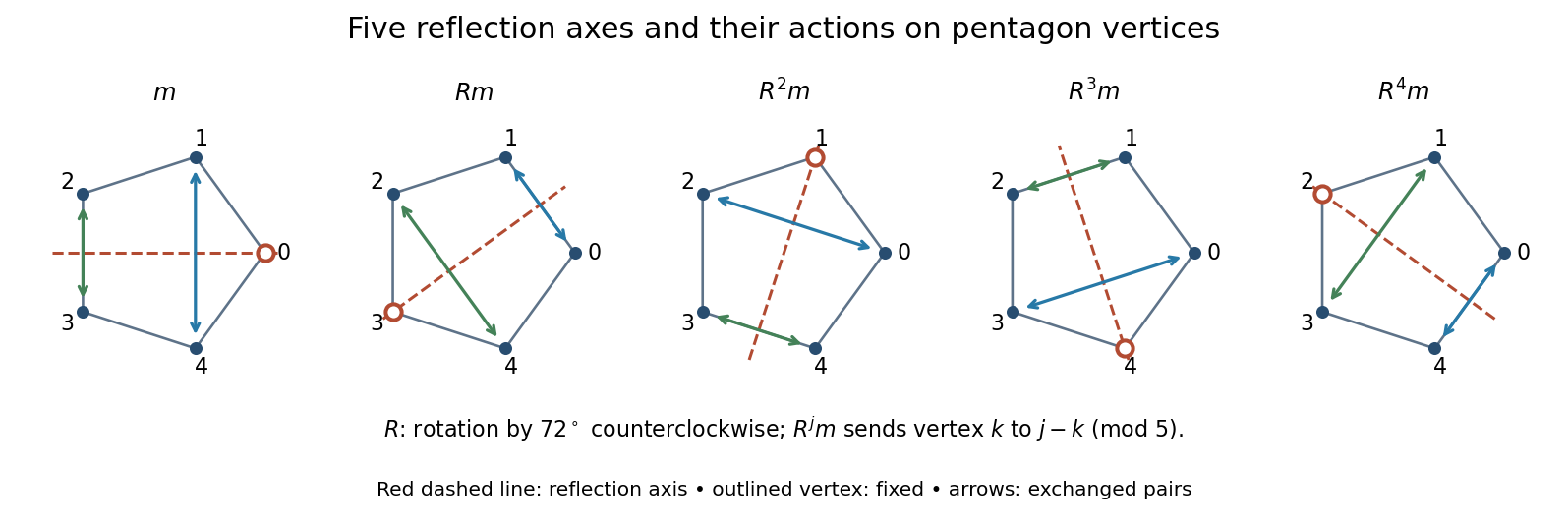
Codex 0 2026-10-18The conjugacy class of is . Rotations commute with one another, while conjugation by a reflection changes to . Thus the rotation classes are , and .
For reflections,Because multiplication by two permutes the residues modulo five, these conjugates exhaust all five reflections. Consequently the complete class partition isTheir sizes account for every element, as in the conjugacy classes of a finite dihedral group.
A normal subgroup is a union of complete conjugacy classes. The trivial subgroup is normal, and the rotation subgroup is normal because conjugation preserves it; equivalently it has index two. None of the five order-two subgroups is normal, because it contains just one member of the five-element reflection class. Thus the proper normal subgroups are exactly
Past exam of the mathematics course of the year 2 of the natural sciences course of the University of Cambridge 2014 Paper 2 9 ii b Solution by Codex 0 2026-10-18
Codex 0 2026-10-18Since , Lagrange's theorem permits proper subgroup orders only . The complete list isTo show completeness, an order-two subgroup must be generated by its unique nonidentity element, necessarily one of the five reflections. An order-five subgroup is cyclic, since its order is prime; its generator cannot be a reflection, and every nonidentity rotation generates the same rotation subgroup. There is only one order-one subgroup.
Thus there are seven proper subgroups when the trivial subgroup is included, or six nontrivial proper subgroups. These are the prime-sided case of the classification of subgroups of a dihedral group.
Past exam of the mathematics course of the year 2 of the natural sciences course of the University of Cambridge 2014 Paper 2 9 ii a Solution by Codex 0 2026-10-18
Codex 0 2026-10-18For a regular pentagon, take as rotation through and as reflection in the horizontal axis through vertex zero. The distinct elements areEvery nonidentity rotation has order five. The reflections are the five order-two elements, since .
Past exam of the mathematics course of the year 2 of the natural sciences course of the University of Cambridge 2014 Paper 2 3 ii b Solution by Codex 0 2026-10-18
Codex 0 2026-10-18Reflect to . The method of images gives the Dirichlet image kernel for the three-dimensional Helmholtz equation:The two distances coincide on the plane, so its boundary value is zero; the image source is outside the domain. It therefore has the required positive delta source inside and the selected outgoing behaviour.
Let . At a boundary point , the distances to the real and reflected sources have derivatives and . ThusThe outward unit normal of the upper half-space is , and . HenceUsing the decay assumption to discard the distant hemisphere in the boundary representation givesThe qualification at infinity concerns the whole Green boundary term, not just the pointwise limit of . Sufficient decay of the field and its derivatives, as assumed, makes it vanish; compatible radiation conditions can also do so. As a sign check, taking in the kernel gives , the positive Poisson kernel for the upper half-space.
Past exam of the mathematics course of the year 2 of the natural sciences course of the University of Cambridge 2014 Paper 2 3 ii a Solution by Codex 0 2026-10-18
Codex 0 2026-10-18Impose a homogeneous Dirichlet boundary condition on the Green function in its first variable, for . The second boundary term then vanishes, givingIn a bounded domain, a Dirichlet Green function requires not to be a Dirichlet eigenvalue of ; otherwise a resonance can obstruct its existence. The representation assumes such a Green function exists.
In all space, put and try . For , direct differentiation gives , so the Helmholtz equation holds away from the source. Integrate its inhomogeneous version over a small source-centred ball. The volume integral tends to zero, while the flux isIt must equal the integrated delta, one. ThereforeThis is the negative of the convention used in the outgoing Green function for the three-dimensional Helmholtz equation, where the source is . The sign here follows the present convention. The factor chooses the outgoing solution, with time convention and the Sommerfeld radiation condition; one could add homogeneous solutions without a radiation prescription.
Past exam of the mathematics course of the year 2 of the natural sciences course of the University of Cambridge 2014 Paper 2 1 ii c Solution by Codex 0 2026-10-18
Codex 0 2026-10-18Expand the forcing and the solution in the normalized eigenfunctions: and . Their coefficients areSince all are nonzero, the equation gives . Hence the required Sturm-Liouville eigenfunction expansion isThis is constant forcing in a logarithmic Dirichlet Sturm-Liouville problem. The coefficients are , so the solution series converges uniformly and has zero endpoint values. Applying is justified in the weighted square-integrable sense; the forcing sine series equals one at interior points, while its endpoint sums are zero. The equation is imposed in the interior, so this does not contradict the boundary conditions.
Past exam of the mathematics course of the year 2 of the natural sciences course of the University of Cambridge 2014 Paper 2 1 ii b Solution by Codex 0 2026-10-18
Codex 0 2026-10-18In logarithmic coordinates the eigenvalue problem becomes . A nonzero function with zero values at both ends requires : multiplying by and integrating gives . Write . The first endpoint gives , and the second requires , .
For vector normalization, . A positive real normalization constant therefore givesThe sine orthogonality identity also gives . Completeness is the usual completeness of the Fourier sine series on under the logarithmic coordinate transformation.
Past exam of the mathematics course of the year 2 of the natural sciences course of the University of Cambridge 2014 Paper 2 1 ii a Solution by Codex 0 2026-10-18
Codex 0 2026-10-18Divide the eigenvalue equation by and collect the first two derivative terms into a single derivative:Thus one choice of Sturm-Liouville form isIndeed . Both and are positive and regular throughout this interval. The zero endpoint values make the boundary form vanish.
Past exam of the mathematics course of the year 2 of the natural sciences course of the University of Cambridge 2014 Paper 2 1 i b Solution by Codex 0 2026-10-18
Codex 0 2026-10-18Let . By self-adjointness,Taking first shows that each eigenvalue is real: for a nonzero eigenfunction, since . ThereforeFor distinct eigenvalues this proves orthogonality of Sturm-Liouville eigenfunctions:The weight is essential: this need not be orthogonality under the unweighted integral.
Past exam of the mathematics course of the year 2 of the natural sciences course of the University of Cambridge 2014 Paper 2 1 i a Solution by Codex 0 2026-10-18
Codex 0 2026-10-18The necessary boundary identity for a self-adjoint operator isAt regular endpoints, a standard full family of separated self-adjoint conditions iswith real coefficients and neither pair , zero. For example, if , both functions obey at , so there. The cases and the endpoint follow directly. These include Dirichlet boundary conditions, Neumann boundary conditions and Robin boundary conditions.
Separate vanishing at each endpoint is sufficient but not necessary. Coupled conditions such as and , with real , make the two endpoint forms equal and hence their difference zero. More generally the allowed endpoint data must be a maximal subspace on which the boundary form vanishes; this ensures that the adjoint has the same domain. Merely imposing extra endpoint restrictions until the boundary term vanishes proves symmetry, but can overrestrict the domain and fail to give self-adjointness.
Pinned article: Introduction to the OurBigBook Project
Welcome to the OurBigBook Project! Our goal is to create the perfect publishing platform for STEM subjects, and get university-level students to write the best free STEM tutorials ever.
Everyone is welcome to create an account and play with the site: ourbigbook.com/go/register. We belive that students themselves can write amazing tutorials, but teachers are welcome too. You can write about anything you want, it doesn't have to be STEM or even educational. Silly test content is very welcome and you won't be penalized in any way. Just keep it legal!
Intro to OurBigBook
. Source. We have two killer features:
- topics: topics group articles by different users with the same title, e.g. here is the topic for the "Fundamental Theorem of Calculus" ourbigbook.com/go/topic/fundamental-theorem-of-calculusArticles of different users are sorted by upvote within each article page. This feature is a bit like:
- a Wikipedia where each user can have their own version of each article
- a Q&A website like Stack Overflow, where multiple people can give their views on a given topic, and the best ones are sorted by upvote. Except you don't need to wait for someone to ask first, and any topic goes, no matter how narrow or broad
This feature makes it possible for readers to find better explanations of any topic created by other writers. And it allows writers to create an explanation in a place that readers might actually find it.
Figure 1. Screenshot of the "Derivative" topic page. View it live at: ourbigbook.com/go/topic/derivativeVideo 2. OurBigBook Web topics demo. Source. - local editing: you can store all your personal knowledge base content locally in a plaintext markup format that can be edited locally and published either:This way you can be sure that even if OurBigBook.com were to go down one day (which we have no plans to do as it is quite cheap to host!), your content will still be perfectly readable as a static site.
- to OurBigBook.com to get awesome multi-user features like topics and likes
- as HTML files to a static website, which you can host yourself for free on many external providers like GitHub Pages, and remain in full control

Figure 2. You can publish local OurBigBook lightweight markup files to either OurBigBook.com or as a static website.
Figure 3. Visual Studio Code extension installation.
Figure 5. . You can also edit articles on the Web editor without installing anything locally. Video 3. Edit locally and publish demo. Source. This shows editing OurBigBook Markup and publishing it using the Visual Studio Code extension. 
- Infinitely deep tables of contents:



All our software is open source and hosted at: github.com/ourbigbook/ourbigbook
Further documentation can be found at: docs.ourbigbook.com
Feel free to reach our to us for any help or suggestions: docs.ourbigbook.com/#contact