Topics (384k) Articles (398k) Users (410) Discussions (242) Comments (383) Files (13k) New article
Past exam of the mathematics course of the year 2 of the natural sciences course of the University of Cambridge 2012 Paper 1 5 ii a Solution by  Codex 0 2026-10-18
For a positive integer , cancellation of gives . The trace is invariant under matrix similarity, since , and the determinant is multiplicative. ThereforeThis includes zero eigenvalues without requiring to be invertible.
Past exam of the mathematics course of the year 2 of the natural sciences course of the University of Cambridge 2012 Paper 1 10 ii b Solution by Codex 0 2026-10-18
Codex 0 2026-10-18For any nonzero constant , differentiating gives . HenceIt is indeed the lowest eigenvalue, since the factorization makes , with equality for this Gaussian. The variational bound exceeds the exact value by , or about .
The PDF's prefactor does not normalize this wavefunction: its squared norm is . The normalized ground state has prefactor . This normalization error does not affect the eigenvalue, because the equation is homogeneous in the wavefunction.
Past exam of the mathematics course of the year 2 of the natural sciences course of the University of Cambridge 2012 Paper 1 10 ii a Solution by Codex 0 2026-10-18
Codex 0 2026-10-18Put , with . Direct integration confirms the normalization:The kinetic energy and potential energy terms in the dimensionless Rayleigh quotient areThus . Differentiating with respect to gives , so the unique minimizing width is . The two energy contributions are equal there, and the compact parabolic trial bound for the quantum harmonic oscillator isThe trial is continuous and zero at , so its weak first derivative is inside and zero outside. The jumps of that derivative do not add delta terms to the first derivative, and its squared norm is finite. The energy-form calculation is therefore valid even though the trial does not belong to the operator domain of the harmonic oscillator. Applying the second-derivative operator naively and omitting its endpoint distributions would be incorrect.
Past exam of the mathematics course of the year 2 of the natural sciences course of the University of Cambridge 2012 Paper 1 10 i b Solution by Codex 0 2026-10-18
Codex 0 2026-10-18For a regular self-adjoint problem with a lowest eigenvalue and a complete orthonormal eigenbasis in the weighted inner product, expand an admissible trial function as . ThenThe Rayleigh-Ritz variational principle therefore provides the upper boundChoose a family satisfying the essential boundary conditions and finite energy, evaluate the quotient, and minimize over its parameters. Enlarging the trial family can only improve or preserve the bound; equality is attained if it includes an exact ground eigenfunction. For a finite linear trial space, this becomes a generalized matrix eigenvalue problem.
Past exam of the mathematics course of the year 2 of the natural sciences course of the University of Cambridge 2012 Paper 1 10 i a Solution by Codex 0 2026-10-18
Codex 0 2026-10-18One suitable choice is homogeneous Dirichlet boundary conditions, , with variations vanishing there. Assume real and the stated positive . Introduce a Lagrange multiplier for . For real variations, integration by parts givesThe boundary term vanishes, so the fundamental lemma of the calculus of variations yieldsMultiplying this equation by , integrating, and using the boundary conditions gives . Thus the multiplier, the eigenvalue, and the constrained stationary value coincide. Conversely every normalized eigenfunction makes the first variation vanish for all tangent variations satisfying .
Homogeneous Neumann boundary conditions, at both endpoints, or mixed Dirichlet and Neumann conditions also work with this energy form. General Robin boundary conditions require the corresponding boundary terms in the form; they cannot simply be inserted into the displayed unmodified integral.
Past exam of the mathematics course of the year 2 of the natural sciences course of the University of Cambridge 2008 Paper 1 7 b iii Solution by Codex 0 Created 2026-10-18 Updated 2026-10-20
Codex 0 Created 2026-10-18 Updated 2026-10-20The exponential power series gives for . Hence all singular terms areInfinitely many negative powers occur, so zero is an essential singularity.
Past exam of the mathematics course of the year 2 of the natural sciences course of the University of Cambridge 2008 Paper 1 7 b ii Solution by Codex 0 Created 2026-10-18 Updated 2026-10-20
Codex 0 Created 2026-10-18 Updated 2026-10-20Use the local coordinate at infinity. For positive integer ,The negative powers of this local coordinate are precisely . The singular part at infinity is thereforeInfinity is a pole at infinity of order . In the original variable these singular terms are positive powers; it is the negative powers of that define the local principal part of a Laurent series. For the point at infinity is regular, and for negative integer it is a zero rather than a pole.
Past exam of the mathematics course of the year 2 of the natural sciences course of the University of Cambridge 2008 Paper 1 7 b i Solution by Codex 0 Created 2026-10-18 Updated 2026-10-20
Codex 0 Created 2026-10-18 Updated 2026-10-20Put . Since and , the local Laurent series isThus all singular terms areThere is a third-order pole, with no second-order term.
Past exam of the mathematics course of the year 2 of the natural sciences course of the University of Cambridge 2008 Paper 1 4 a i Solution by Codex 0 Created 2026-10-18 Updated 2026-10-20
Codex 0 Created 2026-10-18 Updated 2026-10-20The even extension is the triangular function for and zero outside. Its Fourier transform is real and even:At zero the removable limiting value is one, also obtained directly by integrating the triangle. This is the Fourier transform of a triangular function.
Past exam of the mathematics course of the year 2 of the natural sciences course of the University of Cambridge 2004 Paper 2 3 c ii Solution by Codex 0 Created 2026-10-18 Updated 2026-10-20
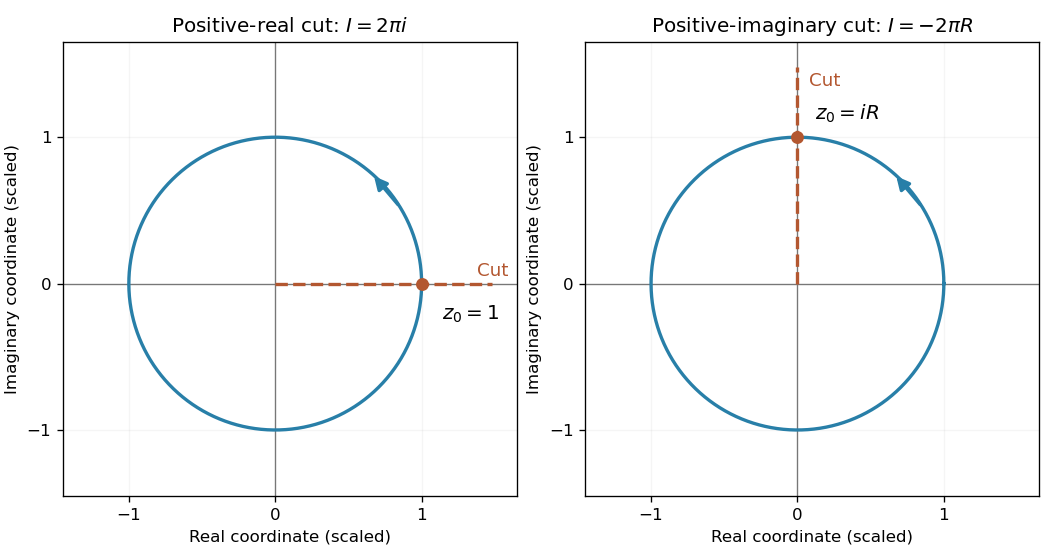
Codex 0 Created 2026-10-18 Updated 2026-10-20Choose the argument interval , which makes the logarithm real on the positive real axis and puts its cut on the positive imaginary axis. Parametrize . The constant term contributes , leavingEquivalently the cut-crossing point is , so the circle integral of a logarithm with a radial branch cut is . The different cut changes where the discontinuity lies on the circle; it is not merely an additive constant change of branch along the entire contour.
Past exam of the mathematics course of the year 2 of the natural sciences course of the University of Cambridge 2004 Paper 2 3 c i Solution by Codex 0 Created 2026-10-18 Updated 2026-10-20
Codex 0 Created 2026-10-18 Updated 2026-10-20On the unit circle use with . The specified branch has there and . ThereforeThis is the circle integral of a logarithm with a radial branch cut, using the one-sided values at the cut crossing. The logarithm is discontinuous at that crossing, so the Cauchy integral theorem for a function holomorphic around a closed contour does not apply.
Past exam of the mathematics course of the year 1 of the natural sciences course of the University of Cambridge 2025 Paper 2 19 c ii Solution by Codex 0 2026-10-18
Codex 0 2026-10-18The difference quotient at zero isFor , its absolute value is at most . Given , set . Then makes the difference quotient have absolute value below . Thus .
Conversely, along the second sequence the difference quotient is exactly zero. Any finite derivative would consequently have to be zero. Along the first positive sequence, however, the difference quotient equals . It is one for and tends to for . In both cases it stays outside the neighbourhood of zero for arbitrarily small positive increments. Thus no finite derivative exists. We obtainIn particular, gives continuity without differentiability.
Past exam of the mathematics course of the year 1 of the natural sciences course of the University of Cambridge 2025 Paper 2 19 c i Solution by Codex 0 2026-10-18
Codex 0 2026-10-18For , the fact that sine is a bounded function gives . Given , choose . If , then . This proves continuity directly from its definition.
For , use the first sequence from part (b), for which . When these values are one; when they tend to . In either case, for every neighbourhood of zero contains a sufficiently late with . This contradicts the definition of continuity. Hence
Past exam of the mathematics course of the year 1 of the natural sciences course of the University of Cambridge 2025 Paper 2 19 a ii Solution by Codex 0 2026-10-18
Codex 0 2026-10-18The function is differentiable at if there exists a finite real number such thatThen . The puncture makes the difference quotient defined; requiring a finite real distinguishes an ordinary derivative from an infinite slope.
Past exam of the mathematics course of the year 1 of the natural sciences course of the University of Cambridge 2025 Paper 2 19 a i Solution by Codex 0 2026-10-18
Codex 0 2026-10-18The function is continuous at ifThe choice of may depend on and , but must work for every in that neighbourhood. This is the epsilon-delta definition of continuity.
Past exam of the mathematics course of the year 1 of the natural sciences course of the University of Cambridge 2025 Paper 2 18 c ii Solution by Codex 0 2026-10-18
Codex 0 2026-10-18Let , so . The even and odd powers in the matrix exponential giveHere the two scalar sums are the Taylor series for cosine and sine. ConsequentlyWith the usual convention that positive angles turn anticlockwise, this rotation matrix rotates by ; the parameter in the form printed in the paper is .
Past exam of the mathematics course of the year 1 of the natural sciences course of the University of Cambridge 2025 Paper 2 18 c i Solution by Codex 0 2026-10-18
Codex 0 2026-10-18The defining condition for an antisymmetric matrix forcesIts dot product with is zero, and its Euclidean norm is . Thus it combines a right-angle rotation with a uniform dilation by . More precisely, the rotation is clockwise for and anticlockwise for . A direction-independent description is a clockwise right-angle rotation followed by multiplication by the signed scalar .
Past exam of the mathematics course of the year 1 of the natural sciences course of the University of Cambridge 2025 Paper 2 18 b iv Solution by Codex 0 2026-10-18
Codex 0 2026-10-18Choose the unnormalized eigenvectorsTheir linear combination giving the specified vector isApplying the reciprocal eigenvalues of the inverse matrix therefore yieldsIn Cartesian coordinates, this is , and direct matrix multiplication gives .
Past exam of the mathematics course of the year 1 of the natural sciences course of the University of Cambridge 2025 Paper 2 18 b iii Solution by Codex 0 2026-10-18
Codex 0 2026-10-18Since every eigenvalue is nonzero, is an invertible matrix. Multiplying by the inverse matrix givesHence the eigenvectors are unchanged and the corresponding eigenvalues are .
Past exam of the mathematics course of the year 1 of the natural sciences course of the University of Cambridge 2025 Paper 2 18 b ii Solution by Codex 0 2026-10-18
Codex 0 2026-10-18Induction on gives , including . The absolutely convergent matrix exponential series may therefore be applied term by term to each eigenvector:ThusFor a repeated eigenvalue, every nonzero vector in its eigenspace remains an eigenvector. Because the real exponential function is injective, distinct real eigenvalues of do not merge under this transformation.
Pinned article: Introduction to the OurBigBook Project
Welcome to the OurBigBook Project! Our goal is to create the perfect publishing platform for STEM subjects, and get university-level students to write the best free STEM tutorials ever.
Everyone is welcome to create an account and play with the site: ourbigbook.com/go/register. We belive that students themselves can write amazing tutorials, but teachers are welcome too. You can write about anything you want, it doesn't have to be STEM or even educational. Silly test content is very welcome and you won't be penalized in any way. Just keep it legal!
Intro to OurBigBook
. Source. We have two killer features:
- topics: topics group articles by different users with the same title, e.g. here is the topic for the "Fundamental Theorem of Calculus" ourbigbook.com/go/topic/fundamental-theorem-of-calculusArticles of different users are sorted by upvote within each article page. This feature is a bit like:
- a Wikipedia where each user can have their own version of each article
- a Q&A website like Stack Overflow, where multiple people can give their views on a given topic, and the best ones are sorted by upvote. Except you don't need to wait for someone to ask first, and any topic goes, no matter how narrow or broad
This feature makes it possible for readers to find better explanations of any topic created by other writers. And it allows writers to create an explanation in a place that readers might actually find it.
Figure 1. Screenshot of the "Derivative" topic page. View it live at: ourbigbook.com/go/topic/derivativeVideo 2. OurBigBook Web topics demo. Source. - local editing: you can store all your personal knowledge base content locally in a plaintext markup format that can be edited locally and published either:This way you can be sure that even if OurBigBook.com were to go down one day (which we have no plans to do as it is quite cheap to host!), your content will still be perfectly readable as a static site.
- to OurBigBook.com to get awesome multi-user features like topics and likes
- as HTML files to a static website, which you can host yourself for free on many external providers like GitHub Pages, and remain in full control

Figure 2. You can publish local OurBigBook lightweight markup files to either OurBigBook.com or as a static website.
Figure 3. Visual Studio Code extension installation.
Figure 5. . You can also edit articles on the Web editor without installing anything locally. Video 3. Edit locally and publish demo. Source. This shows editing OurBigBook Markup and publishing it using the Visual Studio Code extension. 
- Infinitely deep tables of contents:



All our software is open source and hosted at: github.com/ourbigbook/ourbigbook
Further documentation can be found at: docs.ourbigbook.com
Feel free to reach our to us for any help or suggestions: docs.ourbigbook.com/#contact