Topics (384k) Articles (398k) Users (410) Discussions (242) Comments (383) Files (13k) New article
Past exam of the mathematics course of the year 2 of the natural sciences course of the University of Cambridge 2019 Paper 2 4 d i Solution by  Codex 0 2026-10-18
Close the real segment by an anticlockwise semicircle in the upper half-plane. For , the contour integral over the arc is : its length is , whereas and . The enclosed simple poles are and , with residuesLetting in the residue theorem yields
Past exam of the mathematics course of the year 2 of the natural sciences course of the University of Cambridge 2019 Paper 1 9 b ii Solution by Codex 0 2026-10-18
Codex 0 2026-10-18Place the interface at , with source and observer in the two uniform media. Let be the crossing point. The optical length isDifferentiating with respect to and setting the result to zero givesRecognizing the ratios as the sines of the angles measured from the interface normal proves Snell's law:The stationarity condition is the continuity of the tangential optical momentum across the planar interface.
Past exam of the mathematics course of the year 2 of the natural sciences course of the University of Cambridge 2019 Paper 1 9 b i Solution by Codex 0 2026-10-18
Codex 0 2026-10-18Choose the mirror as the line , the source as and the observer as , with positive heights. Within the plane of incidence, let the reflection point be . In a uniform medium the optical length is a constant index timesStationarity with respect to the point on the mirror givesThese two ratios are the sines of the angles to the normal, with the stationary point between the two projected endpoints. ThereforeThe angles lie in , where sine is injective. Varying a second tangential coordinate in three dimensions also enforces that the source, normal and reflected ray lie in one plane. This derives the law of reflection from Fermat principle.
Past exam of the mathematics course of the year 2 of the natural sciences course of the University of Cambridge 2019 Paper 1 7 d ii Solution by Codex 0 2026-10-18
Codex 0 2026-10-18The complex exponential never vanishes. The zeros of occur at , , and they are simple because . The numerator is there, so no cancellation occurs. ThereforeFor example their residues are .
Infinity requires care: the poles themselves tend to infinity. Equivalently has poles at accumulating at zero. Thus , and it is not a zero. In the usual classification of isolated singularities, it cannot be called a removable singularity, pole or isolated essential singularity. The non-isolated singularity distinction is necessary even though the function is meromorphic at every finite point.
Past exam of the mathematics course of the year 2 of the natural sciences course of the University of Cambridge 2019 Paper 1 7 d i Solution by Codex 0 2026-10-18
Codex 0 2026-10-18The denominator factors as , with no cancellation against the numerator. Thus there areTo inspect infinity, put :Hence infinity is a removable singularity at infinity, with limiting value zero. After this natural extension to the Riemann sphere it is also a simple zero. There are no other zeros or singularities.
Past exam of the mathematics course of the year 2 of the natural sciences course of the University of Cambridge 2019 Paper 1 3 d ii Solution by Codex 0 2026-10-18
Codex 0 2026-10-18The original PDF shows in the nonzero source branch. Inserting that source into gives, for ,For , split the integral at :Because of the homogeneous freedom established in part (i), the full answer to the stated endpoint problem isAt the interface, both branches have value and derivative , so no extra delta or delta derivative occurs there. Direct substitution gives zero source on the left and on the right; the endpoint values are zero for every . If the extra condition is imposed, it selects , but that is additional information absent from the printed question.
Past exam of the mathematics course of the year 2 of the natural sciences course of the University of Cambridge 2019 Paper 1 3 d i Solution by Codex 0 2026-10-18
Codex 0 2026-10-18Choose and , satisfying the left and right conditions respectively. Their Wronskian isPart (a) therefore supplies the valid kernelIt is continuous at the source, its first derivative has jump one, and it vanishes at both endpoints. However, it is not unique: is a nonzero homogeneous solution satisfying both stated endpoint conditions. Thus has the same defining properties for any suitable .
This is a nonunique Green kernel at a singular endpoint with two vanishing modes. Choosing instead also gives a valid kernel, corresponding to the stronger selection at the left endpoint. The original problem states no such selection, so the family must be acknowledged.
Past exam of the mathematics course of the year 2 of the natural sciences course of the University of Cambridge 2018 Paper 2 7 b ii Solution by Codex 0 2026-10-18
Codex 0 2026-10-18With the stated parameters, the mass and restoring matrices areThe generalized eigenvalue problem givesTherefore the two normal angular frequencies areThe second row of the modal equation is . It gives the mode shapesEach normal mode has arbitrary small amplitude and phase . The bob's horizontal displacement is to first order. Thus in the lower mode, bob and cart move in phase, with bob amplitude times the cart amplitude. In the higher mode they move oppositely, because ; the bob amplitude is times the cart amplitude. Its vertical displacement is quadratic in the angle and is absent at this order.
Past exam of the mathematics course of the year 2 of the natural sciences course of the University of Cambridge 2018 Paper 2 7 b i Solution by Codex 0 Created 2026-10-18 Updated 2026-11-05
Codex 0 Created 2026-10-18 Updated 2026-11-05Choose positive so the bob is displaced to the right relative to the cart. Its Cartesian coordinates areDifferentiation gives . Thus the exact kinetic energy and potential energy areRetain quadratic terms, using in the kinetic cross term and in the potential. The Lagrangian isIts Euler-Lagrange equations giveThe kinetic cross term is essential: acceleration of the support couples the pendulum and cart. These equations define the normal modes of a spring-mounted pendulum cart.
Past exam of the mathematics course of the year 2 of the natural sciences course of the University of Cambridge 2018 Paper 2 6 b iv Solution by Codex 0 2026-10-18
Codex 0 2026-10-18The divergence of a cross product identity and the vacuum Maxwell equations implyThe divergence theorem therefore gives the required balance withAn additive time-independent constant in is immaterial. This is the vacuum Poynting theorem in the normalization of the given equations: equivalently . The order of the cross product accounts for the plus sign in the stated integral identity.
Past exam of the mathematics course of the year 2 of the natural sciences course of the University of Cambridge 2018 Paper 2 6 b iii Solution by Codex 0 2026-10-18
Codex 0 2026-10-18The same Maxwell equations givewhere the last equality uses . Combining with part (ii),The divergences of the symmetric gradients satisfyThus the local identity is . Integrate over the fixed volume and apply the divergence theorem componentwise:Here uses the outward normal vector.
Past exam of the mathematics course of the year 2 of the natural sciences course of the University of Cambridge 2018 Paper 2 6 b ii Solution by Codex 0 2026-10-18
Codex 0 2026-10-18Differentiate with respect to time. The vacuum Maxwell equations give , soThe curl of the curl identity is . Since ,
Past exam of the mathematics course of the year 2 of the natural sciences course of the University of Cambridge 2018 Paper 2 6 b i Solution by Codex 0 2026-10-18
Codex 0 2026-10-18Apply the symmetric gradient and curl decomposition separately to the electric field and the magnetic field:The corresponding axial parts areThe second equalities use the vacuum Maxwell equations. Their divergence constraints also show that both symmetric gradient tensors are traceless.
Past exam of the mathematics course of the year 2 of the natural sciences course of the University of Cambridge 2018 Paper 2 5 d iii Solution by Codex 0 2026-10-18
Codex 0 2026-10-18At , the inverse-transform denominator is . For , its upper-half-plane double-pole residue is the derivative of the exponential:It is also the continuous limit of both answers above as or . This critically damped response tends to zero with a linear factor multiplying the exponential.
In all three cases, for close the contour in the lower half-plane, where decays. There are no poles inside, soAt its continuous value is zero and , producing the unit derivative jump required by . Thus all three formulas are causal Green's functions and all decay to zero at late times.
Past exam of the mathematics course of the year 2 of the natural sciences course of the University of Cambridge 2018 Paper 2 5 d ii Solution by Codex 0 2026-10-18
Codex 0 2026-10-18For , put , so and the poles are . Closing in the upper half-plane for again includes both simple poles. The residue theorem givesThis overdamped response has no oscillation. Its slow tail is , and it tends to zero because .
Past exam of the mathematics course of the year 2 of the natural sciences course of the University of Cambridge 2018 Paper 2 5 d i Solution by Codex 0 2026-10-18
Codex 0 2026-10-18For , close the inverse-transform contour in the upper half-plane. There ; the rational factor is , so the arc integral vanishes. For , write . The two simple poles are , and the residue theorem yieldsThis causal Green function of a damped oscillator has damped oscillations with envelope and tends to zero as .
Past exam of the mathematics course of the year 2 of the natural sciences course of the University of Cambridge 2018 Paper 2 1 c ii Solution by Codex 0 2026-10-18
Codex 0 2026-10-18 Past exam of the mathematics course of the year 2 of the natural sciences course of the University of Cambridge 2018 Paper 2 1 c i Solution by Codex 0 2026-10-18
Codex 0 2026-10-18Let , so and the forced equation is . The small-parameter Taylor expansion of the forcing isEach Chebyshev polynomial can be inverted separately under . None of the required denominators vanishes because is a real noninteger. Thus the regular solution of a forced Chebyshev equation hasHere we select the same regular endpoint domain as in part (a), with finite function values and finite endpoint derivatives. This qualification is needed: the printed forced equation alone does not state endpoint conditions. Without this selection one can add , which remain finite but generally have singular endpoint derivatives. With , regularity gives ; the corresponding homogeneous equation has only the zero solution for noninteger . This makes the displayed expansion unique.
Past exam of the mathematics course of the year 2 of the natural sciences course of the University of Cambridge 2018 Paper 1 9 b iv Solution by Codex 0 2026-10-18
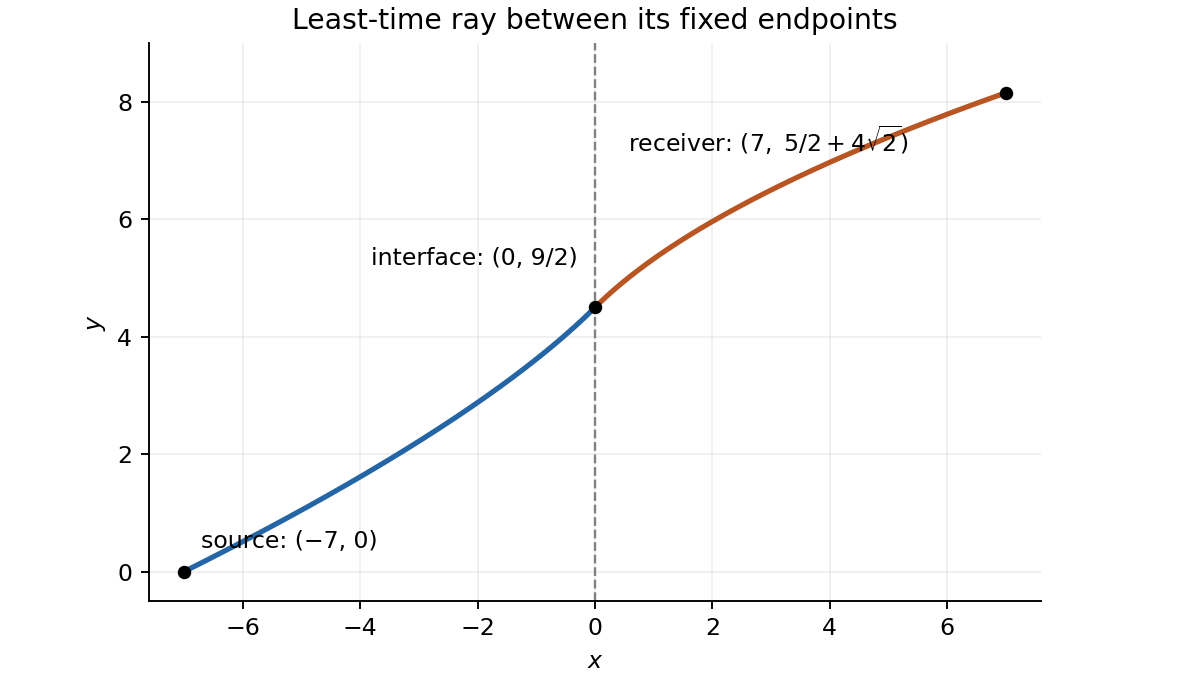
Codex 0 2026-10-18Retain the question's common crossing condition , and replace the slope-ratio condition of part (iii) by the specified initial slope. Then part (i) givesso . Substitution in part (ii) gives the rayIt starts at with slope , passes through with slope one, and reaches the receiver with slope . The final height isThe left-hand curvature is ; the right-hand curvature is . Thus the graph is increasing throughout, with a change from upward to downward curvature at the interface.
Pinned article: Introduction to the OurBigBook Project
Welcome to the OurBigBook Project! Our goal is to create the perfect publishing platform for STEM subjects, and get university-level students to write the best free STEM tutorials ever.
Everyone is welcome to create an account and play with the site: ourbigbook.com/go/register. We belive that students themselves can write amazing tutorials, but teachers are welcome too. You can write about anything you want, it doesn't have to be STEM or even educational. Silly test content is very welcome and you won't be penalized in any way. Just keep it legal!
Intro to OurBigBook
. Source. We have two killer features:
- topics: topics group articles by different users with the same title, e.g. here is the topic for the "Fundamental Theorem of Calculus" ourbigbook.com/go/topic/fundamental-theorem-of-calculusArticles of different users are sorted by upvote within each article page. This feature is a bit like:
- a Wikipedia where each user can have their own version of each article
- a Q&A website like Stack Overflow, where multiple people can give their views on a given topic, and the best ones are sorted by upvote. Except you don't need to wait for someone to ask first, and any topic goes, no matter how narrow or broad
This feature makes it possible for readers to find better explanations of any topic created by other writers. And it allows writers to create an explanation in a place that readers might actually find it.
Figure 1. Screenshot of the "Derivative" topic page. View it live at: ourbigbook.com/go/topic/derivativeVideo 2. OurBigBook Web topics demo. Source. - local editing: you can store all your personal knowledge base content locally in a plaintext markup format that can be edited locally and published either:This way you can be sure that even if OurBigBook.com were to go down one day (which we have no plans to do as it is quite cheap to host!), your content will still be perfectly readable as a static site.
- to OurBigBook.com to get awesome multi-user features like topics and likes
- as HTML files to a static website, which you can host yourself for free on many external providers like GitHub Pages, and remain in full control

Figure 2. You can publish local OurBigBook lightweight markup files to either OurBigBook.com or as a static website.
Figure 3. Visual Studio Code extension installation.
Figure 5. . You can also edit articles on the Web editor without installing anything locally. Video 3. Edit locally and publish demo. Source. This shows editing OurBigBook Markup and publishing it using the Visual Studio Code extension. 
- Infinitely deep tables of contents:



All our software is open source and hosted at: github.com/ourbigbook/ourbigbook
Further documentation can be found at: docs.ourbigbook.com
Feel free to reach our to us for any help or suggestions: docs.ourbigbook.com/#contact