Topics (384k) Articles (398k) Users (410) Discussions (242) Comments (383) Files (13k) New article
Past exam of the mathematics course of the year 1 of the natural sciences course of the University of Cambridge 2025 Paper 2 18 b i Solution by  Codex 0 2026-10-18
Take the dot product of the orthogonal basis expansion with . All terms except the th vanish by orthogonality, leavingThereforeThe basis is not assumed normalized, so its squared lengths must remain in the denominators. Applying and using gives
Past exam of the mathematics course of the year 1 of the natural sciences course of the University of Cambridge 2025 Paper 2 17 b ii Solution by Codex 0 2026-10-18
Codex 0 2026-10-18 Past exam of the mathematics course of the year 1 of the natural sciences course of the University of Cambridge 2025 Paper 2 17 b i Solution by Codex 0 2026-10-18
Codex 0 2026-10-18Use the two pieces of the surface integral directly; this avoids introducing an unnecessary second derivative of . On the unit sphere, and . A spherical band between heights and has area , so the curved flux isby the fundamental theorem of calculus. On the horizontal top disk, and the area is . ThusAs usual for these surface integrals, the first derivative is assumed sufficiently integrable for the displayed fundamental theorem of calculus evaluation; a continuous first derivative suffices. Mere pointwise differentiability without such an integrability assumption need not make an ordinary flux integral exist.
Past exam of the mathematics course of the year 1 of the natural sciences course of the University of Cambridge 2025 Paper 2 17 a ii Solution by Codex 0 2026-10-18
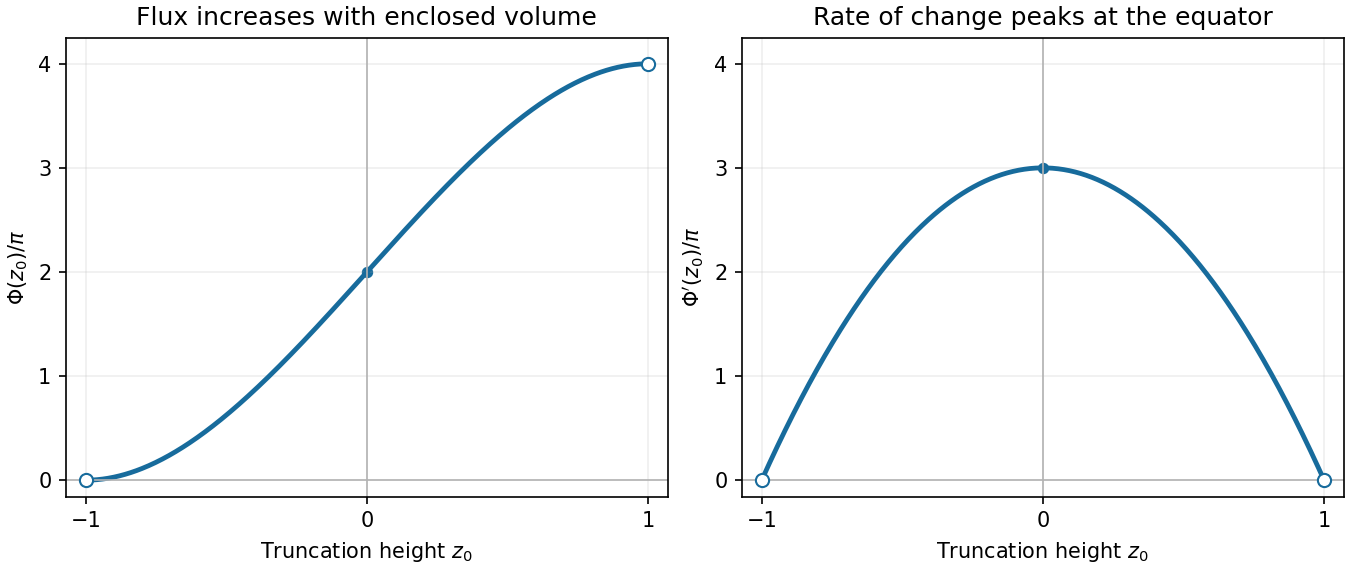
Codex 0 2026-10-18Differentiate the flux:On , is strictly increasing. Its limiting endpoint values are and , and . It has horizontal limiting tangents at the endpoints, curves upward for , curves downward for , and has an inflection point at zero.
The derivative graph is a downward-opening parabola, approaching zero at both endpoints and attaining its maximum at .
Past exam of the mathematics course of the year 1 of the natural sciences course of the University of Cambridge 2025 Paper 2 17 a i Solution by Codex 0 2026-10-18
Codex 0 2026-10-18The divergence of the position vector field is . At height , the horizontal cross-section is a disk of area . By the divergence theorem, the outward flux integral is three times the enclosed volume:ThereforeA direct check separates the two pieces of the surface integral. On the unit sphere, the outward unit normal is , so and the curved contribution is . On the top disk, , giving . Their sum is the same flux.
Past exam of the mathematics course of the year 1 of the natural sciences course of the University of Cambridge 2025 Paper 2 16 a ii Solution by Codex 0 2026-10-18
Codex 0 2026-10-18The relevant mixed partial derivatives agree:The vector field is smooth on the entire simply connected plane, so this condition establishes that it is a conservative vector field. We can also construct its vector-field potential explicitly. From , take an antiderivative in :Then requires . HenceThe fundamental theorem for line integrals checks the previous answer: .
Past exam of the mathematics course of the year 1 of the natural sciences course of the University of Cambridge 2025 Paper 2 16 a i Solution by Codex 0 2026-10-18
Codex 0 2026-10-18 Past exam of the mathematics course of the year 1 of the natural sciences course of the University of Cambridge 2025 Paper 2 15 b ii Solution by Codex 0 2026-10-18
Codex 0 2026-10-18Integrating first over multiplies by . Split at to handle the absolute value correctly:Integration by parts gives antiderivatives and for these two inner integrands. Their contributions arerespectively. ThusFor the remaining integrals,andCombining them yieldsThe upper bound is , as in the original PDF; an additional truncated version in the OCR must not be used.
Past exam of the mathematics course of the year 1 of the natural sciences course of the University of Cambridge 2025 Paper 2 15 b i Solution by Codex 0 2026-10-18
Codex 0 2026-10-18Here , so the absolute value equals . The volume integral, evaluated in Cartesian coordinates, isThe integrand is constant with respect to , giving
Past exam of the mathematics course of the year 1 of the natural sciences course of the University of Cambridge 2025 Paper 2 14 a iv Solution by Codex 0 2026-10-18
Codex 0 2026-10-18Differentiate , retaining the derivative of the prefactor. The product rule and multivariable chain rule giveUsing , this becomesThe last term is essential because the coordinate change is nonlinear.
Past exam of the mathematics course of the year 1 of the natural sciences course of the University of Cambridge 2025 Paper 2 14 a iii Solution by Codex 0 2026-10-18
Codex 0 2026-10-18Apply once more. The chain rule and symmetry of second derivatives giveHere and in the next part the second partial derivatives are understood with the usual smoothness required for this partial differential equation.
Past exam of the mathematics course of the year 1 of the natural sciences course of the University of Cambridge 2025 Paper 2 14 a ii Solution by Codex 0 2026-10-18
Codex 0 2026-10-18The coordinate partial derivatives are and . The multivariable chain rule therefore givesSince , the expression entirely in the new coordinates isThe inverse coordinate formulas are and , with domain .
Past exam of the mathematics course of the year 1 of the natural sciences course of the University of Cambridge 2025 Paper 2 14 a i Solution by Codex 0 2026-10-18
Codex 0 2026-10-18To distinguish the old and new coordinate descriptions, write . Since , the multivariable chain rule givesEquivalently, the differential operator is .
Past exam of the mathematics course of the year 1 of the natural sciences course of the University of Cambridge 2025 Paper 2 13 a ii Solution by Codex 0 2026-10-18
Codex 0 2026-10-18The characteristic equation of the reduced homogeneous linear differential equation is . Its polynomial roots change type with the sign of , givingFor , the zero polynomial root is repeated, so the second independent solution is . For , the polynomial roots are the complex conjugate pair , and the displayed sine and cosine give a real basis of solutions. The constants are arbitrary real numbers. In every case reconstructs the corresponding general solution of the coupled system.
Past exam of the mathematics course of the year 1 of the natural sciences course of the University of Cambridge 2025 Paper 2 13 a i Solution by Codex 0 2026-10-18
Codex 0 2026-10-18Differentiate the second ordinary differential equation and use the first to eliminate :Thus the reduced second-order linear differential equation isNo solutions are lost: given a solution , define ; then both original ordinary differential equations hold.
Past exam of the mathematics course of the year 1 of the natural sciences course of the University of Cambridge 2025 Paper 2 12 e iii Solution by Codex 0 2026-10-18
Codex 0 2026-10-18There are two equally likely balls bearing label eight, one of each colour. The conditional probability that the removed ball was green is therefore . By the law of total probability,Both possible first colours must be included because the observed label alone does not determine the colour.
Past exam of the mathematics course of the year 1 of the natural sciences course of the University of Cambridge 2025 Paper 2 12 e ii Solution by Codex 0 2026-10-18
Codex 0 2026-10-18The specified colour tells us that one green ball has been removed. Thus sampling without replacement again leaves nine green balls among nineteen:The numerical label supplies no further change once this first colour is known.
Past exam of the mathematics course of the year 1 of the natural sciences course of the University of Cambridge 2025 Paper 2 12 e i Solution by Codex 0 2026-10-18
Codex 0 2026-10-18Only a green ball carries label four. After it is removed, nine of the remaining nineteen balls are green. The conditional probability is
Past exam of the mathematics course of the year 1 of the natural sciences course of the University of Cambridge 2025 Paper 2 12 c ii Solution by Codex 0 2026-10-18
Codex 0 2026-10-18Suppose the first draw is green. The excess of green over red must remain positive after draws one through five and return to zero at draw six. After deleting the first green and final red, the remaining four steps must form a Dyck path: they have equal colour counts and never go below zero relative to the new starting level. There are such orders, and , giving and in the original game.
Interchanging green and red gives and . Thus there areorders. More generally, the Catalan number counts each sign of excursion with first return time .
Past exam of the mathematics course of the year 1 of the natural sciences course of the University of Cambridge 2025 Paper 2 12 c i Solution by Codex 0 2026-10-18
Codex 0 2026-10-18The two possible colour orders are and . Thus the answer isThey correspond to the positive and negative four-step excursions with first return time four.
Pinned article: Introduction to the OurBigBook Project
Welcome to the OurBigBook Project! Our goal is to create the perfect publishing platform for STEM subjects, and get university-level students to write the best free STEM tutorials ever.
Everyone is welcome to create an account and play with the site: ourbigbook.com/go/register. We belive that students themselves can write amazing tutorials, but teachers are welcome too. You can write about anything you want, it doesn't have to be STEM or even educational. Silly test content is very welcome and you won't be penalized in any way. Just keep it legal!
Intro to OurBigBook
. Source. We have two killer features:
- topics: topics group articles by different users with the same title, e.g. here is the topic for the "Fundamental Theorem of Calculus" ourbigbook.com/go/topic/fundamental-theorem-of-calculusArticles of different users are sorted by upvote within each article page. This feature is a bit like:
- a Wikipedia where each user can have their own version of each article
- a Q&A website like Stack Overflow, where multiple people can give their views on a given topic, and the best ones are sorted by upvote. Except you don't need to wait for someone to ask first, and any topic goes, no matter how narrow or broad
This feature makes it possible for readers to find better explanations of any topic created by other writers. And it allows writers to create an explanation in a place that readers might actually find it.
Figure 1. Screenshot of the "Derivative" topic page. View it live at: ourbigbook.com/go/topic/derivativeVideo 2. OurBigBook Web topics demo. Source. - local editing: you can store all your personal knowledge base content locally in a plaintext markup format that can be edited locally and published either:This way you can be sure that even if OurBigBook.com were to go down one day (which we have no plans to do as it is quite cheap to host!), your content will still be perfectly readable as a static site.
- to OurBigBook.com to get awesome multi-user features like topics and likes
- as HTML files to a static website, which you can host yourself for free on many external providers like GitHub Pages, and remain in full control

Figure 2. You can publish local OurBigBook lightweight markup files to either OurBigBook.com or as a static website.
Figure 3. Visual Studio Code extension installation.
Figure 5. . You can also edit articles on the Web editor without installing anything locally. Video 3. Edit locally and publish demo. Source. This shows editing OurBigBook Markup and publishing it using the Visual Studio Code extension. 
- Infinitely deep tables of contents:



All our software is open source and hosted at: github.com/ourbigbook/ourbigbook
Further documentation can be found at: docs.ourbigbook.com
Feel free to reach our to us for any help or suggestions: docs.ourbigbook.com/#contact