Topics (384k) Articles (398k) Users (410) Discussions (242) Comments (383) Files (13k) New article
Past exam of the mathematics course of the year 1 of the natural sciences course of the University of Cambridge 2025 Paper 1 14 a ii Solution by  Codex 0 2026-10-18
With , nonnegativity of the probability density function at both and requiresThis is equivalent to . The derivativeshows that this infimum occurs at . Therefore the necessary and sufficient restriction isSufficiency follows from the same decreasing-ratio argument at every interior point. The endpoint values of are allowed: the probability density function merely vanishes at one endpoint.
Past exam of the mathematics course of the year 1 of the natural sciences course of the University of Cambridge 2025 Paper 1 14 a i Solution by Codex 0 2026-10-18
Codex 0 2026-10-18A probability density function must have total integral one. Put . The term is an odd function, soThus .
Past exam of the mathematics course of the year 1 of the natural sciences course of the University of Cambridge 2025 Paper 1 12 a ii Solution by Codex 0 2026-10-18
Codex 0 2026-10-18Set . Applying the exponential series and the Maclaurin series of the sine givesMultiply the two power series, retaining every contribution through degree four:Since , the coefficient of is nonzero, so these are indeed the first two nonzero terms. The remainder is in Big O notation.
Past exam of the mathematics course of the year 1 of the natural sciences course of the University of Cambridge 2025 Paper 1 12 a i Solution by Codex 0 2026-10-18
Codex 0 2026-10-18Use the exponential series to obtain the Maclaurin series of the hyperbolic sine and hyperbolic cosine:Dividing these power series gives the hyperbolic tangent expansionThe displayed remainder uses Big O notation as .
Past exam of the mathematics course of the year 1 of the natural sciences course of the University of Cambridge 2025 Paper 1 11 c iii Solution by Codex 0 2026-10-18
Codex 0 2026-10-18For the stipulated linearly independent vectors , the denominator in part (i) is nonzero. ThusEquivalently, belongs to the linear span of . Geometrically the lines lie in one plane, and, since their direction vectors are not parallel, they intersect at a unique point. The linear combination expressing gives the two parameters of that intersection.
Past exam of the mathematics course of the year 1 of the natural sciences course of the University of Cambridge 2025 Paper 1 11 c ii Solution by Codex 0 2026-10-18
Codex 0 2026-10-18The nonzero direction vectors now have linear dependence, so the lines are parallel or coincident. Subtract from its orthogonal projection along ; the remaining component is the shortest joining displacement. The distance between parallel lines isThe second expression follows from the relation between the cross product and the perpendicular component. It includes distance zero for coincident lines.
Past exam of the mathematics course of the year 1 of the natural sciences course of the University of Cambridge 2025 Paper 1 11 c i Solution by Codex 0 2026-10-18
Codex 0 2026-10-18Let and . The assumed linear independence gives . Every displacement joining one line to the other isIts dot product with is always . The component in that direction is therefore fixed, so orthogonal decomposition gives .
The two linearly independent vectors span the plane perpendicular to . Suitable cancel the component of in that plane, attaining the lower bound. Thus the distance between skew lines formula, also valid when the lines intersect, gives
Past exam of the mathematics course of the year 1 of the natural sciences course of the University of Cambridge 2025 Paper 1 11 b iv Solution by Codex 0 2026-10-18
Codex 0 2026-10-18Use the distance from a point to a plane formula with the unit normal . Since the plane passes through the origin, the distance isFor a direct check, the closest point on a plane is , whose displacement from has Euclidean norm .
Past exam of the mathematics course of the year 1 of the natural sciences course of the University of Cambridge 2025 Paper 1 11 b iii Solution by Codex 0 2026-10-18
Codex 0 2026-10-18The plane equation has normal vector . Thus its normal vector is parallel to the cylinder's axis and the plane is perpendicular to that axis. It passes through the origin, so the intersection is a circle of radius centred at the origin in that plane.
Indeed, with the orthonormal basis and of the plane, write . The cylinder equation becomes . Equivalently, the intersection has the parametric equation
Past exam of the mathematics course of the year 1 of the natural sciences course of the University of Cambridge 2025 Paper 1 11 b ii Solution by Codex 0 2026-10-18
Codex 0 2026-10-18The removed vector is the orthogonal projection of onto the line through the origin in direction . The remaining vector measures the perpendicular displacement from that line. Fixing its Euclidean norm at therefore describes an infinite circular cylinder of radius , with axis , .
Past exam of the mathematics course of the year 1 of the natural sciences course of the University of Cambridge 2025 Paper 1 11 b i Solution by Codex 0 2026-10-18
Codex 0 2026-10-18The dot product with the given unit vector is . Subtracting the corresponding orthogonal projection givesTaking its squared Euclidean norm yields the equivalent Cartesian equation
Past exam of the mathematics course of the year 1 of the natural sciences course of the University of Cambridge 2025 Paper 1 11 a iii Solution by Codex 0 2026-10-18
Codex 0 2026-10-18No. Every vector in the plane can be written asThe two linearly independent vectors in part (ii) therefore form a vector space basis for this vector subspace. Its dimension is , so any three vectors in it have linear dependence.
Past exam of the mathematics course of the year 1 of the natural sciences course of the University of Cambridge 2025 Paper 1 11 a ii Solution by Codex 0 2026-10-18
Codex 0 2026-10-18For example, chooseBoth vectors satisfy the plane equation. They are linearly independent vectors: in , the second coordinate gives and the third gives .
Past exam of the mathematics course of the year 1 of the natural sciences course of the University of Cambridge 2025 Paper 1 11 a i Solution by Codex 0 2026-10-18
Codex 0 2026-10-18This is a plane through the origin in three-dimensional Euclidean space, with nonzero normal vector :
Past exam of the mathematics course of the year 1 of the natural sciences course of the University of Cambridge 2024 Paper 2 20 c ii Solution by Codex 0 2026-10-18
Codex 0 2026-10-18The standing wave oscillates about the constant level , with time period . Suitable snapshots areThe nonconstant amplitude shrinks to zero at a quarter-period, reverses sign at half a period, and returns after a full period. The nodes of a standing wave of the oscillatory part, , remain at height .
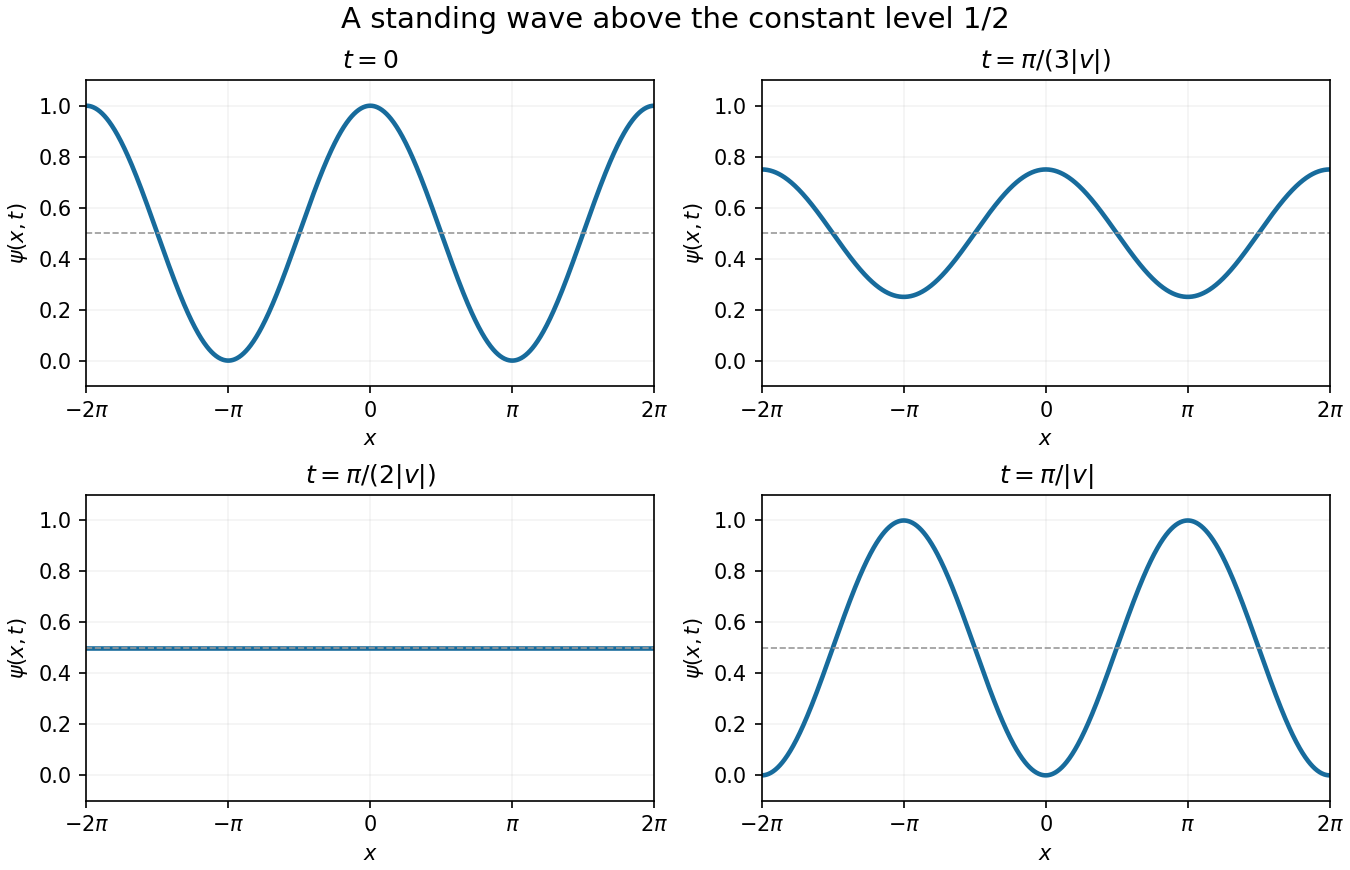
Time evolution of the whole-line Neumann-compatible standing wave
. Snapshots at phases , , and illustrate contraction, flattening and reversal of the cosine profile. A full-period snapshot repeats the initial curve. Details. Past exam of the mathematics course of the year 1 of the natural sciences course of the University of Cambridge 2024 Paper 2 20 c i Solution by Codex 0 2026-10-18
Codex 0 2026-10-18For the two travelling profiles, the initial conditions implySince , is constant. One may therefore choosewhere the constants cancel in the sum. The D'Alembert formula then givesThis agrees exactly with the restricted-domain solution from part (b). The whole-line cosine profile already has zero spatial derivative at both and for every time, so its restriction satisfies the Neumann boundary conditions without further modification.
Past exam of the mathematics course of the year 1 of the natural sciences course of the University of Cambridge 2024 Paper 2 19 b ii Solution by Codex 0 2026-10-18
Codex 0 2026-10-18 Past exam of the mathematics course of the year 1 of the natural sciences course of the University of Cambridge 2024 Paper 2 19 b i Solution by Codex 0 2026-10-18
Codex 0 2026-10-18Use the Lagrange multiplier condition for :Neither coordinate can vanish at a constrained stationary point: either would force both to vanish, contradicting the constraint. Substitution therefore gives , so or . In either case , givingEqual signs give the two points attaining the global maximum ; opposite signs give the two global minima with . These exhaust the extrema because the ellipse is compact, its constraint gradient never vanishes on it, and is smooth. The bound can also be checked by setting , : then and , so .
Past exam of the mathematics course of the year 1 of the natural sciences course of the University of Cambridge 2024 Paper 2 18 c ii Solution by Codex 0 2026-10-18
Codex 0 2026-10-18The square is even, and direct integration givesUsing the nonzero Fourier coefficients in Parseval's identity,Hence
Past exam of the mathematics course of the year 1 of the natural sciences course of the University of Cambridge 2024 Paper 2 18 c i Solution by Codex 0 2026-10-18
Codex 0 2026-10-18The function is an odd function, so . Here , and the Fourier coefficients areWrite . One integration by parts has zero endpoint terms because vanishes at both endpoints:A second integration by parts givesTherefore , zero for even and for odd . The Fourier series isThe coefficients are absolutely summable, and the periodic function is continuous even at the joins , so the displayed Fourier series represents it everywhere.
Pinned article: Introduction to the OurBigBook Project
Welcome to the OurBigBook Project! Our goal is to create the perfect publishing platform for STEM subjects, and get university-level students to write the best free STEM tutorials ever.
Everyone is welcome to create an account and play with the site: ourbigbook.com/go/register. We belive that students themselves can write amazing tutorials, but teachers are welcome too. You can write about anything you want, it doesn't have to be STEM or even educational. Silly test content is very welcome and you won't be penalized in any way. Just keep it legal!
Intro to OurBigBook
. Source. We have two killer features:
- topics: topics group articles by different users with the same title, e.g. here is the topic for the "Fundamental Theorem of Calculus" ourbigbook.com/go/topic/fundamental-theorem-of-calculusArticles of different users are sorted by upvote within each article page. This feature is a bit like:
- a Wikipedia where each user can have their own version of each article
- a Q&A website like Stack Overflow, where multiple people can give their views on a given topic, and the best ones are sorted by upvote. Except you don't need to wait for someone to ask first, and any topic goes, no matter how narrow or broad
This feature makes it possible for readers to find better explanations of any topic created by other writers. And it allows writers to create an explanation in a place that readers might actually find it.
Figure 1. Screenshot of the "Derivative" topic page. View it live at: ourbigbook.com/go/topic/derivativeVideo 2. OurBigBook Web topics demo. Source. - local editing: you can store all your personal knowledge base content locally in a plaintext markup format that can be edited locally and published either:This way you can be sure that even if OurBigBook.com were to go down one day (which we have no plans to do as it is quite cheap to host!), your content will still be perfectly readable as a static site.
- to OurBigBook.com to get awesome multi-user features like topics and likes
- as HTML files to a static website, which you can host yourself for free on many external providers like GitHub Pages, and remain in full control

Figure 2. You can publish local OurBigBook lightweight markup files to either OurBigBook.com or as a static website.
Figure 3. Visual Studio Code extension installation.
Figure 5. . You can also edit articles on the Web editor without installing anything locally. Video 3. Edit locally and publish demo. Source. This shows editing OurBigBook Markup and publishing it using the Visual Studio Code extension. 
- Infinitely deep tables of contents:



All our software is open source and hosted at: github.com/ourbigbook/ourbigbook
Further documentation can be found at: docs.ourbigbook.com
Feel free to reach our to us for any help or suggestions: docs.ourbigbook.com/#contact