Topics (384k) Articles (398k) Users (410) Discussions (242) Comments (383) Files (13k) New article
Past exam of the mathematics course of the year 1 of the natural sciences course of the University of Cambridge 2022 Paper 1 14 b i Solution by  Codex 0 2026-10-18
The chain rule gives and . Since , , and , the answer isEvery partial derivative of on the right is evaluated at , .
Past exam of the mathematics course of the year 1 of the natural sciences course of the University of Cambridge 2022 Paper 1 14 a ii Solution by Codex 0 2026-10-18
Codex 0 2026-10-18For , integrate with respect to to obtainIts other partial derivative is . Comparing with gives . Thus the most general potential on the plane is
Past exam of the mathematics course of the year 1 of the natural sciences course of the University of Cambridge 2022 Paper 1 14 a i Solution by Codex 0 2026-10-18
Codex 0 2026-10-18An exact differential form must have . Direct partial differentiation givesThus must hold identically. Since is not identically zero for a fixed nonzero , the only possibility isThe explicit potential in part (ii) verifies sufficiency.
Past exam of the mathematics course of the year 1 of the natural sciences course of the University of Cambridge 2022 Paper 1 12 a iv Solution by Codex 0 2026-10-18
Codex 0 2026-10-18For a vertical slice through the triangle, and . Reversing the order by Fubini's theorem givesThe agreement checks that both orders describe the same region.
Past exam of the mathematics course of the year 1 of the natural sciences course of the University of Cambridge 2022 Paper 1 12 a iii Solution by Codex 0 2026-10-18
Codex 0 2026-10-18 Past exam of the mathematics course of the year 1 of the natural sciences course of the University of Cambridge 2022 Paper 1 12 a ii Solution by Codex 0 2026-10-18
Codex 0 2026-10-18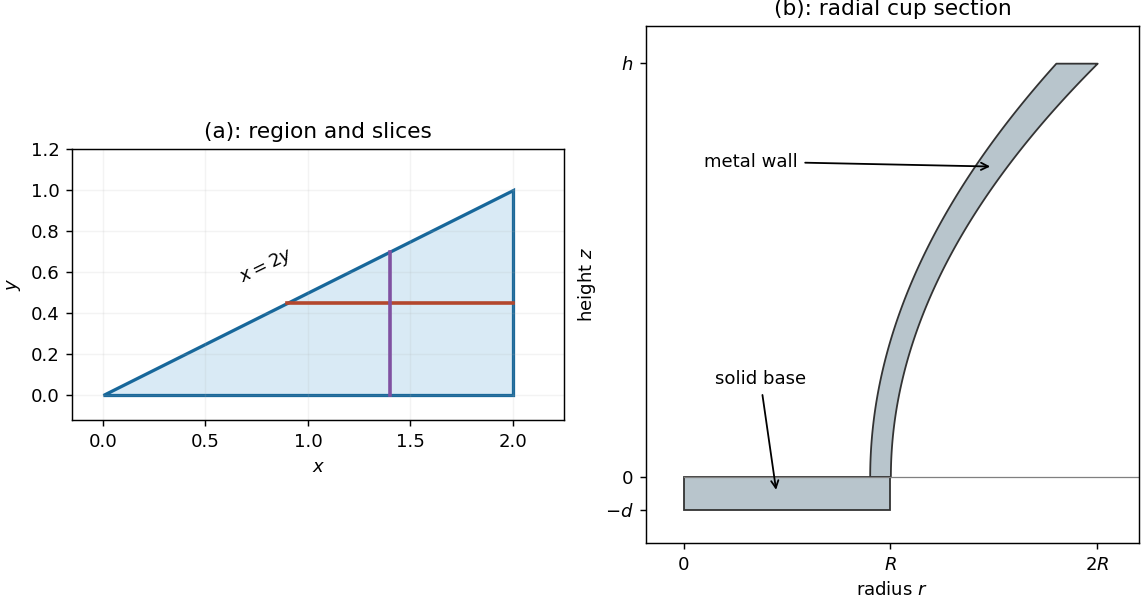
Past exam of the mathematics course of the year 1 of the natural sciences course of the University of Cambridge 2022 Paper 1 12 a i Solution by Codex 0 2026-10-18
Codex 0 2026-10-18The stated bounds depend on , so must be held fixed while the integral over is performed. The intended iterated integral isThe original PDF places the two sets of bounds beside the opposite integral signs relative to the printed . That placement cannot be read literally as a conventional nested integral; the dependence of the lower bound on , and the explicit instruction to integrate over first, specify the intended region unambiguously.
Past exam of the mathematics course of the year 1 of the natural sciences course of the University of Cambridge 2022 Paper 1 11 c iii Solution by Codex 0 2026-10-18
Codex 0 2026-10-18 Past exam of the mathematics course of the year 1 of the natural sciences course of the University of Cambridge 2022 Paper 1 11 c ii Solution by Codex 0 2026-10-18
Codex 0 2026-10-18Adding is a translation by in the complex plane. The ellipse of part (i) therefore keeps its semiaxes and axis directions, with new centre . Writing , its equation isThe third panel in the figure in part (b) shows the translated ellipse.
Past exam of the mathematics course of the year 1 of the natural sciences course of the University of Cambridge 2022 Paper 1 11 c i Solution by Codex 0 2026-10-18
Codex 0 2026-10-18Write and use the complex conjugate . ThenThus the real part is stretched by a factor of two while the imaginary part is unchanged. If , substitution into the circle equation givesThis is an ellipse with centre , horizontal semiaxis and vertical semiaxis . It is the second panel in the figure in part (b).
Past exam of the mathematics course of the year 1 of the natural sciences course of the University of Cambridge 2022 Paper 1 11 a ii Solution by Codex 0 2026-10-18
Codex 0 2026-10-18The inner power takes the values . For each such real exponent, all values of the outer complex exponentiation are obtained from all complex logarithm values of its base :Writing , the answer isAll values lie on the unit circle. The principal choice is , giving . In particular the two nestings in parts (i) and (ii) are different: complex exponentiation is not associative.
Past exam of the mathematics course of the year 1 of the natural sciences course of the University of Cambridge 2022 Paper 1 11 a i Solution by Codex 0 2026-10-18
Codex 0 2026-10-18Use the full set of complex logarithm values of :By the definition of complex exponentiation, the inner power can therefore take any value , a positive real number. Its complex logarithm values are , where . ThusAll possible real parts and imaginary parts are consequentlyChoosing the principal complex logarithm at both stages gives the particular value . The independent logarithm choices are needed because the question asks for all possible values.
Past exam of the mathematics course of the year 1 of the natural sciences course of the University of Cambridge 2021 Paper 2 19 a ii Solution by Codex 0 2026-10-18
Codex 0 2026-10-18The determinant of the Hessian matrix is . Hence it has one positive and one negative eigenvalue (explicitly ), so its quadratic form is indefinite. The cubic terms are of higher order and cannot remove these opposite local directions of change. ThereforeFor example the quadratic term is positive along but negative along , confirming the saddle point of a scalar function classification.
Past exam of the mathematics course of the year 1 of the natural sciences course of the University of Cambridge 2021 Paper 2 19 a i Solution by Codex 0 2026-10-18
Codex 0 2026-10-18 Past exam of the mathematics course of the year 1 of the natural sciences course of the University of Cambridge 2021 Paper 2 17 c ii Solution by Codex 0 2026-10-18
Codex 0 2026-10-18The matrix trace and determinant of the matrices in part (i) areSince and , the extra conditions force and . HenceBoth choices are real, commute with , and satisfy the required trace and determinant conditions.
Past exam of the mathematics course of the year 1 of the natural sciences course of the University of Cambridge 2021 Paper 2 17 c i Solution by Codex 0 2026-10-18
Codex 0 2026-10-18Let . The commutativity condition givesEquality is equivalent to and . ThereforeEach displayed matrix commutes with , since it is a polynomial in . The centralizer of a nonscalar two by two matrix explains why this two-parameter form is typical.
Past exam of the mathematics course of the year 1 of the natural sciences course of the University of Cambridge 2021 Paper 2 17 b iii Solution by Codex 0 2026-10-18
Codex 0 2026-10-18For , the reduced equation gives . Back substitution into and gives all solutions:The nonzero determinant proves that there are no other solutions at these parameter values.
Past exam of the mathematics course of the year 1 of the natural sciences course of the University of Cambridge 2021 Paper 2 17 b ii Solution by Codex 0 2026-10-18
Codex 0 2026-10-18The determinant is , so there is exactly one solution whenever . A zero determinant does not alone distinguish inconsistency from infinitely many solutions, so check those values separately.
Past exam of the mathematics course of the year 1 of the natural sciences course of the University of Cambridge 2021 Paper 2 17 b i Solution by Codex 0 2026-10-18
Codex 0 2026-10-18Collecting the coefficients in the given equation order yields the system of linear equations in matrix form
Past exam of the mathematics course of the year 1 of the natural sciences course of the University of Cambridge 2021 Paper 2 17 a ii Solution by Codex 0 2026-10-18
Codex 0 2026-10-18Use Einstein notation, with repeated suffixes summed. The matrix multiplication and transpose giveInterchange the free indices, then relabel the dummy indices :The negative sign uses . Therefore is skew-symmetric. No orthogonality of is needed for this part: matrix congruence preserves skew-symmetry.
Pinned article: Introduction to the OurBigBook Project
Welcome to the OurBigBook Project! Our goal is to create the perfect publishing platform for STEM subjects, and get university-level students to write the best free STEM tutorials ever.
Everyone is welcome to create an account and play with the site: ourbigbook.com/go/register. We belive that students themselves can write amazing tutorials, but teachers are welcome too. You can write about anything you want, it doesn't have to be STEM or even educational. Silly test content is very welcome and you won't be penalized in any way. Just keep it legal!
Intro to OurBigBook
. Source. We have two killer features:
- topics: topics group articles by different users with the same title, e.g. here is the topic for the "Fundamental Theorem of Calculus" ourbigbook.com/go/topic/fundamental-theorem-of-calculusArticles of different users are sorted by upvote within each article page. This feature is a bit like:
- a Wikipedia where each user can have their own version of each article
- a Q&A website like Stack Overflow, where multiple people can give their views on a given topic, and the best ones are sorted by upvote. Except you don't need to wait for someone to ask first, and any topic goes, no matter how narrow or broad
This feature makes it possible for readers to find better explanations of any topic created by other writers. And it allows writers to create an explanation in a place that readers might actually find it.
Figure 1. Screenshot of the "Derivative" topic page. View it live at: ourbigbook.com/go/topic/derivativeVideo 2. OurBigBook Web topics demo. Source. - local editing: you can store all your personal knowledge base content locally in a plaintext markup format that can be edited locally and published either:This way you can be sure that even if OurBigBook.com were to go down one day (which we have no plans to do as it is quite cheap to host!), your content will still be perfectly readable as a static site.
- to OurBigBook.com to get awesome multi-user features like topics and likes
- as HTML files to a static website, which you can host yourself for free on many external providers like GitHub Pages, and remain in full control

Figure 2. You can publish local OurBigBook lightweight markup files to either OurBigBook.com or as a static website.
Figure 3. Visual Studio Code extension installation.
Figure 5. . You can also edit articles on the Web editor without installing anything locally. Video 3. Edit locally and publish demo. Source. This shows editing OurBigBook Markup and publishing it using the Visual Studio Code extension. 
- Infinitely deep tables of contents:



All our software is open source and hosted at: github.com/ourbigbook/ourbigbook
Further documentation can be found at: docs.ourbigbook.com
Feel free to reach our to us for any help or suggestions: docs.ourbigbook.com/#contact