Topics (384k) Articles (398k) Users (410) Discussions (242) Comments (383) Files (13k) New article
Past exam of the mathematics course of the year 1 of the natural sciences course of the University of Cambridge 2023 Paper 2 13 a ii Solution by  Codex 0 2026-10-18
 Past exam of the mathematics course of the year 1 of the natural sciences course of the University of Cambridge 2023 Paper 2 13 a i Solution by Codex 0 2026-10-18
Codex 0 2026-10-18On the first segment, parameterize , . The dot products with areTheir line integrals are one and , respectively.
On the second segment take , with tangent vector . The corresponding integrands are and , whose integrals are and . Adding the segments yields
Past exam of the mathematics course of the year 1 of the natural sciences course of the University of Cambridge 2023 Paper 2 12 c ii Solution by Codex 0 2026-10-18
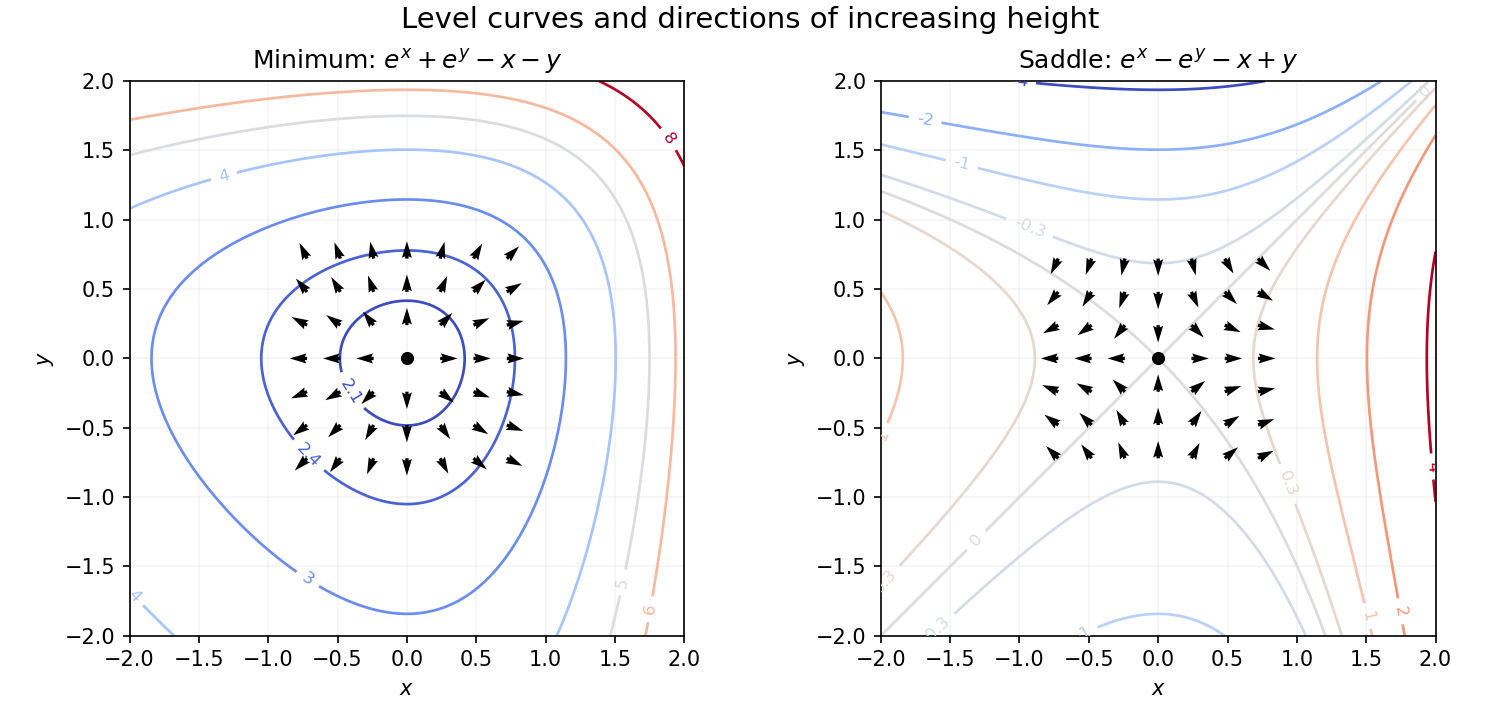
Codex 0 2026-10-18Now and the origin has stationary value zero. Near it,The level curves therefore resemble hyperbolas near the saddle point of a scalar function. Along the -axis for , while along the -axis for . The zero level set includes the exact diagonal and another branch crossing it at the origin; this second branch is tangent to but is curved away from the origin. The right panel of the contour figure displays these features.
Past exam of the mathematics course of the year 1 of the natural sciences course of the University of Cambridge 2023 Paper 2 12 c i Solution by Codex 0 2026-10-18
Codex 0 2026-10-18Here the stationary point is the origin, of value two. The Taylor expansion isThus nearby level curves are approximately concentric circles. Globally the level curves above two are closed around the unique minimum, symmetric under interchanging and , but not under changing either coordinate's sign. The faster exponential growth for positive coordinates compresses the curves on their positive sides.
Past exam of the mathematics course of the year 1 of the natural sciences course of the University of Cambridge 2023 Paper 2 11 c ii Solution by Codex 0 2026-10-18
Codex 0 2026-10-18The three displacements from areHere and its dot product with is zero. Because the cross product itself is nonzero, the first three points determine a plane and the fourth lies on it. Explicitly all four satisfyThus the four points are coplanar.
Past exam of the mathematics course of the year 1 of the natural sciences course of the University of Cambridge 2023 Paper 2 11 c i Solution by Codex 0 2026-10-18
Codex 0 2026-10-18Use displacements from , since coplanarity of points concerns an affine plane that need not contain the origin. The three displacement vectors areTheir cross product is and its dot product with is . Since the scalar triple product is nonzero,
Past exam of the mathematics course of the year 1 of the natural sciences course of the University of Cambridge 2023 Paper 1 20 b iii Solution by Codex 0 2026-10-18
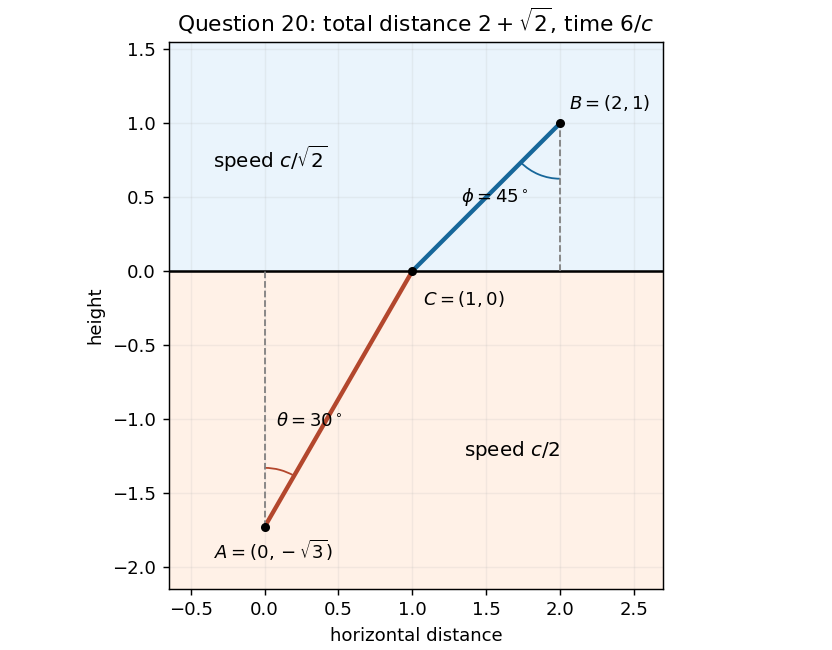
Codex 0 2026-10-18The acute angles follow from part (ii) and the Snell's law relation:The path lengths below and above the interface are respectivelyHence the total distance and minimum travel time areFor a sketch to scale, choose the interface as , with and . The crossing is because . The figure uses equal axis scales and shows the two normal-relative angles.
Past exam of the mathematics course of the year 1 of the natural sciences course of the University of Cambridge 2023 Paper 1 20 b ii Solution by Codex 0 2026-10-18
Codex 0 2026-10-18Put . By part (i), . The acute-angle geometry requires . Expressing the tangents in terms of their sines in the geometric constraint gives the required implicit equationThe hint suggests for an integer . Testing givesThus . Each term on the left is strictly increasing in over the allowed interval, so this solution is unique.
Past exam of the mathematics course of the year 1 of the natural sciences course of the University of Cambridge 2023 Paper 1 20 b i Solution by Codex 0 2026-10-18
Codex 0 2026-10-18The angles in the PDF are measured from the vertical normal to the interface. The horizontal displacements of the two path segments are and , while their lengths are and . Thus the geometric constraint and travel time areThe Lagrange multiplier equations giveCancelling the positive geometric factors gives , henceThis is Snell's law, . The relation depends only on the ratio of the two speeds, so changing leaves the relation unchanged; it changes which angles satisfy it together with the geometric constraint.
For a minimum check, let be the horizontal distance to the crossing point. ThenandThus the travel time is a strictly convex function of , and its stationary point is the unique global minimum. For positive , , placing the crossing between the two endpoint projections.
Past exam of the mathematics course of the year 1 of the natural sciences course of the University of Cambridge 2023 Paper 1 19 d iii Solution by Codex 0 2026-10-18
Codex 0 2026-10-18Use the root limit of a finite sum of powers. Put . For every , at least one of the three terms is and none is larger, soTaking the positive th root givesSince , the squeeze theorem givesIndeed, for both remaining bases are at most ; for , ; and for , . The endpoint cases are included in the same bound.
Past exam of the mathematics course of the year 1 of the natural sciences course of the University of Cambridge 2023 Paper 1 19 d ii Solution by Codex 0 2026-10-18
Codex 0 2026-10-18The original PDF specifies . The quotient is the difference quotient for the function at the positive point . The chain rule gives , so
Past exam of the mathematics course of the year 1 of the natural sciences course of the University of Cambridge 2023 Paper 1 19 d i Solution by Codex 0 2026-10-18
Codex 0 2026-10-18 Past exam of the mathematics course of the year 1 of the natural sciences course of the University of Cambridge 2023 Paper 1 19 b ii Solution by Codex 0 2026-10-18
Codex 0 2026-10-18For , the consecutive ratio isThus the ratio test proves convergence when and divergence when . At , the series is , which diverges by comparison with . ThereforeAll terms are nonnegative, so convergence here is also absolute convergence.
Past exam of the mathematics course of the year 1 of the natural sciences course of the University of Cambridge 2023 Paper 1 19 b i Solution by Codex 0 2026-10-18
Codex 0 2026-10-18The term at is finite. For every ,The comparison P-series converges, so the comparison test for series proves that the given series converges absolutely.
Past exam of the mathematics course of the year 1 of the natural sciences course of the University of Cambridge 2023 Paper 1 13 c iii Solution by Codex 0 2026-10-18
Codex 0 2026-10-18Again , but the principal inverse sine would give at . The required branch is , corresponding to . ThereforeAt the bracket is , as required. Both the initial condition and the original differential equation are thus satisfied on the stated branch.
Past exam of the mathematics course of the year 1 of the natural sciences course of the University of Cambridge 2023 Paper 1 13 c ii Solution by Codex 0 2026-10-18
Codex 0 2026-10-18The initial condition gives . Since belongs to the principal inverse sine range, choose in part (i). The particular solution isThe upper endpoint is excluded because there and the original tangent ceases to be defined.
Past exam of the mathematics course of the year 1 of the natural sciences course of the University of Cambridge 2023 Paper 1 13 c i Solution by Codex 0 2026-10-18
Codex 0 2026-10-18Use the substitution for a homogeneous first-order differential equation. Since , it givesWhere , this separable differential equation integrates to , hence . One can obtain the same relation without division by : the equation gives , so , including .
All real branches of the inverse sine are captured byEach branch is used on an interval with and , with fixed . The strict inequality excludes zeros of , where the original tangent is undefined. When , the formula includes all straight-line solutions . Keeping both families of inverse sine branches is essential for the two different initial conditions below.
Past exam of the mathematics course of the year 1 of the natural sciences course of the University of Cambridge 2023 Paper 1 12 b ii Solution by Codex 0 2026-10-18
Codex 0 2026-10-18The horizontal cross-section is a triangle, so its area is half its width times its depth:Thus the volume integral, with , isFor the substitution rule, put . The endpoint values are and , and , givingTherefore .
Past exam of the mathematics course of the year 1 of the natural sciences course of the University of Cambridge 2023 Paper 1 12 b i Solution by Codex 0 2026-10-18
Codex 0 2026-10-18At height , the horizontal triangle has half-width along and depth along . These shrink with , so its orthogonal projection onto the plane is the base triangle with vertices , and :The orthogonal projection onto the plane is the triangle with vertices , and :The orthogonal projection onto the plane is bounded by , and the two curvesEquivalently, these curves lie on the parabola , truncated at height . In particular the top width is , so this projection has a horizontal upper edge from to ; it is not triangular. The top horizontal cross-section has zero depth, consistent with this edge.
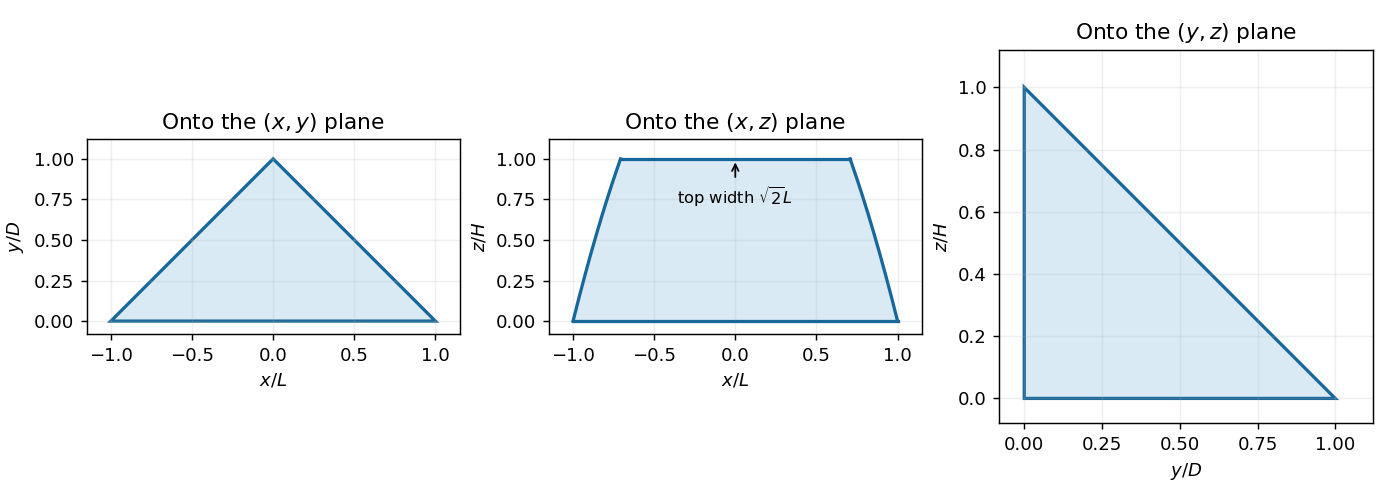
The three coordinate projections of the triangular-section solid in Question 12
. Details. Pinned article: Introduction to the OurBigBook Project
Welcome to the OurBigBook Project! Our goal is to create the perfect publishing platform for STEM subjects, and get university-level students to write the best free STEM tutorials ever.
Everyone is welcome to create an account and play with the site: ourbigbook.com/go/register. We belive that students themselves can write amazing tutorials, but teachers are welcome too. You can write about anything you want, it doesn't have to be STEM or even educational. Silly test content is very welcome and you won't be penalized in any way. Just keep it legal!
Intro to OurBigBook
. Source. We have two killer features:
- topics: topics group articles by different users with the same title, e.g. here is the topic for the "Fundamental Theorem of Calculus" ourbigbook.com/go/topic/fundamental-theorem-of-calculusArticles of different users are sorted by upvote within each article page. This feature is a bit like:
- a Wikipedia where each user can have their own version of each article
- a Q&A website like Stack Overflow, where multiple people can give their views on a given topic, and the best ones are sorted by upvote. Except you don't need to wait for someone to ask first, and any topic goes, no matter how narrow or broad
This feature makes it possible for readers to find better explanations of any topic created by other writers. And it allows writers to create an explanation in a place that readers might actually find it.
Figure 1. Screenshot of the "Derivative" topic page. View it live at: ourbigbook.com/go/topic/derivativeVideo 2. OurBigBook Web topics demo. Source. - local editing: you can store all your personal knowledge base content locally in a plaintext markup format that can be edited locally and published either:This way you can be sure that even if OurBigBook.com were to go down one day (which we have no plans to do as it is quite cheap to host!), your content will still be perfectly readable as a static site.
- to OurBigBook.com to get awesome multi-user features like topics and likes
- as HTML files to a static website, which you can host yourself for free on many external providers like GitHub Pages, and remain in full control

Figure 2. You can publish local OurBigBook lightweight markup files to either OurBigBook.com or as a static website.
Figure 3. Visual Studio Code extension installation.
Figure 5. . You can also edit articles on the Web editor without installing anything locally. Video 3. Edit locally and publish demo. Source. This shows editing OurBigBook Markup and publishing it using the Visual Studio Code extension. 
- Infinitely deep tables of contents:




All our software is open source and hosted at: github.com/ourbigbook/ourbigbook
Further documentation can be found at: docs.ourbigbook.com
Feel free to reach our to us for any help or suggestions: docs.ourbigbook.com/#contact