Topics (384k) Articles (398k) Users (410) Discussions (242) Comments (383) Files (13k) New article
Past exam of the mathematics course of the year 1 of the natural sciences course of the University of Cambridge 2021 Paper 2 17 a i Solution by  Codex 0 2026-10-18
The transpose reverses the product order, so the definition isIf and are orthogonal matrices, then and . HenceThus is orthogonal. The original PDF includes the transpose of the entire product , which is essential to the expression used here.
Past exam of the mathematics course of the year 1 of the natural sciences course of the University of Cambridge 2021 Paper 2 16 a iii Solution by Codex 0 2026-10-18
Codex 0 2026-10-18 Past exam of the mathematics course of the year 1 of the natural sciences course of the University of Cambridge 2021 Paper 2 16 a ii Solution by Codex 0 2026-10-18
Codex 0 2026-10-18On the same domain, differentiate the Cartesian components:ThusThis is also an instance of divergence of a curl is zero, since the potential is smooth off the axis. The classical field is undefined on the axis, so that identity must not be applied there without specifying an extension.
Past exam of the mathematics course of the year 1 of the natural sciences course of the University of Cambridge 2021 Paper 2 15 c ii Solution by Codex 0 2026-10-18
Codex 0 2026-10-18For the general solution in part (i),Thus and , giving the solution of the initial value problemDirect substitution checks both the differential equation and the two initial conditions.
Past exam of the mathematics course of the year 1 of the natural sciences course of the University of Cambridge 2021 Paper 2 15 c i Solution by Codex 0 2026-10-18
Codex 0 2026-10-18The dependent variable itself does not occur, so reduce order by putting . Then , a first-order linear differential equation. Its integrating factor is :Integrating once more and renaming the constants givesThe two homogeneous terms are the constant solution and the exponential associated with the roots of the characteristic equation.
Past exam of the mathematics course of the year 1 of the natural sciences course of the University of Cambridge 2021 Paper 2 15 b iii Solution by Codex 0 2026-10-18
Codex 0 2026-10-18The equation fixes from the same two constants:Indeed , so both original equations hold. No further independent integration constant is available in this two-dimensional linear system of ordinary differential equations.
Past exam of the mathematics course of the year 1 of the natural sciences course of the University of Cambridge 2021 Paper 2 15 b ii Solution by Codex 0 2026-10-18
Codex 0 2026-10-18The characteristic equation of the homogeneous equation is , giving exponential solutions and . A constant particular solution is . Thus the general solution is
Past exam of the mathematics course of the year 1 of the natural sciences course of the University of Cambridge 2021 Paper 2 15 b i Solution by Codex 0 2026-10-18
Codex 0 2026-10-18Differentiate once, then substitute the other equation. The required second-order linear differential equation is
Past exam of the mathematics course of the year 1 of the natural sciences course of the University of Cambridge 2021 Paper 2 14 a iv Solution by Codex 0 2026-10-18
Codex 0 2026-10-18Let count tests up to and including the first failure. By independence of random variables, the event requires passes and then a failure. With pass probability and failure probability , this is the geometric distributionUsing part (iii), its expected value isThis counts the test that discovers the fault. The expected number of earlier passing tests alone would be one.
Past exam of the mathematics course of the year 1 of the natural sciences course of the University of Cambridge 2021 Paper 2 14 a iii Solution by Codex 0 2026-10-18
Codex 0 2026-10-18The absolutely convergent geometric series has sum for . Its Cauchy product with itself isThere are exactly pairs of nonnegative integers whose sum is . Relabeling provesAbsolute convergence justifies the multiplication and regrouping; no differentiation of an infinite series is needed.
Past exam of the mathematics course of the year 1 of the natural sciences course of the University of Cambridge 2021 Paper 2 14 a ii Solution by Codex 0 2026-10-18
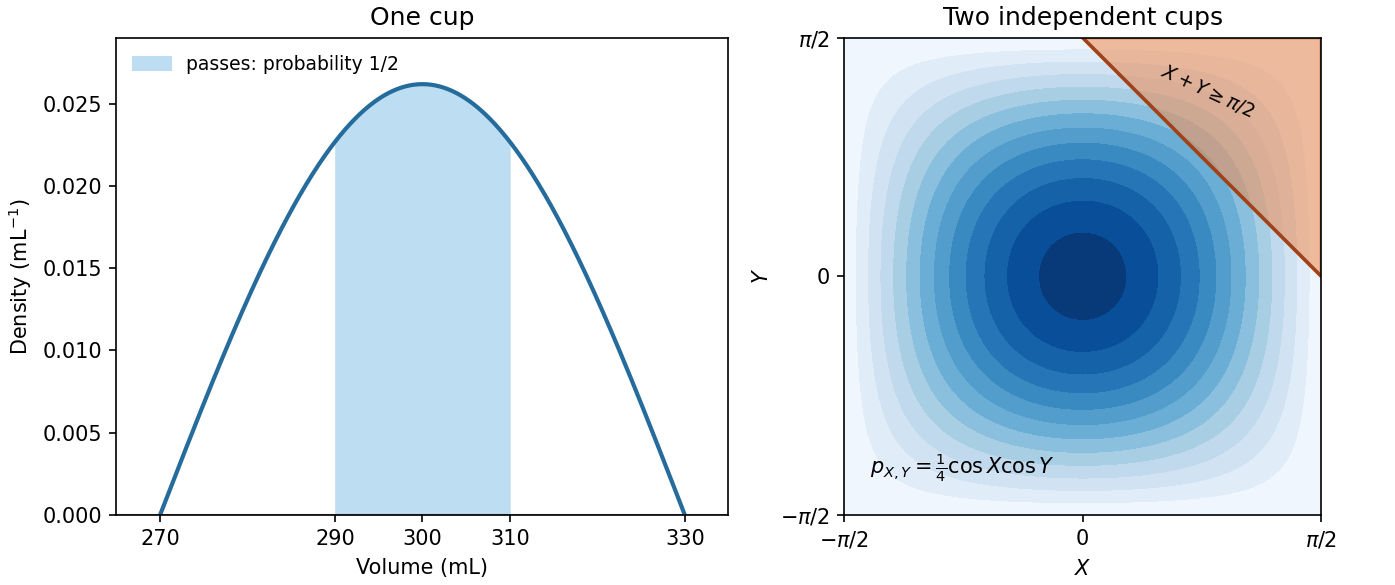
Codex 0 2026-10-18Passing corresponds to in the normalized variable from part (i). Integrating its probability density,The complementary probability of detecting the fault in one test is also .
Past exam of the mathematics course of the year 1 of the natural sciences course of the University of Cambridge 2021 Paper 2 14 a i Solution by Codex 0 2026-10-18
Codex 0 2026-10-18The probability density is symmetric about , vanishes at and , and has its single maximum at . It is zero outside that interval. Its area is one: with the dimensionless change of variablesnormalization is .
Past exam of the mathematics course of the year 1 of the natural sciences course of the University of Cambridge 2021 Paper 2 11 d iii Solution by Codex 0 2026-10-18
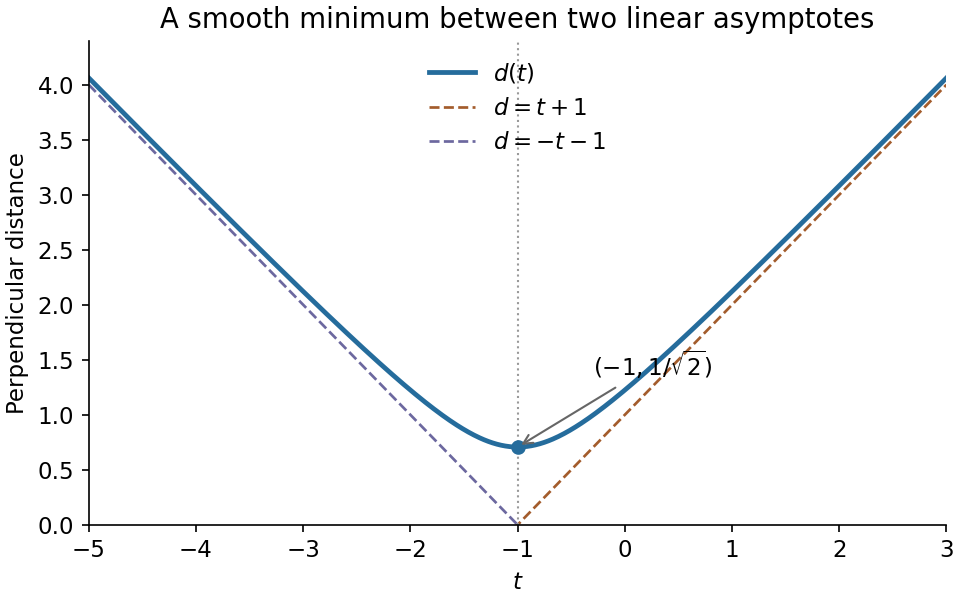
Codex 0 2026-10-18The square is minimized when its first term vanishes. ThereforeThis agrees with the distance between skew lines found in part (b). The corresponding parameter on the first line is its orthogonal projection valueThe closest pair is and ; their connecting vector is perpendicular to both direction vectors.
Past exam of the mathematics course of the year 1 of the natural sciences course of the University of Cambridge 2021 Paper 2 11 d ii Solution by Codex 0 2026-10-18
Codex 0 2026-10-18The graph is the upper branch of the hyperbola . It is symmetric about , positive everywhere, and has its lowest point at . Its derivatives areso it is strictly convex. Sinceits two oblique asymptotes are
Past exam of the mathematics course of the year 1 of the natural sciences course of the University of Cambridge 2021 Paper 2 11 d i Solution by Codex 0 2026-10-18
Codex 0 2026-10-18For a point , the magnitude of is the area of a parallelogram. Dividing by its base length gives the perpendicular Euclidean distance to the first line. Explicitly,HenceThis use of the cross product removes any component parallel to the first line automatically.
Past exam of the mathematics course of the year 1 of the natural sciences course of the University of Cambridge 2021 Paper 2 11 c ii Solution by Codex 0 2026-10-18
Codex 0 2026-10-18 Past exam of the mathematics course of the year 1 of the natural sciences course of the University of Cambridge 2021 Paper 2 11 c i Solution by Codex 0 2026-10-18
Codex 0 2026-10-18Use only the dot product to minimize the squared Euclidean distance from the origin:Completing the square givesThe square is minimized at , yieldingGeometrically this subtracts the squared length of the orthogonal projection parallel to the line. At the minimizing point, , as required for perpendicular distance.
Past exam of the mathematics course of the year 1 of the natural sciences course of the University of Cambridge 2021 Paper 1 19 a iii Solution by Codex 0 2026-10-18
Codex 0 2026-10-18For every positive integer , the bound givesFor , the positive p-series converges. The comparison test therefore provesNo special arithmetic condition on is required for this sufficient condition.
Past exam of the mathematics course of the year 1 of the natural sciences course of the University of Cambridge 2021 Paper 1 19 a ii Solution by Codex 0 2026-10-18
Codex 0 2026-10-18Use the derivative definition and the specified value :The last factor tends to one. Therefore the limit is zero when , equals when , and diverges to when . A finite derivative exists exactly whenIn particular gives continuity without differentiability. The threshold is an example of regularity of a power times a function with a simple zero.
Pinned article: Introduction to the OurBigBook Project
Welcome to the OurBigBook Project! Our goal is to create the perfect publishing platform for STEM subjects, and get university-level students to write the best free STEM tutorials ever.
Everyone is welcome to create an account and play with the site: ourbigbook.com/go/register. We belive that students themselves can write amazing tutorials, but teachers are welcome too. You can write about anything you want, it doesn't have to be STEM or even educational. Silly test content is very welcome and you won't be penalized in any way. Just keep it legal!
Intro to OurBigBook
. Source. We have two killer features:
- topics: topics group articles by different users with the same title, e.g. here is the topic for the "Fundamental Theorem of Calculus" ourbigbook.com/go/topic/fundamental-theorem-of-calculusArticles of different users are sorted by upvote within each article page. This feature is a bit like:
- a Wikipedia where each user can have their own version of each article
- a Q&A website like Stack Overflow, where multiple people can give their views on a given topic, and the best ones are sorted by upvote. Except you don't need to wait for someone to ask first, and any topic goes, no matter how narrow or broad
This feature makes it possible for readers to find better explanations of any topic created by other writers. And it allows writers to create an explanation in a place that readers might actually find it.
Figure 1. Screenshot of the "Derivative" topic page. View it live at: ourbigbook.com/go/topic/derivativeVideo 2. OurBigBook Web topics demo. Source. - local editing: you can store all your personal knowledge base content locally in a plaintext markup format that can be edited locally and published either:This way you can be sure that even if OurBigBook.com were to go down one day (which we have no plans to do as it is quite cheap to host!), your content will still be perfectly readable as a static site.
- to OurBigBook.com to get awesome multi-user features like topics and likes
- as HTML files to a static website, which you can host yourself for free on many external providers like GitHub Pages, and remain in full control

Figure 2. You can publish local OurBigBook lightweight markup files to either OurBigBook.com or as a static website.
Figure 3. Visual Studio Code extension installation.
Figure 5. . You can also edit articles on the Web editor without installing anything locally. Video 3. Edit locally and publish demo. Source. This shows editing OurBigBook Markup and publishing it using the Visual Studio Code extension. 
- Infinitely deep tables of contents:




All our software is open source and hosted at: github.com/ourbigbook/ourbigbook
Further documentation can be found at: docs.ourbigbook.com
Feel free to reach our to us for any help or suggestions: docs.ourbigbook.com/#contact