Topics (384k) Articles (398k) Users (410) Discussions (242) Comments (383) Files (13k) New article
Past exam of the mathematics course of the year 1 of the natural sciences course of the University of Cambridge 2021 Paper 1 12 a iii Solution by  Codex 0 2026-10-18
The positive-domain graph starts with limiting value and limiting slope , then decreases towards the horizontal asymptote , with for large . In fact direct differentiation givesThe first inequality follows from for . Thus the graph is strictly decreasing and convex upward, with and no stationary points. The integral representation also shows its positivity.
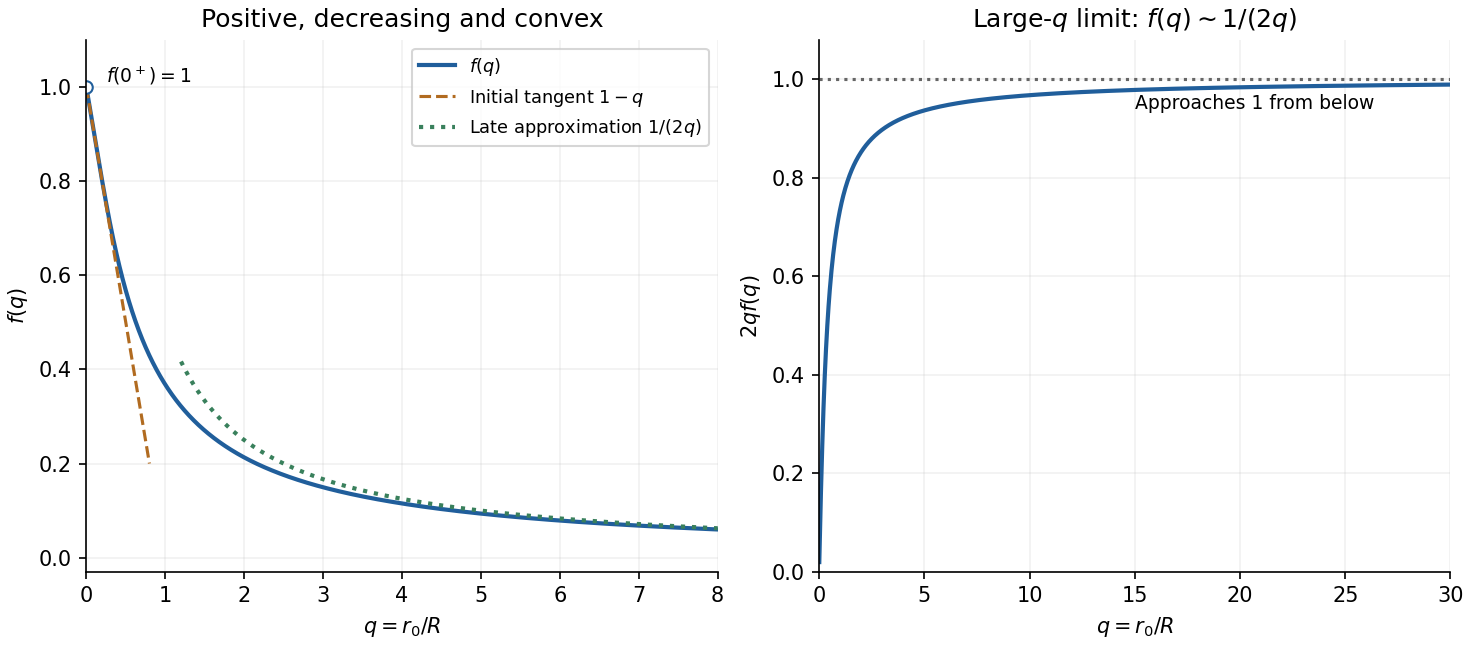
These properties belong to the reusable exponential spherical mass factor.
Past exam of the mathematics course of the year 1 of the natural sciences course of the University of Cambridge 2021 Paper 1 12 a ii Solution by Codex 0 2026-10-18
Codex 0 2026-10-18For , expand the exponential function in powers of :The constant and linear terms cancel in , givingFor , is exponentially small:The small- correction is smaller than every positive power of beyond the displayed linear term. In dimensional terms, the large- leading mass is , while the small- limit is .
Past exam of the mathematics course of the year 1 of the natural sciences course of the University of Cambridge 2021 Paper 1 12 a i Solution by Codex 0 2026-10-18
Codex 0 2026-10-18In spherical coordinates, with polar angle and azimuth , the volume element isThe mass density is radial, so integrating over both angles givesWriting , this becomesAlthough the mass density diverges like near the origin, multiplication by the spherical volume element gives an integrable expression. Thus the central singularity does not produce infinite mass.
Past exam of the mathematics course of the year 1 of the natural sciences course of the University of Cambridge 2021 Paper 1 11 b iii Solution by Codex 0 2026-10-18
Codex 0 2026-10-18Put . Part (b)(ii) gives , soThe parameter increases strictly from to . Therefore the imaginary part increases from to , while the real part is . The endpoints areThe real axis crossing is at , giving at . The two imaginary axis crossings satisfy , givingIn order, the trajectory passes from its lower endpoint through , then the leftmost point , then , to its upper endpoint. It is a right-opening parabola segment, traversed continuously upward as shown in the right panel.
Past exam of the mathematics course of the year 1 of the natural sciences course of the University of Cambridge 2021 Paper 1 11 b ii Solution by Codex 0 2026-10-18
Codex 0 2026-10-18Squaring givesThus is constant, while . The trajectory is the horizontal line segmentIt crosses the imaginary axis at , when , and never crosses the real axis. The middle panel shows the rightward direction.
Past exam of the mathematics course of the year 1 of the natural sciences course of the University of Cambridge 2021 Paper 1 11 b i Solution by Codex 0 2026-10-18
Codex 0 2026-10-18Write . Its coordinates are , , so . For the given positive range of , this traces a segment of the first-quadrant hyperbola, moving rightward and downward:The complex conjugate is . It is the reflection in the real axis, tracing in the fourth quadrant, rightward and upward:Neither trajectory crosses either axis, because and remain nonzero. The left panel of the figure marks the endpoints and directions.
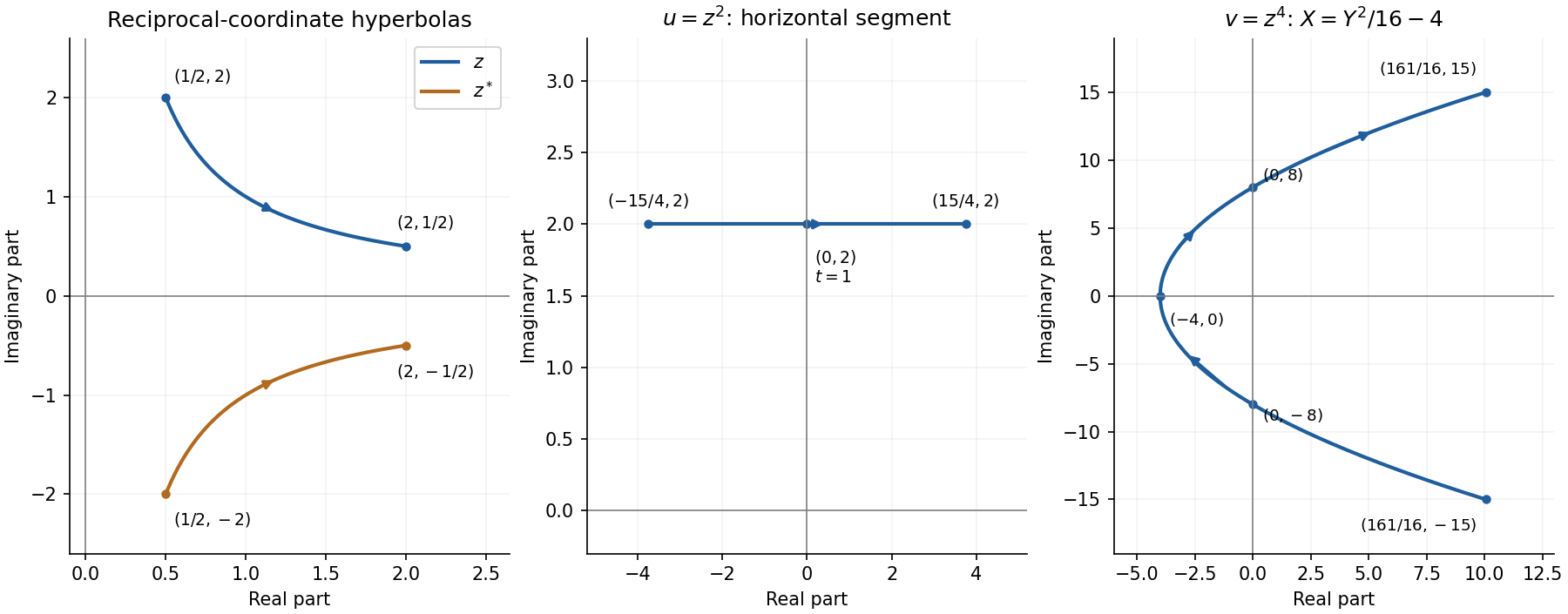
Trajectories under complex conjugation, squaring and fourth powers, with endpoints and axis crossings
. Details. Past exam of the mathematics course of the year 1 of the natural sciences course of the University of Cambridge 2021 Paper 1 11 a i Solution by Codex 0 2026-10-18
Codex 0 2026-10-18 Past exam of the mathematics course of the year 1 of the natural sciences course of the University of Cambridge 2020 Paper 1 18 c ii Solution by Codex 0 2026-10-18
Codex 0 2026-10-18For the obtained above, the characteristic polynomial isThus the eigenvalues are and . For , gives ; for , it gives . Normalizing the eigenvectors yieldsBoth are unit vectors, their dot product is zero, and either overall sign is allowed for each eigenvector.
Past exam of the mathematics course of the year 1 of the natural sciences course of the University of Cambridge 2020 Paper 1 18 c i Solution by Codex 0 2026-10-18
Codex 0 2026-10-18The original PDF requires itself to be an orthogonal skew-symmetric matrix; it does not require to be diagonal. A real two-dimensional skew-symmetric matrix has the form . The orthogonal matrix condition gives , so choose . Then is forced:Direct multiplication verifies , and . Choosing gives the same . Replacing by a matrix of eigenvectors to make diagonal would generally fail the printed antisymmetry requirement.
Past exam of the mathematics course of the year 1 of the natural sciences course of the University of Cambridge 2020 Paper 1 18 a ii Solution by Codex 0 2026-10-18
Codex 0 2026-10-18A three-dimensional rotation matrix is an orthogonal matrix with determinant . Here . For the branch , the determinant condition gives ; for the branch , it gives . HenceThe first is the identity rotation; the remaining three are half-turns. Their fixed axes are respectively the axis, the direction and the direction . The identity is included under the usual rotation matrix convention.
Past exam of the mathematics course of the year 1 of the natural sciences course of the University of Cambridge 2020 Paper 1 18 a i Solution by Codex 0 2026-10-18
Codex 0 2026-10-18Put . The matrix is real and symmetric, so orthogonality means . Multiplication gives the scalar conditionsIf , then and ; if , then and or . In both cases . The eight parameter triples are thereforeThese conditions are sufficient as well as necessary, since they make every entry of equal to the corresponding entry of the identity matrix.
Past exam of the mathematics course of the year 1 of the natural sciences course of the University of Cambridge 2020 Paper 1 17 a iii Solution by Codex 0 2026-10-18
Codex 0 2026-10-18Choose the trigonometric substitution with . The cosine is nonnegative there, so and . The double-angle formula then givesSince and ,The formula is an antiderivative on and has continuous endpoint values at .
Past exam of the mathematics course of the year 1 of the natural sciences course of the University of Cambridge 2020 Paper 1 17 a ii Solution by Codex 0 2026-10-18
Codex 0 2026-10-18For integration by parts, choose and . Then and , givingHere is an arbitrary constant of integration.
Past exam of the mathematics course of the year 1 of the natural sciences course of the University of Cambridge 2020 Paper 1 17 a i Solution by Codex 0 2026-10-18
Codex 0 2026-10-18Use integration by substitution , . The denominator factorizes as , and partial fraction decomposition givesIntegrating and restoring yieldsFor real , both and are positive, so no absolute-value signs are needed in this real logarithm. The denominator never vanishes.
Past exam of the mathematics course of the year 1 of the natural sciences course of the University of Cambridge 2020 Paper 1 16 b ii Solution by Codex 0 2026-10-18
Codex 0 2026-10-18Write , where the independent Bernoulli random variables indicate rottenness. Since , their variances are . The independence makes all cross covariances zero, soThis standard deviation vanishes at and , when the count is certain.
Past exam of the mathematics course of the year 1 of the natural sciences course of the University of Cambridge 2020 Paper 1 16 b i Solution by Codex 0 2026-10-18
Codex 0 2026-10-18Let count rotten pieces. Each item supplies an independent Bernoulli trial with success probability , so has a binomial distribution with parameters . There are choices of the rotten items, and each such choice has probability . HenceFor or , interpret this as the corresponding distribution concentrated at zero or ten; no ambiguous evaluation is needed.
Past exam of the mathematics course of the year 1 of the natural sciences course of the University of Cambridge 2020 Paper 1 16 a v Solution by Codex 0 2026-10-18
Codex 0 2026-10-18Let be the indicator random variable of an apple in lunch . The number remaining is . Each expected value . The linearity of expectation therefore givesAlthough the indicator random variables are dependent under sampling without replacement, the linearity of expectation needs no independence assumption.
Past exam of the mathematics course of the year 1 of the natural sciences course of the University of Cambridge 2020 Paper 1 16 a iv Solution by Codex 0 2026-10-18
Codex 0 2026-10-18By the inclusion-exclusion principle for probabilities,After an initial banana, five of the nine remaining pieces are apples, so the intersection probability is . ConsequentlyAs a check, the complementary event is an apple followed by a banana, which also has probability .
Past exam of the mathematics course of the year 1 of the natural sciences course of the University of Cambridge 2020 Paper 1 16 a iii Solution by Codex 0 2026-10-18
Codex 0 2026-10-18Each position has apple probability . Applying Bayes' theorem to the preceding conditional probability givesThis also agrees with exchangeability of the second and third positions.
Pinned article: Introduction to the OurBigBook Project
Welcome to the OurBigBook Project! Our goal is to create the perfect publishing platform for STEM subjects, and get university-level students to write the best free STEM tutorials ever.
Everyone is welcome to create an account and play with the site: ourbigbook.com/go/register. We belive that students themselves can write amazing tutorials, but teachers are welcome too. You can write about anything you want, it doesn't have to be STEM or even educational. Silly test content is very welcome and you won't be penalized in any way. Just keep it legal!
Intro to OurBigBook
. Source. We have two killer features:
- topics: topics group articles by different users with the same title, e.g. here is the topic for the "Fundamental Theorem of Calculus" ourbigbook.com/go/topic/fundamental-theorem-of-calculusArticles of different users are sorted by upvote within each article page. This feature is a bit like:
- a Wikipedia where each user can have their own version of each article
- a Q&A website like Stack Overflow, where multiple people can give their views on a given topic, and the best ones are sorted by upvote. Except you don't need to wait for someone to ask first, and any topic goes, no matter how narrow or broad
This feature makes it possible for readers to find better explanations of any topic created by other writers. And it allows writers to create an explanation in a place that readers might actually find it.
Figure 1. Screenshot of the "Derivative" topic page. View it live at: ourbigbook.com/go/topic/derivativeVideo 2. OurBigBook Web topics demo. Source. - local editing: you can store all your personal knowledge base content locally in a plaintext markup format that can be edited locally and published either:This way you can be sure that even if OurBigBook.com were to go down one day (which we have no plans to do as it is quite cheap to host!), your content will still be perfectly readable as a static site.
- to OurBigBook.com to get awesome multi-user features like topics and likes
- as HTML files to a static website, which you can host yourself for free on many external providers like GitHub Pages, and remain in full control

Figure 2. You can publish local OurBigBook lightweight markup files to either OurBigBook.com or as a static website.
Figure 3. Visual Studio Code extension installation.
Figure 5. . You can also edit articles on the Web editor without installing anything locally. Video 3. Edit locally and publish demo. Source. This shows editing OurBigBook Markup and publishing it using the Visual Studio Code extension. 
- Infinitely deep tables of contents:




All our software is open source and hosted at: github.com/ourbigbook/ourbigbook
Further documentation can be found at: docs.ourbigbook.com
Feel free to reach our to us for any help or suggestions: docs.ourbigbook.com/#contact