Topics (384k) Articles (398k) Users (410) Discussions (242) Comments (383) Files (13k) New article
Past exam of the mathematics course of the year 1 of the natural sciences course of the University of Cambridge 2023 Paper 1 12 a i Solution by  Codex 0 2026-10-18
At height , the circular sector has radius and angle . Its area is , so slicing by horizontal cross-sections gives the volume integralUse the substitution rule . ThenAn integration by parts gives the antiderivative , whose endpoint difference is . Therefore
Past exam of the mathematics course of the year 1 of the natural sciences course of the University of Cambridge 2023 Paper 1 11 b ii Solution by Codex 0 2026-10-18
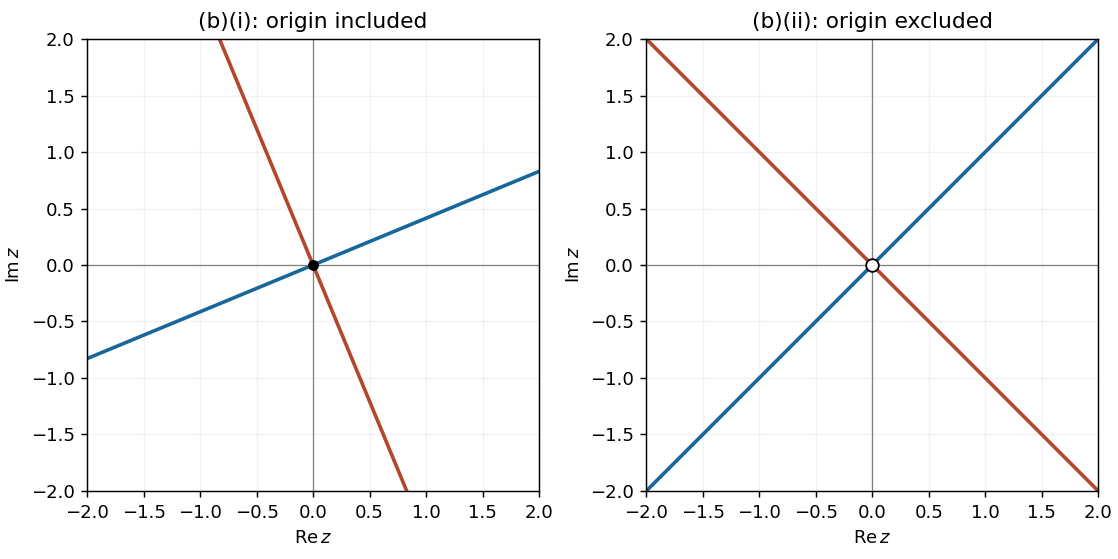
Codex 0 2026-10-18The denominator requires . Write , where and . Multiplication by the nonzero denominator givesso . Conversely, if and , then and . Thus the required Argand diagram consists exactly ofThese are two perpendicular straight lines, with the origin removed as shown in the figure in part (i).
Past exam of the mathematics course of the year 1 of the natural sciences course of the University of Cambridge 2023 Paper 1 11 b i Solution by Codex 0 2026-10-18
Codex 0 2026-10-18Since , equating its real part and imaginary part gives , orThe quadratic equation in factors as . Thus the set is the union of two straight lines through the origin:Their slopes multiply to , so they are perpendicular. Their angles to the real axis are and , modulo . The origin is included.
Past exam of the mathematics course of the year 1 of the natural sciences course of the University of Cambridge 2023 Paper 1 11 a ii Solution by Codex 0 2026-10-18
Codex 0 2026-10-18Multiply numerator and denominator by the complex conjugate :Thus the real part is and the imaginary part is .
Past exam of the mathematics course of the year 1 of the natural sciences course of the University of Cambridge 2023 Paper 1 11 a i Solution by Codex 0 2026-10-18
Codex 0 2026-10-18 Past exam of the mathematics course of the year 1 of the natural sciences course of the University of Cambridge 2022 Paper 2 18 a iii Solution by Codex 0 2026-10-18
Codex 0 2026-10-18The standard Fourier series iswith Fourier coefficientsThese follow by taking inner products with the individual basis vectors and using their orthogonality and squared norms.
Past exam of the mathematics course of the year 1 of the natural sciences course of the University of Cambridge 2022 Paper 2 18 a ii Solution by Codex 0 2026-10-18
Codex 0 2026-10-18With inner product , orthogonality meansThe constant function has squared norm , and each sine or cosine has squared norm . Thus the displayed family is orthogonal but not normalized; these different lengths determine the coefficient factors.
Past exam of the mathematics course of the year 1 of the natural sciences course of the University of Cambridge 2022 Paper 2 18 a i Solution by Codex 0 2026-10-18
Codex 0 2026-10-18A standard complete orthogonal family is the real Fourier basisCompleteness gives expansion in the L2 space for a square-integrable function. Mere integrability alone does not guarantee pointwise convergence of a Fourier series; the explicit function in part (b) is continuous and piecewise smooth, so this issue does not obstruct its expansion.
Past exam of the mathematics course of the year 1 of the natural sciences course of the University of Cambridge 2022 Paper 2 17 b iii Solution by Codex 0 2026-10-18
Codex 0 2026-10-18For , the matrix is invertible, so there is exactly one solution. To exhibit it, subtract the first linear equation from the third to obtain , then subtract twice the second from the first to obtain . Back-substitution givesAt , the first and third linear equations have identical left-hand sides but right-hand sides one and three, so there is no solution.
Past exam of the mathematics course of the year 1 of the natural sciences course of the University of Cambridge 2022 Paper 2 17 b ii Solution by Codex 0 2026-10-18
Codex 0 2026-10-18 Past exam of the mathematics course of the year 1 of the natural sciences course of the University of Cambridge 2022 Paper 2 17 b i Solution by Codex 0 2026-10-18
Codex 0 2026-10-18 Past exam of the mathematics course of the year 1 of the natural sciences course of the University of Cambridge 2022 Paper 2 16 b ii Solution by Codex 0 2026-10-18
Codex 0 2026-10-18For , the vector field is . On the cone,The first term has zero integral by symmetry. Using polar coordinates for the remaining double integral givesOn the paraboloid ,Again the term cancels by symmetry, givingTherefore direct surface integral yieldsNo separate disk at is included: that rim joins the two surfaces and is not an additional face of the closed boundary.
Past exam of the mathematics course of the year 1 of the natural sciences course of the University of Cambridge 2022 Paper 2 16 b i Solution by Codex 0 2026-10-18
Codex 0 2026-10-18Both patches project onto the unit disk in the -plane. Their outward oriented surface elements areThe cone's apex has zero area and does not affect the surface integral. For , the vector field is , soThe terms involving vanish by reflection symmetry of the disk. Thus the total outward flux isThis calculation evaluates the two surface integrals directly.
Past exam of the mathematics course of the year 1 of the natural sciences course of the University of Cambridge 2022 Paper 2 15 a iii Solution by Codex 0 2026-10-18
Codex 0 2026-10-18Here as well, but the branch through is the other inverse-sine branch:Its derivative is , and both the sign of and the original equation agree with this choice.
Past exam of the mathematics course of the year 1 of the natural sciences course of the University of Cambridge 2022 Paper 2 15 a ii Solution by Codex 0 2026-10-18
Codex 0 2026-10-18Again . Since the initial sine is nonzero, the local branch must satisfy . Selecting the inverse-sine branch through givesThis passes through the specified point and has , which verifies the original equation on this interval.
Past exam of the mathematics course of the year 1 of the natural sciences course of the University of Cambridge 2022 Paper 2 15 a i Solution by Codex 0 2026-10-18
Codex 0 2026-10-18The initial data force , so the implicit relation factors as . Near this permits either the constant branch or the sine branch:Both satisfy the original equation, including its degenerate value at the initial point. They have different slopes there, zero and one, so the initial value problem is not unique. There are no further differentiable local branches through that point: away from the two factors cannot switch, and joining the two different branches at zero would give unequal one-sided derivatives.
Past exam of the mathematics course of the year 1 of the natural sciences course of the University of Cambridge 2022 Paper 2 14 a iii Solution by Codex 0 2026-10-18
Codex 0 2026-10-18Let be the independent avocado count. There are three disjoint ways to have fewer than two total trees: no trees, only one avocado, or only one lemon. Their probabilities giveThe sum is generally a Poisson binomial distribution, rather than a single binomial distribution, because the two success probabilities may differ.
Past exam of the mathematics course of the year 1 of the natural sciences course of the University of Cambridge 2022 Paper 2 14 a ii Solution by Codex 0 2026-10-18
Codex 0 2026-10-18Take the complement of an event: fewer than two successes means zero or one. These mutually exclusive events have probabilities and . Hence
Past exam of the mathematics course of the year 1 of the natural sciences course of the University of Cambridge 2022 Paper 2 14 a i Solution by Codex 0 2026-10-18
Codex 0 2026-10-18Let count successful lemon seeds. By independence it has a binomial distribution with five trials and success probability . Therefore
Past exam of the mathematics course of the year 1 of the natural sciences course of the University of Cambridge 2022 Paper 2 13 a iii Solution by Codex 0 2026-10-18
Codex 0 2026-10-18Put . The second coordinate is exactly , so this is the same parabola as in part (i), with a different increasing parametrization. Since runs from zero to one and , the line integral isEquivalently, substitute the original parameter to get . This demonstrates that a line integral depends on the oriented path, not on its speed of traversal.
Pinned article: Introduction to the OurBigBook Project
Welcome to the OurBigBook Project! Our goal is to create the perfect publishing platform for STEM subjects, and get university-level students to write the best free STEM tutorials ever.
Everyone is welcome to create an account and play with the site: ourbigbook.com/go/register. We belive that students themselves can write amazing tutorials, but teachers are welcome too. You can write about anything you want, it doesn't have to be STEM or even educational. Silly test content is very welcome and you won't be penalized in any way. Just keep it legal!
Intro to OurBigBook
. Source. We have two killer features:
- topics: topics group articles by different users with the same title, e.g. here is the topic for the "Fundamental Theorem of Calculus" ourbigbook.com/go/topic/fundamental-theorem-of-calculusArticles of different users are sorted by upvote within each article page. This feature is a bit like:
- a Wikipedia where each user can have their own version of each article
- a Q&A website like Stack Overflow, where multiple people can give their views on a given topic, and the best ones are sorted by upvote. Except you don't need to wait for someone to ask first, and any topic goes, no matter how narrow or broad
This feature makes it possible for readers to find better explanations of any topic created by other writers. And it allows writers to create an explanation in a place that readers might actually find it.
Figure 1. Screenshot of the "Derivative" topic page. View it live at: ourbigbook.com/go/topic/derivativeVideo 2. OurBigBook Web topics demo. Source. - local editing: you can store all your personal knowledge base content locally in a plaintext markup format that can be edited locally and published either:This way you can be sure that even if OurBigBook.com were to go down one day (which we have no plans to do as it is quite cheap to host!), your content will still be perfectly readable as a static site.
- to OurBigBook.com to get awesome multi-user features like topics and likes
- as HTML files to a static website, which you can host yourself for free on many external providers like GitHub Pages, and remain in full control

Figure 2. You can publish local OurBigBook lightweight markup files to either OurBigBook.com or as a static website.
Figure 3. Visual Studio Code extension installation.
Figure 5. . You can also edit articles on the Web editor without installing anything locally. Video 3. Edit locally and publish demo. Source. This shows editing OurBigBook Markup and publishing it using the Visual Studio Code extension. 
- Infinitely deep tables of contents:



All our software is open source and hosted at: github.com/ourbigbook/ourbigbook
Further documentation can be found at: docs.ourbigbook.com
Feel free to reach our to us for any help or suggestions: docs.ourbigbook.com/#contact