Topics (384k) Articles (398k) Users (410) Discussions (242) Comments (383) Files (13k) New article
Past exam of the mathematics course of the year 2 of the natural sciences course of the University of Cambridge 2022 Paper 1 2 a Solution by  Codex 0 2026-10-18
Remove the common nonzero factor and expand in the small parameter . To first order, the modified Laplacian contributes only its derivatives: its derivative term has the extra factor . The regular perturbation expansion therefore givesThus the two residuals are and , respectively. Subscripts after a comma denote partial derivatives. We retain , as appropriate to the oscillatory wave and the elimination below.
Past exam of the mathematics course of the year 2 of the natural sciences course of the University of Cambridge 2022 Paper 1 10 c Solution by Codex 0 2026-10-18
Codex 0 2026-10-18For the two sine modes, orthogonality givesThe diagonal potential integrals vanish, while the mixed one isThus , giving the two-sine variational bound for a Dirichlet Mathieu equation:Its derivative vanishes when . Hence the two stationary parameters are . To identify the minimum, use the normalized sine basis: the restricted self-adjoint operator has real symmetric matrixIts smaller eigenvalue is the minimum of the Rayleigh quotient, attained at the negative stationary parameter. ThereforeThe estimate improves on the single-sine value . The Rayleigh-Ritz variational principle remains valid here even though changes sign: on this finite interval the Sturm-Liouville operator is self-adjoint and bounded below, which is sufficient for the upper bound.
Past exam of the mathematics course of the year 2 of the natural sciences course of the University of Cambridge 2022 Paper 1 10 b Solution by Codex 0 2026-10-18
Codex 0 2026-10-18Use the normalized eigenfunctions and their weighted inner product . Orthogonality givesFor complex trials, means the corresponding Hermitian quadratic form with ; it agrees with the displayed functional on real trials. If , division by yieldsSince , this is at least . The Rayleigh-Ritz variational principle therefore gives an upper bound from any admissible trial, improved by minimizing over trial parameters or enlarging the trial space. Equality holds when the trial is entirely in the lowest eigenspace.
The displayed ratio using presupposes . If , use the undivided quotient instead; the same upper-bound argument still applies. No ground-state coefficient can be divided out in that case.
Past exam of the mathematics course of the year 2 of the natural sciences course of the University of Cambridge 2022 Paper 1 10 a Solution by Codex 0 2026-10-18
Codex 0 2026-10-18Choose homogeneous Dirichlet boundary conditions , and take a nonzero real admissible trial . Write the numerator as and denominator as . For an endpoint-zero variation , integration by parts givesThus the first variation of the Rayleigh quotient isBy the fundamental lemma of the calculus of variations, stationarity is equivalent toConversely, multiplying an eigenfunction equation by and integrating gives , so its first variation vanishes. This establishes the equivalence for the chosen Sturm-Liouville problem. Homogeneous Neumann boundary conditions, or a mixed Dirichlet-Neumann pair, also cancel the boundary term; general Robin boundary conditions require adding the corresponding boundary contribution to the numerator.
Past exam of the mathematics course of the year 2 of the natural sciences course of the University of Cambridge 2022 Paper 1 1 d Solution by Codex 0 2026-10-18
Codex 0 2026-10-18Since , its divergence is the Laplacian of :The divergence theorem changes the outward flux through the whole closed boundary into . Rotational symmetry makes the term vanish. With and the Jacobian determinant from part (c),Both the curved face and the top disk are included in this surface integral through the divergence theorem.
Past exam of the mathematics course of the year 2 of the natural sciences course of the University of Cambridge 2022 Paper 1 1 c Solution by Codex 0 2026-10-18
Codex 0 2026-10-18The Jacobian determinant is the oriented scalar triple product of the three coordinate basis vectors:Here , soThe sign is nonnegative on the stated range, and the absolute Jacobian determinant also equals as expected for orthogonal coordinates.
Past exam of the mathematics course of the year 2 of the natural sciences course of the University of Cambridge 2022 Paper 1 1 b Solution by Codex 0 2026-10-18
Codex 0 2026-10-18Differentiate the position vector with respect to the three coordinates to obtain the coordinate basis vectors:The chain rule gives . The scale factors of orthogonal coordinates are the corresponding norms:Direct dot products give , , and . Thus the parabolic coordinates are orthogonal wherever the coordinate vectors are nondegenerate. Their degeneracy on is the usual axis degeneracy of the azimuthal coordinate.
Past exam of the mathematics course of the year 2 of the natural sciences course of the University of Cambridge 2022 Paper 1 1 a Solution by Codex 0 2026-10-18
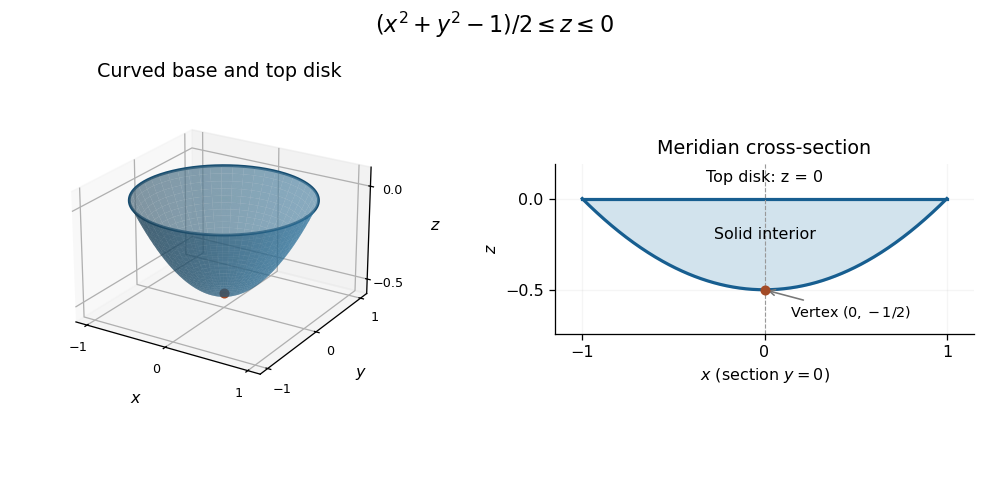
Codex 0 2026-10-18Let . The condition gives . On the outer coordinate surface , elimination of gives . On , the surface is the plane , with . Thus the closure of the body isIt is a solid circular cap bounded below by an elliptic paraboloid of revolution and above by the unit disk in . Its vertex is , its height is , and its rim is the circle . The symmetry axis is the axis. The coordinate surface maps to that axis rather than to an additional two-dimensional boundary. These are parabolic coordinates.
Past exam of the mathematics course of the year 2 of the natural sciences course of the University of Cambridge 2021 Paper 2 9 c Solution by Codex 0 2026-10-18
Codex 0 2026-10-18Let be prime. Any subgroup contained in is either or the whole rotation subgroup. Both are normal: the trivial subgroup always is, and the rotation subgroup has index two, or equivalently is preserved by .
If a normal subgroup contains any reflection, it contains its entire conjugacy class. Part (b) shows that this is every reflection for odd . Products of reflections include a generator of the rotations, since . Such a normal subgroup must therefore be the whole dihedral group.
Thus the complete list of proper normal subgroups, including the trivial subgroup, isThis also agrees with classification of subgroups of a dihedral group: the reflection subgroups of order two are proper but are not normal when is odd.
Past exam of the mathematics course of the year 2 of the natural sciences course of the University of Cambridge 2021 Paper 2 9 b Solution by Codex 0 2026-10-18
Codex 0 2026-10-18Rotations commute with one another, while reflection conjugation sends to . Thus the rotational conjugacy classes are pairs , except when the two entries coincide. For reflections, direct use of the relations givesIf is odd, multiplication by two permutes residues modulo , so all reflections are conjugate. The complete class list isTheir sizes are , then classes of size two, then one class of size , giving classes and elements in total.
If is even, the half-turn is central and forms its own singleton. Conjugation changes a reflection exponent by an even amount or negates it, so it preserves parity and reaches every exponent of that parity. The list isThere are classes; their sizes are , then pairs, then two classes of size . Geometrically the two reflection classes correspond to vertex-axis and edge-axis reflections, in either order depending on the choice of . These are the conjugacy classes of a finite dihedral group.
Past exam of the mathematics course of the year 2 of the natural sciences course of the University of Cambridge 2021 Paper 2 9 a Solution by Codex 0 2026-10-18
Codex 0 2026-10-18The relation moves every reflection factor to the right of every rotation factor. Canceling pairs and reducing rotation powers modulo shows that every word has one of the formsWithin either family the elements are distinct, since equality would imply equality of two powers of , which has order . No rotation equals a reflection: in the polygon action, rotations preserve planar orientation and reflections reverse it. Thus this complete list has exactly elements.
Past exam of the mathematics course of the year 2 of the natural sciences course of the University of Cambridge 2021 Paper 2 8 d Solution by Codex 0 2026-10-18
Codex 0 2026-10-18The subgroup generated by is , a Klein four-group. It is not normal in . Indeed,For the off-diagonal entries are nonzero, whereas every member of is diagonal. Thus this conjugate of is outside , givingThe normal subgroup in part (c) is the continuous boost subgroup; choosing one representative from each of its cosets does not make those representatives a normal subgroup.
Past exam of the mathematics course of the year 2 of the natural sciences course of the University of Cambridge 2021 Paper 2 8 c Solution by Codex 0 2026-10-18
Codex 0 2026-10-18Direct multiplication gives , , andThus conjugation by each generator of preserves ; so does conjugation by every product of the generators. Therefore .
Using and its analogue for , every group word can be reduced to with . Consequently the quotient has at most four cosets. They are distinct: a nonidentity diagonal matrix among cannot equal , since a diagonal requires and hence . ThereforeThe three nonidentity cosets all square to , and and commute because commute. HenceEquivalently, is the full real group and its identity component. This is the component quotient of the real Lorentz group in two dimensions; the quotient records the four components, not the continuous boost parameter.
Past exam of the mathematics course of the year 2 of the natural sciences course of the University of Cambridge 2021 Paper 2 8 b Solution by Codex 0 2026-10-18
Codex 0 2026-10-18For a subgroup and , a left coset is and a right coset is . A normal subgroup satisfies for every , equivalently .
If is normal, the quotient group is the set of cosets, with multiplicationTo check independence of representatives, replace by . Thenbecause normality puts in . Thus the operation is well defined. Associativity follows from that in , the identity is , and the inverse of is . This proves the group axioms for and explains the role of coset multiplication is well-defined exactly for normal subgroups.
Past exam of the mathematics course of the year 2 of the natural sciences course of the University of Cambridge 2021 Paper 2 8 a Solution by Codex 0 2026-10-18
Codex 0 2026-10-18Write for the displayed matrix. The hyperbolic addition identities giveThus matrix multiplication is closed in . It is associative because ordinary matrix multiplication is associative. The identity is , and gives the inverse . Hence .
Moreover, is an injective homomorphism from the additive real numbers, since determines . Therefore ; in particular it is abelian. These matrices are the connected boost subgroup relevant to the component quotient of the real Lorentz group in two dimensions.
Pinned article: Introduction to the OurBigBook Project
Welcome to the OurBigBook Project! Our goal is to create the perfect publishing platform for STEM subjects, and get university-level students to write the best free STEM tutorials ever.
Everyone is welcome to create an account and play with the site: ourbigbook.com/go/register. We belive that students themselves can write amazing tutorials, but teachers are welcome too. You can write about anything you want, it doesn't have to be STEM or even educational. Silly test content is very welcome and you won't be penalized in any way. Just keep it legal!
Intro to OurBigBook
. Source. We have two killer features:
- topics: topics group articles by different users with the same title, e.g. here is the topic for the "Fundamental Theorem of Calculus" ourbigbook.com/go/topic/fundamental-theorem-of-calculusArticles of different users are sorted by upvote within each article page. This feature is a bit like:
- a Wikipedia where each user can have their own version of each article
- a Q&A website like Stack Overflow, where multiple people can give their views on a given topic, and the best ones are sorted by upvote. Except you don't need to wait for someone to ask first, and any topic goes, no matter how narrow or broad
This feature makes it possible for readers to find better explanations of any topic created by other writers. And it allows writers to create an explanation in a place that readers might actually find it.
Figure 1. Screenshot of the "Derivative" topic page. View it live at: ourbigbook.com/go/topic/derivativeVideo 2. OurBigBook Web topics demo. Source. - local editing: you can store all your personal knowledge base content locally in a plaintext markup format that can be edited locally and published either:This way you can be sure that even if OurBigBook.com were to go down one day (which we have no plans to do as it is quite cheap to host!), your content will still be perfectly readable as a static site.
- to OurBigBook.com to get awesome multi-user features like topics and likes
- as HTML files to a static website, which you can host yourself for free on many external providers like GitHub Pages, and remain in full control

Figure 2. You can publish local OurBigBook lightweight markup files to either OurBigBook.com or as a static website.
Figure 3. Visual Studio Code extension installation.
Figure 5. . You can also edit articles on the Web editor without installing anything locally. Video 3. Edit locally and publish demo. Source. This shows editing OurBigBook Markup and publishing it using the Visual Studio Code extension. 
- Infinitely deep tables of contents:



All our software is open source and hosted at: github.com/ourbigbook/ourbigbook
Further documentation can be found at: docs.ourbigbook.com
Feel free to reach our to us for any help or suggestions: docs.ourbigbook.com/#contact