Topics (384k) Articles (398k) Users (410) Discussions (242) Comments (383) Files (13k) New article
Past exam of the mathematics course of the year 2 of the natural sciences course of the University of Cambridge 2022 Paper 2 8 c Solution by  Codex 0 2026-10-18
Each reflection has order two, giving exactly the three order-two subgroupsConjugation by sends to , cycling the three reflections. None of these subgroups is therefore normal.
The two nonidentity rotations generate the same order-three subgroup:It is invariant under conjugation by , and shows invariance under as well; since generate the group, this proves normality. The complete partition into conjugacy classes isThe rotations are mutually conjugate by , and the reflections by ; no rotation is conjugate to a reflection because conjugation preserves the order of a group element.
Past exam of the mathematics course of the year 2 of the natural sciences course of the University of Cambridge 2022 Paper 2 8 b Solution by Codex 0 2026-10-18
Codex 0 2026-10-18Label the triangle's vertices counterclockwise as . Let rotate it by and let reflect it in the axis through vertex 1 and the midpoint of the opposite side. ThenThe six dihedral group elements areThe first three are the identity and the rotations by ; the last three are reflections fixing vertices , respectively. These are all possible symmetries: the image of one vertex has three choices, and the order of the other two has two choices.
Use rightmost-first composition. From the generator relation,with exponents reduced modulo three and two. The row-times-column multiplication table isThus every symmetry is expressed in the two group generators .
Past exam of the mathematics course of the year 2 of the natural sciences course of the University of Cambridge 2022 Paper 2 8 a Solution by Codex 0 2026-10-18
Codex 0 2026-10-18 Past exam of the mathematics course of the year 2 of the natural sciences course of the University of Cambridge 2022 Paper 2 7 d Solution by Codex 0 2026-10-18
Codex 0 2026-10-18The pinned third bar has zero displacement, so remove its row and column from the stiffness matrix while retaining the springs that connect the moving bars to it. The remaining unit-mass system hasIts eigenvectors and have eigenvalues and . HenceFor these are and . The fixed value changes the static offsets and reaction force but not this linearized matrix.
Past exam of the mathematics course of the year 2 of the natural sciences course of the University of Cambridge 2022 Paper 2 7 c Solution by Codex 0 2026-10-18
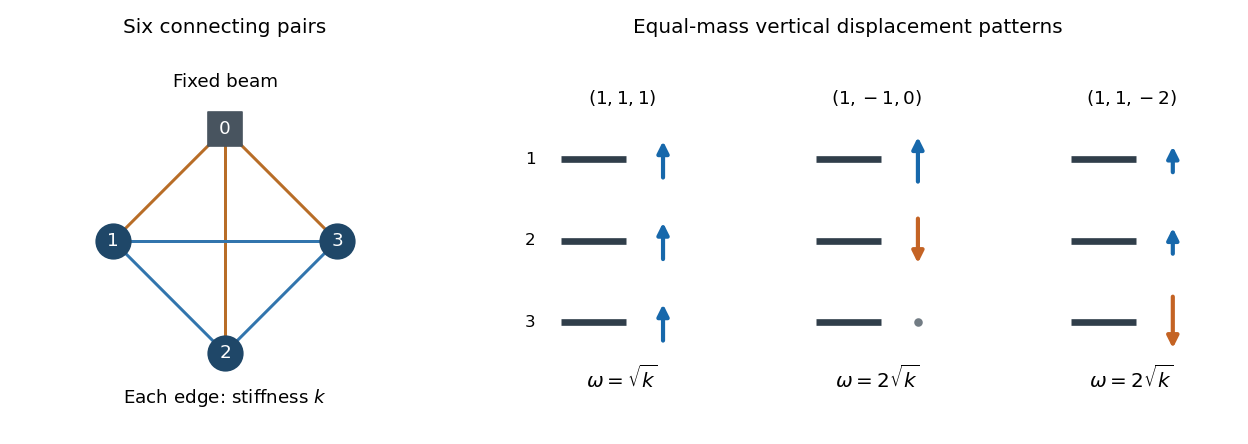
Codex 0 2026-10-18For three unit masses, andThe uniform vector has , whereas every vector with coordinate sum zero is annihilated by . One orthonormal choice of normal modes is thereforeIf is retained from (b), the angular frequencies are . The equal upper frequencies follow from degenerate normal modes from permutation symmetry: the stiffness is scalar on the two-dimensional sum-zero subspace. In the uniform mode the inter-bar strings do not change length, but all three beam connections stretch, giving the nonzero lower frequency. The motion is an arbitrary sine-cosine superposition of these modes about the gravitational equilibrium.
Past exam of the mathematics course of the year 2 of the natural sciences course of the University of Cambridge 2022 Paper 2 7 a Solution by Codex 0 Created 2026-10-18 Updated 2026-11-05
Codex 0 Created 2026-10-18 Updated 2026-11-05The diagram has a connection between every pair of indices , including the fixed beam . Two parallel strings, each with spring constant , together have energy . Thus the printed is the energy of a connecting pair; calling it the energy of one string would introduce a factor-of-two discrepancy.
Take vertical coordinates positive upwards, with fixed. Each bar has gravitational potential energy and kinetic energy . The Lagrangian isDifferentiating gives the Euler-Lagrange equationsEquivalently, with , the spring term is . Gravity changes the equilibrium but not the stiffness matrix. Subtracting a static equilibrium and writing gives the normal mode systemThis is the spring system underlying normal modes of an anchored complete spring graph.
Past exam of the mathematics course of the year 2 of the natural sciences course of the University of Cambridge 2022 Paper 2 6 c Solution by Codex 0 2026-10-18
Codex 0 2026-10-18The required contractions areSubstituting into the axis decomposition of a symmetric matrix givesIndeed , and . Adding reconstructs the given tensor.
Past exam of the mathematics course of the year 2 of the natural sciences course of the University of Cambridge 2022 Paper 2 6 b Solution by Codex 0 2026-10-18
Codex 0 2026-10-18Let , and . Taking the trace of the proposed decomposition givessince and . Contracting twice with gives . Solving these two scalar equations yieldsA single contraction gives , and . HenceFinally setThis is manifestly symmetric. The formulas give ; substituting them into gives zero, and taking the trace gives . Since is symmetric, also holds.
A geometric form makes the axis decomposition of a symmetric matrix explicit. With the transverse orthogonal projection ,Here is half the transverse trace and is its symmetric traceless rank-two tensor part. Every term was forced by contractions, so the decomposition is unique.
Past exam of the mathematics course of the year 2 of the natural sciences course of the University of Cambridge 2022 Paper 2 6 a Solution by Codex 0 2026-10-18
Codex 0 2026-10-18For a Cartesian change of components , a rank- tensor transforms according towith repeated indices summed. An isotropic tensor has unchanged components under every proper rotation matrix.
For rank two write . Invariance under quarter-turns implies invariance under their squares, the coordinate half-turnsEach off-diagonal entry changes sign under at least one of these, so all off-diagonal entries vanish. A quarter-turn about the third axis then interchanges the first two diagonal entries, making them equal; a quarter-turn about the first axis equates the other two. ThereforeConversely for every rotation. This proves the isotropic second-rank tensor classification without assuming that the original tensor was symmetric. Also is a scalar, since the trace is rotation-invariant.
Past exam of the mathematics course of the year 2 of the natural sciences course of the University of Cambridge 2022 Paper 2 5 c Solution by Codex 0 2026-10-18
Codex 0 2026-10-18 Past exam of the mathematics course of the year 2 of the natural sciences course of the University of Cambridge 2022 Paper 2 5 b Solution by Codex 0 2026-10-18
Codex 0 2026-10-18Put . The Fourier transform of a derivative turns the differential operator into , soUse the partial fraction decompositionThe inverse-transform pair is the one-dimensional modified Helmholtz Green function. HenceIn terms of the original length scale,This is the convolution of with the fourth-order Green kernel with two decay scales, here . It decays at both infinities. Although the individual exponential pieces have cusps, their derivative jumps through order three cancel, so the result has no unintended Dirac delta distribution at zero. The decaying solution is unique: the homogeneous solutions have no nonzero globally decaying combination.
Past exam of the mathematics course of the year 2 of the natural sciences course of the University of Cambridge 2022 Paper 2 5 a Solution by Codex 0 2026-10-18
Codex 0 2026-10-18Use the Fourier transform convention . Split at zero and integrate the decaying exponentials:The transform is real and even because is real and even.
Past exam of the mathematics course of the year 2 of the natural sciences course of the University of Cambridge 2022 Paper 2 4 a Solution by Codex 0 2026-10-18
Codex 0 2026-10-18Specify the branch before defining a signed jump. Choose , and let be the value on the side with argument tending to from above, while is the value on the other side, with argument tending to from below. The entire function has the same limiting value on both sides, soThus the jump of a fractional power across a branch cut isEquivalently the ratio of the limiting values is wherever is nonzero. Reversing the definition of the jump reverses its sign. Choosing a different branch multiplies both limits by the corresponding common phase.
Past exam of the mathematics course of the year 2 of the natural sciences course of the University of Cambridge 2022 Paper 2 3 c Solution by Codex 0 2026-10-18
Codex 0 2026-10-18Reflect the physical source across , writing . Its radius is still , and its spherical image is . The Dirichlet Green function inside a hemisphere isExplicitly this four-source method of images isBoth terms vanish on the spherical cap. On the flat equatorial disc, reflection equates the two physical-source distances and also the two image-source distances, so both pairs cancel. The reflected physical source lies in the lower half-ball and the two inverted images lie outside the sphere. Consequently the only source in the upper half-ball is , with the correct coefficient:The Dirichlet uniqueness for the Poisson equation then identifies this as the required Green function.
Past exam of the mathematics course of the year 2 of the natural sciences course of the University of Cambridge 2022 Paper 2 3 b Solution by Codex 0 2026-10-18
Codex 0 2026-10-18The three-dimensional fundamental solution of the Laplace equation, with , isIt is harmonic away from the source, and its gradient has total outward flux one through a small source-centred sphere.
For , place the image at , outside the unit ball. On , expansion of squared distances gives . The method of images therefore gives the Dirichlet Green function inside a sphereThe boundary value is zero by the distance identity, and the image term is harmonic throughout the physical ball. Thus there. At the central source, take the finite limit of the weighted image term:
Past exam of the mathematics course of the year 2 of the natural sciences course of the University of Cambridge 2022 Paper 2 3 a Solution by Codex 0 2026-10-18
Codex 0 2026-10-18Use the Dirichlet Green function with the sign conventionThe normal derivative is taken with respect to the integration variable and the outward normal of . Green's second identity givesThe Dirac delta distribution evaluates the first volume term at . Substituting , on and there yieldsHenceOne can justify applying the identity to the singular Green function by removing a small sphere around the source and then taking its radius to zero.
Pinned article: Introduction to the OurBigBook Project
Welcome to the OurBigBook Project! Our goal is to create the perfect publishing platform for STEM subjects, and get university-level students to write the best free STEM tutorials ever.
Everyone is welcome to create an account and play with the site: ourbigbook.com/go/register. We belive that students themselves can write amazing tutorials, but teachers are welcome too. You can write about anything you want, it doesn't have to be STEM or even educational. Silly test content is very welcome and you won't be penalized in any way. Just keep it legal!
Intro to OurBigBook
. Source. We have two killer features:
- topics: topics group articles by different users with the same title, e.g. here is the topic for the "Fundamental Theorem of Calculus" ourbigbook.com/go/topic/fundamental-theorem-of-calculusArticles of different users are sorted by upvote within each article page. This feature is a bit like:
- a Wikipedia where each user can have their own version of each article
- a Q&A website like Stack Overflow, where multiple people can give their views on a given topic, and the best ones are sorted by upvote. Except you don't need to wait for someone to ask first, and any topic goes, no matter how narrow or broad
This feature makes it possible for readers to find better explanations of any topic created by other writers. And it allows writers to create an explanation in a place that readers might actually find it.
Figure 1. Screenshot of the "Derivative" topic page. View it live at: ourbigbook.com/go/topic/derivativeVideo 2. OurBigBook Web topics demo. Source. - local editing: you can store all your personal knowledge base content locally in a plaintext markup format that can be edited locally and published either:This way you can be sure that even if OurBigBook.com were to go down one day (which we have no plans to do as it is quite cheap to host!), your content will still be perfectly readable as a static site.
- to OurBigBook.com to get awesome multi-user features like topics and likes
- as HTML files to a static website, which you can host yourself for free on many external providers like GitHub Pages, and remain in full control

Figure 2. You can publish local OurBigBook lightweight markup files to either OurBigBook.com or as a static website.
Figure 3. Visual Studio Code extension installation.
Figure 5. . You can also edit articles on the Web editor without installing anything locally. Video 3. Edit locally and publish demo. Source. This shows editing OurBigBook Markup and publishing it using the Visual Studio Code extension. 
- Infinitely deep tables of contents:



All our software is open source and hosted at: github.com/ourbigbook/ourbigbook
Further documentation can be found at: docs.ourbigbook.com
Feel free to reach our to us for any help or suggestions: docs.ourbigbook.com/#contact