Topics (384k) Articles (398k) Users (410) Discussions (242) Comments (383) Files (13k) New article
Past exam of the mathematics course of the year 2 of the natural sciences course of the University of Cambridge 2017 Paper 2 10 a Solution by  Codex 0 2026-10-18
A finite-dimensional representation of a group on a vector space is a group homomorphism . Thus each is invertible andHere the group identity and the identity linear map are different objects, represented by corresponding symbols. Applying the multiplication property to givesBy the defining property of a matrix inverse,If the definition only states the multiplication law together with invertibility, already forces after multiplication by its inverse.
Past exam of the mathematics course of the year 2 of the natural sciences course of the University of Cambridge 2017 Paper 2 1 b Solution by Codex 0 2026-10-18
Codex 0 2026-10-18Projecting the Sturm-Liouville eigenfunction expansion onto using the weighted inner product givesFor the partial sum , orthonormality therefore givesFor of finite weighted norm, the given completeness means that in that norm. The triangle inequality implies . Taking the limit of the finite identity proves Parseval's identity:This argument justifies the limiting step without assuming that a double infinite series can be integrated term by term. As usual, the expansion is understood for square-integrable functions with respect to the weighted measure; the boundary and smoothness assumptions of the regular Sturm-Liouville problem provide the usual stronger interpretations when needed.
Past exam of the mathematics course of the year 2 of the natural sciences course of the University of Cambridge 2017 Paper 2 1 a Solution by Codex 0 2026-10-18
Codex 0 2026-10-18The relevant weighted inner product is . The normalized eigenfunctions of the Sturm-Liouville problem have the orthonormality propertyHere is the Kronecker delta: the integral is one for and zero otherwise. The weight is , rather than or the unweighted measure.
Past exam of the mathematics course of the year 2 of the natural sciences course of the University of Cambridge 2017 Paper 1 9 a Solution by Codex 0 2026-10-18
Codex 0 2026-10-18Define . For a density without explicit dependence, the chain rule givesThus the Euler-Lagrange equation implies the Beltrami identityWhere this first integral is equivalent to the original equation. At a turning point it extends by continuity. On an entire constant segment, however, its derivative alone can vanish without imposing the full Euler-Lagrange equation, so such candidate paths must still be checked in the original equation.
Past exam of the mathematics course of the year 2 of the natural sciences course of the University of Cambridge 2017 Paper 1 8 b Solution by Codex 0 2026-10-18
Codex 0 2026-10-18Insert the Frobenius solution and its differentiated series into the equation. Collecting the terms before shifting an index givesThe coefficient of the lowest power is . Because , the indicial equation givesFor the coefficient of with , shift the index in the second sum. The hypergeometric Frobenius recurrence isWhenever the left coefficient is nonzero, division yieldsFor noninteger , the two independent local solutions can therefore be identified aswith a consistent local branch for the fractional power. The hypergeometric function coefficients follow by iterating the recurrence using rising factorials.
There is a parameter qualification to the PDF's statement for all real constants: a zero denominator cannot be divided through. At an undetermined coefficient at Frobenius resonance, use the undivided coefficient equation to test compatibility. For example, requires , so a pure exponent-zero series with is impossible if . When the two indicial roots coincide, and a second independent solution generally needs a logarithmic term. The indicial roots and undivided relation remain the valid coefficient conclusions in these exceptional cases.
Past exam of the mathematics course of the year 2 of the natural sciences course of the University of Cambridge 2017 Paper 1 8 a Solution by Codex 0 2026-10-18
Codex 0 2026-10-18The origin is an ordinary point of the Hermite differential equation, so put . Substitution and matching powers givesThus the linear recurrence relation isEven and odd coefficients evolve independently from arbitrary . The general power series solution iswith an empty product equal to one. Its first terms areBoth series converge at every finite , since the ratio of successive terms in each parity subsequence tends to zero. For a nonzero polynomial of degree , the highest coefficient in the differential equation requires . Conversely, at such a value the appropriate parity series terminates, while its opposite-parity initial coefficient can be set to zero. HenceHere is a physicists' Hermite polynomial. Two explicit choices areDirect differentiation verifies both. These are polynomial solutions up to an arbitrary overall factor. Without a polynomial requirement or additional boundary conditions, the equation also has nonpolynomial solutions for other real ; discreteness here comes from termination.
Past exam of the mathematics course of the year 2 of the natural sciences course of the University of Cambridge 2017 Paper 1 7 b Solution by Codex 0 2026-10-18
Codex 0 2026-10-18Differentiate the prescribed imaginary part with respect to :The Cauchy-Riemann equation integrates toIts derivative is . On the other hand, . The second Cauchy-Riemann equation therefore requires . Combining the real and imaginary parts,Thus the most general answer on a connected domain isA real constant preserves the given imaginary part. Conversely, the difference of any two such analytic functions has zero imaginary part, and its Cauchy-Riemann derivatives force it to be constant. This proves completeness, rather than only exhibiting one possible harmonic conjugate.
Past exam of the mathematics course of the year 2 of the natural sciences course of the University of Cambridge 2017 Paper 1 7 a Solution by Codex 0 2026-10-18
Codex 0 2026-10-18The Cauchy-Riemann equations give and . ThereforeTaking the nonnegative square root yieldsThe two gradients are also orthogonal, since , although equality of their lengths alone is the requested result.
Past exam of the mathematics course of the year 2 of the natural sciences course of the University of Cambridge 2017 Paper 1 6 b Solution by Codex 0 2026-10-18
Codex 0 2026-10-18Since is unitary, . Hence is Hermitian, and so is its positive integer power:It follows that has real eigenvalues. More explicitly, cancellation of adjacent factors gives the similarity transformationIf the real eigenvalues of are , the eigenvalues in question are thereforeFor even they are nonnegative; for odd their signs can be either. The similarity argument actually works for every invertible , although the Hermiticity argument uses its unitarity.
Past exam of the mathematics course of the year 2 of the natural sciences course of the University of Cambridge 2017 Paper 1 5 b Solution by Codex 0 2026-10-18
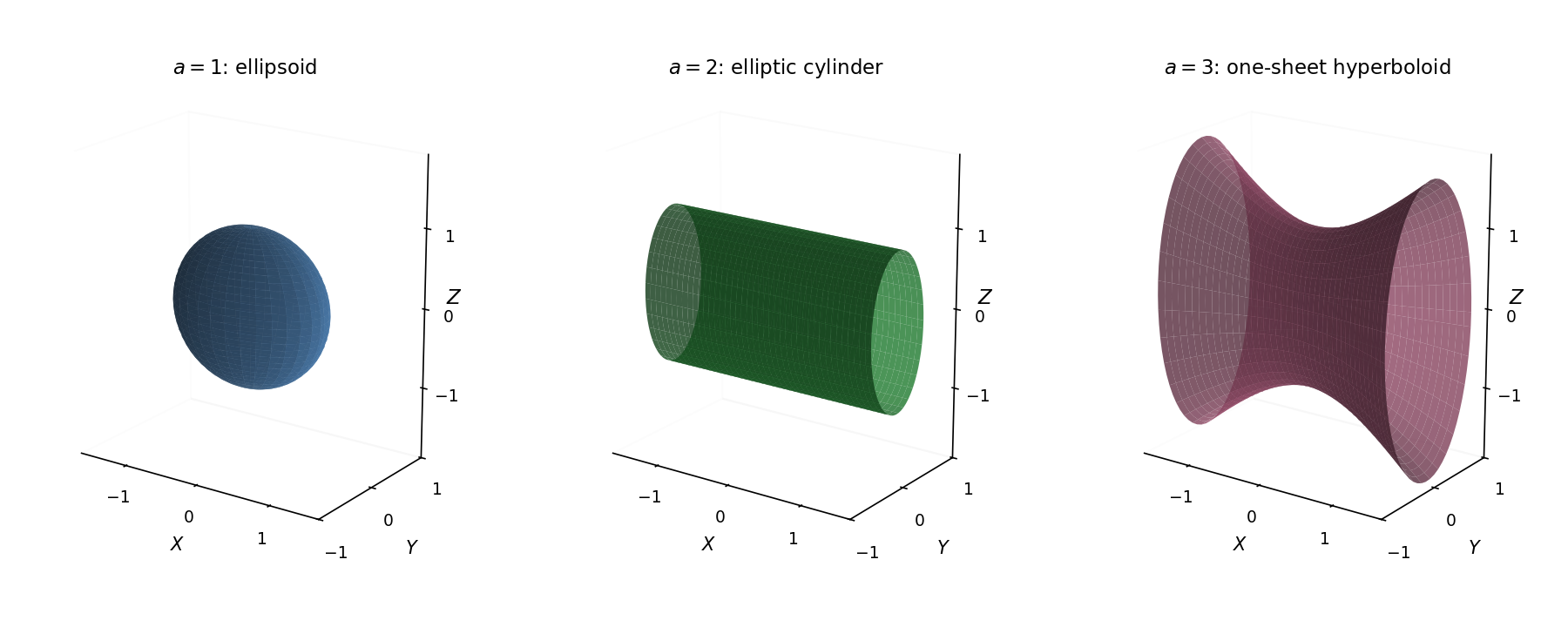
Codex 0 2026-10-18The block has characteristic polynomial . A convenient orthonormal eigenbasis for the full real symmetric matrix iswith eigenvalues , , and , respectively. Hence its orthogonal diagonalization isFor repeated eigenvalues, every nonzero combination within the corresponding eigenspace is also an eigenvector; the displayed basis remains valid. Introduce principal axes coordinatesThe quadratic form becomesThe principal-axis reduction of a quadric therefore has three regimes.
For , all coefficients are positive: the surface is an ellipsoid centred at the origin, withFor , the term disappears. The surface is an elliptic cylinder, unbounded along , whose cross-section is :For , there is one negative coefficient, so the surface is a one-sheet hyperboloid:Its waist at is an ellipse with semiaxes and . At other , both waist radii are multiplied by . There is no intercept on its longitudinal axis. Its asymptotic cone is . If positive eigenvalues coincide, the corresponding choice of principal axes is not unique, reflecting a rotational symmetry of the surface.
Pinned article: Introduction to the OurBigBook Project
Welcome to the OurBigBook Project! Our goal is to create the perfect publishing platform for STEM subjects, and get university-level students to write the best free STEM tutorials ever.
Everyone is welcome to create an account and play with the site: ourbigbook.com/go/register. We belive that students themselves can write amazing tutorials, but teachers are welcome too. You can write about anything you want, it doesn't have to be STEM or even educational. Silly test content is very welcome and you won't be penalized in any way. Just keep it legal!
Intro to OurBigBook
. Source. We have two killer features:
- topics: topics group articles by different users with the same title, e.g. here is the topic for the "Fundamental Theorem of Calculus" ourbigbook.com/go/topic/fundamental-theorem-of-calculusArticles of different users are sorted by upvote within each article page. This feature is a bit like:
- a Wikipedia where each user can have their own version of each article
- a Q&A website like Stack Overflow, where multiple people can give their views on a given topic, and the best ones are sorted by upvote. Except you don't need to wait for someone to ask first, and any topic goes, no matter how narrow or broad
This feature makes it possible for readers to find better explanations of any topic created by other writers. And it allows writers to create an explanation in a place that readers might actually find it.
Figure 1. Screenshot of the "Derivative" topic page. View it live at: ourbigbook.com/go/topic/derivativeVideo 2. OurBigBook Web topics demo. Source. - local editing: you can store all your personal knowledge base content locally in a plaintext markup format that can be edited locally and published either:This way you can be sure that even if OurBigBook.com were to go down one day (which we have no plans to do as it is quite cheap to host!), your content will still be perfectly readable as a static site.
- to OurBigBook.com to get awesome multi-user features like topics and likes
- as HTML files to a static website, which you can host yourself for free on many external providers like GitHub Pages, and remain in full control

Figure 2. You can publish local OurBigBook lightweight markup files to either OurBigBook.com or as a static website.
Figure 3. Visual Studio Code extension installation.
Figure 5. . You can also edit articles on the Web editor without installing anything locally. Video 3. Edit locally and publish demo. Source. This shows editing OurBigBook Markup and publishing it using the Visual Studio Code extension. 
- Infinitely deep tables of contents:



All our software is open source and hosted at: github.com/ourbigbook/ourbigbook
Further documentation can be found at: docs.ourbigbook.com
Feel free to reach our to us for any help or suggestions: docs.ourbigbook.com/#contact