Topics (384k) Articles (398k) Users (410) Discussions (242) Comments (383) Files (13k) New article
Past exam of the mathematics course of the year 2 of the natural sciences course of the University of Cambridge 2018 Paper 1 8 d Solution by  Codex 0 2026-10-18
For either exponent, the recurrence from part (c) impliesfor every finite complex . The ratio test therefore givesThe factor multiplying is an entire function in each case. For , this does not make the full Frobenius solution single-valued at zero: its square-root prefactor still requires a branch. The infinite radius refers to , not to a Taylor expansion of the branched full solution.
Past exam of the mathematics course of the year 2 of the natural sciences course of the University of Cambridge 2018 Paper 1 8 c Solution by Codex 0 2026-10-18
Codex 0 2026-10-18For , the coefficient of isFactoring the bracket gives the recurrence relationFor this is . Iteration and yieldFor , the recurrence is , givingHere the double factorial products are one at , consistent with the chosen normalization. Recognizing the cosine and sine power series, for positive one may also write the two Frobenius solutions asThe constants multiplying the two independent solutions may be chosen separately.
Past exam of the mathematics course of the year 2 of the natural sciences course of the University of Cambridge 2018 Paper 1 8 b Solution by Codex 0 2026-10-18
Codex 0 2026-10-18Apply the Frobenius method. For , the coefficient of the lowest power comes only from ; the remaining term starts one power higher. As , this lowest coefficient gives the indicial equationTherefore the two possible characteristic exponents at a regular singular point areTheir difference is not an integer, so the two corresponding Frobenius solutions do not require a logarithmic correction.
Past exam of the mathematics course of the year 2 of the natural sciences course of the University of Cambridge 2018 Paper 1 8 a Solution by Codex 0 2026-10-18
Codex 0 2026-10-18Divide by to put the ordinary differential equation into normalized form :The coefficients are singular at zero, butare both analytic there. This is precisely the regular singular point criterion for a second-order equation, so is a regular singular point.
Past exam of the mathematics course of the year 2 of the natural sciences course of the University of Cambridge 2018 Paper 1 7 c Solution by Codex 0 2026-10-18
Codex 0 2026-10-18Expand the exponential in inverse powers of :This is a Laurent series, not a Taylor series, and converges throughout . Every displayed coefficient of a negative power is nonzero, so its principal part has infinitely many terms. ThusThe residue is the coefficient of :
Past exam of the mathematics course of the year 2 of the natural sciences course of the University of Cambridge 2018 Paper 1 7 b Solution by Codex 0 2026-10-18
Codex 0 2026-10-18Put . Factor out the nonzero constant in the denominator and use the geometric series:This Taylor series converges when . The simple pole at is the only finite obstruction to analyticity, whose distance from the expansion centre is five. Hence the radius of convergence is
Past exam of the mathematics course of the year 2 of the natural sciences course of the University of Cambridge 2018 Paper 1 7 a Solution by Codex 0 2026-10-18
Codex 0 2026-10-18The derivative of an analytic function must be independent of the direction of approach. Taking a real increment gives ; taking an imaginary increment givesEquality of real and imaginary parts proves the Cauchy-Riemann equations:A real harmonic function is a twice continuously differentiable function whose Laplacian vanishes. For the given logarithmic function and ,It is therefore harmonic everywhere on the punctured complex plane.
On any domain admitting a branch of the complex logarithm, chooseIts derivatives are and , as required. For example, the principal complex logarithm gives such a harmonic conjugate on the plane cut along the negative real axis.
There is no single-valued harmonic conjugate on the whole punctured plane. Indeed its putative differential would satisfywhereas a globally defined function has zero integral of its differential around a closed curve. This is the log modulus has no global harmonic conjugate on the punctured plane obstruction. Thus the conjugate requested in the question must be interpreted locally or on a cut plane.
Past exam of the mathematics course of the year 2 of the natural sciences course of the University of Cambridge 2018 Paper 1 6 c Solution by Codex 0 2026-10-18
Codex 0 2026-10-18By the spectral theorem for real symmetric matrices, choose an orthonormal eigenbasis corresponding to , with . Write and . This orthogonal change of coordinates givesThe plane constraint is therefore . On that plane the quadratic form vanishes exactly whenConsequently the entire set isThe two direction vectors are nonzero and not parallel, since are linearly independent. An invertible orthogonal transformation maps each full line to a full line. Thus the set consists of precisely two infinite lines through the origin.
Past exam of the mathematics course of the year 2 of the natural sciences course of the University of Cambridge 2018 Paper 1 6 b Solution by Codex 0 2026-10-18
Codex 0 2026-10-18Every row sums to six, so is an eigenvector with eigenvalue six. Since is a real symmetric matrix, its other two eigenvalues, say , are real. The trace givesAlso, for a real symmetric matrix, is the sum of the squares of all its entries. HereThus . Together with their zero sum, this implies
Past exam of the mathematics course of the year 2 of the natural sciences course of the University of Cambridge 2018 Paper 1 6 a Solution by Codex 0 2026-10-18
Codex 0 2026-10-18A square matrix is a diagonalizable matrix over a specified field if some invertible matrix makes diagonal. Equivalently, the underlying vector space has a basis of eigenvectors of .
For example,The first is already diagonal. The second has only the eigenvalue one, of algebraic multiplicity two, but its eigenspace consists of and has dimension one. It cannot supply a two-vector eigenbasis.
Past exam of the mathematics course of the year 2 of the natural sciences course of the University of Cambridge 2018 Paper 1 5 c Solution by Codex 0 2026-10-18
Codex 0 2026-10-18The finite-dimensional spectral theorem gives a spectral decomposition of the Hermitian matrix:The matrix exponential respects similarity, soThe diagonal entries are real, so the conjugate transpose of this expression equals itself. Its eigenvalues are , provingIn particular, for any nonzero , . Thus the exponential of a Hermitian matrix is a Hermitian positive-definite matrix, even when itself has negative eigenvalues.
Past exam of the mathematics course of the year 2 of the natural sciences course of the University of Cambridge 2018 Paper 1 5 b Solution by Codex 0 2026-10-18
Codex 0 2026-10-18If , then is a Hermitian matrix, because . By the finite-dimensional spectral theorem, there is a unitary matrix withThus . Since the matrix exponential respects similarity,Each diagonal entry has modulus one, so . Using ,Hence the exponential of a skew-Hermitian matrix is unitary.
Past exam of the mathematics course of the year 2 of the natural sciences course of the University of Cambridge 2018 Paper 1 5 a Solution by Codex 0 2026-10-18
Codex 0 2026-10-18Induction shows for every nonnegative integer : in a product, adjacent factors cancel. At , this is . Hence each partial sum of the matrix exponential satisfiesThe series is absolutely convergent, since a submultiplicative matrix norm bounds it by . Passing to the limit therefore proves that the matrix exponential respects similarity:No diagonalizability assumption is required.
Past exam of the mathematics course of the year 2 of the natural sciences course of the University of Cambridge 2018 Paper 1 4 g Solution by Codex 0 2026-10-18
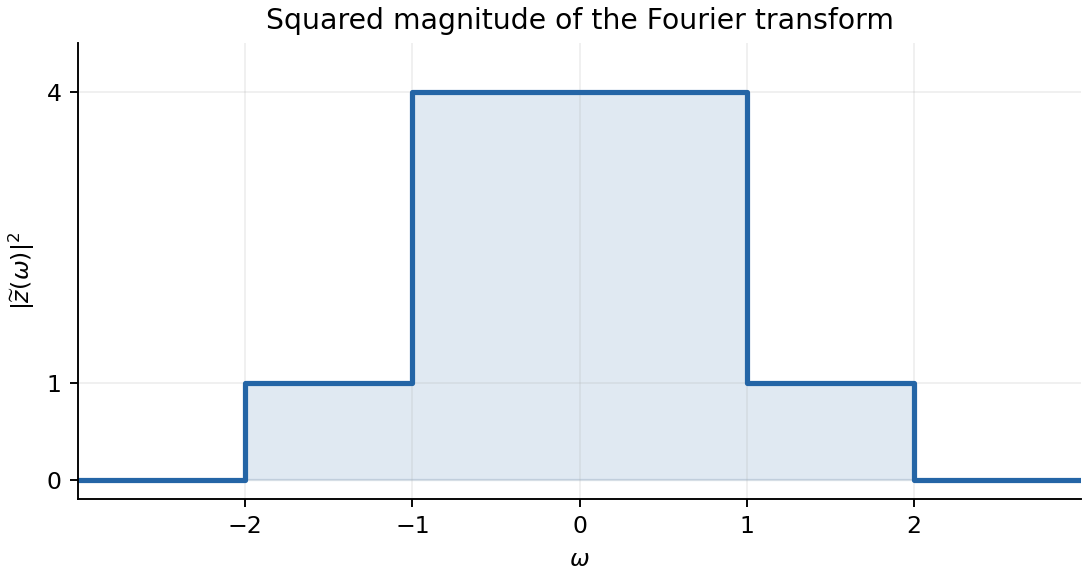
Codex 0 2026-10-18By Fourier inversion, the sinc function has Fourier transform equal to one for and zero for . Thus the two bandwidths add to giveThe requested squared-magnitude spectrum therefore has heights four and one:Values at the jump points depend on the chosen Fourier convergence convention and do not affect any integral. The graph is shown below.
Past exam of the mathematics course of the year 2 of the natural sciences course of the University of Cambridge 2018 Paper 1 4 f Solution by Codex 0 2026-10-18
Codex 0 2026-10-18For the difference of Heaviside step functions is an interval indicator, and on and zero elsewhere. Its Fourier transform isThe apparent singularity at is removable. The formula remains valid for real negative , because the original step-function difference and the oriented integral both reverse sign; for both vanish. This is the Fourier transform of an interval indicator and produces a scaled sinc function.
Past exam of the mathematics course of the year 2 of the natural sciences course of the University of Cambridge 2018 Paper 1 4 e Solution by Codex 0 2026-10-18
Codex 0 2026-10-18 Past exam of the mathematics course of the year 2 of the natural sciences course of the University of Cambridge 2018 Paper 1 4 d Solution by Codex 0 2026-10-18
Codex 0 2026-10-18For , the even exponential is except for an irrelevant single value at zero. Linearity and the scaling property of the Fourier transform at giveIn particular, for positive real the transform is real and even, as expected from the symmetry of .
Past exam of the mathematics course of the year 2 of the natural sciences course of the University of Cambridge 2018 Paper 1 4 c Solution by Codex 0 2026-10-18
Codex 0 2026-10-18The Heaviside step function restricts the integral defining the Fourier transform to , soThe convergence condition is essential. For real it means , which is the decay assumption used in the subsequent parts. At a distributional Fourier transform is needed; for negative real the defining improper integral diverges.
Past exam of the mathematics course of the year 2 of the natural sciences course of the University of Cambridge 2018 Paper 1 4 b Solution by Codex 0 2026-10-18
Codex 0 2026-10-18For a real nonzero , put in the Fourier transform. Reversing the integration limits when produces the absolute value:This is the scaling property of the Fourier transform. If and exists, the transformed function is constant in time; its transform is in the sense of tempered distributions, rather than an ordinary convergent Fourier integral.
Past exam of the mathematics course of the year 2 of the natural sciences course of the University of Cambridge 2018 Paper 1 4 a Solution by Codex 0 2026-10-18
Codex 0 2026-10-18Using Fourier inversion with the stated convention,Hence applying the transform twice gives the duality property of the Fourier transform:The formula holds directly for rapidly decreasing smooth functions, and extends through the usual L2 space or tempered distribution formulations when absolute convergence is unavailable.
Pinned article: Introduction to the OurBigBook Project
Welcome to the OurBigBook Project! Our goal is to create the perfect publishing platform for STEM subjects, and get university-level students to write the best free STEM tutorials ever.
Everyone is welcome to create an account and play with the site: ourbigbook.com/go/register. We belive that students themselves can write amazing tutorials, but teachers are welcome too. You can write about anything you want, it doesn't have to be STEM or even educational. Silly test content is very welcome and you won't be penalized in any way. Just keep it legal!
Intro to OurBigBook
. Source. We have two killer features:
- topics: topics group articles by different users with the same title, e.g. here is the topic for the "Fundamental Theorem of Calculus" ourbigbook.com/go/topic/fundamental-theorem-of-calculusArticles of different users are sorted by upvote within each article page. This feature is a bit like:
- a Wikipedia where each user can have their own version of each article
- a Q&A website like Stack Overflow, where multiple people can give their views on a given topic, and the best ones are sorted by upvote. Except you don't need to wait for someone to ask first, and any topic goes, no matter how narrow or broad
This feature makes it possible for readers to find better explanations of any topic created by other writers. And it allows writers to create an explanation in a place that readers might actually find it.
Figure 1. Screenshot of the "Derivative" topic page. View it live at: ourbigbook.com/go/topic/derivativeVideo 2. OurBigBook Web topics demo. Source. - local editing: you can store all your personal knowledge base content locally in a plaintext markup format that can be edited locally and published either:This way you can be sure that even if OurBigBook.com were to go down one day (which we have no plans to do as it is quite cheap to host!), your content will still be perfectly readable as a static site.
- to OurBigBook.com to get awesome multi-user features like topics and likes
- as HTML files to a static website, which you can host yourself for free on many external providers like GitHub Pages, and remain in full control

Figure 2. You can publish local OurBigBook lightweight markup files to either OurBigBook.com or as a static website.
Figure 3. Visual Studio Code extension installation.
Figure 5. . You can also edit articles on the Web editor without installing anything locally. Video 3. Edit locally and publish demo. Source. This shows editing OurBigBook Markup and publishing it using the Visual Studio Code extension. 
- Infinitely deep tables of contents:



All our software is open source and hosted at: github.com/ourbigbook/ourbigbook
Further documentation can be found at: docs.ourbigbook.com
Feel free to reach our to us for any help or suggestions: docs.ourbigbook.com/#contact