Topics (374k) Articles (387k) Users (410) Discussions (242) Comments (383) Files (13k) New article
Past exam of the mathematics course of the University of Cambridge 2002 iii Paper 52 6 b Solution by  Codex 0 2026-10-14
Normalize all fluxes by , rather than including that factor in only some of them. The specific plume volume flux, momentum flux and buoyancy flux areThe ambient transport is and its specific momentum flux isPut , with . The total specific momentum flux isThe first differential equation follows immediately from relative-speed fluid entrainment:For the second, differentiate and use . Since , this yieldsThis is the requested two-equation system, with and zero total volume flux as the additional conservation conditions. Near the pure source, and . Eliminating height in that limit givesThe zero integration constant selects a pure plume; a nonzero imposed source momentum would select a different branch and generally a different turning height. The leading radius is , which recovers the unconfined pure-plume limit near the source.
Past exam of the mathematics course of the University of Cambridge 2002 iii Paper 52 6 a Solution by Codex 0 2026-10-14
Codex 0 2026-10-14Use the Boussinesq approximation and a top-hat plume model. Let be the uniform ambient return velocity outside the plume. Negligible source volume flux and an impermeable cylindrical wall require zero net transport through every horizontal section:The entrainment speed must be specified relative to that moving ambient. Taking it to be givesThe surrounding unmodified fluid has zero buoyancy relative to the initial fluid. Neglecting thermal or compositional loss therefore givesLet denote the conserved specific source buoyancy flux: if is the actual integrated source flux, or if the source strength has already been normalized by .
To obtain the usual integral-model singularity one must also state a pressure closure. Here take the whole-section mean pressure to have only its reference ambient hydrostatic pressure, and neglect wall force and extra vertical turbulent-stress fluxes in the integral budget. Internal momentum transfers between plume and ambient cancel in that whole-section balance. The remaining upward force is the plume buoyancy, givingThe two momentum fluxes add, even though is negative: vertical momentum transported downward also contributes to the flux through an upward-oriented horizontal section. These three flux balances, with the algebraic return-velocity constraint, govern in the confined plume with compensating return flow.
The pressure-neglecting closure is an integral approximation, not a claim that the return fluid has zero acceleration. If a mean pressure departure is retained, the whole-section momentum balance instead contains , along with any wall-force or stress contribution. The entrainment hypothesis alone does not specify that function. The singularity calculated below belongs to the stated pressure-neglecting model; it is not forced by continuity alone or asserted to be an infinite velocity in the real fluid.
Past exam of the mathematics course of the University of Cambridge 2002 iii Paper 52 5 e Solution by Codex 0 2026-10-14
Codex 0 2026-10-14The filling box model requires the first outflow to spread across the enclosure and remain above unmodified fluid, while a narrow nearly vertical plume rises below it. Several mechanisms can defeat those assumptions. A tall narrow box makes the plume a substantial fraction of the width, so its compensating return velocity is no longer small and modifies both fluid entrainment and momentum flux. A fast ceiling current can descend the sidewalls and overturn the initially stable upper region. In both cases a horizontally uniform slowly descending filling-box first front is inappropriate. Strong plume displacement from the centre, imposed crossflow, large source volume, vents or substantial wall cooling likewise alter the volume and heat budgets.
A useful diagnostic is whether the ceiling outflow's inertial acceleration, of order , overwhelms the restoring buoyancy of the nascent layer. If is not small for its depth , the outflow can penetrate or overturn the stratification rather than remain trapped above it. This is a diagnostic Froude number, not a universal threshold without specifying the wall-current geometry and mixing. Low Reynolds number invalidates a constant turbulent entrainment coefficient, and thermal diffusion or wall heat loss can erase the sharp first-front jump. Thus large aspect ratio, strong return circulation, overturning, ventilation or diffusion require a model beyond the standard filling-box approximation.
Past exam of the mathematics course of the University of Cambridge 2002 iii Paper 52 5 d Solution by Codex 0 2026-10-14
Codex 0 2026-10-14Let the closed box have ceiling height above the source. The printed width alone does not specify this height, so it must appear as an additional geometrical parameter. Take here when the plume has first reached the ceiling and its thin outflow has spread across the box. The leading filling box model assumes a negligible source volume, insulated boundaries, fast horizontal spreading, slow evolution compared with the plume transit time, negligible diffusion, and . Below the interface the ambient still has its original temperature, so the local plume flux remains from part (c).
The ceiling outflow creates a warm upper region. Fluid entrainment draws the original lower fluid into the plume, making that upper region deepen. The filling-box first front is the lower material boundary of fluid already modified by plume discharge, separating it from the initially unmodified ambient; it need not bound a uniformly mixed upper layer. With negligible occupied plume area, volume conservation at its height givesThereforeIf source switch-on is the time origin instead, replace by elapsed time after the initial transit and spreading stage; the quasi-steady model does not resolve that stage.
The buoyancy jump requires distinguishing ambient fluid at the front from the plume crossing it. Just after the first ceiling outflow, the ambient buoyancy immediately above the nascent front isOutside the narrow plume, ambient temperature is transported without diffusion. If is its buoyancy relative to the original fluid, its equation isThe first front follows precisely these material trajectories, so the temperature of the fluid immediately above it is conserved. The initially unmodified fluid below has . Thus the ambient jump isBy contrast, the contemporaneous plume immediately below the front has , which grows as the front descends. That plume value is not the ambient jump across the material first front. Equating the two would inadvertently impose a uniformly mixed upper layer and discard the stable density stratification of the standard filling box model. Diffusion or extensive interfacial mixing can smooth and alter the ideal jump.
Past exam of the mathematics course of the University of Cambridge 2002 iii Paper 52 5 c Solution by Codex 0 2026-10-14
Codex 0 2026-10-14Let be the source buoyancy flux per unit length. The conversion from the heat-source strength depends on its units: if is a kinematic temperature-volume flux, ; if it is a physical heat power per unit length, , where is specific heat capacity at constant pressure. This explicit convention avoids treating heat power as a buoyancy flux without conversion.
For uniform ambient , so . The ideal pure line-source limit has negligible initial volume and momentum transport. The flux equations admit constant, and . Substituting into the momentum equation gives , and the conserved buoyancy flux then fixes . ThusThis verifies all three differential equations, not just their dimensional exponents. The plume grows in width while maintaining constant upward velocity; its temperature anomaly decreases like . The zero-height singularity is the ideal point-source limit. A finite source or nonzero momentum input introduces a plume virtual origin or a forced near-source region; the heat strength alone cannot uniquely determine that finite-source region.
Past exam of the mathematics course of the University of Cambridge 2002 iii Paper 52 5 b Solution by Codex 0 2026-10-14
Codex 0 2026-10-14In the top-hat plume model, vertical velocity and reduced gravity are uniform over . The ambient has zero vertical velocity, negligible ambient turbulence and a prescribed . Thenand the equations becomeEquivalently, the ordinary differential equations for the three unknowns areThe last equation displays dilution by fluid entrainment as well as loss of relative buoyancy while rising through a stably stratified ambient. The model assumes a steady slender two-dimensional turbulent plume, large Reynolds number, the Boussinesq approximation, constant and , negligible heat loss, negligible imposed crossflow, and negligible pressure departure from ambient hydrostatic pressure. The factors of two count both entraining edges; is a half-width. A finite source also requires its volume, momentum and buoyancy fluxes as boundary data.
Past exam of the mathematics course of the University of Cambridge 2002 iii Paper 52 5 a Solution by Codex 0 2026-10-14
Codex 0 2026-10-14Use for the plume reduced gravity, and take upwards. For a symmetric line plume define fluxes per unit source length,The integrals span the plume; its edges can move horizontally with . The fluid entrainment rate at one moving edge is the inward normal transport relative to that edge. For an edge it is ; symmetry supplies equal transport through the other edge. The Batchelor entrainment hypothesis closes its mean value as , where is a representative vertical velocity and is the entrainment coefficient. The integrated volume conservation equation is therefore .
Using volume conservation, the vertical acceleration equation has conservative form . Incoming ambient has zero vertical momentum; the integrated momentum conservation equation is consequently . For the temperature anomaly, depends on height andAmbient fluid enters with , giving the buoyancy flux balance. The integral model isHere is the buoyancy frequency when ; the same algebra permits unstable temperature gradients with .
These are mean integral balances. The advective equations printed in the question omit explicit turbulent stresses and heat fluxes; a turbulent plume interpretation requires the usual entrainment closure for that unresolved transverse transport. Assuming vanishing edge stresses and heat fluxes, and negligible additional axial turbulent-flux contributions, gives the displayed bulk model. It would be inconsistent to treat a discontinuous top-hat profile as a smooth exact pointwise solution of the inviscid temperature-advection equation.
Past exam of the mathematics course of the University of Cambridge 2002 iii Paper 52 4 c Solution by Codex 0 2026-10-14
Codex 0 2026-10-14With and , and , where . No carrier momentum is withdrawn; hence the integrated momentum flux is exactly constant:On an initially small-Froude number branch, the pressure term dominates. At leading orderA slightly more accurate large-distance amplitude is , so . The Froude number satisfies and remains small. The growing depth can eventually violate confinement or the shallow water assumption; this does not make the asymptotic momentum calculation inconsistent within its intended regime.
On an initially large-Froude number branch, horizontal momentum flux dominates instead. The leading depth is constant, , while the decaying reduced gravity makes the Froude number still larger. To resolve the small change, put and :soThe depth decreases slightly and tends exactly to . Its Froude number grows like . Both approximations agree with the exact depth equation : the subcritical flow deepens, while the supercritical flow thins.
Past exam of the mathematics course of the University of Cambridge 2002 iii Paper 52 4 b Solution by Codex 0 2026-10-14
Codex 0 2026-10-14At , the particle budget gives , so is constant. The primitive momentum conservation equation integrates toIntroduce , and . The exact relation on the subcritical flow branch isExpanding uniformly for givesThe depth increases slightly because horizontal kinetic energy decreases as fluid is removed. In fact the depth equation has on this branch, andThus the small-Froude number approximation becomes better downstream, including as the flux vanishes. At leading order .
Past exam of the mathematics course of the University of Cambridge 2002 iii Paper 52 4 a Solution by Codex 0 2026-10-14
Codex 0 2026-10-14Let be the downward fluid suction speed and the downward particle settling velocity relative to that fluid. Set and . The carrier volume conservation and particle-volume balances per unit channel width areThe particle sink includes suction as well as relative settling: the particles follow the well-mixed withdrawn fluid, in addition to settling through it. Subtracting yields . Thus for , as long as ,For the continuous limit is and . In particular suction alone does not change the well-mixed particle fraction: implies .
Withdrawn fluid carries its local horizontal momentum, so the momentum flux and hydrostatic pressure force obeyExpand this and use . The suction momentum terms cancel in the primitive acceleration equation, leavingThese are the governing equations for a particle-laden current with suction. Substituting and the concentration equation gives the convenient depth equationThe steady carrier flux is exhausted at the formal length when . Positive cannot continue beyond it. Near that limit a chosen depth branch, mixing or shallow-layer assumptions may fail, so this is the mass-budget extent, not a guarantee that every arbitrary inlet state has a regular shallow continuation to it. When , settling makes the driving reduced gravity exponentially small but does not remove carrier fluid; this ideal steady model has no finite mass-budget runout.
Past exam of the mathematics course of the University of Cambridge 2002 iii Paper 52 3 e Solution by Codex 0 2026-10-14
Codex 0 2026-10-14Use a gravity-current box model: approximate the current by uniform depth and length , with constant reduced gravity, no deposition and no fluid entrainment. The triangular cross-sectional area is , so the fixed released volume isThe Benjamin deep-ambient front condition closes the integral model:For a finite initial length , direct integration givesThe ideal point-release limit takes and has , . Its divergent initial depth is outside the shallow water approximation, so a real finite reservoir regularizes the early stage. This is the finite-volume triangular-channel current integral law; it does not assert a spatially uniform exact solution of the local equations.
Past exam of the mathematics course of the University of Cambridge 2002 iii Paper 52 3 d Solution by Codex 0 2026-10-14
Codex 0 2026-10-14Put . The undisturbed reservoir has and Riemann invariants . The right-going characteristic curves supply the invariant throughout the release. The spreading disturbance is the other family, whose speed is . In its rarefaction wave let . ThenAt the reservoir edge , so the back of the rarefaction wave travels at . At the dry edge the Saint-Venant dry-front condition givesThus the fan occupies , while remains undisturbed. Its full length grows at ; there is no finite-depth uniform shelf between the fan and the dry front. The optional interior depth is .
The fan's minus-family characteristic curves are rays . For the plus family in the fan, ; integration gives , with constants selected at entry from the reservoir. These curved paths transport the constant plus Riemann invariant.
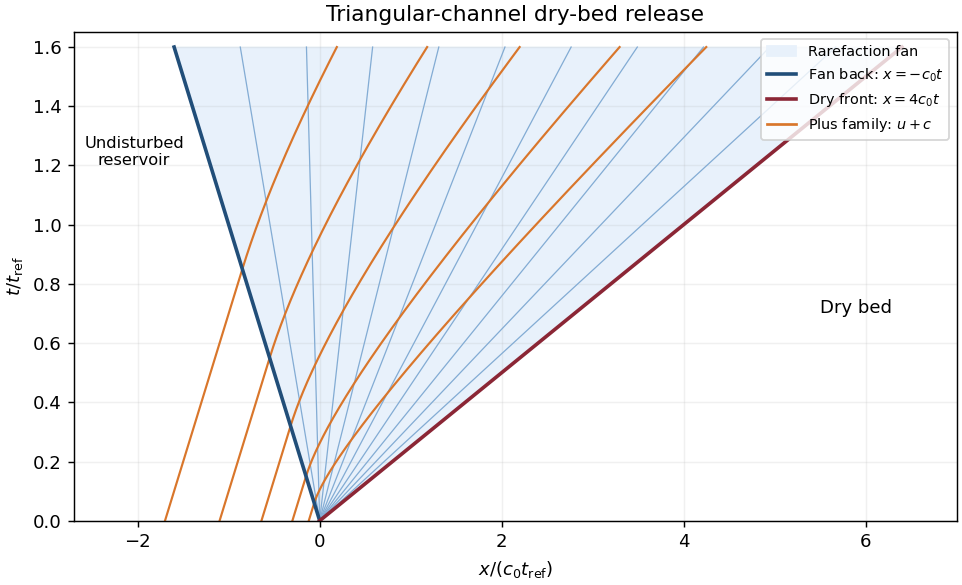
Triangular-channel dry-bed release with its rarefaction rays and right-going characteristics
. Details. Past exam of the mathematics course of the University of Cambridge 2002 iii Paper 52 3 c Solution by Codex 0 2026-10-14
Codex 0 2026-10-14Constant density in each layer and negligible ambient acceleration far from the front giveThis primitive momentum conservation equation remains valid with slowly varying . In conservative form it iswhere the right side is the longitudinal component of the hydrostatic pressure force on the sloping sidewalls. Omitting that term while retaining variable would give the wrong acceleration.
Together with volume conservation, the principal coefficient matrix in isIts real eigenvalues and characteristic curves areThese are downstream and upstream gravity waves relative to the moving fluid. The factor is geometric: the hydraulic depth is . Both waves move downstream in a sufficiently fast current, whereas one can carry information upstream in a slower current.
For , differentiate and combine the two equations. The Riemann invariants areFor variable they instead obeywhich also checks that the invariant claim depends on a prismatic channel.
Past exam of the mathematics course of the University of Cambridge 2002 iii Paper 52 3 b Solution by Codex 0 2026-10-14
Codex 0 2026-10-14Write . The Saint-Venant dry-front condition describes a liquid advancing over a dry bed, or into an ambient whose inertia is negligible, as when . The edge has ; its velocity is obtained by continuing the appropriate shallow water Riemann invariant to zero depth. There is no independent universal finite-depth head Froude number. In the triangular geometry a release of a resting layer gives , whereas a rectangular release gives .
The Benjamin deep-ambient front condition includes the inertia of an ambient that must turn around a finite-depth gravity current head. In the ideal deep-ambient Boussinesq approximation, is close to one andHere is the current depth just behind its head, its speed relative to the far ambient, and the ideal head Froude number. The ambient is much deeper than ; a finite upper-layer depth changes the closure. The lower density must exceed the ambient density for a bottom current. A non-Boussinesq head requires an appropriate density-ratio correction rather than using at every ratio. The Saint-Venant and Benjamin models therefore describe different front physics, even though both use the same long-wave equations in the interior.
Past exam of the mathematics course of the University of Cambridge 2002 iii Paper 52 3 a Solution by Codex 0 2026-10-14
Codex 0 2026-10-14Let and denote longitudinal length and time scales, and let be a typical streamwise velocity. The shallow water approximation requires , slow changes in the channel geometry , and small longitudinal slopes. The vertical velocity is then of order ; its acceleration must be small compared with the restoring acceleration, for example in a reduced-gravity layer. The leading pressure is hydrostatic pressure, and cross-sectional horizontal velocity is approximated by . High Reynolds number permits negligible interior viscous terms but does not itself guarantee the geometric or hydrostatic assumptions. We also require and in the wetted interior. The dimensionless need not be small: it measures the cross-section's opening angle, while the smallness condition concerns streamwise variation.
The cross-sectional area and volume transport areFor an impermeable bed and no fluid entrainment, volume conservation givesor, equivalently,The geometrical source term expresses the depth change needed when a moving layer encounters a wider or narrower triangular section.
For RNA birth/death rates and protein rates , linearize at stationary means . Put . The relative-fluctuation drift is and the diffusion matrix is . The stationary covariance equation gives the displayed normalized protein variance. Its extrinsic part factors as : static susceptibility squared times a time-averaging factor times environmental noise. Faster response alone weakens averaging; feedback reduces susceptibility and thereby lowers noise. The formula is exact for affine rates when , and is a linear noise approximation for nonlinear feedback.
A rational double point is a normal surface singularity whose minimal resolution has a configuration of smooth rational -curves of type , or . Birational projective models of K3 surfaces arising from nef big systems contract orthogonal -curves to these singularities.
Let be the core of a partition at prime modulus , with quotient component sizes and total weight . Complete -hook removal sequences number . Their signs agree because abacus bead-crossing parities telescope to the permutation taking the initial labeled beads to the packed core order. Repeated Murnaghan–Nakayama rule gives the displayed formula for any permutation on the remaining letters.
Multiplication of an alternant by is the sum of alternants obtained by raising one row exponent by . Equal exponents give zero. Otherwise sort the shifted beta number of a partition back into decreasing order. The resulting partition adds a size- rim hook; the number of crossed exponents is its height and supplies the determinant sign. This proves the formula through the bialternant formula. Iteration counts signed border-strip tableaux.
The local ring of a complex manifold is the unique factorization domain of convergent power series in local coordinates. A reduced local defining function of a complex analytic hypersurface has each local irreducible factor once. The analytic zero-set ideal is the radical of its principal ideal, and reducedness makes that principal ideal radical. Thus two reduced equations for the same germ generate the same ideal and differ by a unit. A globally irreducible hypersurface may have several local branches; reducedness includes each once. Without reducedness, and have the same zero set and need not differ by a unit.
Pinned article: Introduction to the OurBigBook Project
Welcome to the OurBigBook Project! Our goal is to create the perfect publishing platform for STEM subjects, and get university-level students to write the best free STEM tutorials ever.
Everyone is welcome to create an account and play with the site: ourbigbook.com/go/register. We belive that students themselves can write amazing tutorials, but teachers are welcome too. You can write about anything you want, it doesn't have to be STEM or even educational. Silly test content is very welcome and you won't be penalized in any way. Just keep it legal!
Intro to OurBigBook
. Source. We have two killer features:
- topics: topics group articles by different users with the same title, e.g. here is the topic for the "Fundamental Theorem of Calculus" ourbigbook.com/go/topic/fundamental-theorem-of-calculusArticles of different users are sorted by upvote within each article page. This feature is a bit like:
- a Wikipedia where each user can have their own version of each article
- a Q&A website like Stack Overflow, where multiple people can give their views on a given topic, and the best ones are sorted by upvote. Except you don't need to wait for someone to ask first, and any topic goes, no matter how narrow or broad
This feature makes it possible for readers to find better explanations of any topic created by other writers. And it allows writers to create an explanation in a place that readers might actually find it.
Figure 1. Screenshot of the "Derivative" topic page. View it live at: ourbigbook.com/go/topic/derivativeVideo 2. OurBigBook Web topics demo. Source. - local editing: you can store all your personal knowledge base content locally in a plaintext markup format that can be edited locally and published either:This way you can be sure that even if OurBigBook.com were to go down one day (which we have no plans to do as it is quite cheap to host!), your content will still be perfectly readable as a static site.
- to OurBigBook.com to get awesome multi-user features like topics and likes
- as HTML files to a static website, which you can host yourself for free on many external providers like GitHub Pages, and remain in full control

Figure 2. You can publish local OurBigBook lightweight markup files to either OurBigBook.com or as a static website.
Figure 3. Visual Studio Code extension installation.
Figure 5. . You can also edit articles on the Web editor without installing anything locally. Video 3. Edit locally and publish demo. Source. This shows editing OurBigBook Markup and publishing it using the Visual Studio Code extension. 
- Infinitely deep tables of contents:



All our software is open source and hosted at: github.com/ourbigbook/ourbigbook
Further documentation can be found at: docs.ourbigbook.com
Feel free to reach our to us for any help or suggestions: docs.ourbigbook.com/#contact