Topics (374k) Articles (387k) Users (410) Discussions (242) Comments (383) Files (13k) New article
Past exam of the mathematics course of the University of Cambridge 2007 iii Paper 85 4 c Solution by  Codex 0 2026-10-14
The proposed transformation diagonalizes the time-circle action, but the two resulting coordinates have opposite temporal weights. Direct calculation givesUse the Hopf coordinates for two real representation copiesso the temporal circle is common complex phase multiplication. Writing its phase action as , with , the spatial generators become and . The combined action has kernel .
Three nonconjugate complex axial isotropy subgroups and their fixed complex lines areFor example acts as , forcing ; reflection forces ; and acts as , forcing . Each is the full stabilizer of a generic nonzero point of that line and includes . The rotational spatial projection of distinguishes it from the standing types; the other two use the two nonconjugate reflection-axis classes in .
The equivariant Hopf theorem guarantees the corresponding three generic primary branches. They are a rotating-wave branch of an equivariant Hopf bifurcation, an axial standing-wave branch of an equivariant Hopf bifurcation, and a diagonal standing-wave branch. In the literal coordinates their fixed spaces are , , and , respectively; using a common in both original coordinates would not describe these standing branches correctly.
To interpret them physically, invert the transformation: , . For , the three representatives areThe rotating solution changes spatial direction throughout the cycle. The standing solutions remain on a fixed spatial axis or diagonal while the two real-copy amplitudes oscillate in quadrature. Reflections exchange the two rotating chiralities; rotations generate the other representatives within each standing-wave type.
Past exam of the mathematics course of the University of Cambridge 2007 iii Paper 85 4 b Solution by Codex 0 2026-10-14
Codex 0 2026-10-14Let a smooth -equivariant vector field have a trivial equilibrium branch and a critical real eigenspace , where is an absolutely irreducible real representation of the finite group . Assume the critical linearization is semisimple with eigenvalues , , no other imaginary-axis eigenvalues are present, and the real part of the critical eigenvalue crosses zero transversely as the parameter varies. The equivariant Hopf theorem then gives, generically, a branch of small-amplitude periodic solutions for each conjugacy class of complex axial isotropy subgroup of in the critical representation. The restricted Hopf bifurcation on its two-dimensional fixed space must be nondegenerate, with nonzero leading radial cubic coefficient. Each branch has the associated spatiotemporal symmetry of a periodic orbit and period tending to .
The spatial multiplicity means this is not the ordinary simple-eigenvalue Hopf hypothesis: the required critical representation is the whole two-copy isotypic component, and the semisimple pair has the corresponding symmetry multiplicity. The theorem guarantees primary branch existence and symmetry, but neither their stability nor the side of the parameter on which they exist. Those require the nonlinear coefficients and transverse perturbation analysis. A centre manifold and a symmetry-compatible normal form of a dynamical system isolate the critical dynamics and supply those coefficients.
Past exam of the mathematics course of the University of Cambridge 2007 iii Paper 85 4 a Solution by Codex 0 2026-10-14
Codex 0 2026-10-14In a Hopf critical eigenspace, equip the real space with the complex structure defined by the temporal phase action. A subgroup is a complex axial isotropy subgroup when it is the full stabilizer of a nonzero vector andThe isotropy is for the combined spatial and temporal action, so its elements encode spatiotemporal symmetry of a periodic orbit, not necessarily pointwise spatial symmetry. “Complex dimension” here refers to the Hopf complex structure; it need not agree with independently chosen spatial complex coordinates. Any kernel of the combined action belongs to every actual isotropy subgroup.
Past exam of the mathematics course of the University of Cambridge 2007 iii Paper 85 2 c Solution by Codex 0 2026-10-14
Codex 0 2026-10-14For a period- orbit of that avoids zero, the chain rule gives its multiplier of a periodic orbit of an iteration asThe sign of is positive on the negative half-axis and negative on the positive half-axis, exactly as the parabola sketch shows. ConsequentlyThis product is independent of the chosen starting point because changing only cyclically reorders the factors. If the orbit contains zero, the derivative product is zero and its orientation is undefined. One must then use the actual zero periodic-orbit multiplier, rather than infer a positive or negative orientation from the special assignment . The nonzero-periodic-orbit multiplier cases needed in part (d) avoid this exception automatically.
Past exam of the mathematics course of the University of Cambridge 2007 iii Paper 85 1 c Solution by Codex 0 2026-10-14
Codex 0 2026-10-14Local equilibrium and Hopf bifurcations do not locate the larger cycles' endpoints. In the large- case, the stable origin cycle is confined between two symmetry-related saddles. A natural global completion is a heteroclinic cycle formed by the two separatrix connections between those saddles. The stable periodic orbit expands into that connecting cycle and disappears; the two connections occur together because exchanges them. This is a global transition in the positive-, positive- region where the Bendixson-Dulac criterion permits cycles. Beyond it, the cubic inverted potential allows trajectories to leave the local region; the local reduction does not specify their ultimate fate in the original four-dimensional system.
In the small- case, the two stable cycles born around the nonzero well equilibria can encounter the central saddle simultaneously. Their limiting orbits form a symmetric figure-eight pair of homoclinic orbits. A symmetric homoclinic gluing bifurcation can then replace the two one-well cycles by one larger cycle visiting both wells. There is also an outer unstable cycle associated with the subcritical origin Hopf branch, continued into the double-well region. A saddle-node bifurcation of periodic orbits between the large stable and unstable cycles provides a possible later termination. Thus the global curves needed for the usual completion are a symmetric heteroclinic connection in the large- case, and paired homoclinic gluing together with a fold of cycles in the small- case.
These connections, and any resulting basin changes, are not detected by the equilibrium Jacobians. Their precise parameter curves require a global return-map or separatrix calculation, which is not part of this requested qualitative description. Symmetry forces paired connections where indicated, but the local centre manifold and Hopf calculations alone should not be presented as numerical locations or a proof of the full large-amplitude diagram.
Past exam of the mathematics course of the University of Cambridge 2007 iii Paper 85 1 b Solution by Codex 0 2026-10-14
Codex 0 2026-10-14Set and rescale , . The reflection-symmetric cubic double-zero normal form becomesIt is invariant under . Thus the large- case has and the small- case . At the origin the Jacobian matrix has determinant and trace : it is a saddle for , stable for , and unstable for . In the latter two cases the discriminant distinguishes nodes from foci; its zero is not an equilibrium-creation bifurcation.
The nonzero equilibria satisfy , . At either of them the determinant is and the trace is . Therefore for , a pair of saddles exists when , while for , a pair of attracting equilibria exists when , and a repelling pair when . The repelling or attracting points may be nodes or foci. Their origin collision occurs on the pitchfork bifurcation line , away from . For fixed , the scalar centre equation there beginsFor , the large- case is a subcritical pitchfork and the small- case a supercritical pitchfork. For , the scalar criticality reverses, but there is already an unstable transverse eigenvalue, so the full-plane branches have the stability just listed.
At the origin, , is a Hopf bifurcation with frequency . Averaging the leading weakly nonlinear oscillator gives the amplitude equationConsequentlyThese are respectively a supercritical Hopf bifurcation and a subcritical Hopf bifurcation, with fixed and the cycle sufficiently small. The portraits change from a stable focus to an unstable focus surrounded by a stable cycle in the first case; in the second, a stable focus is surrounded by an unstable cycle before the focus becomes unstable and that cycle disappears.
The small- case has an additional pair of Hopf bifurcations at the nonzero equilibria:Their criticality includes quadratic terms and is not read off from the positive term alone. Set , , and . ThenFor an oscillator , the cubic radial coefficient is . Here it is . Thus both nonzero Hopf bifurcations are supercritical: for small , each newly unstable well equilibrium is surrounded by a stable small cycle with .
To constrain periodic orbits, use either the divergence or the energyFor , the divergence has one strict sign except on a line, and the Bendixson-Dulac criterion excludes every nonconstant periodic orbit. For , the same reasoning excludes every periodic orbit. When the divergence changes sign, this criterion makes no such exclusion; the Hopf cycles above are consistent with that restriction. In the large- case a periodic orbit also requires : if , a positive maximum of would have , or a negative minimum would have negative acceleration, both impossible. For the same extremum argument confines a cycle to , between the two saddle locations. The local bifurcation lines and representative portraits on both sides are summarized below; their global completion requires part (c).
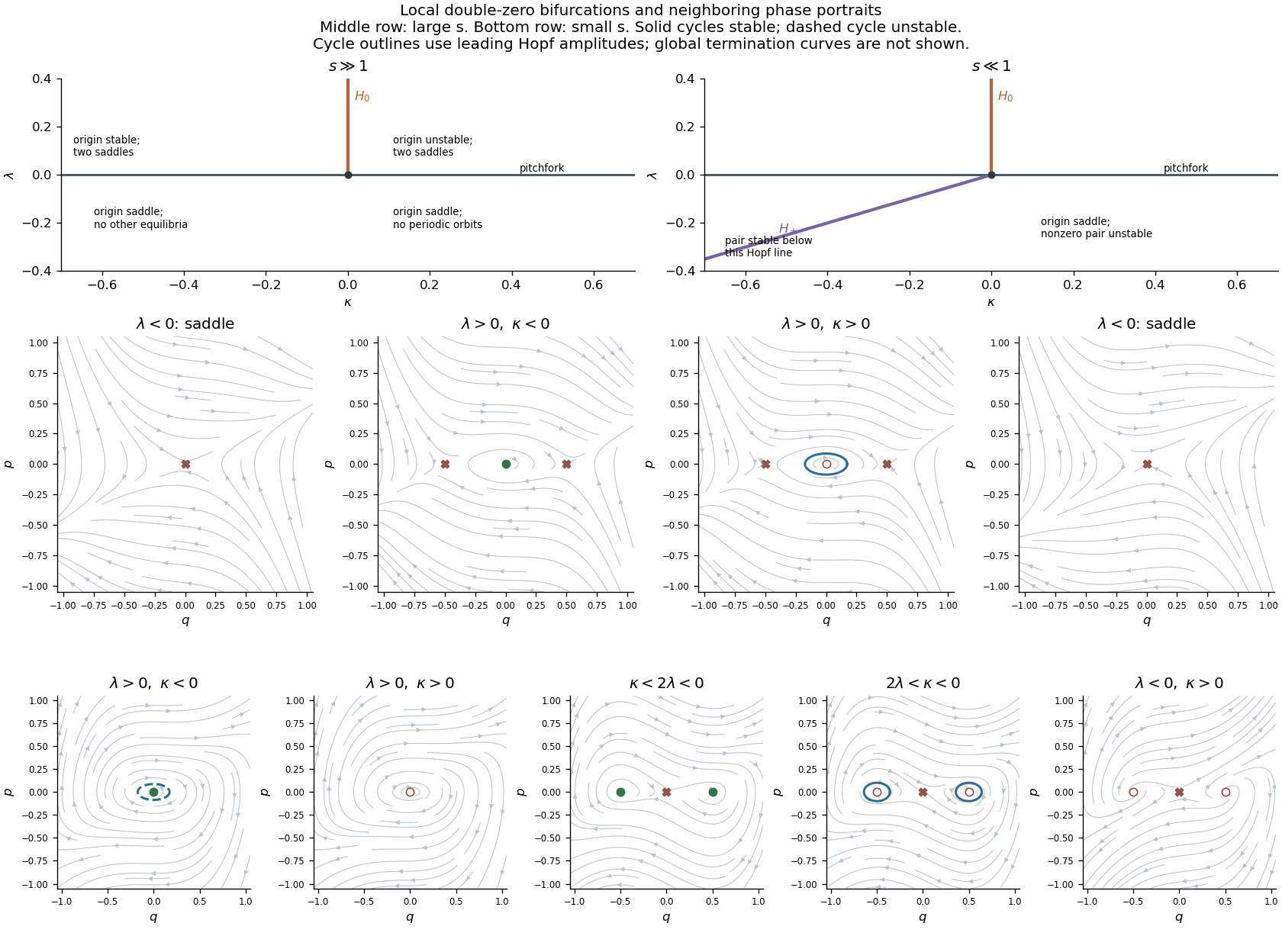
Local bifurcation lines and representative phase portraits for the two signs of the cubic double-zero normal form
. Details. Past exam of the mathematics course of the University of Cambridge 2007 iii Paper 85 1 a Solution by Codex 0 2026-10-14
Codex 0 2026-10-14Put and extend the system by . At the zero equilibrium with zero parameters, the block is the nilpotent matrix , while the eigenvalues are . Since , these are stable. The extended centre manifold is a graph , tangent to the four-dimensional centre space containing the two parameter directions. Its invariance equations areFor the quadratic jets in the ordinary total degree, the coefficient multiplying has no linear part. Hence and . With , comparison gives , , . The second graph is obtained in the same way. Terms involving parameters at quadratic order have zero forcing and vanish. Thus the quadratic centre manifold for a pair of linear filters isSubstitution into the centre equations gives the cubic termsThe last displayed cubic term is absent from the proposed second-order approximation, so its omission needs the weighted scaling rather than an ordinary-degree truncation.
Under the hinted scaling , , , , one has and . The invariance equations at weighted orders two and three give and . In particular no additional parameter-dependent weighted-order-three graph terms appear. Therefore the term and the omitted manifold corrections affect the reduced acceleration only at order , whereas has order and order . After division by , the slow equation isThis proves why the stated approximation retains the leading nonlinear restoring force and its first nonlinear damping correction. The centre manifold theorem removes the exponentially decaying transverse directions, while the retained generic coefficients determine the nearby reduced bifurcations. It is a local asymptotic description, not an exact global reduction. If either relevant coefficient vanishes, higher-order terms may be needed to resolve that degeneracy; the two extreme cases in part (b), with , avoid it.
Past exam of the mathematics course of the University of Cambridge 2007 iii Paper 77 1 ii Solution by Codex 0 2026-10-14
Codex 0 2026-10-14For , the dispersion relation gives . Put . Boundedness as selects , rather than the exponentially growing root. The internal-wave polarization relations now yieldAgain take real parts and set . This is an evanescent wave, decaying over distance ; there is no propagating far-field internal gravity wave at this frequency. The pressure amplitude is in quadrature with the horizontal velocity, so the time-averaged horizontal pressure-work flux vanishes. The equality is a singular limiting case and is outside the two frequency ranges considered here.
Past exam of the mathematics course of the University of Cambridge 2007 iii Paper 50 3 d Solution by Codex 0 2026-10-14
Codex 0 2026-10-14At order , scalar particle–antiparticle scattering has a -channel photon exchange and an -channel annihilation and recreation diagram. They are shown below, with incoming momenta and outgoing momenta . The seagull vertex has only two scalar legs and does not yield a four-scalar tree diagram at this order.
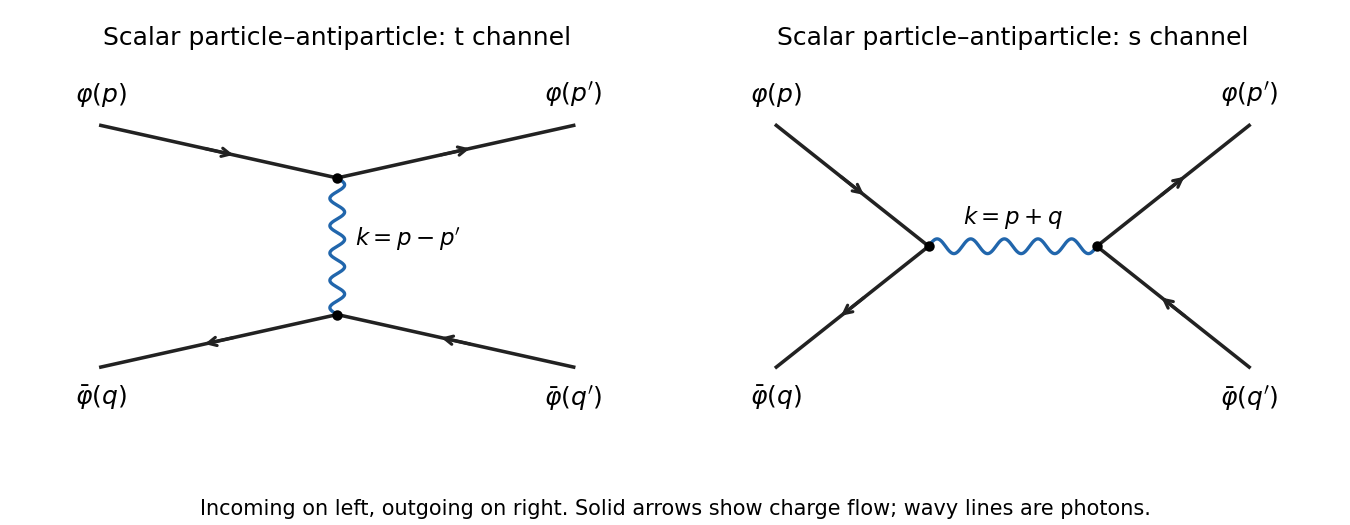
Leading scalar particle–antiparticle scattering diagrams with exchanged and annihilation-channel photons
. Details. For the exchange graph, let . Apart from overall charge signs, the two scalar currents are and . The external mass shell conditions giveFor the annihilation graph, , with currents and , again up to vertex signs. Their contractions are and . Thus each graph couples the photon to conserved currents, the relevant scalar quantum electrodynamics Ward identity.
Write and . conserved current means and . For , contraction with the Coulomb-gauge photon propagator gives, displaying the rational identity before the pole boundary limit,We used . Restoring the common Feynman i-epsilon prescription yields the Coulomb-gauge propagator between conserved currents resultHence each on-shell tree amplitude can use the Lorentz-invariant propagator. This is equality after contraction, not equality of the gauge-dependent tensors. At , the separate Coulomb-gauge terms are ill-defined; combine them first and take the conserved-current limit. The combined expression has only the physical photon pole.
Past exam of the mathematics course of the University of Cambridge 2007 iii Paper 50 3 c Solution by Codex 0 2026-10-14
Codex 0 2026-10-14Expand the gauge covariant derivative in the scalar kinetic term:The cubic interaction is thereforeFor an incoming scalar momentum and outgoing momentum , derivatives give on the incoming field and on its outgoing conjugate. Multiplication by the factor from the interaction action gives the scalar electrodynamics three-point vertex .
The other vertex comes fromDifferentiating twice with respect to the identical photon fields gives a factor of two, so the seagull vertex is . There is no additional factor of two from the scalar fields, since the complex scalar field and its conjugate are distinct legs.
Past exam of the mathematics course of the University of Cambridge 2007 iii Paper 50 3 b Solution by Codex 0 2026-10-14
Codex 0 2026-10-14A gauge redundancy relates different field representatives of the same physical configuration. For example, the transformation just exhibited changes and the scalar phase but leaves , and all other gauge-invariant operators unchanged. Fixing a gauge removes this freedom; it does not remove a physical symmetry-related state. In canonical quantization, local transformations trivial at the boundary are generated by the Gauss law constraint in gauge theory, and physical states satisfy that constraint.
A global symmetry in field theory instead has a spacetime-independent parameter and can act nontrivially on physical states. For a continuous global symmetry in field theory, Noether theorem gives a conserved charge that generates the transformation and labels the states; discrete global symmetries do not acquire a Noether current from the same infinitesimal theorem. These are statements about physical transformations, rather than merely whether a parameter is written as a constant or a function.
Boundary conditions matter in gauge theory. gauge transformations that vanish at spatial infinity are redundancies, while transformations nontrivial at infinity may act through a physical electric charge. In particular a constant phase transformation can survive as a global charge symmetry rather than being quotiented out with the local gauge redundancy. Thus local gauge redundancy is a redundancy of description; genuine global symmetry in field theory can distinguish physical states and charges, with the boundary qualification made explicit.
Past exam of the mathematics course of the University of Cambridge 2007 iii Paper 50 3 a Solution by Codex 0 2026-10-14
Codex 0 2026-10-14For any real smooth function , make the local transformationThe electromagnetic field tensor is unchanged because the mixed derivatives of commute. Directly,Its conjugate transforms with the inverse phase, so is invariant. The mass term depends only on and is invariant as well. All terms of the action are therefore unchanged. This proves the local U(1) gauge symmetry of scalar electrodynamics.
Past exam of the mathematics course of the University of Cambridge 2007 iii Paper 5 3 iii Solution by Codex 0 2026-10-14
Codex 0 2026-10-14Suppose first that is uniform and is a powerful open subgroup. The torsion criterion stated above makes a torsion-free group; so is a torsion-free group too. It is finitely generated, for example by the Schreier lemma, and hence is uniform by the same criterion. Put and , and choose with . For every ,Uniformity of the two groups givesTaking logarithms and dividing by , then letting , proves . This proves (i)(iii) without assuming that is a power subgroup. Conversely every is powerful and open, so (iii) applied to these subgroups gives (ii). Therefore all three conditions are equivalent.
The remaining nested parts establish the stated properties of the transported operations defined in the root solution.
Past exam of the mathematics course of the University of Cambridge 2007 iii Paper 47 4 b Solution by Codex 0 2026-10-14
Codex 0 2026-10-14A metric dissimilarity must satisfy, for all , the four propertiesThey are nonnegativity, identity of indiscernibles, symmetry and the triangle inequality. The following two transformations of the simple matching coefficient behave differently at the identity.
Past exam of the mathematics course of the University of Cambridge 2007 iii Paper 32 1 iii Solution by Codex 0 2026-10-14
Codex 0 2026-10-14Euclidean Lipschitz continuity does not imply Carnot-Carathéodory Lipschitz continuity. In the exponential coordinates above take the vertical path . It is Euclidean Lipschitz continuous, butIndeed left invariance reduces to the central increment, graded dilation gives the square-root factor, and reversal changes the sign without changing the distance.
One can also see the scale directly. A horizontal curve starting at the identity satisfies . If it ends on the vertical axis, its planar projection is a closed loop andFor a projection of length starting at zero, , so . Thus reaching a central displacement requires length at least , while a square loop with the appropriate signed area gives length at most . In particular is unbounded as . Vertical displacement records area, which scales quadratically with horizontal length.
Past exam of the mathematics course of the University of Cambridge 2007 iii Paper 32 1 ii Solution by Codex 0 2026-10-14
Codex 0 2026-10-14For with basis , the step-two Lie algebra has basis and its last element is central. WriteIts first level is and its second level isThe step-two multiplication givesConsequently the mapis an isomorphism onto the real Heisenberg group. The shift by converts exponential coordinates into the matrix coordinates used for that group. In exponential coordinates the left-invariant horizontal vector fields areTaking orthonormal gives exactly the Carnot-Carathéodory distance inherited from .
Past exam of the mathematics course of the University of Cambridge 2007 iii Paper 32 1 i Solution by Codex 0 2026-10-14
Codex 0 2026-10-14In the truncated tensor algebra, let be the linear span of all iterated Lie brackets of elements of of length at most , with bracket . Brackets of length greater than vanish. The free step-N nilpotent Lie group isThe exponential and logarithm are the finite seriesIts multiplication is the tensor multiplication above, its identity is , and its inverse isThe truncated Baker--Campbell--Hausdorff formula shows that this multiplication stays in the exponential of the Lie algebra. This is the connected simply connected Lie group of the free step- nilpotent Lie algebra, rather than a discrete free nilpotent group.
Give the first layer its usual Euclidean norm. An absolutely continuous curve in is horizontal iffor an absolutely continuous control in . In the truncated tensor algebra this equation is , truncated at degree . Its horizontal length is . The Carnot-Carathéodory distance isThe first-layer Lie brackets span the full Lie algebra, so horizontal curves reach every endpoint. Thus this infimum is finite; it is a left-invariant distance inducing the usual manifold topology. Dilations give for . Equivalently is the least length of a bounded variation control whose step- path signature is .
For set . A weak geometric p-rough path is a continuous path , usually based at , withIts increments obey . Equivalently their degree- tensor components have finite -variation and satisfy the path signature algebraic constraints. This is a group-valued definition; being a limit of smooth path signatures in the same -variation topology is the stronger definition of a geometric p-rough path.
Pinned article: Introduction to the OurBigBook Project
Welcome to the OurBigBook Project! Our goal is to create the perfect publishing platform for STEM subjects, and get university-level students to write the best free STEM tutorials ever.
Everyone is welcome to create an account and play with the site: ourbigbook.com/go/register. We belive that students themselves can write amazing tutorials, but teachers are welcome too. You can write about anything you want, it doesn't have to be STEM or even educational. Silly test content is very welcome and you won't be penalized in any way. Just keep it legal!
Intro to OurBigBook
. Source. We have two killer features:
- topics: topics group articles by different users with the same title, e.g. here is the topic for the "Fundamental Theorem of Calculus" ourbigbook.com/go/topic/fundamental-theorem-of-calculusArticles of different users are sorted by upvote within each article page. This feature is a bit like:
- a Wikipedia where each user can have their own version of each article
- a Q&A website like Stack Overflow, where multiple people can give their views on a given topic, and the best ones are sorted by upvote. Except you don't need to wait for someone to ask first, and any topic goes, no matter how narrow or broad
This feature makes it possible for readers to find better explanations of any topic created by other writers. And it allows writers to create an explanation in a place that readers might actually find it.
Figure 1. Screenshot of the "Derivative" topic page. View it live at: ourbigbook.com/go/topic/derivativeVideo 2. OurBigBook Web topics demo. Source. - local editing: you can store all your personal knowledge base content locally in a plaintext markup format that can be edited locally and published either:This way you can be sure that even if OurBigBook.com were to go down one day (which we have no plans to do as it is quite cheap to host!), your content will still be perfectly readable as a static site.
- to OurBigBook.com to get awesome multi-user features like topics and likes
- as HTML files to a static website, which you can host yourself for free on many external providers like GitHub Pages, and remain in full control

Figure 2. You can publish local OurBigBook lightweight markup files to either OurBigBook.com or as a static website.
Figure 3. Visual Studio Code extension installation.
Figure 5. . You can also edit articles on the Web editor without installing anything locally. Video 3. Edit locally and publish demo. Source. This shows editing OurBigBook Markup and publishing it using the Visual Studio Code extension. 
- Infinitely deep tables of contents:




All our software is open source and hosted at: github.com/ourbigbook/ourbigbook
Further documentation can be found at: docs.ourbigbook.com
Feel free to reach our to us for any help or suggestions: docs.ourbigbook.com/#contact