Topics (374k) Articles (387k) Users (410) Discussions (242) Comments (383) Files (13k) New article

Suppose an integer-valued certifiable function is -Lipschitz under one-coordinate changes and a value at least has a certificate of at most coordinates. Any input with value at most must differ on at least certificate positions. Equal weights on those positions bound its Talagrand convex distance from the low-value event. Applying Talagrand's convex distance inequality gives the displayed product bound. For , median tails integrate to , and deviations of order have exponentially small probability.
Use equitable regularity energy with exceptional vertices retained as singleton cells. The refinement variance identity for regularity energy shows that splitting along an irregular pair's witnesses raises energy by more than . More than irregular ordered pairs therefore raise energy by more than when the exceptional set occupies at most half the vertices.
For equalization with a controlled exceptional set, cut each of the at most witness atoms into pieces of size and put leftovers into singleton exceptional cells. This is a refinement, so it cannot decrease energy. At most vertices are lost. Start with enough cells that this loss, over rounds, is at most ; the initial exceptional set uses the other half. The number of cells grows by a bounded recurrence depending only on and the prescribed minimum. Energy lies in , so the process terminates.
For every , all sufficiently large finite graphs admit a set partition into at most nonempty cells, each of size at most , with the displayed ordered irregular-pair weight bound. Start with small cells. Use regularity energy including diagonal rectangles, refine simultaneously by the witness subsets of all irregular pairs, and apply the refinement variance identity for regularity energy. Each failing round raises energy by more than , while energy lies in . The recurrence bounds the final cell count. Equitability is unnecessary for this weighted version.
A coset leader is a minimum-Hamming-weight word in a coset of a linear code. It represents a most economical error pattern with the associated syndrome. Several leaders can tie; they need not be unique outside the code's guaranteed correction radius.
Use . Two integrations by parts of the anisotropic source give the exact Cosmic microwave background anisotropy amplitude . The emission velocity was eliminated using . The local observer bracket is a monopole plus a dipole and can be discarded only after explicitly restricting to the measured higher angular multipoles. This identity fixes endpoint signs and integral factors without importing a different scalar-metric convention.
For a photon in , the null geodesic condition cancels the homogeneous term in the derivative of . The remaining first-order geodesic equation gives the displayed momentum change. Its direction is constant at zeroth order, so first-order redshift and brightness sources can be evaluated on the unperturbed ray; direction deflection multiplied by an already first-order anisotropy is second order.
For synchronous gauge metric , conserved-background comoving momentum obeys . In the linear Collisionless Boltzmann equation, insert to obtain the displayed source. Using instead reverses both signs; it does not change the physics. The scalar contraction is .
Let be a symplectic orthogonal complement splitting into two symplectic subspaces of dimension two. In symplectic bases, the graph of a function pulls back the symplectic form to . It is a symplectic subspace exactly when . Its symplectic orientation agrees with the orientation transported from exactly when . When , the transverse oriented pair has negative intersection sign, whereas two distinct complex lines in a compatible complex two-space have positive intersection sign.
If is nonempty, bounded and open in standard symplectic Euclidean space, and is a codimension-two symplectic subspace, a linear symplectic change of coordinates makes . Boundedness of the remaining coordinate projection places inside a finite-radius symplectic cylinder. Openness puts a small ball inside it. Monotonicity and normalization of a symplectic capacity give the displayed strict bounds.
Construct a symplectic basis two vectors at a time. Choose ; the nondegenerate bilinear form supplies with , and set . For any vector , remove its paired components byThen . Thus, for , the symplectic orthogonal complement gives a direct sum ; its restricted bilinear form remains nondegenerate. Repeat there until no vectors remain, then put all before all . This proves even dimension and existence together. Only the nonzero pairing is divided out, so the construction also works in characteristic two. The pair-splitting argument is described in Bilinear Forms by Keith Conrad (Keith Conrad, Bilinear Forms, §5, proof of Theorem 5.1 and Theorem 5.4).
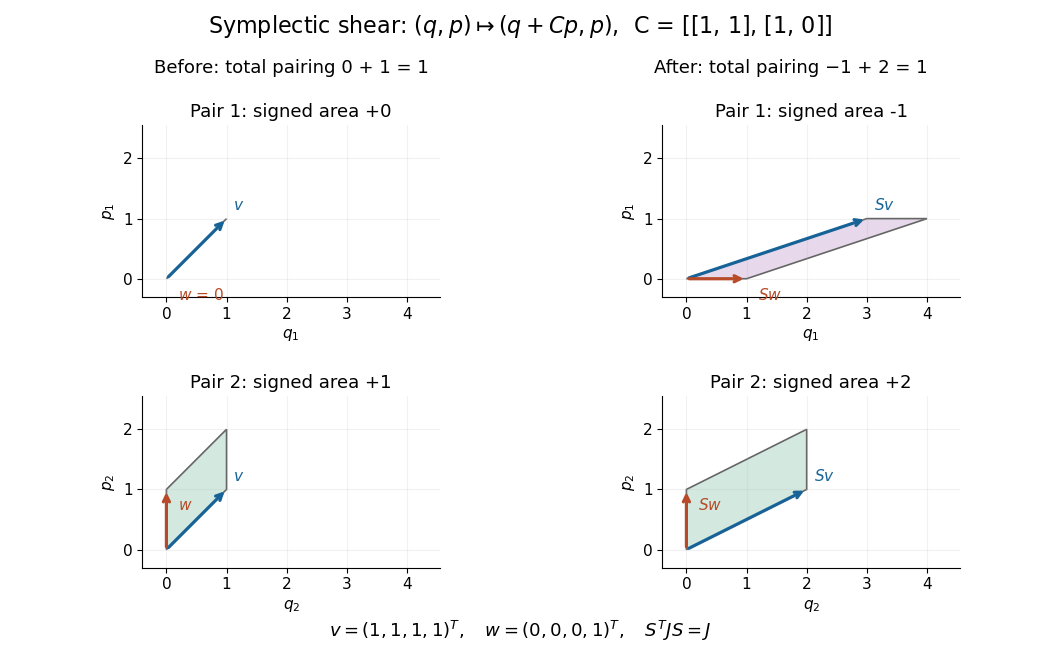
On , use the standard basis and the alternating bilinear form with matrix above for . A second symplectic basis isFor instance, , while and the cross-pairings vanish. The change of basis matrix, whose columns are these new basis vectors in , isThe symmetric matrix makes , so is a symplectic matrix. Explicitly, multiplying the blocks gives a lower-right block ; the other blocks agree with . For a fixed vector, change of basis means , henceTheir symplectic form gives in , and in . The separate coordinate-plane contributions change, but their sum does not.
The same matrix also represents an active symplectic linear map: keeping one basis fixed, it sends to . The following diagram shows this active interpretation over the real numbers. Its preserved total pairing is precisely the test used for linear canonical transformations.
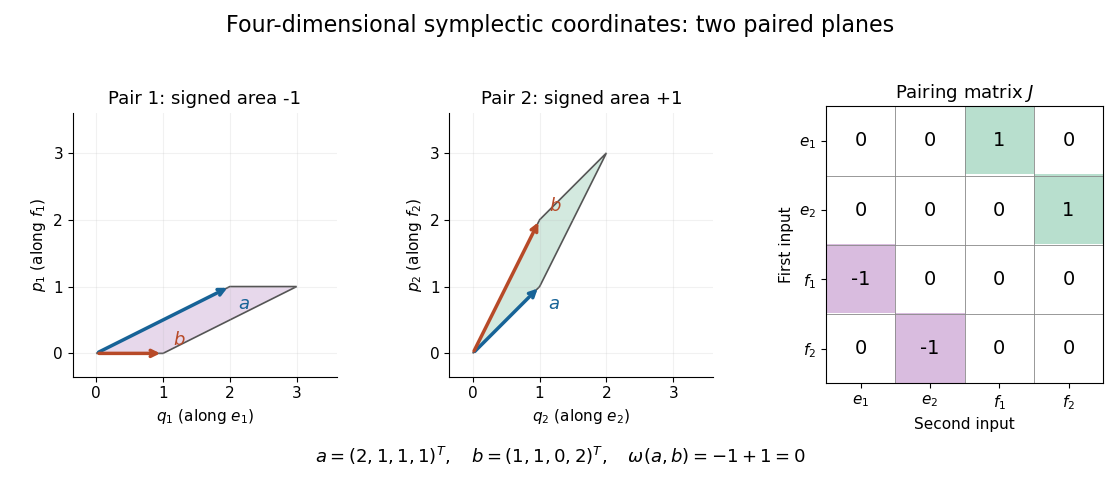
Write vectors in a symplectic basis as and . Their coordinate vectors and the matrix of a bilinear form areHere is the identity matrix, and denotes transpose. The ordering matters: interleaving the basis as instead gives a block diagonal matrix with blocks . Some conventions reverse every , giving instead. Always check the displayed pairing convention.[ref]
Symplectic Geometry. §1.1, p. 83: e-then-f basis and its block matrix; the coordinate formula follows by bilinearity
Over the real numbers, each summand is the signed area of a parallelogram in the coordinate plane. For and , the two signed areas are and , so although the vectors are linearly independent. The cancellation concerns the symplectic form; it does not assert that their dot product vanishes. Over a general field, the same determinant formula is algebraic, without a signed geometric interpretation.
For , represent as . The Tonelli theorem applies to the nonnegative integrand. The inner integral in is , leaving . Substitution and the Euler beta function together with the Gamma reflection formula give the result. The bounds at zero and infinity explain exactly the index range.
Give every site a distinct label and interchange labels at the edge marks defining the symmetric simple exclusion process. Each forward or backward label path makes only finitely many jumps in a bounded time interval, since its total rate is . Occupations are transported along these paths. The backward ancestors of a finite set have the law of the finite-particle symmetric exclusion process, by time reversal of the Poisson marks. This proves the product self-duality of symmetric exclusion.
On a finite graph with symmetric edge-swap rates, the stirring representation of symmetric exclusion transports the occupations by a random permutation. An independent identically distributed Bernoulli distribution occupation field is invariant under every deterministic permutation, and hence under this random permutation when it is independent of the initial field. Therefore the displayed product measure is invariant, including densities zero and one. Equivalently, an edge swap preserves the number of particles and has the same reverse rate, giving detailed balance.
Its adjoint is on all of , with no endpoint conditions. Every complex is an adjoint eigenvalue, with eigenfunction . Thus every complex obstructs surjectivity of . The original operator has no eigenvalues because its zero initial value kills any solution of .
// Target: analysis.bigb
For a symmetric finite game, pure-action expected payoffs against independent identical opposing mixed strategies are continuous. The displayed map takes the probability simplex continuously into itself. At a Brouwer fixed-point theorem fixed point, put and . The fixed-point equations give . If , every supported action has strictly positive excess payoff, contradicting . Hence and every supported action is a best response, proving a symmetric Nash equilibrium.
For functions in the form domain, this symmetric bilinear energy equals when is in the generator domain. Its finite-time approximation is . The quadratic energy may take the extended value infinity.
// Target: analysis.bigb
This is the critical infection rate for the contact process started from one infected site to avoid its absorbing empty state forever. It concerns infection somewhere in the graph at all times, rather than repeated infection of a fixed site. On a transitive graph it is independent of the starting site. Infection-arrow inclusion couples different rates monotonically.
Local survival means repeated infection of a fixed vertex at arbitrarily large times in the contact process. It implies global survival, but infection can survive by moving away from every fixed vertex on an infinite graph. On a transitive graph the threshold is independent of the chosen vertex, and , with the global survival threshold of the contact process.
Pinned article: Introduction to the OurBigBook Project
Welcome to the OurBigBook Project! Our goal is to create the perfect publishing platform for STEM subjects, and get university-level students to write the best free STEM tutorials ever.
Everyone is welcome to create an account and play with the site: ourbigbook.com/go/register. We belive that students themselves can write amazing tutorials, but teachers are welcome too. You can write about anything you want, it doesn't have to be STEM or even educational. Silly test content is very welcome and you won't be penalized in any way. Just keep it legal!
Intro to OurBigBook
. Source. We have two killer features:
- topics: topics group articles by different users with the same title, e.g. here is the topic for the "Fundamental Theorem of Calculus" ourbigbook.com/go/topic/fundamental-theorem-of-calculusArticles of different users are sorted by upvote within each article page. This feature is a bit like:
- a Wikipedia where each user can have their own version of each article
- a Q&A website like Stack Overflow, where multiple people can give their views on a given topic, and the best ones are sorted by upvote. Except you don't need to wait for someone to ask first, and any topic goes, no matter how narrow or broad
This feature makes it possible for readers to find better explanations of any topic created by other writers. And it allows writers to create an explanation in a place that readers might actually find it.
Figure 1. Screenshot of the "Derivative" topic page. View it live at: ourbigbook.com/go/topic/derivativeVideo 2. OurBigBook Web topics demo. Source. - local editing: you can store all your personal knowledge base content locally in a plaintext markup format that can be edited locally and published either:This way you can be sure that even if OurBigBook.com were to go down one day (which we have no plans to do as it is quite cheap to host!), your content will still be perfectly readable as a static site.
- to OurBigBook.com to get awesome multi-user features like topics and likes
- as HTML files to a static website, which you can host yourself for free on many external providers like GitHub Pages, and remain in full control

Figure 2. You can publish local OurBigBook lightweight markup files to either OurBigBook.com or as a static website.
Figure 3. Visual Studio Code extension installation.
Figure 5. . You can also edit articles on the Web editor without installing anything locally. Video 3. Edit locally and publish demo. Source. This shows editing OurBigBook Markup and publishing it using the Visual Studio Code extension. 
- Infinitely deep tables of contents:




All our software is open source and hosted at: github.com/ourbigbook/ourbigbook
Further documentation can be found at: docs.ourbigbook.com
Feel free to reach our to us for any help or suggestions: docs.ourbigbook.com/#contact