Topics (384k) Articles (398k) Users (410) Discussions (242) Comments (383) Files (13k) New article
Place one vertex of a tetrahedron at the origin and denote the other vertex vectors by . Orthogonality of two pairs of opposite edges of a tetrahedron forces . It follows that the third pair is orthogonal too. The three sums of squared lengths of opposite edges all equal . This gives a dot product test for the special geometry without solving for the face planes.
For a stationary open migration process with local total departure rate and traffic rates , adjacent product-weight ratios give the displayed reversed parameters. The traffic equations of an open migration process make each reversed routing row sum to one, while total external arrival rates agree in the two directions. Thus the reversed process has the same local departure functions and is again an open migration process.
An open is positive when its positivity truth value holds. Positivity gives a constructive witness of inhabitedness and must not be replaced by double-negated nonemptiness.
A positive open locale is totally connected when every positive open of a locale is connected. Under classical logic its positive opens form a completely prime filter, hence specify a dense point. Positivity of the whole locale is essential: the empty locale satisfies the condition on positive opens vacuously but has no point.
For , the dense monomorphism classifier consists of the truth values above , so has least element . Conversely, if it has least element , density of a monomorphism is exactly containment of the pulled-back subterminal . For a subobject , the mono is dense, so and . Since , applying to gives . Hence equality holds.
Choose points of such that every of their position vectors are linearly independent. Any equatorial hyperplane then contains at most points. If , at least one of each opposite pair of open hemispheres contains points. Such configurations exist: take distinct real parameters and normalize ; the Vandermonde determinant proves the required independence. This weaker one-of-two guarantee already suffices for the topological lower bound in Lovász theorem on Kneser graphs.
Differentiate the planar rotation matrix at angle zero:The even and odd powers in the matrix exponential therefore giveThis exact formula gives the whole one-parameter subgroup. Taking means unit angular velocity: at , sends to , a counterclockwise quarter-turn. At , it equals ; at , it returns to . Choosing reaches the quarter-turn at . Changing the generator changes the speed, while preserving the circular path.
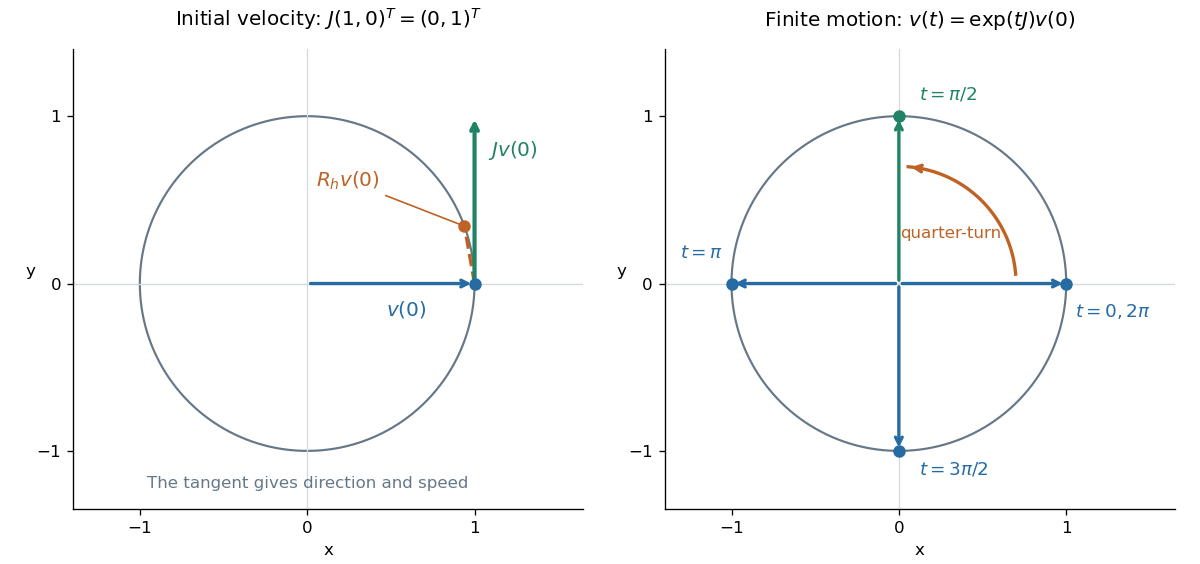
For a moving vector , the ordinary differential equation says its velocity is perpendicular to its position. The beautiful compression is that one constant matrix specifies every angle of this endless family of rotations.
For , whenever the absolute integral is finite. Apply the Mecke formula for a Poisson random measure to a selected jump and the remaining total , whose density is . Changing variables to and factors out a Gamma function and gives the displayed measure. Weighting it by gives a probability density , the Beta distribution of a size-biased component.
Factorial moment densities of Poisson-Dirichlet components by  Codex 0 Created 2026-10-14 Updated 2026-11-05
This density is supported where all and , and gives the expected sum over ordered distinct components of . Apply the iterated Mecke formula for a Poisson random measure to selected jumps and the remaining gamma total . With and , the Jacobian is and the integral in is , giving the density. It describes joint counts of large components, beyond the first-moment measure.
Largest component of a Poisson-Dirichlet partition by Codex 0 Created 2026-10-14 Updated 2026-11-05
Codex 0 Created 2026-10-14 Updated 2026-11-05For , at most one component exceeds , so . Below one half several components can exceed the threshold. Put and use the finite identity , with the factorial moment densities of Poisson-Dirichlet components. It gives the full probability distribution as finite inclusion-exclusion over , . In contrast, a size-biased component is beta-distributed.
Thermal eigenvalues of the spherical nonlinear sigma model by Codex 0 Created 2026-10-14 Updated 2026-11-05
Codex 0 Created 2026-10-14 Updated 2026-11-05With , the one-loop renormalization-group beta function is . For and , its two nonnegative renormalization-group fixed points are zero and . Differentiating the beta function gives the displayed thermal eigenvalues, so the nonzero point has correlation-length critical exponent to leading order. At the zero eigenvalue requires nonlinear analysis: is marginally relevant for , but the perturbative spin-wave theory has a line of fixed points and omits vortices.
For , the scalar one-loop determinant has the displayed local divergent potential. If is a quartic polynomial, then has degree at most two and has degree at most four. Its subtraction therefore uses the original polynomial couplings and a vacuum-energy term. A polynomial potential of degree instead produces degree , requiring new couplings. This is a direct potential-level illustration of power counting in quantum field theory and renormalizability.
At quadratic order, for . Solving the linear equation for gives the displayed expression. If , the ultraviolet limit is zero and the infrared limit is . Initial data above reach a Landau pole at a finite ultraviolet scale. The interacting value is the Wilson-Fisher fixed point along the quartic coupling direction; the full scalar theory also has a thermal relevant direction at the Wilson-Fisher fixed point, so a critical infrared limit requires mass tuning.
For a positive weak quartic scalar field theory coupling in four dimensions, the one-loop renormalization-group beta function is , . Integration gives the displayed inverse-coupling law, so tends to zero logarithmically as and grows toward the ultraviolet. The interacting Wilson-Fisher fixed point of dimensions merges with the Gaussian fixed point at . This describes the quartic direction in the massless or critically tuned infrared regime, not disappearance of every finite-energy interaction in a massive theory. The ultraviolet Landau pole signals breakdown of that perturbative extrapolation; one loop alone does not prove a nonperturbative triviality theorem.
With interaction , the tadpole diagram has symmetry factor one half. After Wick rotation and a rotationally invariant Euclidean cutoff, its self-energy is . The sphere area and radial integral give the displayed shift. It is independent of external momentum, so no one-loop momentum-dependent wave-function renormalization arises from this graph. Different regulator schemes can treat power divergences differently while defining the same chosen pole mass.
With equatorial qubit measurement vectors , the gate in one-bit teleportation is . Direct multiplication gives and . Moving a Pauli frame through this gate therefore exchanges its and exponents and reverses the angle if the old exponent is one, as displayed up to global phase. A measurement outcome adds a further factor. This calculation supplies adaptive angle choices and the final classical output-bit correction of a linear cluster state computation.
For circular Couette flow with , the rotating-frame reduction of circular viscoelastic shear gives shear rate . The total shear stress is , and the azimuthal minus radial normal-stress difference is in the stress convention where . Radial force balance without inertia is , which integrates to the displayed pressure. The pressure constant is undetermined by these equations.
In an inertialess cone-and-plate rheometer, reverse a steady torque from T to -T at time zero. The polymer shear stress remains continuous while the positive solvent viscosity allows the rate to jump. The linear stress equation gives and the displayed velocity for t>0, where . The transient backward speed exceeds the final backward speed because stored polymer stress initially retains its former sign.
Put in the Oldroyd-A model. It obeys . Pulling back as converts this to an ordinary linear relaxation equation. With decayed remote-past initial memory, its solution isAt a finite initial time, include the homogeneous transported term . The integral-only law is not equivalent to all arbitrary initial-value solutions without a memory condition.
For constant simple shear flow rate , the nonpressure stress in the component-first gradient convention isThus the first normal-stress difference is , while the second is . Adding the incompressibility pressure changes neither difference.
Pinned article: Introduction to the OurBigBook Project
Welcome to the OurBigBook Project! Our goal is to create the perfect publishing platform for STEM subjects, and get university-level students to write the best free STEM tutorials ever.
Everyone is welcome to create an account and play with the site: ourbigbook.com/go/register. We belive that students themselves can write amazing tutorials, but teachers are welcome too. You can write about anything you want, it doesn't have to be STEM or even educational. Silly test content is very welcome and you won't be penalized in any way. Just keep it legal!
Intro to OurBigBook
. Source. We have two killer features:
- topics: topics group articles by different users with the same title, e.g. here is the topic for the "Fundamental Theorem of Calculus" ourbigbook.com/go/topic/fundamental-theorem-of-calculusArticles of different users are sorted by upvote within each article page. This feature is a bit like:
- a Wikipedia where each user can have their own version of each article
- a Q&A website like Stack Overflow, where multiple people can give their views on a given topic, and the best ones are sorted by upvote. Except you don't need to wait for someone to ask first, and any topic goes, no matter how narrow or broad
This feature makes it possible for readers to find better explanations of any topic created by other writers. And it allows writers to create an explanation in a place that readers might actually find it.
Figure 1. Screenshot of the "Derivative" topic page. View it live at: ourbigbook.com/go/topic/derivativeVideo 2. OurBigBook Web topics demo. Source. - local editing: you can store all your personal knowledge base content locally in a plaintext markup format that can be edited locally and published either:This way you can be sure that even if OurBigBook.com were to go down one day (which we have no plans to do as it is quite cheap to host!), your content will still be perfectly readable as a static site.
- to OurBigBook.com to get awesome multi-user features like topics and likes
- as HTML files to a static website, which you can host yourself for free on many external providers like GitHub Pages, and remain in full control

Figure 2. You can publish local OurBigBook lightweight markup files to either OurBigBook.com or as a static website.
Figure 3. Visual Studio Code extension installation.
Figure 5. . You can also edit articles on the Web editor without installing anything locally. Video 3. Edit locally and publish demo. Source. This shows editing OurBigBook Markup and publishing it using the Visual Studio Code extension. 
- Infinitely deep tables of contents:



All our software is open source and hosted at: github.com/ourbigbook/ourbigbook
Further documentation can be found at: docs.ourbigbook.com
Feel free to reach our to us for any help or suggestions: docs.ourbigbook.com/#contact