Topics (384k) Articles (398k) Users (410) Discussions (242) Comments (383) Files (13k) New article

An orthonormal multiresolution analysis separates coarse scaling functions from progressively finer wavelet details. On a bounded interval, the approximation space at level has dimension of order . Higher resolution reduces projection bias but estimates more noisy coefficients. In an orthonormal Gaussian sequence model with coefficient noise variance , risk is the omitted squared coefficient sum plus . Selecting or shrinking individual detail coefficients yields spatially adaptive complexity; a data-selected subset need not have effective degrees of freedom equal to its raw selected count.
A group action on a set of at least three points is three-transitive when it is transitive on ordered triples of distinct points. It implies a two-transitive group action, since a distinct pair can be completed to a distinct triple. The implication is strict: the projective general linear group in projective dimension at least two is two-transitive on projective points, but collinear and noncollinear triples belong to different group orbits.
The groups form a compact-open neighbourhood basis at one inside the units of a non-Archimedean local field. A smooth character trivial on but nontrivial on cannot have a nonzero fixed vector under for . This elementary conductor comparison controls admissibility and smooth duals of direct sums.
A bouquet graph consists of one vertex and self-loops. Its vertex has degree , and its graph excess is . The two-loop bouquet is one of the three possible kernels of a bicyclic graph; in a simple subdivision, each loop must expand to a cycle of length at least three.
The endpoint expansion of this multiderivative multistep method has unscaled defect and zero-stability roots , giving third-order convergence with suitably accurate starting values. On the Dahlquist test equation its amplification roots obey . The complex quadratic Schur criterion puts both roots in the open unit disk for , and only the simple root one reaches the boundary at . Thus it is A-stable; its higher derivative places it outside the hypotheses of the Second Dahlquist barrier.
For the multiderivative multistep method , with , centered expansion gives defect coefficients , , and at powers . Their simultaneous vanishing gives the displayed parameters. The next coefficient is at , so the formal order is six. Reflection symmetry removes every even defect power. The method satisfies fifth-order conditions but cannot have exact order five.
For and , inserting a smooth exact solution into the displayed recurrence gives defect . This follows by expanding . The terms through vanish and the coefficient is nonzero. Its zero-step polynomial is , whose roots are simple and of unit modulus. Thus it is zero-stable and has order six, provided starting values and derivative evaluations have corresponding accuracy.
The actual Sv39 page table geometry uses three nine-bit indices and a twelve-bit offset for base 4096-byte memory pages. Each table contains 512 eight-byte page table entries, exactly one 4096-byte memory page; the
satp processor register identifies the root. A 64-bit virtual address must repeat bit 38 in bits 63 through 39. Higher-level terminal entries can also map aligned larger memory pages, shortening the page table walk. These rules differ from the 16-bit, four-byte-entry two-level address translation model. [ref]For ordinary Sv39 page tables, valid nonterminal page table entries reference the next table with read, write, and execute flags clear; those clear flags do not prohibit reading the eventual data. The terminal entry supplies access permissions, with additional processor privilege level and status checks. An invalid entry, malformed encoding, or denied access can cause a page fault. Thus the model's set intersection of read/write permissions at both levels must not be applied mechanically to Sv39 page tables. [ref]
In xv6 RISC-V source code, root allocation is separate from lower-level allocation:
uvmcreate() allocates and clears a root page table, while walk() with allocation enabled allocates and clears missing lower-level tables and installs valid references to them. With allocation disabled, a missing table makes walk() return failure. This software routine finds a page table entry for the operating system; it is not the hardware's complete permission-checking page table walk. [ref]Use the two-level address translation model and map exactly four resident virtual memory pages, numbered
0x12, 0x13, 0xa0, and 0xa1. Assign their data page frames to 0x07, 0x02, 0x05, and 0x06, respectively. Only two root indices occur: 1 and 10. Allocate exactly three table nodes: the root at 0x8000, the lower-level table for root index 1 at 0x9000, and the lower-level table for root index 10 at 0xa000. Root entries 1 and 10 reference those tables; all other root entries are absent. Lower-level entries 2 and 3 in the first table and entries 0 and 1 in the second table hold the four mappings; every other lower-level entry is absent. Use the read-only permissions already specified for virtual memory page 0x12; let the other three mappings permit user reads and writes, with no execution, and let both populated root entries permit user reads and writes.Each root index covers 16 virtual memory pages, hence bytes of the address space. A compact table node occupies bytes. The three nodes therefore require bytes of table storage, including the root and all absent entry slots in the allocated nodes. A single-level array requires bytes for the same address space, saving bytes in the compact model. Four data page frames occupy another bytes; those contents are separate from table storage.
If instead the allocator dedicates a whole 256-byte page frame to every table node, the three nodes consume 768 bytes, leaving bytes unused within those allocations. The single-level table fills four such page frames and still consumes 1024 bytes. Thus this example saves 256 bytes of allocated table storage under that alternative policy. Neither accounting includes allocator metadata, operating-system process records, or translation lookaside buffer storage; data allocations are the same in both designs.
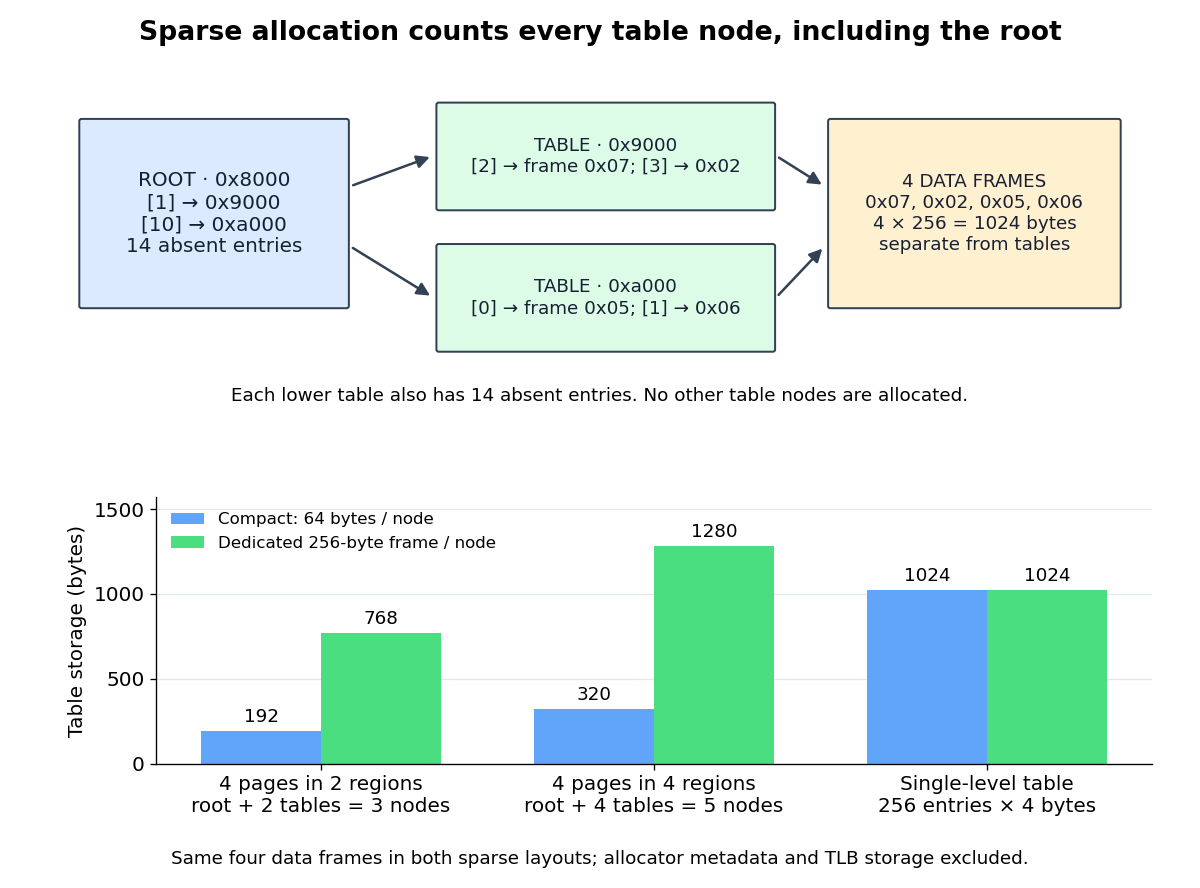
All table nodes for four mapped pages, and the footprint change when the same four pages occupy four root regions
. Details. Placement matters as well as mapping count. Four virtual memory pages
0x12, 0x42, 0x72, and 0xa2 require the root plus four lower-level tables: five nodes, 320 compact bytes, or 1280 bytes with a dedicated page frame per node. Only four data page frames are still required. Let be the number of distinct root indices represented by the mappings. With no retained empty lower-level tables, table storage is compact bytes or allocated bytes under the dedicated-page frame policy. Even an empty address space retains the root in this accounting, so costs 64 or 256 bytes.For a fully populated address space, : 17 nodes cost 1088 compact bytes or 4352 allocated bytes. The single-level table remains 1024 bytes. Sparse allocation is therefore a conditional space benefit; scattered mappings, node allocation granularity, and the root's overhead can reverse it. Additional dependent lookups on a TLB miss also have a cost, but node counts alone establish no universal execution-time ordering.
Choose an original teaching model with 16-bit virtual addresses, 16-bit physical addresses, and 256-byte memory pages and page frames. The eight high bits identify a virtual memory page; divide these into two four-bit indices. The eight low bits are the offset within the memory page. Thus each page table has 16 entries: the root selects a lower-level page table, and that table selects a data page frame. Every page table entry is four bytes, including its reference and flags. These are chosen model parameters, not a hardware entry encoding.
For a virtual address , extract the root index , lower-level index , and offset by Euclidean division:Here is the floor function and denotes the remainder in Euclidean division. Each index ranges from 0 to 15, and ranges from 0 to 255. In hexadecimal, virtual address
0x1234 splits into , , and ; its binary numeral system representation is 0001 | 0010 | 00110100.Fix the requested operation to be a one-byte user read. Assume both table nodes and the data page frame are resident, table reads are allowed, and no mapping changes during the page table walk. The model requires presence at both levels and takes the set intersection of the two entries' read, write, execute, and user-access permissions. This is an explicit memory protection rule for this model; Sv39 page tables use different rules. The root's physical address is
0x8000; the relevant entries are:| Record | Physical address of record | Reference held in the page table entry | Presence and permissions |
|---|---|---|---|
| Root entry 1 | 0x8000 + 1*4 = 0x8004 | Lower-level table at 0x9000 | Present; user; read/write; no execute |
| Lower-level entry 2 | 0x9000 + 2*4 = 0x9008 | Data page frame 0x07, base 0x0700 | Present; user; read-only; no execute |
The first lookup obtains a table reference, not the final data physical address. The second lookup obtains page frame number 7. Both entries permit a user read, so the original offset is added to the data page frame base:The page table walk therefore reads records at
0x8004 and 0x9008, then the requested read accesses data at 0x0734. All three are distinct physical addresses. These are two dependent table lookups followed by one data access, not a claim of three accesses to main computer memory: a memory cache can satisfy table lookups, and cached intermediate translations can skip them.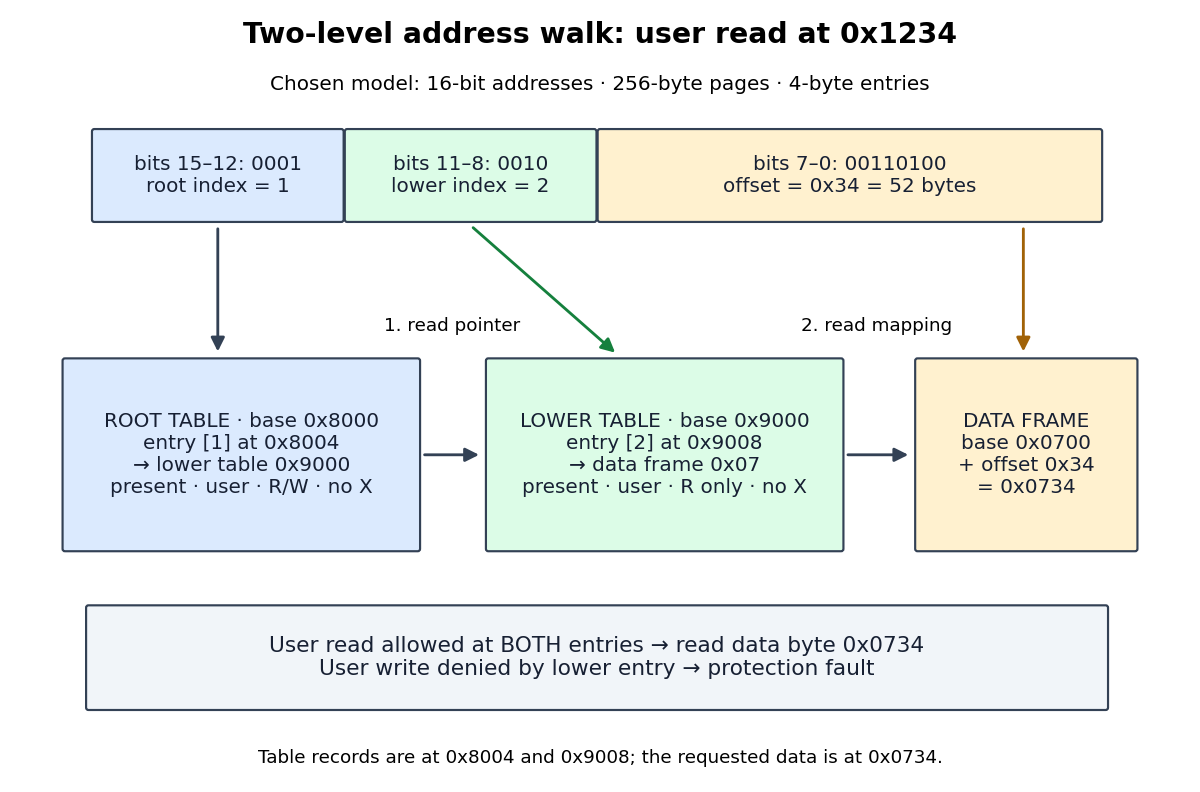
Under the same memory protection rule, a user write at
0x1234 fails because lower-level entry 2 denies writes, even though root entry 1 allows them. Clearing either entry's presence flag also prevents the access. An absent root entry stops the page table walk before any lower-level lookup. A page fault then requires the operating system to determine whether a permitted mapping needs storage or the access is invalid; absence alone does not establish demand paging eligibility.With an empty translation lookaside buffer, the permitted read causes a TLB miss and this successful page table walk, with no page fault. If the resulting mapping and permissions are cached for the current address space, a later read at
0x1235 can use a TLB hit to reach 0x0735. A later write can cause a protection page fault on a TLB hit because the cached mapping remains read-only. Assume cached permissions are current; changing them requires the architecture's prescribed invalidation. A TLB miss describes a missing cached translation, while a page fault describes an access that cannot proceed under the translation or protection rules. [ref]Page Tables by The kernel development community. MMU, TLB, and Page Faults: translation caches, page walks, and faults for missing or forbidden mappings
The moving-average polynomial records the coefficients of the finite noise filter. Evaluating it at the backshift operator gives . In a reduced ARMA representation, invertibility is equivalent to having no roots in the closed unit disc.
A multivariate moving-average model filters vector white noise through fixed matrix coefficients. If the noise has zero mean and lag-zero covariance matrix , with all nonzero-lag cross-covariances zero, then the filtered process is a weakly stationary process. With the convention , its covariance matrix is , omitting terms outside the filter range. Positive and negative lags satisfy .
At a nondegenerate critical point placed at the origin, integral Taylor theorem gives , where is a smooth symmetric matrix and . A constant linear change makes diagonal with entries . Successive completion of squares, with the Schur complement at each step, produces a smooth invertible triangular matrix such that . The pivots keep their nonzero signs near zero. The map has invertible derivative at zero, so the inverse function theorem makes it a coordinate system. The signs are the Hessian matrix signature by Sylvester's law of inertia.
For a closed manifold and a Morse function, the displayed strong inequalities hold for every , with equality at the top dimension. Indeed the Morse chain complex rank formula makes the alternating sum equal to . Adding the inequalities at and gives . The weak inequalities, even together with equality of Euler characteristics, are less restrictive: and satisfy those numerical conditions but violate the strong inequality at .
Here is the signed number of unparametrized trajectories of a Morse-Smale gradient flow from to . Compactifying one-dimensional trajectory moduli spaces gives . The generators coincide with the cells furnished by the unstable manifolds, and the trajectory count is their cellular incidence number, so the complex computes integral homology.
A nonconstant morphism of algebraic varieties between smooth projective integral curves is finite, and its degree is the degree of the induced extension of function fields. It is also the degree of the pullback of a rational point, with ramification multiplicities and residue degrees included: locally the finite coordinate algebra is a torsion-free module over the target discrete valuation ring, hence free of its generic rank. For and a rational function defining , the pullback of infinity is its pole divisor, so the total pole degree equals . A degree-one finite map to a normal curve is an isomorphism, since a finite integral algebra inside its unchanged function field equals the integrally closed target ring.
A -algebra isomorphism between the local rings at closed points extends to a morphism on some neighborhoods: represent the images of finitely many affine coordinate generators by fractions, and shrink where their denominators are nonzero and their finitely many relations hold. Extend its inverse the same way. The two compositions agree with the identity as germs; finitely many coordinate equalities make them identities after shrinking again. Taking inverse images of these neighborhoods then gives mutually inverse actual neighborhood isomorphisms, not just a formal-completion isomorphism.
A dominant morphism of varieties is generically finite when its extension of function fields is finite. Its degree is the degree of this field extension. A dominant morphism between integral varieties of equal dimension is generically finite; over a suitable nonempty open subset of the target its fibers are finite.
A flat proper morphism of algebraic varieties whose geometric fibres are plane conics, usually presented as a quadratic equation in a projective bundle of relative dimension two. The generic fibre is normally required to be smooth; singular conics can occur in special fibres. A conic bundle from a line on a smooth cubic surface has five reducible fibres over the projective line.
Pinned article: Introduction to the OurBigBook Project
Welcome to the OurBigBook Project! Our goal is to create the perfect publishing platform for STEM subjects, and get university-level students to write the best free STEM tutorials ever.
Everyone is welcome to create an account and play with the site: ourbigbook.com/go/register. We belive that students themselves can write amazing tutorials, but teachers are welcome too. You can write about anything you want, it doesn't have to be STEM or even educational. Silly test content is very welcome and you won't be penalized in any way. Just keep it legal!
Intro to OurBigBook
. Source. We have two killer features:
- topics: topics group articles by different users with the same title, e.g. here is the topic for the "Fundamental Theorem of Calculus" ourbigbook.com/go/topic/fundamental-theorem-of-calculusArticles of different users are sorted by upvote within each article page. This feature is a bit like:
- a Wikipedia where each user can have their own version of each article
- a Q&A website like Stack Overflow, where multiple people can give their views on a given topic, and the best ones are sorted by upvote. Except you don't need to wait for someone to ask first, and any topic goes, no matter how narrow or broad
This feature makes it possible for readers to find better explanations of any topic created by other writers. And it allows writers to create an explanation in a place that readers might actually find it.
Figure 1. Screenshot of the "Derivative" topic page. View it live at: ourbigbook.com/go/topic/derivativeVideo 2. OurBigBook Web topics demo. Source. - local editing: you can store all your personal knowledge base content locally in a plaintext markup format that can be edited locally and published either:This way you can be sure that even if OurBigBook.com were to go down one day (which we have no plans to do as it is quite cheap to host!), your content will still be perfectly readable as a static site.
- to OurBigBook.com to get awesome multi-user features like topics and likes
- as HTML files to a static website, which you can host yourself for free on many external providers like GitHub Pages, and remain in full control

Figure 2. You can publish local OurBigBook lightweight markup files to either OurBigBook.com or as a static website.
Figure 3. Visual Studio Code extension installation.
Figure 5. . You can also edit articles on the Web editor without installing anything locally. Video 3. Edit locally and publish demo. Source. This shows editing OurBigBook Markup and publishing it using the Visual Studio Code extension. 
- Infinitely deep tables of contents:




All our software is open source and hosted at: github.com/ourbigbook/ourbigbook
Further documentation can be found at: docs.ourbigbook.com
Feel free to reach our to us for any help or suggestions: docs.ourbigbook.com/#contact