Topics (384k) Articles (398k) Users (410) Discussions (242) Comments (383) Files (13k) New article
Repeatedly take the center of a group after quotienting by the preceding term. A group is a nilpotent group exactly when a finite term is the whole group. This yields the normalizer condition for nilpotent groups.
Choose the first term of the upper central series not contained in . The preceding term lies in , so an element of the new term outside commutes with modulo that preceding term and normalizes .
A finite group is nilpotent exactly when it is the direct product of groups of its Sylow subgroups. The normalizer condition for nilpotent groups and Sylow conjugacy force each Sylow normalizer to be the whole group. Distinct normal Sylow subgroups commute because their commutators lie in their trivial intersection. Conversely finite p-groups are nilpotent by the nontrivial center and induction; direct products preserve nilpotence.
If a nilpotent group is generated by , every element of its commutator subgroup is a product . The sets in the displayed formula need not be subgroups. Induct on the nilpotency class . Collection in gives the desired product with a central error. Since , that error is a product with . These factors are central, and centralizes , so replacing by absorbs the error. For a finitely generated pro-p group, applying this formula in all finite quotients and using compactness makes its algebraically generated commutator subgroup closed.
If a nilpotent group is generated by , every element of its commutator subgroup is a product . The sets in the displayed formula need not be subgroups. Induct on the nilpotency class . Collection in gives the desired product with a central error. Since , that error is a product with . These factors are central, and centralizes , so replacing by absorbs the error. For a finitely generated pro-p group, applying this formula in all finite quotients and using compactness makes its algebraically generated commutator subgroup closed.
Malcev completion of a torsion-free nilpotent group by  Codex 0 Created 2026-10-14 Updated 2026-11-05
Every finitely generated torsion-free group which is a nilpotent group embeds as a discrete cocompact subgroup of a unique simply connected nilpotent real Lie group. Its dimension equals the group's integral cohomological dimension of a group. In dimension three the Lie algebra is either abelian or has a basis with a single nonzero bracket , giving the real Heisenberg group.
Nilpotence criterion for an abelian-by-cyclic group by Codex 0 Created 2026-10-14 Updated 2026-11-05
Codex 0 Created 2026-10-14 Updated 2026-11-05For , the group commutator convention gives in additive notation. Its image is , since is an integral automorphism. The lower central series from its second term is . It terminates exactly when is a nilpotent matrix. For rank two this means , equivalently and . Nilpotence of a finite-index subgroup alone gives virtual nilpotence of the whole group.
A pseudo-Anosov homeomorphism preserves two transverse measured foliations and stretches one while contracting the other by the same factor greater than one. Unlike the Anosov homeomorphism case, the foliations may have singularities.
For finite-index subgroups of a rank- free group, the Nielsen–Schreier formula gives the displayed quotient. Along any sequence whose finite indices tend to infinity, the quotient tends to . Subtracting one from the rank before dividing gives the constant rank gradient .
// Target: geometry-and-topology.bigb
For a heterogeneous SIS model with common recovery rate and a positive endemic equilibrium , force balance gives . When the transmission matrix is irreducible and nonnegative, the positive equilibrium vector and the Perron–Frobenius theorem imply the displayed spectral radius identity. It replaces the homogeneous scalar relation : different recipient types generally have different susceptible fractions.
Assembling a spherical mass distribution in shells gives gravitational potential energy . Integration by parts gives the displayed identity when vanishes at both endpoints. It includes each interacting pair once; no extra factor of one half belongs in the original shell-assembly integral.
The dimensionless coefficient describes the leading axisymmetric departure of a planet's external Newtonian gravitational potential from a monopole: , where is colatitude from the spin axis. An oblate mass distribution has positive . The disturbing function is minus the nonspherical potential term. On a circular inclined Kepler orbit, , so orbit averaging gives . The exact circular nodal rate is ; its small-tilt limit is .
The potential describes the lapse perturbation in conformal Newtonian gauge. The spatial curvature perturbation is conventionally denoted ; the two are equal when the linear scalar anisotropic stress vanishes. On scales where the Newtonian limit applies, agrees with the peculiar gravitational potential. Its Fourier-mode variance and the power spectrum of a comoving curvature perturbation are different observables.
Oberlin College's documented demonstration uses a track, two collision carts, two force probes set to the range, added bars, and a laptop with a Vernier interface. Preparation consists of entering the measurement calibration, securing the force probes to the carts, and zeroing them. Rubber stoppers serve for elastic collisions, clay for inelastic collisions, and hooks with string for pulling. Comparing the two force records tests the mutual interaction; adding mass to one cart tests whether unequal masses change the equality. [ref]
Collision Carts and Force Sensors. Oberlin College, Collision Carts and Force Sensors, Apparatus, Description, and Notes: ranges, mounting, zeroing, attachments, and unequal-mass control
Vernier's force probe uses a bending beam with strain gauges; changing electrical resistance produces a voltage readout calibrated as force. Its manual recommends zeroing in the working orientation. If recalibration is needed, use an unloaded reading and a known suspended gravitational weight; for the range its example is giving . Re-zero after changing orientation. The manual quotes calibrated accuracy , distinct from the resolution of that range, and warns that the interface's data-collection rate can limit collision measurements. [ref]
The following sampling and control choices are proposed additions to that documented experiment. Level the track and check unloaded motion in both directions for slope and friction. Use a soft bumper and one interface for simultaneous records; start before contact and stop after separation. A trial sampling rate of , if supported, would put about 100 samples across a interaction. Increase the sampling rate and repeat until the peak and integrated impulse comparison are stable; a large sample count alone does not establish adequate response. Measure each total moving mass, including the force probe and added bars.
Convert both channels to the same right-positive force convention. Oppositely facing force probes can have matching raw signs because their local positive directions differ; check each sign by a gentle push of known direction before the run. Overlay and , and also examine their signed sum. Integrate both over the same contact interval to compare impulses. Repeat with added mass on one cart, exchange the probes between carts, and check unloaded zeros before and after. These controls help distinguish a physical mass change from a channel offset or gain error.
Agreement within measurement error supports the pair-interaction model over the resolved interval; it does not establish exact equality at arbitrarily short time scales. Misalignment, a loose mounting, sensor-beam dynamics, saturation, unequal timing, and zero drift can spoil the comparison. Track friction and cable pulls are additional external forces; a probe measuring bumper contact need not measure the entire net force on its cart. If a massive connector carries appreciable changing momentum, compare the full cart–connector collection rather than assuming its endpoint forces are an instantaneous cart-to-cart pair. The constructed pulse diagram above illustrates what to compare, and supplies no measurements from this apparatus.
For a fixed collection of two constant-mass bodies in an inertial frame, separate their mutual forces from the resultant external force on each:Adding the two Newton's second law equations and using Newton's third law givesThis is the proof of internal-force cancellation in system momentum. For more bodies, each internal force cancels with its partner once both appear in the sum. A boundary that excludes one interacting body leaves its force in the external force sum. A massive connecting spring must also be included, or its own changing momentum accounted for; its two endpoint forces are not automatically one third-law interaction pair between the carts.
Zero resultant external force gives momentum conservation; complete absence of external forces is sufficient but unnecessary. For constant total mass , the centre of mass has velocity and obeys . Internal interactions can move the parts apart while leaving the centre of mass moving uniformly.
Additional external forces do not invalidate the identified mutual pair. At the instant above, suppose a hand also exerts on . The mutual forces remain and , but the net forces become on and on . Consequently , , , and the centre of mass has acceleration . Pair equality by itself does not promise constant total momentum.
Choose right as positive and let two carts have total moving masses and , including any attached apparatus. At an instant when their repulsive interaction has magnitude , assume no other horizontal forces. Then Newton's third law gives and , while Newton's second law givesThe smaller mass has the larger acceleration magnitude. For a nonzero interaction and zero other horizontal forces, . Meanwhile in force units. The two carts' velocities change while total momentum stays constant.
To distinguish an instantaneous force from its accumulated impulse, prescribe an original triangular interaction pulse lasting :This chosen pulse reaches at ; it is a constructed model, not an experimental trace or a claim about a particular bumper's material response. Its positive area is . The impulse-momentum theorem therefore givesOpposite impulses give opposite momentum changes, while the velocity changes differ because of the unequal masses. The cumulative positive impulse is during the first half and during the second half. Thus and cancel throughout the pulse, not merely at its endpoint.
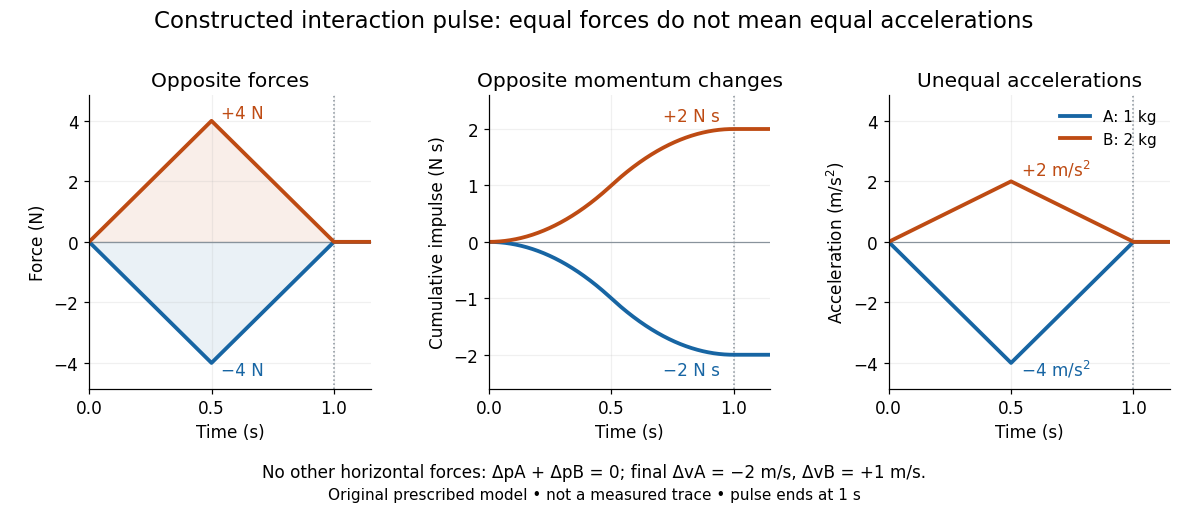
A third-law interaction pair consists of the two forces belonging to the same mutual interaction, with their agent and recipient exchanged. The names action-reaction pair do not imply a delay: in the instantaneous model, the two forces occur together. Test a proposed pair by naming both bodies and the interaction, rather than merely noticing equal magnitudes and opposite directions.
For a book resting on a table, the table's upward normal force and Earth's downward gravitational weight both act on the book. They can balance in the book's free-body diagram, but they are not a third-law interaction pair. The partner of the table's normal force on the book is the book's downward contact force on the table. The partner of Earth's gravitational force on the book is the book's gravitational force on Earth. Their equality does not require equal accelerations: Earth's much greater mass makes its response correspondingly smaller for a given net force.
Similarly, friction on a sliding block from a surface is paired with friction on that surface from the block. For the collection containing only the block, that friction is an external force; including the contacting surface makes both members internal forces. Changing the collection changes the bookkeeping of momentum, not the physical interaction.
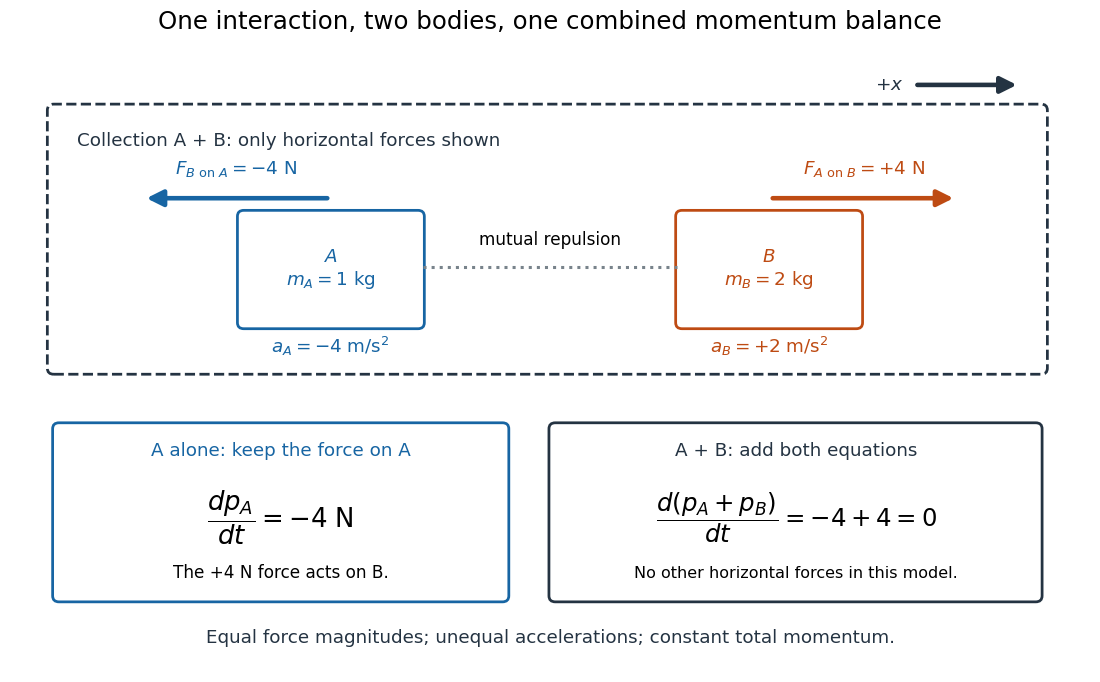
Equal opposite interaction forces act on different bodies and cancel only in the combined momentum balance
. Original one-dimensional model with right positive, and . The upper arrows are the mutual forces; the lower panels retain the force on alone and add both bodies' momentum equations. Only horizontal forces are shown; balanced vertical support is omitted. Details.An idealized front at distance down a uniform slope entrains stationary material so that its moving mass is proportional to . Its linear momentum balance is , where . Multiplying by gives . Every forward-moving branch tends to as , and . Acceleration is smaller than the constant-mass downslope value because some momentum accelerates newly entrained material.
The polynomial identities remain true in positive characteristic of a field, but recovering elementary symmetric polynomials by division can fail. In the prime field of characteristic two, the root lists and have the same power sum zero for every positive exponent: and . Their monic polynomials differ, however: and . Thus even all positive power sums need not determine the polynomial when its degree meets the characteristic. The relation becomes and supplies no value for .
Pinned article: Introduction to the OurBigBook Project
Welcome to the OurBigBook Project! Our goal is to create the perfect publishing platform for STEM subjects, and get university-level students to write the best free STEM tutorials ever.
Everyone is welcome to create an account and play with the site: ourbigbook.com/go/register. We belive that students themselves can write amazing tutorials, but teachers are welcome too. You can write about anything you want, it doesn't have to be STEM or even educational. Silly test content is very welcome and you won't be penalized in any way. Just keep it legal!
Intro to OurBigBook
. Source. We have two killer features:
- topics: topics group articles by different users with the same title, e.g. here is the topic for the "Fundamental Theorem of Calculus" ourbigbook.com/go/topic/fundamental-theorem-of-calculusArticles of different users are sorted by upvote within each article page. This feature is a bit like:
- a Wikipedia where each user can have their own version of each article
- a Q&A website like Stack Overflow, where multiple people can give their views on a given topic, and the best ones are sorted by upvote. Except you don't need to wait for someone to ask first, and any topic goes, no matter how narrow or broad
This feature makes it possible for readers to find better explanations of any topic created by other writers. And it allows writers to create an explanation in a place that readers might actually find it.
Figure 1. Screenshot of the "Derivative" topic page. View it live at: ourbigbook.com/go/topic/derivativeVideo 2. OurBigBook Web topics demo. Source. - local editing: you can store all your personal knowledge base content locally in a plaintext markup format that can be edited locally and published either:This way you can be sure that even if OurBigBook.com were to go down one day (which we have no plans to do as it is quite cheap to host!), your content will still be perfectly readable as a static site.
- to OurBigBook.com to get awesome multi-user features like topics and likes
- as HTML files to a static website, which you can host yourself for free on many external providers like GitHub Pages, and remain in full control

Figure 2. You can publish local OurBigBook lightweight markup files to either OurBigBook.com or as a static website.
Figure 3. Visual Studio Code extension installation.
Figure 5. . You can also edit articles on the Web editor without installing anything locally. Video 3. Edit locally and publish demo. Source. This shows editing OurBigBook Markup and publishing it using the Visual Studio Code extension. 
- Infinitely deep tables of contents:




All our software is open source and hosted at: github.com/ourbigbook/ourbigbook
Further documentation can be found at: docs.ourbigbook.com
Feel free to reach our to us for any help or suggestions: docs.ourbigbook.com/#contact