Topics (384k) Articles (398k) Users (410) Discussions (242) Comments (383) Files (13k) New article
Exact reconstruction does not promise that small errors in power sums produce proportionally small errors in individual polynomial roots. For two roots, let and . Newton's identities give and , so the monic polynomial is . Its polynomial roots are . A zero value of gives a multiple root; positive splits it into two real roots, and negative splits it into a complex-conjugate pair.
With , the second power sum changes by while each polynomial root moves by . The ratio grows without bound as tends to zero. Thus coefficients can stay close while individual root locations are more sensitive. This is a reason to distinguish recovering coefficients by Newton's identities from subsequently approximating the polynomial roots.
For a complex matrix , is the sum of the th powers of its eigenvalues, counted with algebraic multiplicity. This does not require diagonalizability: a similar upper triangular matrix has the eigenvalues on its diagonal, and taking powers raises those diagonal entries to their corresponding powers. Newton's identities therefore recover its characteristic polynomial from the first such traces.
For the Jordan block , and . Hence and , giving . The repeated eigenvalue is recovered even though this matrix is not diagonalizable.[ref]
For the monic polynomial , its root power sums satisfyEach root obeys . Multiplying that equation by and summing over root positions proves the recurrence relation. The first power sums are initialized by Newton's identities; their later values require only this fixed-order recurrence. For , it gives . Directly, . No new root-solving step is needed.[ref]
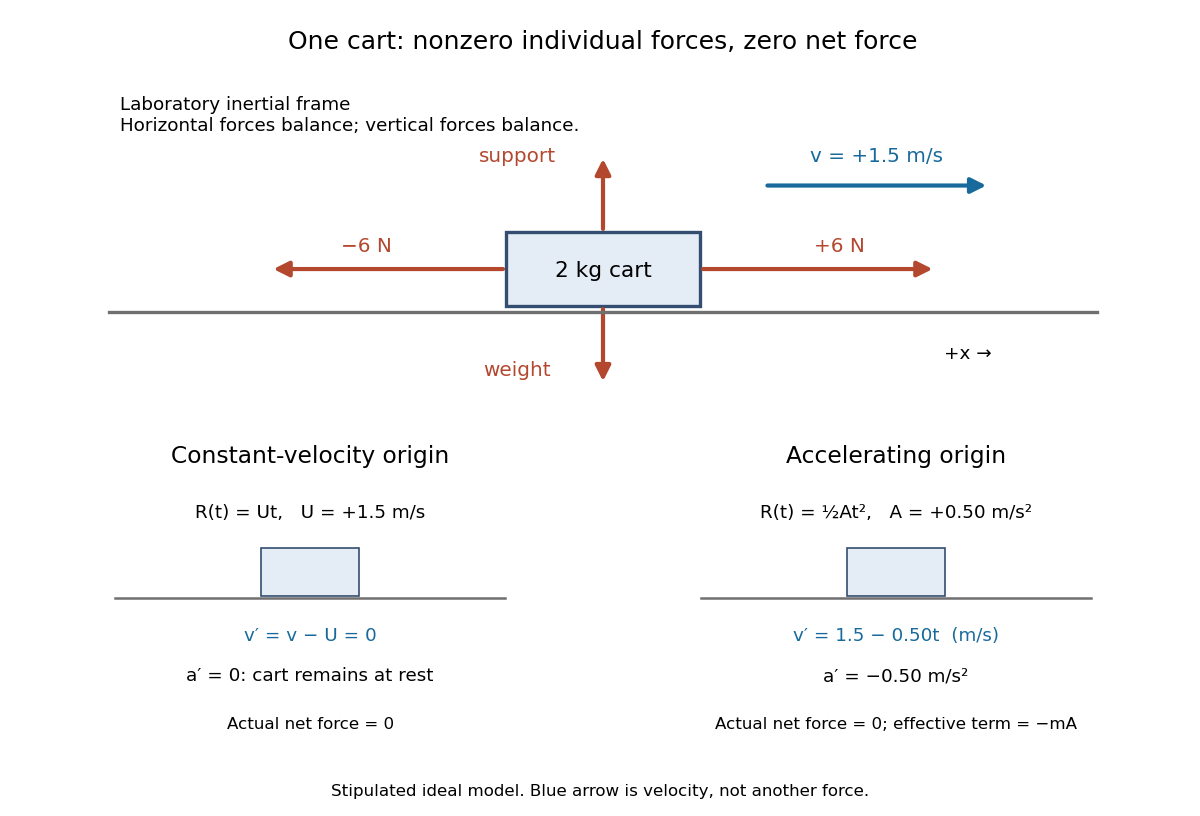
Constant velocity depends on the reference frame. For nonrotating axes and a moving origin of laboratory position , subtracting that origin givesIf with constant velocity , the Galilean transformation leaves acceleration unchanged. The cart moving at in the laboratory is at rest in a frame moving right at . Both descriptions obey Newton's first law.
Instead choose an origin with , where the stipulated constant points right. The same cart hasAt , the cart is instantaneously at rest relative to this accelerating origin, but its relative acceleration is nonzero. In this translating accelerated reference frame, Newton's second law must include the effective inertial force . This term accounts for the accelerating coordinates; the actual external forces on the cart still sum to zero. No rotation-dependent terms are present because the axes remain parallel to the laboratory axes.
An actual teaching experiment in Arbor Scientific's The Level Air Track uses one glider, an air track, two photogates, and a ruler. Turn on the blower and place the glider near the middle. Adjust the feet until it does not drift when released. Put the photogates at least half a track length apart and align them with the glider's flag. Measure the length that interrupts the beams. Give a gentle push, let go, and record each beam-blocking time . The readout is the pair of speeds . The worksheet asks how those speeds compare, which forces remain after the push, and which interaction the air track minimizes.[ref]
The motivating contrast is between a brief push and the subsequent glide. The air cushion reduces contact friction; it does not remove the downward gravitational weight or the upward support force. Similar successive speeds after release are consistent with a small horizontal net external force, rather than with a continuing push. The experiment approximates the zero net external force model over a finite track and observation interval.
To strengthen the documented procedure, use independent measurement calibration: check the flag length and each timer against a known length and time reference; measuring sets the length scale but does not calibrate the timer. Repeat launches in both directions without contact during the timed passage, and check for drift at several track locations. These are additional controls, not reported steps or measured results in the worksheet. A residual inclined plane produces a downhill component of gravitational weight with the same laboratory direction on both runs; friction and drag force oppose the direction of travel. Reversing the launch can therefore help distinguish these effects.
A photogate directly measures a beam-blocking time; is an average speed during that passage, not an exact instantaneous velocity. Assign the direction separately. Equal readings at two gates do not prove zero acceleration everywhere between them: opposing changes could cancel. Measurement uncertainty from timer resolution, an incorrectly measured flag length, residual slope, airflow disturbances, and remaining friction or drag force limit the inference. No measured glider speeds are assumed here.
Consider a stipulated ideal cart modeled as a point mass of mass on a horizontal track in a laboratory inertial frame. Its initial position is and its initial velocity is to the right. Independent devices exert horizontal forces and on this same cart. Its upward support force balances its downward gravitational weight; no other forces contribute. Rotation and deformation are excluded from this model.After , the cart is at , still moving right at . Starting the same model at rest instead would leave it at rest. Force balance determines the zero acceleration, while the initial velocity determines whether the cart moves.
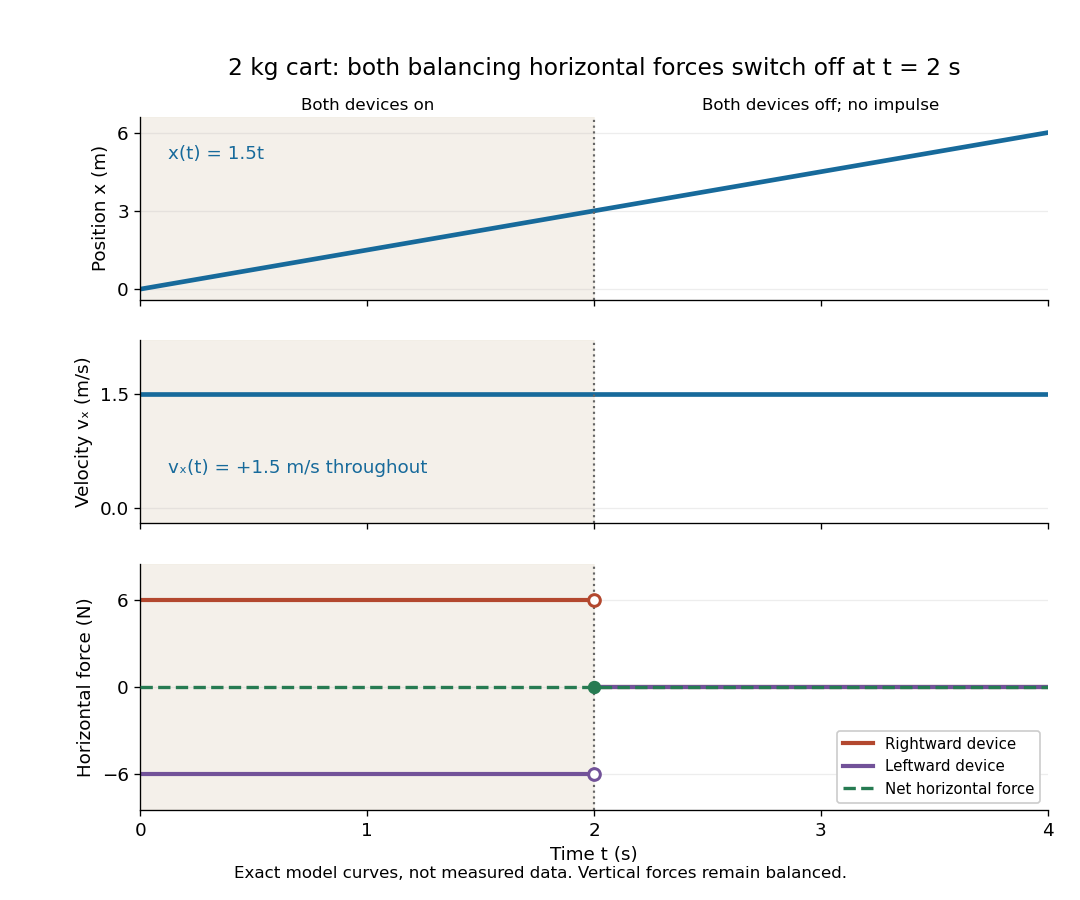
For the plotted model, both horizontal devices are switched off simultaneously at , with no impulse. The support and gravitational weight remain balanced. The individual horizontal forces change, but their sum stays zero on both sides of the switch, so the velocity stays continuous and unchanged. Switching off just one device would be a different model with a nonzero net external force.
Let , and near . The integral Taylor remainder givesA small ball with is invariant under . Iteration there converges at least quadratically, with for .
// Target: numerical-analysis.bigb
Frozen Newton correction for a fixed-point equation by  Codex 0 Created 2026-10-14 Updated 2026-10-25
To solve , let be a bounded approximation to and set . Its derivative is . Every fixed point of is fixed by ; the converse holds when is injective. A good inverse approximation makes a contraction mapping even if itself has an expanding direction.
// Target: analysis.bigb
Using , the Newton–Cartan gravitational connection has only the displayed Hessian components and their antisymmetric partners in the last two indices. The geodesic deviation equation gives relative acceleration . The Poisson equation for Newtonian gravity is therefore . A spatially uniform gravitational acceleration has zero tidal curvature even if the connection coefficients do not vanish in the original coordinates.
At a nonzero critical wavenumber in an isotropic medium, a small transverse wavevector changes its magnitude only at second order. Balancing radial detuning therefore requires the displayed unequal slow-space scales. With the positive carrier , the leading Newell–Whitehead–Segel equation spatial term is . A roll detuning has transverse phase growth ; negative permits a zigzag instability. Changing the carrier convention changes the accompanying sign of . Replacing this operator by an isotropic second-order Laplacian misses the critical circle's geometry.
A formula is stratified if its variables can be assigned integer types so that equality relates variables of the same type and membership requires . Unary set predicates impose no additional difference. Stratification is a syntactic condition; it does not assert that the untyped universe actually has disjoint types. Translating a stratified formula into a typed model permits type-shifting automorphism to recover untyped comprehension.
For an integer-indexed typed model, a type-shifting automorphism is a bijection from each type to the next preserving equality, adjacent-type membership and the set predicates. On type zero define by . Stratified formulas are translated by sending a variable of type to . Typed comprehension then gives the untyped comprehension of NFU. Such an automorphism is external; formulas containing it are not included in the typed comprehension scheme.
A holomorphic function on the unit disc has bounded characteristic when , where . Thus it belongs to the Nevanlinna class. A general meromorphic function requires the additional pole-counting term in its characteristic; the displayed analytic definition has no such term.
An optical and infrared transient powered by radioactive decay in material ejected from a compact-object merger. Its evolving spectrum and light curve probe ejecta composition and rapid neutron-capture process production.
During radiation domination, the weak conversion rate scales as whereas the Hubble parameter scales as . Their crossing fixes the cosmological weak freeze-out temperature. A faster expansion raises it, leaving a larger neutron-to-proton ratio, and shortens the interval for free-neutron decay after freeze-out. Both effects increase the helium-4 mass fraction if the extra component does not independently change reaction rates or inject decay products.
Let , , and . The Wronskian identity for the first-order Rayleigh equation for inviscid shear flow, combined with neutral-mode critical-layer matching, gives . For real , its imaginary part is . The Cauchy principal value is necessary when the outer forcing has a simple real pole.
Let count neutral hydrogen absorbers per column density and absorption distance. The summed column per unit proper light-path length is the mean neutral number density. Since and , that density is . Dividing the proper mass density by gives the comoving density in the displayed formula. The denominator is today's critical density; including neutral helium requires a stated mass correction. For a distribution per redshift, replace by .
A neutral-hydrogen column density traces total hydrogen column only after specifying its neutral fraction . Integrating the latter against the distribution per absorption distance gives the comoving gas mass density in the displayed expression. The factor includes helium if desired. In photoionization equilibrium for optically thin, almost fully ionized hydrogen, , so gas density, temperature, photoionization rate and absorber size are required. An observed distribution alone does not fix the total baryon inventory.
Choose the following original phenomenological mathematical model solely to calculate a paired-pulse readout. It is not experimental data, a fit to the teaching experiment, or a simulation of the Hodgkin-Huxley model. The conditioning action potential defines time zero. Test pulses have fixed width ; denotes their inward electric current amplitude. Impose an absolute neuronal refractory period . No finite test amplitude generates an event for . After that hold, stipulate a required amplitudewith , dimensionless and recovery time constant . Emit a test event exactly when , including equality. For this ideal event readout, assign events to pulse onset and assume the conditioning event is successfully evoked. There is no calculated membrane potential, spike waveform, response latency or stochastic success probability.
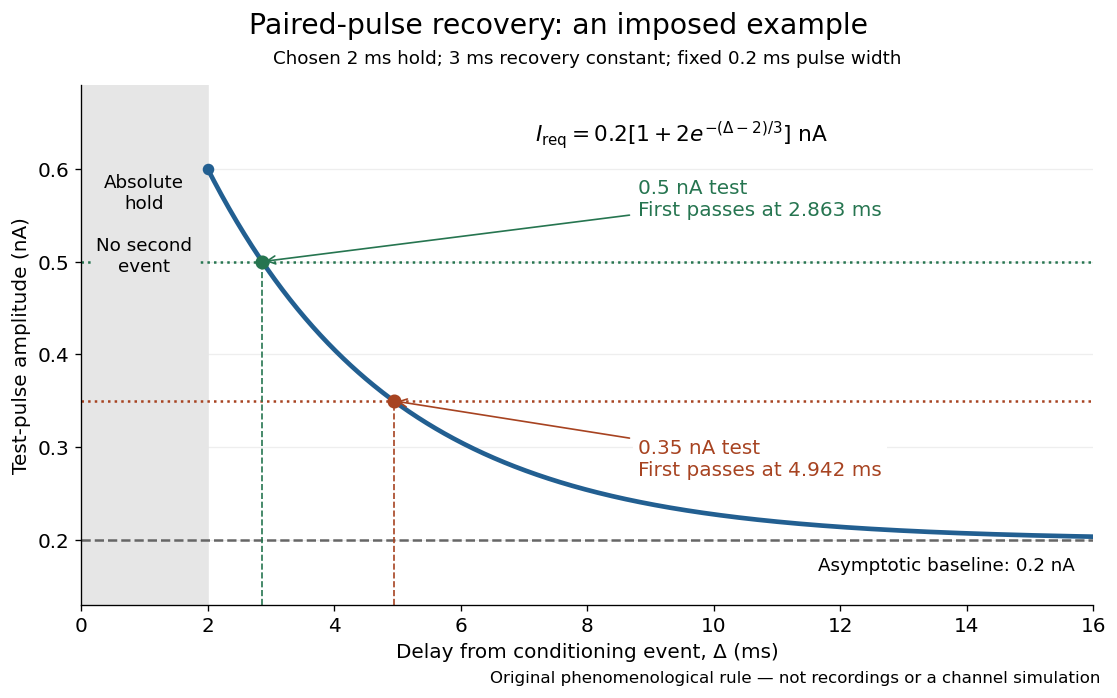
The exponential decay represents a combined recovery deficit; it is neither the Hodgkin-Huxley model's nor a measured potassium electrical conductance. One such curve cannot separately identify sodium recovery and persistent potassium electrical conductance. A constant pulse-width amplitude criterion also does not establish an equivalent rule for other pulse widths or voltage trajectories.
At the hold boundary, . At ,at ,Thus a test fails at because of the imposed hold, fails at because recovery is insufficient for that amplitude, and succeeds at . At , a pulse would instead succeed: failure of the weaker pulse was relative refractoriness.
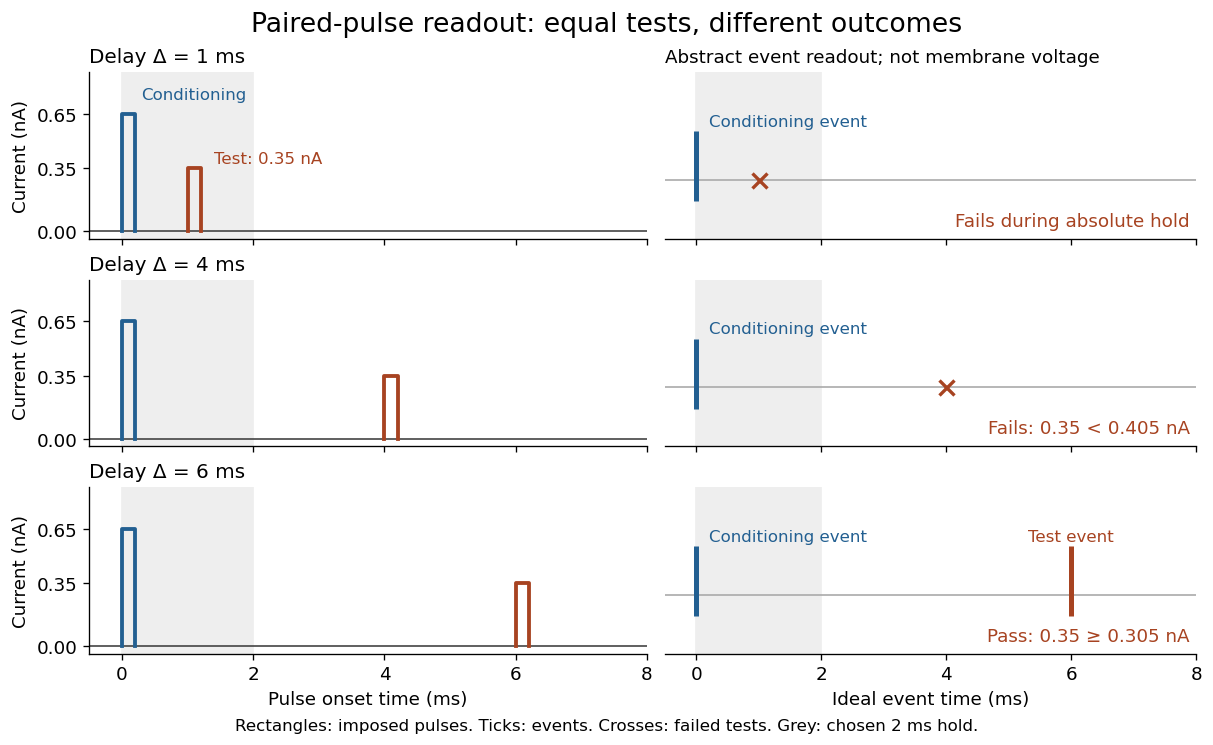
For , solve using the logarithm. The earliest allowed delay isFor this is ; for it is . If , the imposed hold is the only delay restriction. If , no finite delay passes the rule: the required amplitude stays strictly above its asymptotic baseline. A finite experimental “fully recovered” time therefore also needs a tolerance and a readout definition.
This elliptic equation on a spacelike spin hypersurface uses the restriction of the spacetime spin connection, including extrinsic curvature. The spinor tends to a prescribed constant at spatial infinity. It removes the negative derivative square in the divergence of the Nester two-form. It is weaker than the spacetime Killing spinor equation; generic positive-energy initial data need not admit any Killing spinor.
Pinned article: Introduction to the OurBigBook Project
Welcome to the OurBigBook Project! Our goal is to create the perfect publishing platform for STEM subjects, and get university-level students to write the best free STEM tutorials ever.
Everyone is welcome to create an account and play with the site: ourbigbook.com/go/register. We belive that students themselves can write amazing tutorials, but teachers are welcome too. You can write about anything you want, it doesn't have to be STEM or even educational. Silly test content is very welcome and you won't be penalized in any way. Just keep it legal!
Intro to OurBigBook
. Source. We have two killer features:
- topics: topics group articles by different users with the same title, e.g. here is the topic for the "Fundamental Theorem of Calculus" ourbigbook.com/go/topic/fundamental-theorem-of-calculusArticles of different users are sorted by upvote within each article page. This feature is a bit like:
- a Wikipedia where each user can have their own version of each article
- a Q&A website like Stack Overflow, where multiple people can give their views on a given topic, and the best ones are sorted by upvote. Except you don't need to wait for someone to ask first, and any topic goes, no matter how narrow or broad
This feature makes it possible for readers to find better explanations of any topic created by other writers. And it allows writers to create an explanation in a place that readers might actually find it.
Figure 1. Screenshot of the "Derivative" topic page. View it live at: ourbigbook.com/go/topic/derivativeVideo 2. OurBigBook Web topics demo. Source. - local editing: you can store all your personal knowledge base content locally in a plaintext markup format that can be edited locally and published either:This way you can be sure that even if OurBigBook.com were to go down one day (which we have no plans to do as it is quite cheap to host!), your content will still be perfectly readable as a static site.
- to OurBigBook.com to get awesome multi-user features like topics and likes
- as HTML files to a static website, which you can host yourself for free on many external providers like GitHub Pages, and remain in full control

Figure 2. You can publish local OurBigBook lightweight markup files to either OurBigBook.com or as a static website.
Figure 3. Visual Studio Code extension installation.
Figure 5. . You can also edit articles on the Web editor without installing anything locally. Video 3. Edit locally and publish demo. Source. This shows editing OurBigBook Markup and publishing it using the Visual Studio Code extension. 
- Infinitely deep tables of contents:




All our software is open source and hosted at: github.com/ourbigbook/ourbigbook
Further documentation can be found at: docs.ourbigbook.com
Feel free to reach our to us for any help or suggestions: docs.ourbigbook.com/#contact