Topics (384k) Articles (398k) Users (410) Discussions (242) Comments (383) Files (13k) New article
A morphism of algebraic varieties whose source and target are algebraic curves. A nonconstant morphism between smooth projective curves is finite and surjective; its degree is the degree of the induced extension of function fields.
For a nonzero matrix , the operator norm induced by the Euclidean norm satisfies , where is its smallest positive singular value. The singular value decomposition makes the danger visible: a small nonzero stretch becomes a large amplification of errors when inverted.
For instance, when ,A data perturbation changes the reconstructed input by . At , however, the pseudoinverse is : exactly zero and merely small are different cases. Thus the pseudoinverse need not be continuous across a change of matrix rank. With uncertain data, truncated singular value decomposition or Tikhonov regularization can trade exact inversion of weak directions for stability; the cutoff or penalty adds a modelling choice.
Now take one equation for two unknowns:The linear system has an entire affine line of exact solutions. Since has full row rank, its Moore-Penrose inverse isThe kernel is , and all exact solutions areBecause is orthogonal to ,The Euclidean norm is therefore smallest exactly at . The zero residual alone cannot select a solution; the minimum-norm rule supplies the additional criterion.
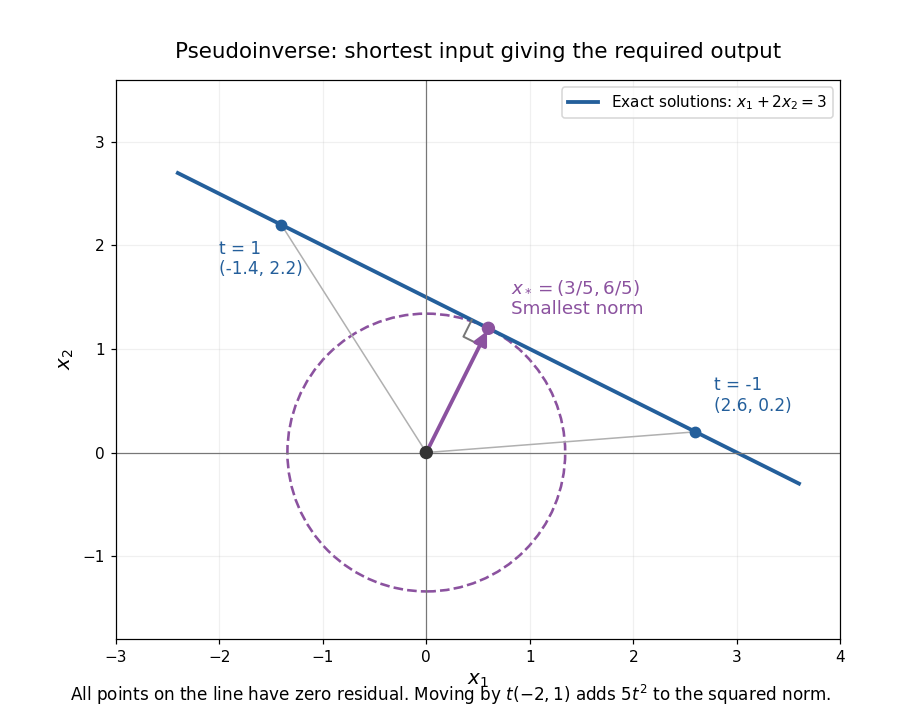
The minimum-norm solution is the closest point of the solution line to the origin
. The affine line is perpendicular to . Moving along the line changes only a kernel component and increases by . Details.This selection depends on the specified inner product. Rescaling one unknown changes what counts as a small Euclidean norm, so units and weighting matter in an application. A minimum-norm answer is mathematically canonical for the chosen geometry, rather than an automatic guarantee of physical plausibility.
Suppose three measurements constrain two unknowns:The linear system asks for , , and , which are incompatible. A least-squares solution makes a balanced compromise. The matrix has full column rank, soThe fitted output and residual areThus the two direct measurements are each overshot by one, and the measured sum is undershot by one. The residual has Euclidean norm and is orthogonal to the column space, the plane in output coordinates .
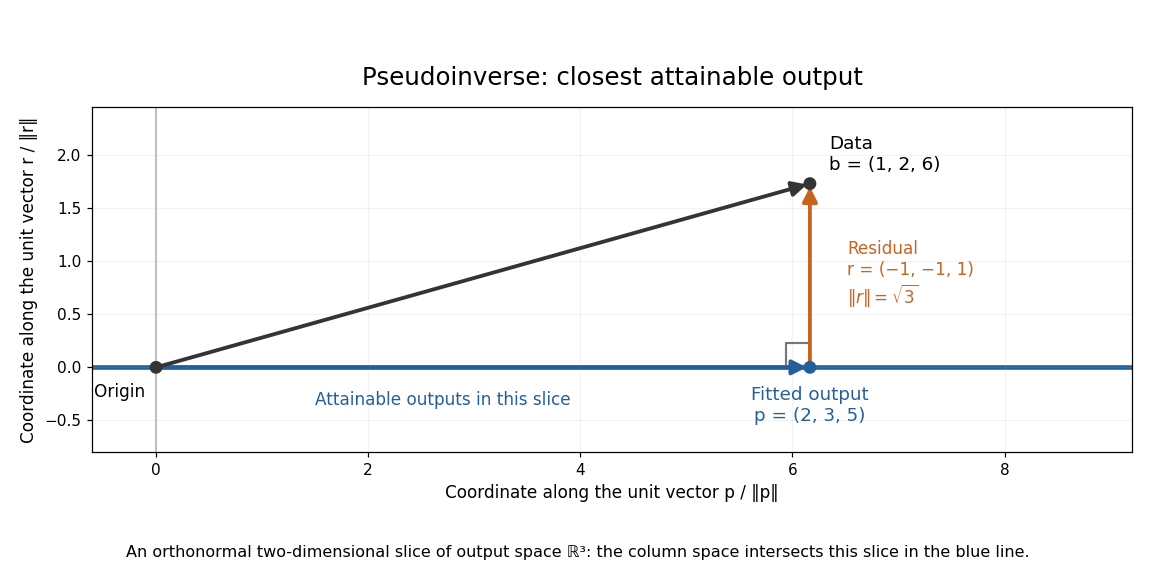
For any perturbation , the orthogonality of to givesSince the kernel of is trivial, every nonzero increases the residual. The least-squares solution is unique in this example. The formula using is convenient for these small exact calculations; an actual numerical computation can use a QR decomposition or singular value decomposition to avoid the extra conditioning cost of the least-squares normal equations. For full column rank, the squared singular values of are the eigenvalues of , so its condition number in the Euclidean norm is . [ref]
https://ocw.mit.edu/courses/18-065-matrix-methods-in-data-analysis-signal-processing-and-machine-learning-spring-2018/resources/lecture-9-four-ways-to-solve-least-squares-problems/. Strang, MIT 18.065 Lecture 9: four ways to solve least-squares problems
Libration is the apparent rocking of a body as seen by an observer. For the Moon, longitudinal libration arises because orbital eccentricity makes its orbital angular speed vary while its spin is much more uniform: the direction to Earth advances ahead of, then falls behind, the mean facing direction. The Moon's tilted geometry also causes latitudinal libration; small actual rotational oscillations provide further corrections. Thus lunar synchronous rotation holds in the mean, rather than requiring exact instantaneous alignment. [ref]. [ref].
A lunar eclipse occurs when Earth blocks some or all of the direct sunlight reaching the Moon. It requires alignment near full Moon; the orbital inclination usually carries the Moon clear of Earth's shadow. Ordinary lunar phases instead arise from viewing different amounts of the sunlit hemisphere. [ref].
A lunar phase is the appearance of the sunlit portion of the Moon as seen from Earth. Outside a lunar eclipse, the distant Sun illuminates approximately one hemisphere of the Moon, but an observer sees a changing overlap of that hemisphere with the hemisphere facing Earth. The lunar phase therefore changes even though synchronous rotation keeps approximately the same near side of the Moon facing Earth. [ref].
The cycle runs through new Moon, waxing crescent, first quarter, waxing gibbous, full Moon, waning gibbous, last quarter and waning crescent. “Waxing” means that the lunar illuminated fraction is increasing; “waning” means it is decreasing. A crescent has less than half its apparent disk sunlit, and a gibbous lunar phase has more than half. First and last quarter each show half a disk: “quarter” refers to progress around the cycle, rather than a quarter of the disk being lit. [ref]
https://aa.usno.navy.mil/data/MoonFraction. US Naval Observatory: disk fractions and waxing versus waning
.An instructive circular orbit model puts Earth at the origin, the Sun far away along , and the Moon at . The sunward position , , gives new Moon; the opposite position , , gives full Moon. Counterclockwise motion gives first quarter at and last quarter at . The Sun's direction is fixed during this snapshot of the cycle. Every small globe in the orbital view is illuminated on its half; the adjacent apparent disks are separate views from Earth, rather than globes viewed from above.
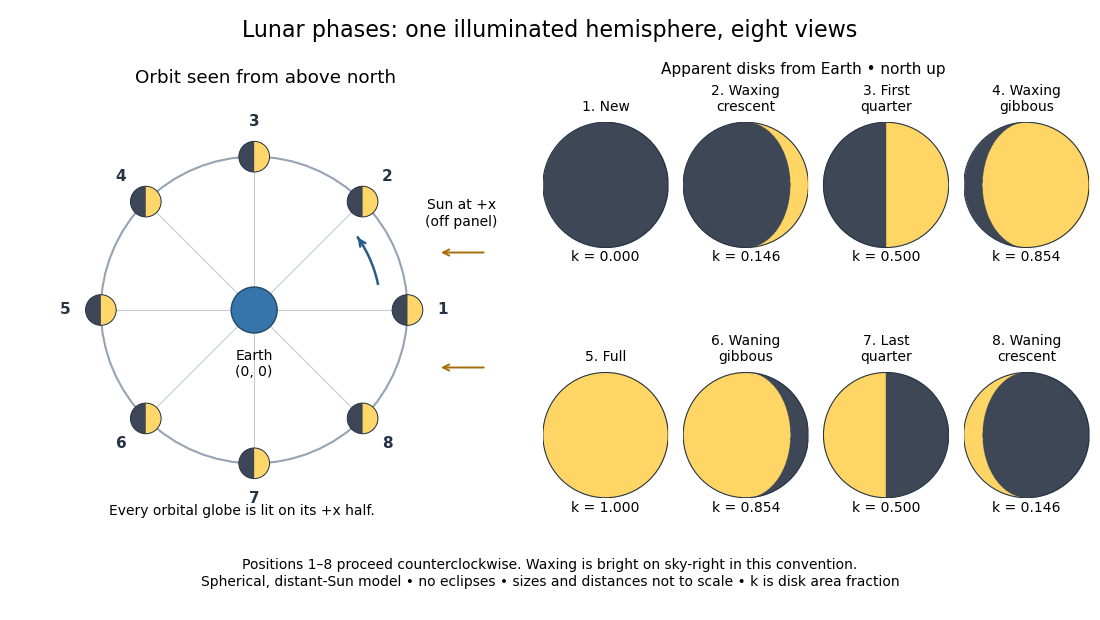
The disk views choose north up, with the upward direction perpendicular to the orbital plane. In this convention waxing lunar phases are bright on the right and waning lunar phases on the left. Local horizon orientation and viewing from different locations on Earth can rotate the apparent disk; its lit edge always points toward the projected direction of the Sun. The lunar illuminated fraction is unaffected by this rotation.
The useful angle is the phase angle , with the Sun, the Moon and the observer at Earth's center: its vertex is at the Moon. Full Moon has , quarter has , and new Moon has in the ideal model. By contrast, the elongation has its vertex at Earth. For a distant Sun, its rays are parallel, soHere is the lunar illuminated fraction: a fraction of projected disk area, not a fraction of the Moon's total surface area or its received radiant flux relative to full Moon. The phase angle and unsigned elongation each lie between and , so either alone gives the illuminated amount without distinguishing waxing from waning. The orbital direction resolves that ambiguity.
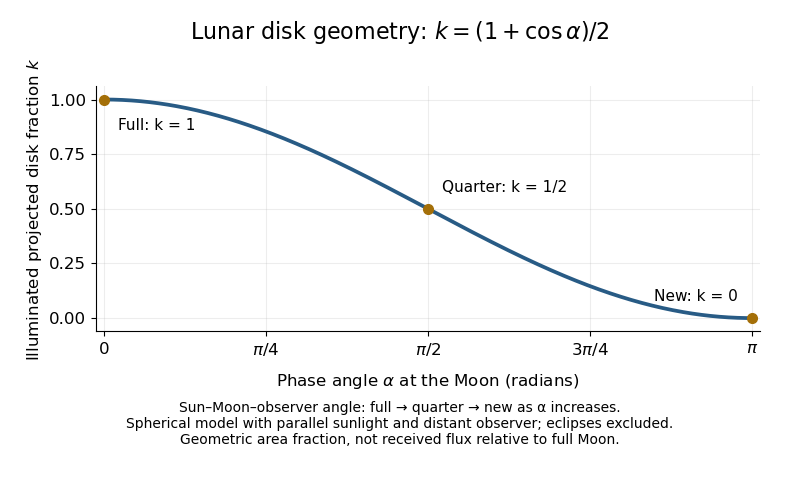
The lunar illuminated fraction has an elegant geometric derivation. Model the Moon as a sphere of unit radius and view it along the direction. Take the Sun's unit direction to be . A visible surface point above apparent disk coordinates has . Direct illumination requires the outward normal's dot product with the sunward direction to be positive. The day-night terminator therefore obeys . At a fixed , set ; the visible day-night terminator is , and the illuminated strip extends from to the right edge . Integrating its width givesThe integral is the area of half a unit circle. Thus a three-dimensional visibility problem reduces to a circle's area and a cosine. The derivation assumes parallel sunlight, a distant observer and a sphere, and ignores a lunar eclipse. Real observed brightness additionally depends on surface scattering of light and observing geometry, so does not promise half the full-Moon radiant flux.
For a worked example, elongation gives phase angle and : a crescent with of its apparent disk sunlit. At elongation , the phase angle is and : a gibbous lunar phase. At , . In each case the same occurs once while waxing and once while waning in the ideal cycle.
Ordinary lunar phases are not caused by Earth's shadow. A lunar eclipse occurs only when the Moon actually enters that shadow near full Moon. The orbital inclination of the Moon is about relative to Earth's orbital plane around the Sun; most full Moons pass above or below the shadow. This is why full Moon does not imply a lunar eclipse every month. [ref]
https://science.nasa.gov/moon/eclipses/. NASA: lunar eclipses and the Moon's roughly five-degree orbital tilt
.The phase cycle is a synodic month, about days, whereas the Moon's orbital period relative to distant stars is a sidereal month, about days. During one sidereal month, Earth advances around the Sun, so the Moon must move farther to repeat the sunward alignment. For coplanar circular orbits traversed in the same direction, subtract their mean motions: , with . HenceUsing and gives , consistent with the mean synodic month of days. After one sidereal month, the sunward direction has advanced about ; catching up takes about more days. These are mean-period estimates: orbital eccentricity and changing geometry make individual synodic months vary. [ref]
https://eclipse.gsfc.nasa.gov/SEhelp/moonorbit.html. Fred Espenak, NASA: sidereal and synodic months and varying lunations
. [ref]https://nssdc.gsfc.nasa.gov/planetary/factsheet/earthfact.html. David R. Williams, NASA: Earth's sidereal orbital period
.The lunar phase is also a practical clock for observing. Full Moon is opposite the Sun and rises roughly at sunset; first quarter is about a right angle from the Sun and is convenient in the evening, while last quarter is convenient before dawn. These are rough guides, not exact rise-time predictions for every place and season. [ref]. Historically, repeated lunar phases provided the month in lunar calendars, while half-lit disks gave Aristarchus of Samos a way to infer astronomical distances. [ref]
https://eclipse.gsfc.nasa.gov/SEhelp/moonorbit.html. Fred Espenak, NASA: lunations and lunar calendars
.The far side of the Moon is the hemisphere directed approximately away from Earth. “Far” describes the direction to Earth; it does not describe illumination by the Sun. The far side of the Moon experiences both sunlight and darkness during the lunar phase cycle. [ref].
The near side of the Moon is the hemisphere directed approximately toward Earth. Libration changes the exact visible boundary, so synchronous rotation does not mean that an observer always sees precisely the same hemisphere.
A real-valued function is a strictly decreasing function if every pair in its domain of a function satisfies . It is a nonincreasing function and is injective, with a strictly decreasing inverse function on its image of a function. Negating a strictly increasing function gives a strictly decreasing function: is an example on the real line, even though its derivative vanishes at zero. Equal outputs are forbidden, unlike for a general nonincreasing function.
For a continuous unbounded nondecreasing function on the nonnegative half-line and , the non-strict inverse is left-continuous in its level argument. It equals the left limit of the strict generalized inverse of a nondecreasing function . Indeed for , while for every , and choosing gives . Similarly . A flat part of at level gives a discrepancy between the two inverses: selects the beginning of the flat part and its end. For a Brownian running maximum, these are the non-strict and strict passage times.
A real-valued function is a nonincreasing function if every pair in its domain of a function satisfies . Equal outputs and flat intervals are allowed. For example, is a nonincreasing function, with a falling segment between two flat portions. Requiring instead gives a strictly decreasing function. Negating a nondecreasing function gives a nonincreasing function.
A nonincreasing sequence of natural numbers has finitely many strict drops, so it is eventually constant. This differs from a strictly decreasing sequence, which cannot continue indefinitely within the natural numbers.
// Target: foundations-of-mathematics.bigb
For a continuous strictly decreasing real function, its average lies strictly between and for . There is a unique with . If is differentiable and throughout the positive half-line, the fundamental theorem of calculus and the derivative formula for the monotone inverse giveContinuity of is unnecessary: differentiability of a strictly monotone function with nonzero derivative at a point suffices for differentiability of its inverse there.
Let be a real interval, and let be differentiable in its interior and continuous at any endpoints belonging to . If the derivative satisfies throughout the interior, then is a nondecreasing function on . For in , the mean value theorem supplies withChanging to , , or gives a nonincreasing function, strictly increasing function, or strictly decreasing function, respectively. The endpoint continuity assumption lets the mean value theorem apply even when or is an endpoint. [ref].
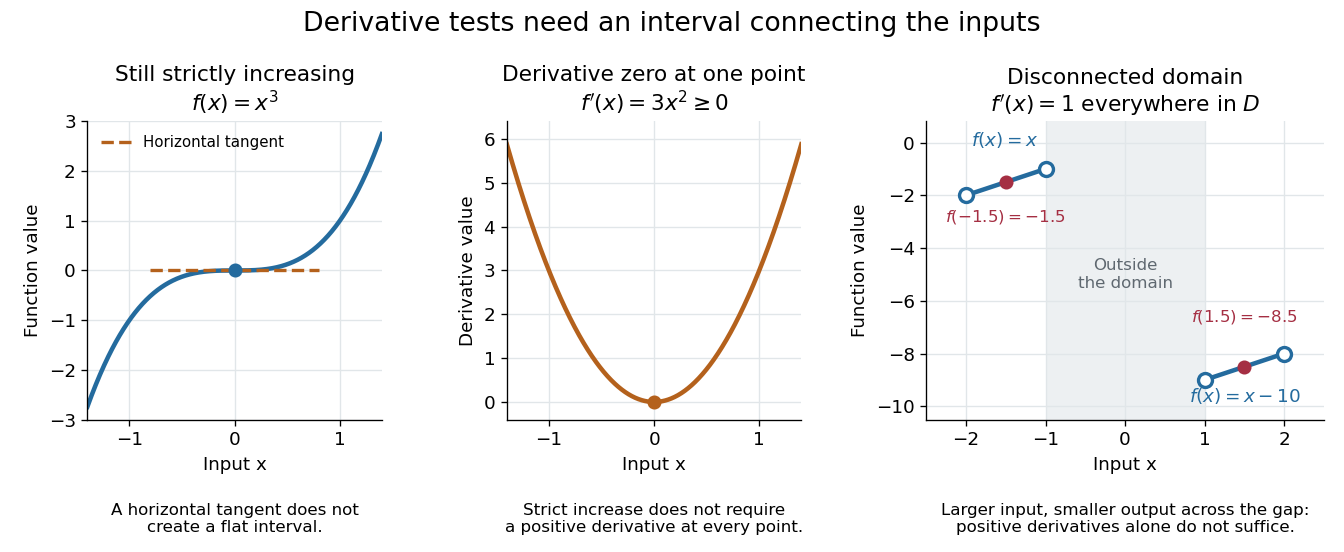
Conversely, if a nondecreasing function on a real interval is differentiable at an interior point , then : the difference quotient is nonnegative for either sign of . A differentiable nonincreasing function has derivative . Strict monotonicity still only forces these weak signs: the strictly increasing function has derivative zero at zero. The sign of the derivative helps locate intervals of monotonicity when sketching a graph. [ref].
The real interval hypothesis matters because a connected subset of the real line contains every point between its inputs. On a disconnected domain of a function, positive derivatives need not give a nondecreasing function. For example, takeHere everywhere in , but while . Each component has a strictly increasing function, yet their outputs are ordered the wrong way across the gap. This function is neither a nondecreasing function nor a nonincreasing function on all of ; the mean value theorem cannot cross the missing interval.
Associate to a finite ordered word the right-associated tensor , retaining a terminal unit: and . Define concatenation maps recursively byThe unit identities derived from the monoidal pentagon and triangle give . Induction on , using the pentagon in the induction step and left-unitor compatibility in the base case, givesNormalize a letter by , a formal unit by , and a tensor expression recursively using . The displayed identities show that normalization commutes with each generating associator or unitor, and therefore also with inverses, tensor products and composites of them. Every structural arrow from expression to expression is consequently , proving monoidal coherence without presupposing it.
Orient associativity towards right association and unit maps towards deletion of unit symbols. A lexicographic measure consisting of the number of leaves and the sum of the sizes of left subtrees decreases at every step. All overlapping reductions have commuting completions: the essential cases are the pentagon identity for a monoidal category, the triangle identity for a monoidal category, and the derived left and right unit identities. Induction on the decreasing measure makes every normalization arrow equal, proving that every structural arrow is determined by its endpoints.
Lifting a based loop in a covering space from every point of its finite fibre gives a permutation of that fibre. Composition of lifted loops yields the monodromy action of a covering space. If a closed geodesic of length has a cycle of length in its monodromy permutation, the corresponding lift closes after traversals and has length . For a primitive base geodesic, these cycles describe the primitive lift components.
Monodromy of hyperplane sections of a smooth curve by  Codex 0 Created 2026-10-14 Updated 2026-11-05
Let , , be a smooth irreducible nondegenerate projective variety of dimension one and degree . Let be the open subset of the dual projective space consisting of hyperplanes meeting in distinct points. The incidence projectionis a -sheeted covering space in the complex analytic topology. Its monodromy is the full symmetric group .[ref]
Sectional monodromy groups of projective curves by Borys Kadets. Proposition 1.1; Lemma 2.2 and Remark 3.5
The incidence space choosing two distinct ordered intersection points is irreducible, so the monodromy action of a covering space is two-transitive. A small loop around an ordinary tangent hyperplane exchanges its two nearby intersection points and fixes the others. Conjugating this transposition by double transitivity gives every transposition, and these generate . In particular the action on -element subsets is transitive for each . For a degree-one projective line, a transverse section has one point and the corresponding group is the trivial .
The signed wall-turbulence length formed from stress velocity and the vertical turbulent buoyancy flux. With upward buoyancy transport positive, stable cooling has and ; heating from below gives . The magnitude marks the transition between shear-dominated and buoyancy-dominated scaling.
In local continuously turbulent scaling at , dependence on the distance to the wall disappears at leading order. The velocity profile is linear and the buoyancy frequency is constant. Local energy balance gives and , with positive dissipation requiring . The coefficients depend on a closure, and this regime should not be imposed on fully collapsed turbulence.
Pinned article: Introduction to the OurBigBook Project
Welcome to the OurBigBook Project! Our goal is to create the perfect publishing platform for STEM subjects, and get university-level students to write the best free STEM tutorials ever.
Everyone is welcome to create an account and play with the site: ourbigbook.com/go/register. We belive that students themselves can write amazing tutorials, but teachers are welcome too. You can write about anything you want, it doesn't have to be STEM or even educational. Silly test content is very welcome and you won't be penalized in any way. Just keep it legal!
Intro to OurBigBook
. Source. We have two killer features:
- topics: topics group articles by different users with the same title, e.g. here is the topic for the "Fundamental Theorem of Calculus" ourbigbook.com/go/topic/fundamental-theorem-of-calculusArticles of different users are sorted by upvote within each article page. This feature is a bit like:
- a Wikipedia where each user can have their own version of each article
- a Q&A website like Stack Overflow, where multiple people can give their views on a given topic, and the best ones are sorted by upvote. Except you don't need to wait for someone to ask first, and any topic goes, no matter how narrow or broad
This feature makes it possible for readers to find better explanations of any topic created by other writers. And it allows writers to create an explanation in a place that readers might actually find it.
Figure 1. Screenshot of the "Derivative" topic page. View it live at: ourbigbook.com/go/topic/derivativeVideo 2. OurBigBook Web topics demo. Source. - local editing: you can store all your personal knowledge base content locally in a plaintext markup format that can be edited locally and published either:This way you can be sure that even if OurBigBook.com were to go down one day (which we have no plans to do as it is quite cheap to host!), your content will still be perfectly readable as a static site.
- to OurBigBook.com to get awesome multi-user features like topics and likes
- as HTML files to a static website, which you can host yourself for free on many external providers like GitHub Pages, and remain in full control

Figure 2. You can publish local OurBigBook lightweight markup files to either OurBigBook.com or as a static website.
Figure 3. Visual Studio Code extension installation.
Figure 5. . You can also edit articles on the Web editor without installing anything locally. Video 3. Edit locally and publish demo. Source. This shows editing OurBigBook Markup and publishing it using the Visual Studio Code extension. 
- Infinitely deep tables of contents:




All our software is open source and hosted at: github.com/ourbigbook/ourbigbook
Further documentation can be found at: docs.ourbigbook.com
Feel free to reach our to us for any help or suggestions: docs.ourbigbook.com/#contact