Topics (384k) Articles (398k) Users (410) Discussions (242) Comments (383) Files (13k) New article
For a single-valued harmonic function tending to zero both at the origin and at infinity, match an angular Fourier series across the unit circle. A nonzero mode with continuous interface value has interior field and exterior field . Its exterior-minus-interior radial derivative is . Thus a prescribed jump coefficient determines . Sine modes obey the same relation. The constant mode must have zero jump under these decay conditions.
For the Laplace equation on , prescribe bottom data and zero top data. A horizontal Fourier transform reduces the equation to , giving the displayed multiplier and its limit at . Integrable transformed data give a bounded inverse-transform solution. The bounded solution is unique by the maximum principle for harmonic functions, using barriers for on expanding rectangles. Without a growth condition, one can add , so the two boundary traces alone do not determine an arbitrary harmonic function on an infinite strip.
For a regular interior and a decaying exterior harmonic potential with continuous values on the unit sphere, the same coefficient multiplies the two radial branches of each Legendre polynomial mode. Its exterior-minus-interior radial derivative is . Thus an axisymmetric prescribed jump produces coefficient . This diagonal matching rule reduces a spherical interface problem to its angular-mode coefficients.
For , , choose and seek a harmonic function with zero values on the horizontal edges, boundary value at , and at , with constant . Separation of variables gives . The outward derivative at the left edge is , giving . The denominator is positive and Poisson uniqueness with a nonnegative Robin normal coefficient proves uniqueness in the regular solution class.
Harmonic Fourier expansions in planar concentric domains by  Codex 0 Created 2026-10-14 Updated 2026-10-18
A single-valued harmonic function in a planar annulus has radial Fourier modes and multiplying for integers . Substitute in Laplace's equation: periodicity gives , while . Regularity at the origin excludes ; boundedness at infinity excludes . Coefficients must give locally convergent series, with the boundary regularity required by the particular Dirichlet problem. Mere finiteness at each finite exterior point does not imply boundedness at infinity.
A Generalized Lane-Emden equation is a semilinear partial differential equation whose highest-order term is the Laplacian:For a radial function in dimensions it becomes . The case gives the classical Lane-Emden equation.
Fix the spatial mean of a scalar order parameter to and sum the Boltzmann weights of all configurations with that mean. The resulting constrained partition function defines this free-energy density, with an additive normalization fixed consistently. For an applied conjugate field , , up to the chosen measure normalization. The thermodynamic limit gives . A homogeneous Landau free energy is an approximation to this constrained potential; phase-separated configurations can convexify it in the full thermodynamic limit.
An isotropic linear elasticity material with equal positive Lamé parameters has Poisson's ratio and the displayed compressional/shear speed ratio. This simplifying model fixes the relative amplitudes in the tensile-crack radiation pattern; it does not describe every stable isotropic solid.
Application applies the lambda term to the lambda term . It associates to the left: . Together with variables and lambda abstraction, it generates all lambda terms.
A pointed complete partial order is reflexive when there are Scott continuous maps and with . Define and interpret lambda abstraction using . The inverse law gives beta soundness; additionally gives eta soundness.
For a locally compact Hausdorff Abelian group, each continuous unitary character defines an algebra character by . Conversely, if is a nonzero algebra character and , the ratio is independent of , continuous and multiplicative. Translation isometries bound all its integer powers, so its modulus is one. The convolution formula recovers . The Gelfand topology corresponds to the compact-open topology on the Pontryagin dual group; conjugating the characters gives the alternative Fourier sign convention.
A measurable function is essentially bounded if some finite nonnegative real number bounds its absolute value almost everywhere. The exceptional null set may contain arbitrarily large values. With Lebesgue measure on , a function equal to zero outside and equal to at is essentially bounded despite being unbounded pointwise: its exceptional countable set is a null set, so works. Its L-infinity norm is zero because it represents the zero equivalence class in Lp space.
Contrast this with on . For every , the values exceeding occupy , a set of positive Lebesgue measure. Hence no finite almost everywhere bound works, and this function is not essentially bounded. Being finite at every input does not imply essential boundedness.
For and , the unreferenced relative potential of the Kuzmin reflection method diverges at large . Referencing each component to the origin before integrating gives the finite potential differenceAt small the subtraction is integrable because ; at large the difference is , integrable because . Its plane force is , where . A circular speed fixes , givingThe beta function substitutions for the force and surface density have different exponents. Its central mass is locally finite, but its total mass diverges at large radius; a potential zero at infinity cannot be imposed. The force and density approach those of the Mestel disk as .
For a standard score and , split kurtosis into the contribution from within standard deviations of the mean and the contribution from outside:The indicator function selects the central outcomes. The bound follows directly from there. Thus : when kurtosis is large, any fixed central range contributes a small fraction. This is a precise reason to emphasize extreme standard scores rather than peak height.[ref]
Kurtosis as Peakedness, 1905 – 2014. R.I.P. by Peter H. Westfall. §5, Why Tails Mostly Determine Kurtosis, inequality (1) and following fixed-h argument
For the rare-outlier three-point distribution with , and . At the other endpoint , all probability mass lies at , so : central dominance is possible when kurtosis is small. More generally, the Cauchy-Schwarz inequality gives ; the equally weighted outcomes attain this minimum.
Changing units or shifting the origin preserves kurtosis. For real constants and , the mean of is , its variance is , and its fourth central moment is . The factors cancel in the ratio, even for negative . Hence excess kurtosis is also unchanged. For example, and have the same kurtosis, although their means and variances differ. The case produces zero variance and is excluded.
For , put probability mass at zero and at each of and . This symmetric probability distribution has mean zero. Its second and fourth moments are both , because the nonzero outcomes have square and fourth power equal to one:For the kurtosis is ; for it is . In the latter case of the probability mass is at zero, yet all of the fourth central moment comes from the remaining . The standard score takes values and , with variance one. Each nonzero outcome contributesto kurtosis. At , the two rare outcomes are ten standard deviations from the mean, and their contributions are .
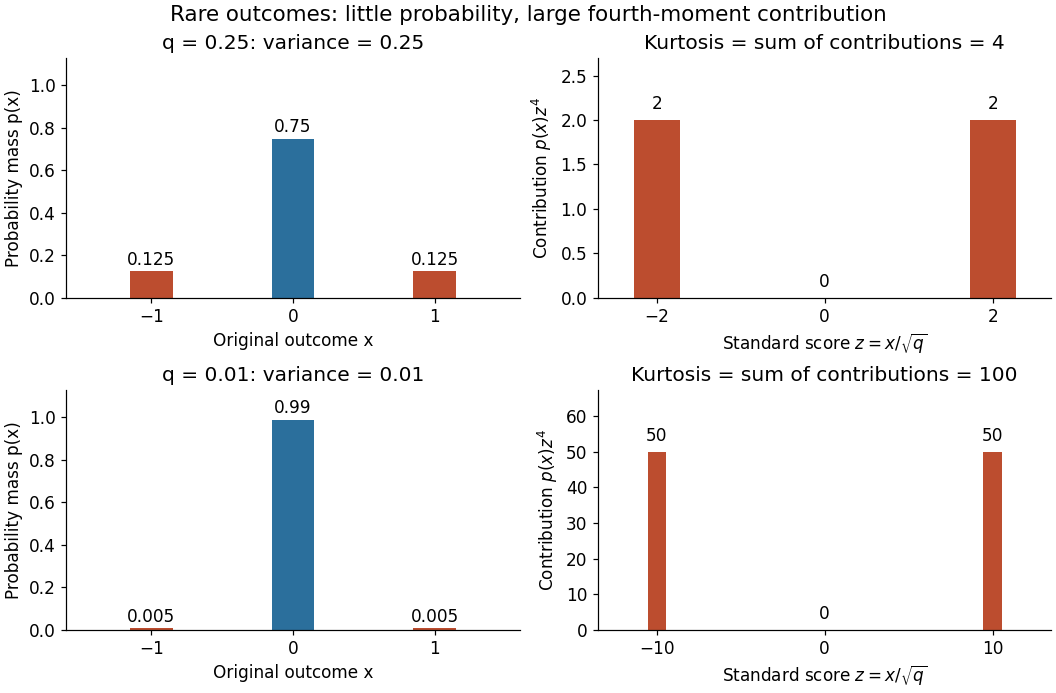
Every member has finite support of a probability distribution, so all its moments are finite. Nevertheless, kurtosis becomes arbitrarily large as approaches zero: high kurtosis does not require an unbounded support of a probability distribution or a heavy-tailed distribution. At the variance vanishes and kurtosis is undefined. At this discrete probability distribution even has the normal distribution value and excess kurtosis zero, so those values do not establish a normal distribution.
Excess kurtosis subtracts from kurtosis, making the normal distribution baseline zero. The non-excess convention is sometimes called raw kurtosis; this still uses a fourth central moment, not the uncentered fourth moment . Software may report either kurtosis or excess kurtosis, so the convention must be stated.[ref]
1.3.5.11. Measures of Skewness and Kurtosis. §1.3.5.11, Alternative Definition of Kurtosis, normal baseline and software convention warning
For a standard normal distribution, the moment-generating function of a standard normal variable gives , hence excess kurtosis zero. For a continuous uniform distribution on , the mean is zero, the variance is one, and direct integration givesThe rare-outlier three-point distribution can instead have kurtosis and excess kurtosis with mean zero and variance one. These are calculated properties of specified probability distributions, rather than a measured statistic.
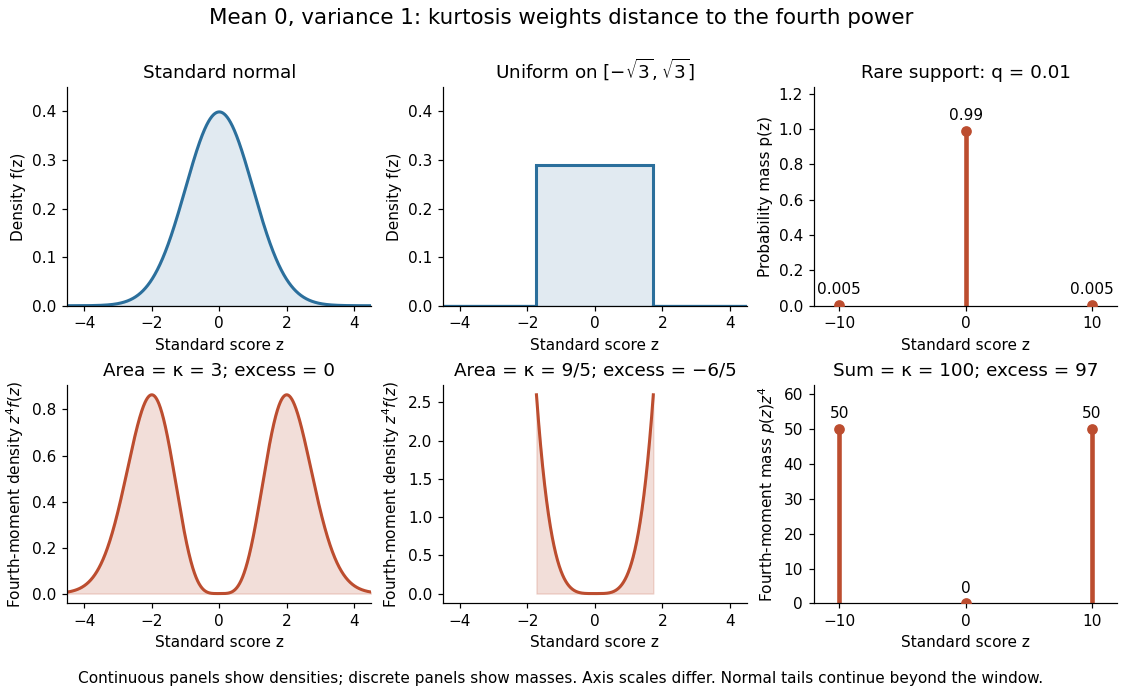
Kurtosis comparison for a standard normal distribution, a continuous uniform distribution, and a rare-outlier three-point distribution
. The upper panels show probability density functions or a probability mass function; the lower panels show their contributions to the fourth central moment. All three probability distributions have mean zero and variance one. Areas in the continuous panels and sums in the discrete panels give kurtosis. The standard normal distribution continues beyond the displayed window; density and mass heights have different meanings. Details.For finite cell complexes, the cohomological cross product gives a split, but not naturally split, short exact sequence . The Tor degree is for cohomology, unlike the shift in the homological version. If one factor's cohomology is free, the Tor term vanishes and the resulting ring is the graded tensor product.
If is a field and has finite total dimension, the cohomology cross product gives the displayed graded-ring isomorphism for arbitrary spaces. Over a field, every chain complex splits into its homology with zero differential and contractible summands. The Eilenberg–Zilber theorem thus replaces the fiber chain complex by a bounded finite-dimensional complex; dualizing its tensor product with gives a finite direct sum of shifted cochain complexes of . Its cohomology is the displayed tensor product. Finiteness prevents the infinite-product obstruction that can occur for two infinite discrete spaces. The standard product formula and its finiteness hypothesis are discussed in pi.math.cornell.edu/~hatcher/AT/ATch3.pdf, Theorem 3.15.
Pinned article: Introduction to the OurBigBook Project
Welcome to the OurBigBook Project! Our goal is to create the perfect publishing platform for STEM subjects, and get university-level students to write the best free STEM tutorials ever.
Everyone is welcome to create an account and play with the site: ourbigbook.com/go/register. We belive that students themselves can write amazing tutorials, but teachers are welcome too. You can write about anything you want, it doesn't have to be STEM or even educational. Silly test content is very welcome and you won't be penalized in any way. Just keep it legal!
Intro to OurBigBook
. Source. We have two killer features:
- topics: topics group articles by different users with the same title, e.g. here is the topic for the "Fundamental Theorem of Calculus" ourbigbook.com/go/topic/fundamental-theorem-of-calculusArticles of different users are sorted by upvote within each article page. This feature is a bit like:
- a Wikipedia where each user can have their own version of each article
- a Q&A website like Stack Overflow, where multiple people can give their views on a given topic, and the best ones are sorted by upvote. Except you don't need to wait for someone to ask first, and any topic goes, no matter how narrow or broad
This feature makes it possible for readers to find better explanations of any topic created by other writers. And it allows writers to create an explanation in a place that readers might actually find it.
Figure 1. Screenshot of the "Derivative" topic page. View it live at: ourbigbook.com/go/topic/derivativeVideo 2. OurBigBook Web topics demo. Source. - local editing: you can store all your personal knowledge base content locally in a plaintext markup format that can be edited locally and published either:This way you can be sure that even if OurBigBook.com were to go down one day (which we have no plans to do as it is quite cheap to host!), your content will still be perfectly readable as a static site.
- to OurBigBook.com to get awesome multi-user features like topics and likes
- as HTML files to a static website, which you can host yourself for free on many external providers like GitHub Pages, and remain in full control

Figure 2. You can publish local OurBigBook lightweight markup files to either OurBigBook.com or as a static website.
Figure 3. Visual Studio Code extension installation.
Figure 5. . You can also edit articles on the Web editor without installing anything locally. Video 3. Edit locally and publish demo. Source. This shows editing OurBigBook Markup and publishing it using the Visual Studio Code extension. 
- Infinitely deep tables of contents:




All our software is open source and hosted at: github.com/ourbigbook/ourbigbook
Further documentation can be found at: docs.ourbigbook.com
Feel free to reach our to us for any help or suggestions: docs.ourbigbook.com/#contact