Topics (384k) Articles (398k) Users (410) Discussions (242) Comments (383) Files (13k) New article
If only reflection and common temporal phase remain, the linear complex matrix is . The symmetric and antisymmetric modes have eigenvalues and , generically separating their Hopf thresholds. One-component rotating-wave axes are no longer invariant. Their hyperbolic finite-amplitude periodic solutions can persist as mixed-mode solutions, often through secondary symmetry-breaking bifurcations, while the double primary onset splits into two simple Hopf onsets. Coefficients determine the detailed secondary diagram and stability.
Independent sign changes and interchange of two coordinates in the natural dihedral group action force the displayed cubic normal form. Apart from the origin, its nondegenerate small equilibria lie on coordinate axes or on the diagonals. An axial branch has squared amplitude and eigenvalues . A diagonal branch has component squared amplitude and eigenvalues . Subtracting the two nonzero equilibrium equations gives , excluding other cubic branches when .
Write the dihedral group as . If , the cyclic subgroup has order . For an even divisor of , and has rotations and reflections, hence order . An odd divisor of always divides . This proves that the necessary divisibility condition from Lagrange's theorem is also sufficient in a dihedral group, although it is not sufficient in arbitrary finite groups.
Write . A subgroup contained in the rotations is a cyclic subgroup , with . If it contains a reflection, every other reflection differs from a chosen by a member of the rotational intersection, so it is , with specified modulo . These subgroups have orders and respectively. This gives a complete list, including the trivial and whole subgroups; see Peter Cameron's group-theory exercise solutions, question1.
Dihedral splitting when the half-rotation order is odd by  Codex 0 Created 2026-10-14 Updated 2026-10-18
Let have order with odd, and let , . The subgroup is a dihedral group of order , while is a central cyclic group of order two. Since is odd, and lies in by Bézout's identity. Thus the original group of order is the direct product of groups . This statement specifies group orders and avoids the two competing conventions for dihedral notation.
The numerical aperture is , where is the refractive index of the medium between object and objective, and is the half-angle of the admitted cone of light. Specify object-side or image-side numerical aperture; the microscope convention usually means the object side.[ref]
Electron diffraction is interference between scattered electron probability amplitudes. It connects the de Broglie wavelength of the incident beam to the arrangement of the scattering material. In elastic scattering from a fixed crystal, , and constructive crystal scattering selects wavevector transfers in the reciprocal lattice. The physical momentum transfer to the electron is in this convention.
Bragg's law expresses the same condition as , where is the spacing of the chosen lattice planes, the diffraction order, and the angle to those planes. The angle between incoming and outgoing propagation directions is for that reflection geometry. In normal-incidence backscattering, a detector's angle from the outward surface normal instead gives ; neither detector colatitude nor angle to the surface normal should silently replace . A finite-row electron diffraction model uses a different spacing, the spacing between sites along a surface row, and makes that distinction explicit.
The entropy power of an -dimensional random vector with finite differential entropy in bits is the variance per coordinate of an isotropic Gaussian distribution with the same differential entropy. The normalization makes when has covariance matrix .
// Target: probability-and-statistics.bigb
In A Mathematical Theory of Communication by Claude Shannon (1948), section 20 extends the discrete entropy formula to continuous densities. Properties 8–9 explicitly discuss coordinate dependence, possible negative values and linear rescaling. Claude Shannon relates this coordinate convention to the engineering use of entropy differences, rather than treating an isolated continuous entropy as an invariant count of messages.[ref]
A Mathematical Theory of Communication by Claude Shannon. section 20, definition and properties 8–9, reprint pp. 35 and 37–38
Apply the same invertible differentiable transformation to two probability distributions with densities and . Both transformed densities acquire the same Jacobian determinant factor. Write their transformed densities as and . Their ratio is unchanged, and the integration measure transforms with the numerator density. Consequently their relative entropy is unchanged:The densities describe two alternative laws in the same coordinate, with a nonzero Jacobian determinant on their common domain, and the expression is assumed well defined. This explains why comparing two laws can survive a change of measurement units even though either law's differential entropy changes. Mutual information, formulated as relative entropy from a product of marginals, has the same invariance under invertible changes to either observed coordinate.
Differential entropy is also the entropy term in the evidence lower bound for continuous variational inference. Its coordinate dependence must be combined consistently with that of the model density; changing units does not justify changing only one term of the objective.
Partition into bins of width , and let the discrete random variable record the bin containing . This is a quantization of . Its probability mass function isand its discrete information entropy is . Let be the average probability density within bin . Rearrangement gives the exact finite-bin identityFor a continuous probability density on , uniform continuity makes the bin averages converge uniformly to the density. Since is continuous at zero with the stated convention, the right-hand side converges to . Thus the increasing resolution cost is ; differential entropy is the remaining offset, rather than the entire discrete encoding cost.
For a continuous uniform distribution, every bin has probability , and exactly. For the continuous uniform distribution's squared transformation above, the exact bin probabilities areThe diagram computes these masses directly, including the bin next to the integrable singularity. It compares their corrected information entropy with the analytic differential entropy .
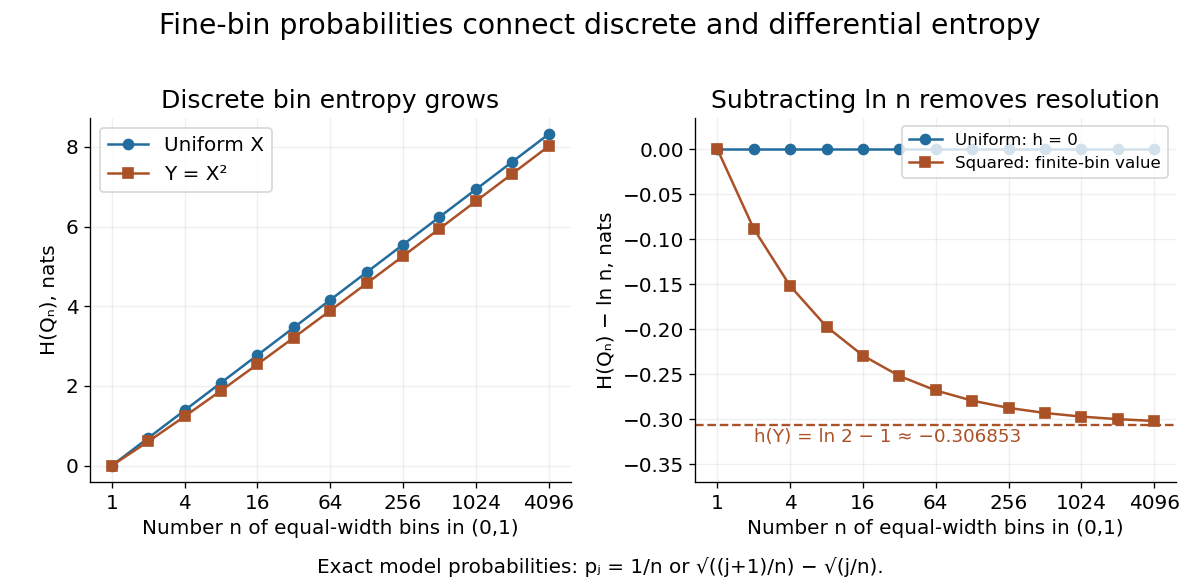
Removing the bin-resolution cost reveals differential entropy
. The left plot shows discrete information entropy increasing with the number of equal-width bins. The right subtracts and compares with the exact differential entropy of a uniform input and its squared transformation. Every plotted point comes from the stated exact probability mass functions; no observations are fitted. Details.For real and , the change of variables formula gives . ThereforeThe absolute value also covers a decreasing transformation. If a numerical length changes from metres to centimetres, and the differential entropy changes by nats, although the physical uncertainty is the same. The reference coordinate scale must therefore accompany an absolute differential entropy value.
Let have a probability density function on an open interval, and let be continuously differentiable, strictly increasing there, with . The change of variables formula givesIf the differential entropy and the expected absolute logarithm of are finite, taking the expectation of the negative logarithm proves the displayed formula, for a fixed base . Local stretching reduces probability density; its contribution to differential entropy is the expected logarithmic stretch. The map is invertible, so this change does not mean that the transformation destroyed information about .
For a normal distribution with mean and positive variance , expand the logarithm of its probability density function:The second term has expected value , hence . Translation of the mean has no effect, while shrinking the standard deviation lowers differential entropy. A standard normal distribution has approximately nats. This connects the continuous spread calculation with entropy power, whose normalization matches a Gaussian distribution's variance.
For a continuous uniform distribution on an interval of length , the probability density is . Direct integration givesThus a uniform law on an interval of length has differential entropy , while length two gives . Both laws have total probability one. The shorter interval has larger probability density, making negative; this is neither a negative probability nor a negative discrete information entropy.
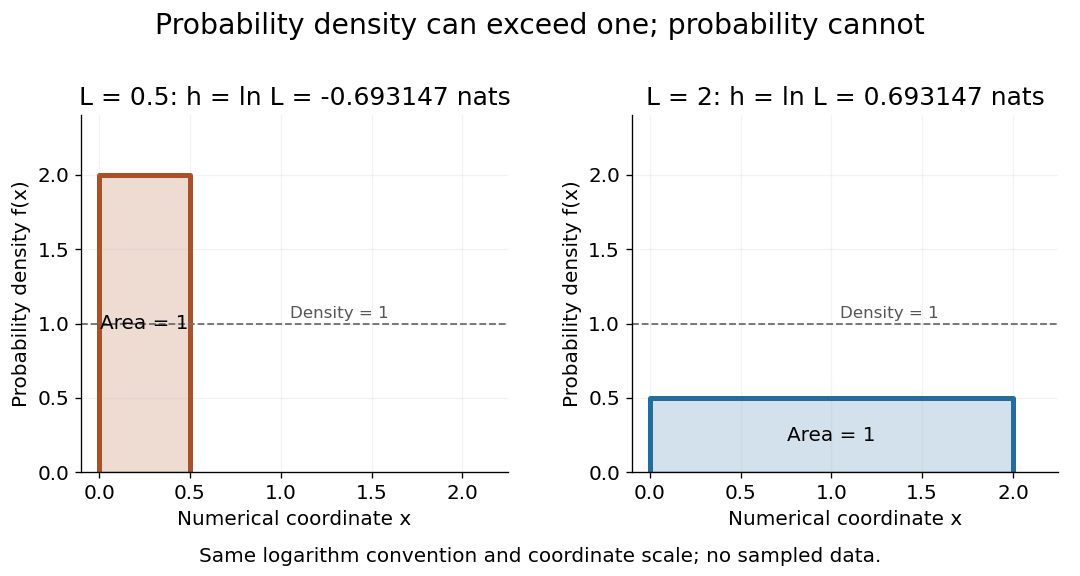
Uniform densities can have negative or positive differential entropy
. The two stipulated continuous uniform distributions have density two on an interval of length and density on an interval of length two. Each rectangle has area one. The reported differential entropy is in nats, using the displayed numerical coordinates. Details.This dicyclic group has classes , , , and the two parity classes of , of sizes . Its quotient by is cyclic of order four, supplying four linear characters with , . Its two remaining irreducible representations have and for , where . The traces are on and zero on . Distinct diagonal eigenlines are exchanged by , proving irreducibility; the degree-square sum proves completeness.
One-qubit reduction of Dicke-state superpositions by Codex 0 Created 2026-10-14 Updated 2026-11-05
Codex 0 Created 2026-10-14 Updated 2026-11-05For , and , the reduced density matrix of any one qubit isUse the Dicke state recursion. The rest-of-system vectors of different Hamming weights are orthogonal. For the diagonal terms this leaves the probabilities of the distinguished bit being zero and one. In the cross term, only the rest vector occurs in both states, with coefficients multiplying and multiplying . Thus , proving the matrix. A single Dicke state alone gives the diagonal matrix .
The -qubit W state is the Dicke state with one excitation:For three qubits it is . Its reduced density matrix on any one qubit is , from the Dicke state recursion. For both diagonal entries are nonzero, so that qubit is entangled with the rest: a pure product state would have a pure marginal. A symmetric-arm reduction of an exchange Hamiltonian supplies a dynamical preparation from one initial excitation.
PSPACE consists of decision problems solvable using a polynomial amount of work space. Running time may be exponential. Enumerating all polynomial-length relation encodings and reusing working storage preserves this bound, as does complementation. In particular fixed-sentence second-order logic model checking lies in PSPACE.
DFA minimization merges states with identical acceptance behavior for every suffix and removes unreachable states. It produces a minimal deterministic finite automaton, unique up to renaming states.
Pinned article: Introduction to the OurBigBook Project
Welcome to the OurBigBook Project! Our goal is to create the perfect publishing platform for STEM subjects, and get university-level students to write the best free STEM tutorials ever.
Everyone is welcome to create an account and play with the site: ourbigbook.com/go/register. We belive that students themselves can write amazing tutorials, but teachers are welcome too. You can write about anything you want, it doesn't have to be STEM or even educational. Silly test content is very welcome and you won't be penalized in any way. Just keep it legal!
Intro to OurBigBook
. Source. We have two killer features:
- topics: topics group articles by different users with the same title, e.g. here is the topic for the "Fundamental Theorem of Calculus" ourbigbook.com/go/topic/fundamental-theorem-of-calculusArticles of different users are sorted by upvote within each article page. This feature is a bit like:
- a Wikipedia where each user can have their own version of each article
- a Q&A website like Stack Overflow, where multiple people can give their views on a given topic, and the best ones are sorted by upvote. Except you don't need to wait for someone to ask first, and any topic goes, no matter how narrow or broad
This feature makes it possible for readers to find better explanations of any topic created by other writers. And it allows writers to create an explanation in a place that readers might actually find it.
Figure 1. Screenshot of the "Derivative" topic page. View it live at: ourbigbook.com/go/topic/derivativeVideo 2. OurBigBook Web topics demo. Source. - local editing: you can store all your personal knowledge base content locally in a plaintext markup format that can be edited locally and published either:This way you can be sure that even if OurBigBook.com were to go down one day (which we have no plans to do as it is quite cheap to host!), your content will still be perfectly readable as a static site.
- to OurBigBook.com to get awesome multi-user features like topics and likes
- as HTML files to a static website, which you can host yourself for free on many external providers like GitHub Pages, and remain in full control

Figure 2. You can publish local OurBigBook lightweight markup files to either OurBigBook.com or as a static website.
Figure 3. Visual Studio Code extension installation.
Figure 5. . You can also edit articles on the Web editor without installing anything locally. Video 3. Edit locally and publish demo. Source. This shows editing OurBigBook Markup and publishing it using the Visual Studio Code extension. 
- Infinitely deep tables of contents:




All our software is open source and hosted at: github.com/ourbigbook/ourbigbook
Further documentation can be found at: docs.ourbigbook.com
Feel free to reach our to us for any help or suggestions: docs.ourbigbook.com/#contact