Topics (384k) Articles (398k) Users (410) Discussions (242) Comments (383) Files (13k) New article
An absorptive phase arises from physical intermediate states or rescattering in a decay amplitude. For a pair of CP symmetry conjugate reactions with otherwise symmetric dynamics, this phase is the same in both amplitudes, whereas a weak phase changes sign. Their differing transformation laws allow interference to produce a direct CP asymmetry.
A shared order governing acquisition of distinct mutex objects. To prevent circular waiting, choose a strict total order and acquire only a higher-ranked mutex while retaining lower-ranked ones. In the two-object deadlock example, every participant acquires A before B. An outline of the argument is that ranks would strictly increase around any alleged waiting cycle, yet return to the starting rank, a contradiction. The rule must include acquisitions hidden inside called routines. It excludes this kind of deadlock, not arbitrary waiting on other resources or failure to schedule an owner.[ref]
Absence of a reachable deadlock. In the finite acquisition model under deadlock, reaching a nonterminal state with no enabled operation is a finite witness to failure, so this formulation is a safety property. Sometimes the phrase is used for eventual acquisition by some requester, a liveness property; the intended requirement must be stated. Neither formulation by itself promises starvation freedom for every requester.
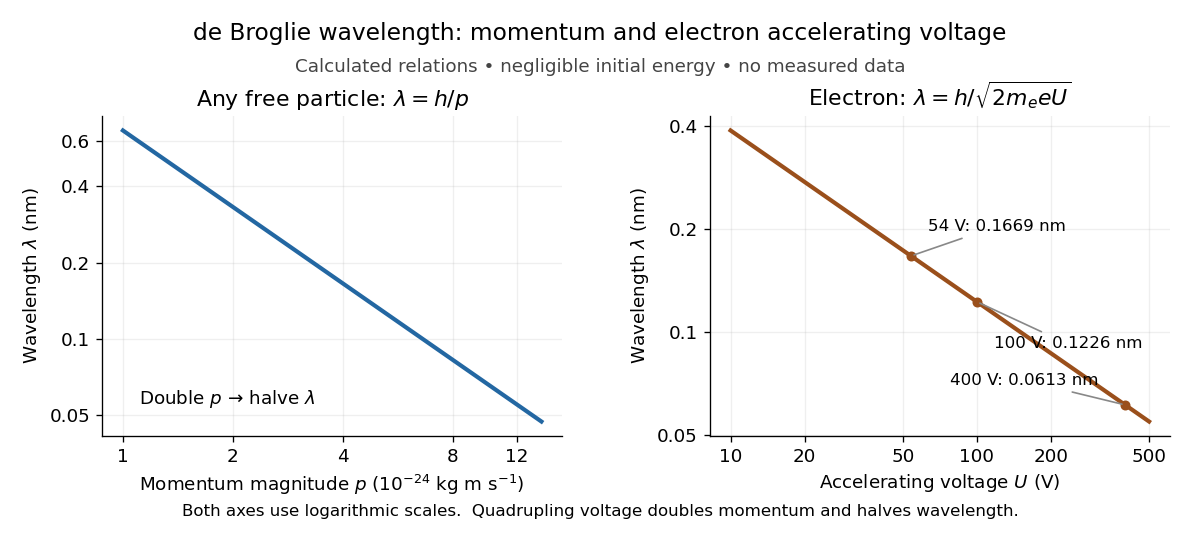
Let an electron start with negligible kinetic energy and move through an increase in electric potential. Its electric charge is , where is the elementary charge, so the decrease in potential energy is . In a field-free region after acceleration,This is an electron formula, not a universal conversion from voltage to wavelength. It assumes negligible initial kinetic energy, negligible losses, and , where is the speed of light. It describes the de Broglie wavelength outside the crystal; the potential energy inside a material can change the local kinetic momentum.
For , take , , and . The rounded electron mass is consistent with the 2022 recommended constants.[ref]
CODATA Value: electron mass by National Institute of Standards and Technology. CODATA electron mass: numerical value and 2022 adjustment label
The electronvolt is an energy unit: must be converted to joules before combining it with in SI units. Dimensional analysis checks both steps:The resulting velocity is about , or , so the nonrelativistic assumption is consistent. For a larger accelerating voltage, the relativistic energy-momentum relation gives , with , while still holds. At the relativistic wavelength is shorter by about .Explicitly, the exact special relativity formula and its nonrelativistic quantum mechanics limit areHere is the gained kinetic energy; the total energy is . At , the nonrelativistic quantum mechanics expression gives , about larger than the exact . This difference matters when using electron diffraction ring positions to infer lattice plane spacings.
For a free particle of mass in nonrelativistic quantum mechanics, choose the potential energy zero and writeApplying the momentum operator returns ; this fixes the sign convention. The angular frequency is measured relative to this chosen energy zero. Adding a constant energy changes only a time-dependent global phase, leaving the spatial de Broglie wavelength unchanged. No rest-energy term is included in this nonrelativistic quantum mechanics convention.
The plane wave has and probability current . Its real part can be drawn as a sine or cosine, but that graph is a component of a probability amplitude, not a transverse displacement. On infinite space this is a generalized momentum eigenstate, not a state satisfying wavefunction normalization. A narrow wave packet instead moves with group velocity ; the phase velocity is not its transport speed.
The equality of canonical momentum and kinetic momentum here assumes a field-free region with the magnetic vector potential chosen zero. For a charged particle in a magnetic field, the kinetic momentum is . An arbitrary canonical phase gradient must not then be substituted into ; the free particle formula needs its stated assumptions.
Under the finite Markov chain hypothesis , the gap identity in the data processing inequality givesBy the zero criterion for conditional mutual information, equality means that and have conditional independence given . After seeing the processed output, the original observation provides no additional information about . Similarly, equality in the other bound, , holds exactly when .
Equality does not require retaining every detail of . Let be independent fair bits, put , and let the processed output be , the first coordinate of . This is a Markov chain, andAlso . The output discards the entire unrelated bit , reducing to , while preserving all mutual information about . This is what makes equality useful for choosing a compact observation that retains all information about the quantity of interest.
Lubrication boundary condition for a crack in a Darcy medium by  Codex 0 Created 2026-10-14 Updated 2026-10-31
In a thin fluid-filled crack, lubrication theory gives flux per unit depth . The surrounding Darcy flow has normal velocity . Conservation in the crack gives , yielding the displayed condition. Pressure is continuous across the crack. This reduced model neglects transverse pressure variation and assumes wall slip lengths are small compared with .
A tall porous column with square width , insulated impermeable sidewalls and a maintained upward temperature decrease admits nearly vertical, zero-net-flux overturning modes. Let be buoyancy mobility and the thermal transport coefficient accompanying Darcy flux. Neumann transverse modes have . In the long-column limit the lowest nonconstant modes have growth rate proportional to . They are warm ascending and cold descending columns with return flow at distant ends. The two lowest modes, varying along either side direction, are degenerate; linear theory alone does not select their nonlinear superposition.
For a bounded real function, its oscillation on an interval is its full range width there. An upper Darboux sum minus a lower Darboux sum is the sum of these widths multiplied by their interval lengths. This gives the Riemann integrability criterion in terms of oscillation.
Eddy-current damping is electromagnetic damping in which motion of an electrical conductor through a magnetic field induces circulating electric currents, producing an opposing force and Joule heating. In the cart experiment it approximates viscous damping over the fitted range; spatial variation of the magnetic field or changes in velocity can limit that approximation.
An experimentally useful question is whether the disappearing oscillation follows viscous damping, and whether increasing the brake changes rather than or . A published teaching protocol uses a cart on an air track, attached between two springs, with ceramic magnets providing eddy-current damping and an ultrasonic motion sensor recording position against time. Replace the magnets with equal masses in the baseline trial so the moving mass stays fixed. Obtain each spring constant from the slope of applied force versus extension, then use . Time many baseline cycles to check . Compare one-magnet and two-magnet free decays; the protocol calls for a fit of the full trace including its offset. [ref]
The following additional controls make the inference testable. Level the air track and hold its air supply fixed. Check the ultrasonic motion sensor at several stationary flag positions against a ruler, including the full planned travel range; record the offset and scale correction. Check elapsed acquisition time against an independent clock, and choose a sampling rate that resolves many samples within the shortest expected oscillation period. Record the resting equilibrium before and after each run. Release the cart from a small measured displacement with minimal initial velocity, with the driving apparatus inactive. Repeat at several release sizes and magnet settings while keeping the springs and total mass unchanged. These are proposed calibration and repeatability checks, not reported measurements from the source.
For underdamping, fit the recorded position to by nonlinear regression. The readout to inspect is a sequence of alternating extrema about with shrinking amplitudes, and the deviations of the fitted curve from the recorded points. The model predictsCompare the right-hand side, determined independently from mass and spring constants, with the fitted left-hand side. A good fit supports a constant-coefficient single normal mode over the observed range; it does not establish a universal microscopic force law. The published protocol denotes the decay rate by and the velocity-proportional coefficient by ; here they are and , respectively.
At critical damping or overdamping, fit the corresponding nonoscillatory response including its offset and both initial conditions, rather than forcing a damped cosine onto the data. Adjusting the brake can explore the transition, but the cited protocol does not establish that its one-magnet or two-magnet settings attain critical damping. A near-critical trace over a short interval can be hard to distinguish from neighbouring damping ratios.
Important limitations are finite sensor range, missed or reflected acoustic wave pulses, measurement noise near equilibrium, nonzero release velocity, and position-dependent magnetic braking. Changing the release size tests for quadratic drag or nonlinear spring response; inspecting deviations near turning points can expose kinetic friction. Slow drift of the offset can imitate a long overdamped tail. Report uncertainties in fitted rates and independently measured ; absence of a visible crossing only bounds the behaviour within the instrument's sensitivity and recording interval. No numerical experimental results are asserted here.
For , let be the real characteristic roots. The response with the specified initial conditions isThe generic late response is governed by , the root nearer zero. For very large damping ratio, : an increasingly strong brake delays the return to equilibrium. This approximation comes from balancing the spring and viscous damping terms after the fast transient. Choosing makes and leaves only the faster root; that exception requires different initial velocities as varies.
For , define the damped angular frequency . The initial value problem has solutionEvery nonzero underdamped response crosses equilibrium repeatedly. Its oscillation period is , not . The amplitude envelope decays as , but the actual displacement also changes sign. The envelope coefficient need not equal : initial velocity fixes the oscillation phase as well as that coefficient.
Viscous damping means a force proportional to, and opposite to, velocity: with . Its coefficient has units , equivalently . The name describes a force law; eddy-current damping can approximate the same law without a viscous fluid. Constant , and produce a linear ordinary differential equation, allowing superposition of responses. Kinetic friction with approximately constant magnitude and quadratic drag obey different laws, so their decay need not have the exponential decay or critical threshold derived here.
Cyclotomic Artin reciprocity over the rational numbers by Codex 0 Created 2026-10-14 Updated 2026-10-20
Codex 0 Created 2026-10-14 Updated 2026-10-20For the cyclotomic field , arithmetic Frobenius automorphisms at primes send to : reduction distinguishes the nth roots of unity, and Frobenius raises residues to their th powers. Multiplicativity therefore sends a fractional ideal with positive rational generator , prime to , to the exponent . Its kernel consists exactly of positive generators congruent to one modulo . This proves Artin reciprocity for the ray class group of modulus without assuming the general reciprocity theorem.
A vector is separating for an operator algebra when evaluation at that vector is injective. A cyclic vector for the commutant of an operator algebra is separating for the original algebra: if , then vanishes on its dense commutant orbit.
If a nonempty subset of is invariant under translation by a nonzero , then repeated translation of any member runs through all residues, so . Thus all translates of a nontrivial subset are distinct. Partitioning the -element subsets into translation classes of size proves for .
// Target: analysis.bigb
A nontrivial subgroup of is generated by , where is the least positive exponent with . Divide any exponent with by ; its remainder also gives an element in and must be zero. A quotient group by a normal subgroup is generated by the coset of , because every coset is a power of that coset. The trivial subgroup and quotient are also cyclic.
This is the sum of content monomials of colorings up to the group action. It equals the cycle index specialized at . One may first use finitely many colors; stabilization defines the corresponding homogeneous symmetric function. Calling the specialized cycle index a cycle indicator makes an equality in the same variables.
An induced cycle is a cycle in a graph whose vertices induce exactly its cycle edges, with no edge between nonconsecutive vertices. A triangle is an induced cycle of length three. A chordal graph forbids induced cycles of length at least four.
Pinned article: Introduction to the OurBigBook Project
Welcome to the OurBigBook Project! Our goal is to create the perfect publishing platform for STEM subjects, and get university-level students to write the best free STEM tutorials ever.
Everyone is welcome to create an account and play with the site: ourbigbook.com/go/register. We belive that students themselves can write amazing tutorials, but teachers are welcome too. You can write about anything you want, it doesn't have to be STEM or even educational. Silly test content is very welcome and you won't be penalized in any way. Just keep it legal!
Intro to OurBigBook
. Source. We have two killer features:
- topics: topics group articles by different users with the same title, e.g. here is the topic for the "Fundamental Theorem of Calculus" ourbigbook.com/go/topic/fundamental-theorem-of-calculusArticles of different users are sorted by upvote within each article page. This feature is a bit like:
- a Wikipedia where each user can have their own version of each article
- a Q&A website like Stack Overflow, where multiple people can give their views on a given topic, and the best ones are sorted by upvote. Except you don't need to wait for someone to ask first, and any topic goes, no matter how narrow or broad
This feature makes it possible for readers to find better explanations of any topic created by other writers. And it allows writers to create an explanation in a place that readers might actually find it.
Figure 1. Screenshot of the "Derivative" topic page. View it live at: ourbigbook.com/go/topic/derivativeVideo 2. OurBigBook Web topics demo. Source. - local editing: you can store all your personal knowledge base content locally in a plaintext markup format that can be edited locally and published either:This way you can be sure that even if OurBigBook.com were to go down one day (which we have no plans to do as it is quite cheap to host!), your content will still be perfectly readable as a static site.
- to OurBigBook.com to get awesome multi-user features like topics and likes
- as HTML files to a static website, which you can host yourself for free on many external providers like GitHub Pages, and remain in full control

Figure 2. You can publish local OurBigBook lightweight markup files to either OurBigBook.com or as a static website.
Figure 3. Visual Studio Code extension installation.
Figure 5. . You can also edit articles on the Web editor without installing anything locally. Video 3. Edit locally and publish demo. Source. This shows editing OurBigBook Markup and publishing it using the Visual Studio Code extension. 
- Infinitely deep tables of contents:



All our software is open source and hosted at: github.com/ourbigbook/ourbigbook
Further documentation can be found at: docs.ourbigbook.com
Feel free to reach our to us for any help or suggestions: docs.ourbigbook.com/#contact