Topics (384k) Articles (398k) Users (410) Discussions (242) Comments (383) Files (13k) New article
A squared triangular number is the square of a number , where is a triangular number. Beginning at , the values are . Nicomachus's theorem gives them a second description as cumulative sums of cubes of numbers.
A nonnegative integer is a triangular number exactly when is a perfect square. Its square root is then an odd integer, and the row index isCompleting the square in proves necessity; reversing the calculation proves sufficiency. For example, , giving . In contrast, lies strictly between and , so twenty is not a triangular number. The criterion turns an apparently open-ended search through a sequence into one exact perfect square check.
For ,An -by- array of cells has cells. One side of the diagonal, including the diagonal itself, contains cells; the other contains . For , the two counts are fifteen and ten, giving twenty-five. The identity is stated in Introduction to Arithmetic by Nicomachus (Hahn teacher edition) (Book II, Chapter 12, §§1–2, printed p. 70).
For distinct objects, the number of unordered pairs of different objects isOrdering the objects gives pairs with the first object, new pairs with the second, and so on down to one. Alternatively, ordered pairs count every unordered pair twice. The binomial coefficient therefore counts the edges of a complete graph on vertices. This is also consistent with the handshaking lemma: each vertex has degree of a vertex , and the degree sum counts every edge twice.
For a positive integer , adding the row of length to the previous arrangement gives . Thus the first differences of the triangular numbers are . The triangular number recurrence provides incremental computation: after , adding seven gives .
The circumcircle of a nondegenerate triangle is the unique circle through its three vertices. Its center is the circumcenter, found by intersecting two perpendicular bisectors; equality of distances to all three vertices proves existence, and subtracting the squared-distance equations proves uniqueness. For a right triangle, the midpoint of its hypotenuse is equidistant from all vertices, so its circumradius is half the hypotenuse length.
The incircle of a triangle is the circle inside the triangle tangent to all three sides. Its center is the intersection of two internal angle bisectors; its radius is , where is the area and the semiperimeter. To prove it is the largest contained circle, let any candidate have center , radius and distances from the three side lines. Splitting the triangle into three triangles with vertex gives . The tangent circle attains equality, proving maximality. For a right triangle with legs and hypotenuse , , since and .
Two triangles are similar if a Euclidean similarity maps one onto the other. Their corresponding angles agree, and corresponding side lengths have a common positive ratio.
Specify the correspondence first: matches , matches and matches . For similar triangles, the common scale factor satisfiesThe ratios compare matching sides in the same order. A Euclidean similarity can also move, turn or reflect the triangle; its orientation on the page is irrelevant. In the Euclidean plane, matching just two interior angles is enough: their sums force the third to match, and equal corresponding angles force the side ratios to agree. This is the angle-angle (AA) criterion for similar triangles. Matching just one angle is insufficient.
Scale the right triangle with vertices , and by . Its new vertices are , and , and its side lengths are . The matching side ratios are . Both triangles have a right angle and the same two other interior angles, approximately and . However, their areas are and : doubling lengths multiplies area by four.
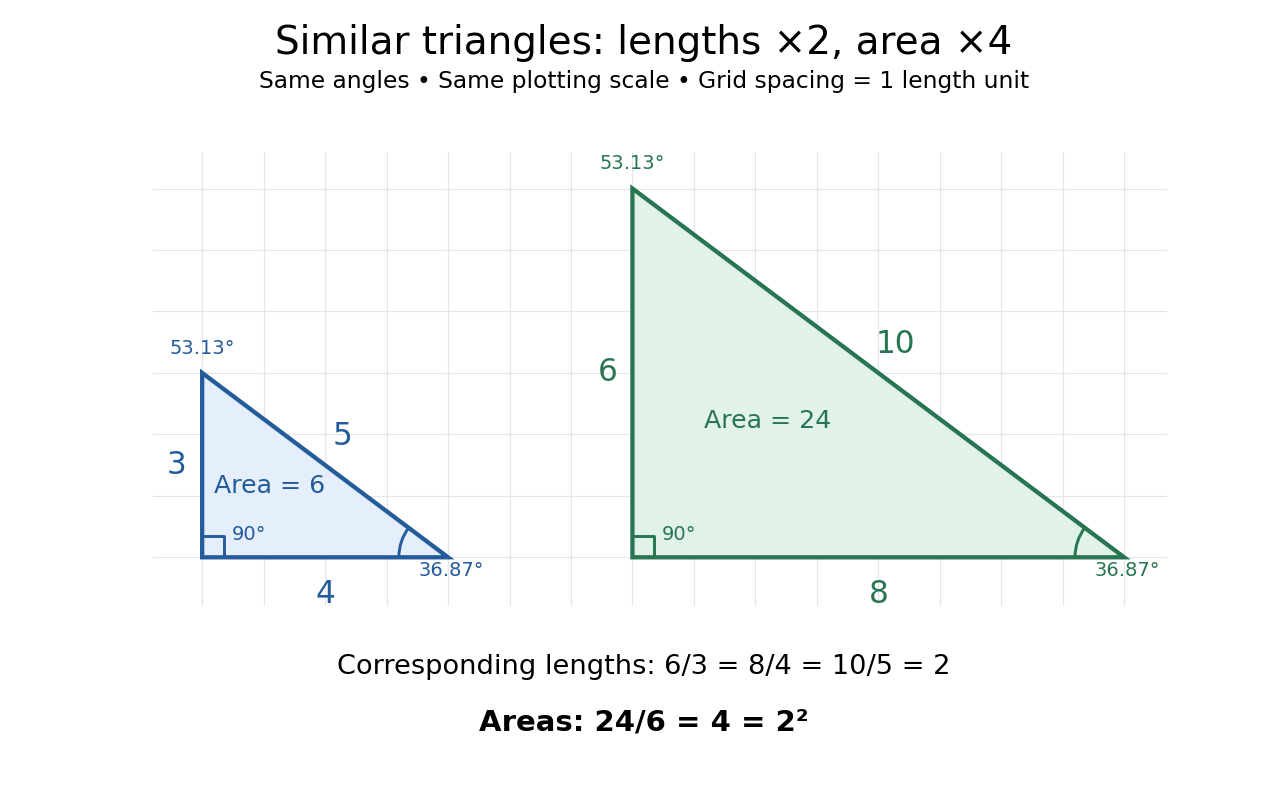
Generally, a Euclidean similarity multiplies both a base and its perpendicular height by , so the area becomes . This explains why an enlarged drawing needs four times as much surface when each length doubles. It also enables indirect measurement: under assumptions of level ground, vertical objects and parallel light rays, an object of height casting a shadow of length provides a right triangle. Another object's shadow of length gives a similar triangle and height . The shared angles justify the inference; visual resemblance alone does not.
Euclid's Elements VI, Definition 1 describes similarity using corresponding angles and proportional sides. VI.4 establishes the implication from matching angles to matching side ratios, while VI.19 states the squared relation between side ratios and areas. These are documented ancient formulations of the principles used above, without establishing a first discoverer.[ref][ref][ref]
https://mathcs.clarku.edu/~djoyce/elements/bookVI/propVI19.html. Euclid, Elements VI.19
A closed spacelike two-surface is marginally outer trapped when its future outgoing null expansion is zero. For the future black-hole type, the ingoing null expansion is negative. An apparent horizon on a chosen spatial slice is ordinarily its outermost such surface under suitable regularity assumptions. The notion depends on the slice and is not the global definition of an event horizon.
TE wave equation in a stratified magnetodielectric by  Codex 0 Created 2026-10-14 Updated 2026-11-05
With permittivity and permeability depending only on and time dependence , a transverse electric polarization obeys the displayed equation. Maxwell's equations give and . The latter satisfies . At normal incidence ; the nonzero magnetic component is .
Transport along a Hamiltonian flow. The solution is wherever the inverse characteristic exists. Equality of mixed derivatives makes the transport vector field divergence-free, so its flow preserves phase-space volume. Smoothness of the Hamiltonian alone gives local characteristics, not a complete flow on all of phase space.
Let , , , , and . The implicit stencil for has centered characteristic moments zero through degree three and fourth moment . Its Fourier numerator and denominator satisfy . The marching operator is a contraction exactly for nonnegative Courant numbers in ; with signed Courant numbers, also include . At the four roots of the method becomes an exact integer grid translation rather than merely third order.
Use dimensionless and , the periodic domain , and the same initial conditionWith zero PDE source term, compare the heat equation and the transport equation . Their exact solutions areEach cosine satisfies , so the heat equation reduces its amplitude according to . The superposition principle combines the constant and two Fourier modes. The transport equation shifts the argument of the entire profile. Both formulas meet the initial condition and matching periodic boundary conditions exactly.[ref]
https://web.stanford.edu/class/math220b/handouts/heateqn.pdf. Stanford Math 220B heat-equation notes, periodic boundary conditions
At , the heat amplitudes are approximately and : the small ripples disappear much sooner than the broad variation. The transport equation retains amplitudes and , shifting the profile right by one unit with wraparound. Both preserve spatial average , but only the heat equation approaches the uniform profile. This gives diffusion its usefulness for smoothing uneven temperatures, while the transport equation models a profile carried by a flow. The signed profile can represent a scaled temperature deviation.
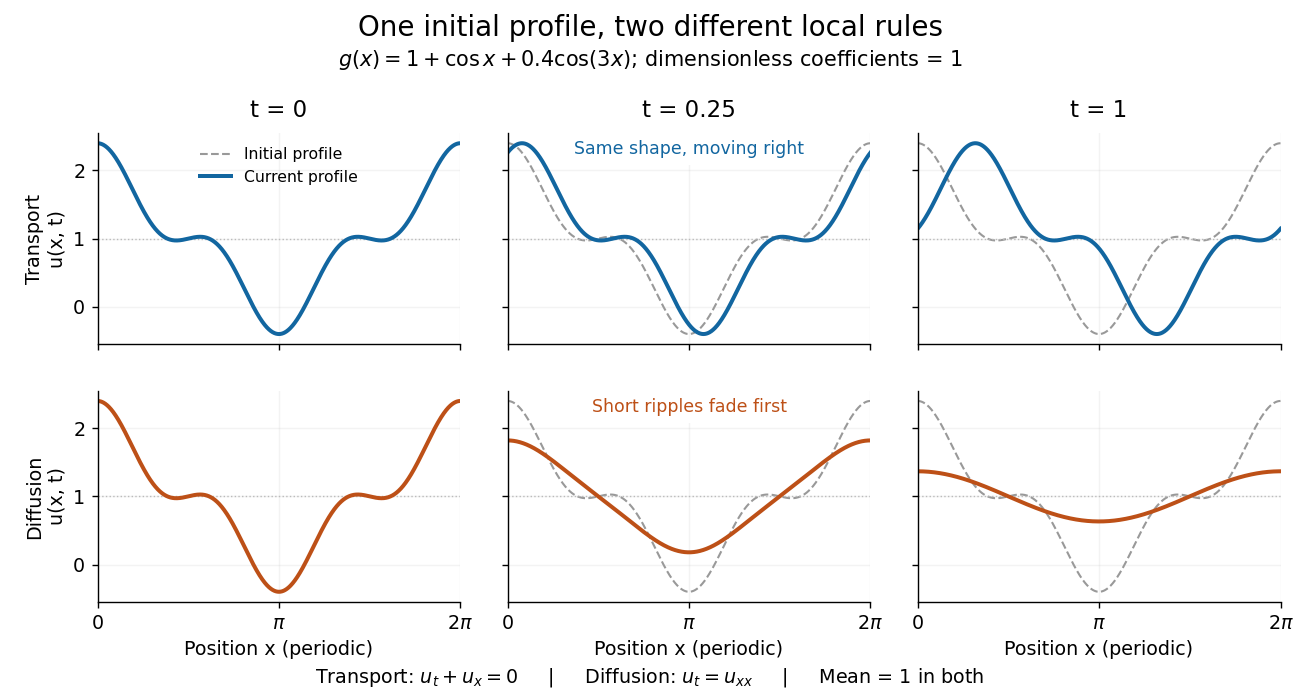
Exact evolution of one periodic profile: transport translates while diffusion preferentially removes short wavelengths
. Details. To restore units, let physical position be and time be . For , the dimensionless coefficient is , with measured in length squared per time. For , it is , with measured in length per time. Both plotted coefficients equal one when and . Thus the example compares specified models on the same scales, rather than identifying diffusivity with velocity.
A tag distinguishing cached address translations belonging to different address spaces. Tags can be reused, but reusing a tag for a different mapping context requires appropriate invalidation.
// Target: computer-science.bigb
A lookup that fails to find the required cached address translation. A successful refill can leave the memory page resident throughout and cause no page fault.
For process A's resident virtual page 4 in address translation, discarding only its translation lookaside buffer entry makes the next read a TLB miss while its contents remain in page frame 13. Page replacement would instead remove the resident memory page; these operations invalidate different kinds of cached information.
A lookup that finds a valid cached address translation for the relevant address space. The access can still cause a page fault if the cached permissions forbid it.
For the 64-byte toy model in address translation, a cached process A page-4 mapping covers reads at both
0x12D and 0x12E, yielding physical addresses 0x36D and 0x36E. The TLB hit reuses the mapping; it does not guarantee that either requested byte is in a data memory cache. Wavevector selection rule for equivariant monomials by Codex 0 Created 2026-10-14 Updated 2026-11-05
Codex 0 Created 2026-10-14 Updated 2026-11-05Consider complex Fourier modes transforming under a translation symmetry as . A monomialtransforms by multiplication with . It can occur in the equation for of an equivariant dynamical system only ifThis follows because must transform with the same wavevector as . The condition enforces translation equivariance; other symmetries can impose additional restrictions on the polynomial coefficients.
Writing , a monomial with total polynomial degree and a prescribed integer vector exists exactly when and is an even integer. To prove this, write and with nonnegative integers . Then . Conversely, any nonnegative even surplus can be distributed among the .
For one nonzero wavevector, a cubic term in its own equation must have and , giving . With several Fourier modes, a relation instead permits the quadratic term in the third equation. The wavevectors decide whether this resonant interaction is possible before any polynomial coefficient is calculated.
The genetic code assigns RNA codons to amino acids or termination signals. Four possible nucleobases at each of three positions give codons. In the standard genetic code, 61 specify amino acids and three are stop codons; several codons can specify the same amino acid. Variants exist, so state which genetic code is being used. See Clark, Douglas and Choi: genetic code assignments and variants.
A streamwise-independent cross-stream disturbance in an inviscid parallel shear flow has time-independent wall-normal velocity. It advects the base streamwise momentum, producing the displayed linear growth of streamwise velocity and quadratic growth of perturbation kinetic energy. This is algebraic amplification, not an exponentially unstable normal mode; it exemplifies transient growth from non-normal modes.
The Orr mechanism amplifies a leading two-dimensional shear disturbance as the background flow swings its wavefronts toward alignment. Conserved perturbation vorticity implies velocity amplitude proportional to the inverse wavevector magnitude. This produces algebraic or transient energy amplification without an exponentially growing normal mode. Viscosity limits the benefit of choosing an initially tightly wound disturbance.
// Target: gravitational-instability-of-an-astrophysical-disk.bigb
Pinned article: Introduction to the OurBigBook Project
Welcome to the OurBigBook Project! Our goal is to create the perfect publishing platform for STEM subjects, and get university-level students to write the best free STEM tutorials ever.
Everyone is welcome to create an account and play with the site: ourbigbook.com/go/register. We belive that students themselves can write amazing tutorials, but teachers are welcome too. You can write about anything you want, it doesn't have to be STEM or even educational. Silly test content is very welcome and you won't be penalized in any way. Just keep it legal!
Intro to OurBigBook
. Source. We have two killer features:
- topics: topics group articles by different users with the same title, e.g. here is the topic for the "Fundamental Theorem of Calculus" ourbigbook.com/go/topic/fundamental-theorem-of-calculusArticles of different users are sorted by upvote within each article page. This feature is a bit like:
- a Wikipedia where each user can have their own version of each article
- a Q&A website like Stack Overflow, where multiple people can give their views on a given topic, and the best ones are sorted by upvote. Except you don't need to wait for someone to ask first, and any topic goes, no matter how narrow or broad
This feature makes it possible for readers to find better explanations of any topic created by other writers. And it allows writers to create an explanation in a place that readers might actually find it.
Figure 1. Screenshot of the "Derivative" topic page. View it live at: ourbigbook.com/go/topic/derivativeVideo 2. OurBigBook Web topics demo. Source. - local editing: you can store all your personal knowledge base content locally in a plaintext markup format that can be edited locally and published either:This way you can be sure that even if OurBigBook.com were to go down one day (which we have no plans to do as it is quite cheap to host!), your content will still be perfectly readable as a static site.
- to OurBigBook.com to get awesome multi-user features like topics and likes
- as HTML files to a static website, which you can host yourself for free on many external providers like GitHub Pages, and remain in full control

Figure 2. You can publish local OurBigBook lightweight markup files to either OurBigBook.com or as a static website.
Figure 3. Visual Studio Code extension installation.
Figure 5. . You can also edit articles on the Web editor without installing anything locally. Video 3. Edit locally and publish demo. Source. This shows editing OurBigBook Markup and publishing it using the Visual Studio Code extension. 
- Infinitely deep tables of contents:




All our software is open source and hosted at: github.com/ourbigbook/ourbigbook
Further documentation can be found at: docs.ourbigbook.com
Feel free to reach our to us for any help or suggestions: docs.ourbigbook.com/#contact