Topics (384k) Articles (398k) Users (410) Discussions (242) Comments (383) Files (13k) New article
For a nonzero Euclidean vector , the Cauchy-Schwarz inequality gives when . Equality is attained uniquely at . On a sphere of radius the minimizer is , and the minimum is . This turns many constrained vector problems into a normalization of one fixed vector. If , every point minimizes the functional.
A bounded continuous factor and an integrable factor give a bounded velocity-integral gain on bounded continuous functions, with bound . The dominated convergence theorem proves joint continuity of the velocity integral. Combined with damped transport, the factorial bound for a Volterra iterate proves existence on arbitrary finite time slabs.
Orientation-preserving affine group of the real line by  Codex 0 Created 2026-10-07 Updated 2026-10-14
The real affine group used here is the orientation-preserving subgroup of the affine group on the real line. It acts by and has multiplication . The positive dilation distinguishes this connected component from the full group, which also contains negative dilations.
Here is a small Lie group where order matters. Write a point as , and letThe one-parameter subgroups and give dilations and translations. With matrix multiplication acting rightmost first, sends to , whereas sends to . At and , translate then double gives , while double then translate gives . Starting at gives endpoints and .
The same order dependence survives infinitesimally: the matrix commutator is . Indeed, the group commutator satisfiesAt , the residual translation is , close to the leading product . It measures a second-order failure of the four moves to cancel. This connects finite composition directly to the Lie bracket on the Lie algebra; see Meinrenken, Section 4, Proposition 4.7.
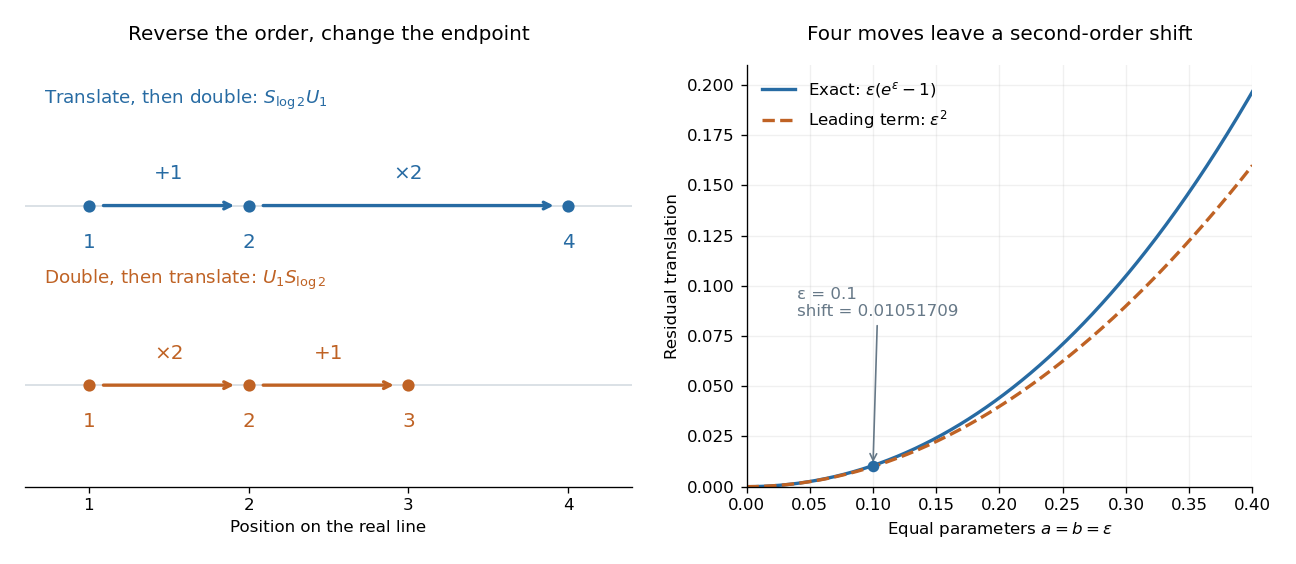
Scaling and translation have different endpoints when their order is reversed
. Details. A smooth homomorphism of Lie groups has differential at the identity. Differentiating makes the corresponding left-invariant vector fields -related. Their commutator action on pulled-back functions shows that the differential of a Lie group homomorphism preserves Lie brackets. The map need not be injective or surjective.
This Lie group acts on the plane by with . Its multiplication is , and its inverse is . It is a semidirect product in which positive dilation acts on the translation subgroup. A dilation generator and translation generators have Lie brackets and .
For fixed genus and systole lower bound , a uniform finite length cutoff determines the entire unmarked length spectrum of a closed hyperbolic surface in the thick part, including multiplicities. Equality up to forces equality everywhere. This is a finite-determination statement for spectra and does not claim that all isospectral surfaces are isometric.
In a compact smooth family of marked closed hyperbolic surfaces, only finitely many free homotopy classes of closed geodesics have length below a fixed bound somewhere in the family. A uniform bilipschitz equivalence with a fixed metric reduces this to local finiteness of its length spectrum.
A mixed Lebesgue norm first takes the Lp norm in one variable and then the norm in another. For finite , ; an infinite exponent replaces that integral norm by an essential supremum. The order matters: generally and are different spaces. This distinction is crucial in free transport dispersion.
For any estimator in a metric parameter space, by the triangle inequality. Average the two risk functions and replace their probability density functions by their minimum. This proves . The overlap equals one minus total variation distance. The same proof applies to squared error for a real-valued statistical functional of the parameter, without requiring that functional to be injective.
If two parameters are separated by at least in a metric, any estimator gives a test by deciding whether its distance from the first parameter is below . For , the event and Markov inequality give the displayed minimax risk bound, where is the product likelihood ratio. The unrestricted claim for every positive is false when both factors on the right are negative.
For a subterminal truth value , the quasi-closed local operator is relative double negation . It has bottom value . Its fixed truth values are Boolean with relative bottom , inherited meet, join closed by and complement . Therefore its sheaf topos is a Boolean topos.
Persistent unmeasured differences between individuals can generate outcome dependence after adjusting for observed covariates. A random intercept is one representation. Conditional independence given that latent variable need not persist after it is integrated out; apparent history dependence can therefore occur without true state dependence.
For an interval set avoiding one residue at each sieving prime, the Ramanujan sum at the forbidden Chinese remainder theorem residue gives a linear combination of Fourier samples equal to . Cauchy-Schwarz inequality gives sample energy at least for each squarefree modulus. Summing these energies and applying the analytic large sieve inequality gives the bound. If primes dividing are excluded, restrict the denominator to ; it is uniformly at least a constant times .
A Lagrangian complement to in a symplectic vector space is a Lagrangian subspace with . Such complements exist smoothly for Lagrangian subbundles. Identify any initial complement with using the symplectic cross-pairing. If its internal pairing is , correct its lift by a vector with . The corrected complement has zero internal pairing.
Finiteness of fixed-degree extensions of a p-adic field by Codex 0 Created 2026-10-07 Updated 2026-10-14
Codex 0 Created 2026-10-07 Updated 2026-10-14A p-adic field has only finitely many extensions of a fixed degree up to isomorphism. There are finitely many possible residue degrees and a unique unramified extension of each such degree. Over each maximal unramified subfield, a totally ramified extension is generated by a root of an Eisenstein polynomial. The coefficient space of these polynomials of fixed degree is compact. Hensel lemma and Krasner's lemma show that sufficiently close polynomials generate isomorphic extensions, giving a finite cover by neighborhoods of a constant extension type.
A Gauss code records the successive crossings encountered when traversing an oriented knot diagram. Each crossing label occurs twice; overpassing/underpassing data and crossing signs make the code sufficient to recover its Wirtinger presentation and smoothing counts. Labels are arbitrary and cyclic starting points represent the same traversal.
A crossing change exchanges the overpassing and underpassing strands at one crossing of a knot diagram. It generally changes the knot; unlike a Reidemeister move, it is not an isotopy. Two oriented band moves realize a crossing change as a genus-one knot cobordism.
Conserved stationary energy and unit timelike normalization give this equation in the Kerr axial analytic extension. For , the negative-sheet maximum of the potential is at . Energy squared above this maximum permits an inward orbit to pass through regular and continue to negative infinity without a turning point. At energy squared one, zero is a turning point. For negative spin the threshold is expressed with .
For the two-field Keller--Segel model, put , , , . The upper growth rate is . When its unique maximum occurs at positive satisfying . For equal diffusion coefficients , this gives . For and , the fastest growth is homogeneous, with infinite wavelength. The finite-domain answer must maximize the growth rate over the permitted Fourier modes. Eliminating chemical dynamics instantaneously generally changes this selected scale.
Pinned article: Introduction to the OurBigBook Project
Welcome to the OurBigBook Project! Our goal is to create the perfect publishing platform for STEM subjects, and get university-level students to write the best free STEM tutorials ever.
Everyone is welcome to create an account and play with the site: ourbigbook.com/go/register. We belive that students themselves can write amazing tutorials, but teachers are welcome too. You can write about anything you want, it doesn't have to be STEM or even educational. Silly test content is very welcome and you won't be penalized in any way. Just keep it legal!
Intro to OurBigBook
. Source. We have two killer features:
- topics: topics group articles by different users with the same title, e.g. here is the topic for the "Fundamental Theorem of Calculus" ourbigbook.com/go/topic/fundamental-theorem-of-calculusArticles of different users are sorted by upvote within each article page. This feature is a bit like:
- a Wikipedia where each user can have their own version of each article
- a Q&A website like Stack Overflow, where multiple people can give their views on a given topic, and the best ones are sorted by upvote. Except you don't need to wait for someone to ask first, and any topic goes, no matter how narrow or broad
This feature makes it possible for readers to find better explanations of any topic created by other writers. And it allows writers to create an explanation in a place that readers might actually find it.
Figure 1. Screenshot of the "Derivative" topic page. View it live at: ourbigbook.com/go/topic/derivativeVideo 2. OurBigBook Web topics demo. Source. - local editing: you can store all your personal knowledge base content locally in a plaintext markup format that can be edited locally and published either:This way you can be sure that even if OurBigBook.com were to go down one day (which we have no plans to do as it is quite cheap to host!), your content will still be perfectly readable as a static site.
- to OurBigBook.com to get awesome multi-user features like topics and likes
- as HTML files to a static website, which you can host yourself for free on many external providers like GitHub Pages, and remain in full control

Figure 2. You can publish local OurBigBook lightweight markup files to either OurBigBook.com or as a static website.
Figure 3. Visual Studio Code extension installation.
Figure 5. . You can also edit articles on the Web editor without installing anything locally. Video 3. Edit locally and publish demo. Source. This shows editing OurBigBook Markup and publishing it using the Visual Studio Code extension. 
- Infinitely deep tables of contents:



All our software is open source and hosted at: github.com/ourbigbook/ourbigbook
Further documentation can be found at: docs.ourbigbook.com
Feel free to reach our to us for any help or suggestions: docs.ourbigbook.com/#contact