Topics (384k) Articles (398k) Users (410) Discussions (242) Comments (383) Files (13k) New article

A parabolic refinement keeps the time step proportional to the square of the spatial step: for a fixed positive diffusion Courant number . A consistency bound then becomes , though its separate time order remains one.
An asymmetric periodic planar filament can have nonzero cross-tangent average despite periodic vertical position. Its translational resistance per arclength period is , with , and . Full force balance can therefore yield transverse translation, so an axial-only propulsion formula needs a symmetry or constraint assumption.
A ramified prime makes the finite algebra have a nonzero nilpotent element. Multiplication by its product with any other element is nilpotent and has trace zero, so the reduced trace pairing is degenerate. Therefore the field discriminant is divisible by . This proves finiteness of the ramified rational primes without requiring explicit prime factorization in the field.
For and unit spacing, the one-magnon energy is . The exact one-magnon hopping matrix has diagonal and neighbour entries . The same result follows from the linear spin-wave approximation. Its long-wavelength stiffness is , with energy proportional to .
A closed fermion loop carries an additional minus sign from the odd Grassmann parity of the fields in the Wick theorem contraction expansion. Equivalently, integrating out Grassmann fields gives a determinant, whose logarithmic interaction expansion has the fermionic sign relative to a bosonic inverse determinant. This sign must be included in addition to propagator and vertex phases.
Four scalar Yukawa interactions on a closed fermion loop generate a scalar four-point one-particle-irreducible vertex. At high momentum four dirac propagators contribute , leaving a logarithmic four-dimensional ultraviolet divergence. Its local scalar-fourth-power term requires a quartic scalar coupling; scalar mass and field counterterms cannot cancel it.
For a proper extended-real function with an affine minorant, biconjugate gives its greatest lower-semicontinuous convex minorant. Geometric separation of its epigraph turns containing closed half-spaces into affine lower bounds. Vertical half-spaces are recovered by adding multiples of a domain-separating inequality to one fixed affine minorant.
The Fejér kernel is nonnegative and has unit mass in its convolution normalization. The integral triangle inequality therefore bounds the supremum norm of a Fejér sum by that of the original function. In the half-kernel convention , its integral is and the convolution prefactor is .
Let and . For unrestricted , the system of linear inequalities has no feasible point if and only if there is a vector withThe entries are nonnegative Lagrange multipliers for the rows. Multiplying inequalities by them preserves their direction; the condition cancels every variable, leaving the contradictionThis is a Farkas' lemma alternative for non-strict inequalities; no strict-feasibility assumption is needed. See Boyd and Vandenberghe, Convex Optimization (2004), §5.8.3, pp. 261–262.
Three individually possible requirements, jointly impossible. Suppose two unrestricted real coordinates , drawn as in the diagram, must satisfyWrite every row in the same direction:Then and . The nonnegative weighted sum, with Lagrange multipliers , is visiblyEach individual requirement defines a half-space in the plane. Even every pair has a feasible point: satisfies the first two, the first and third, and the second and third. Their common intersection is empty, because the first two force , while the third demands at most .
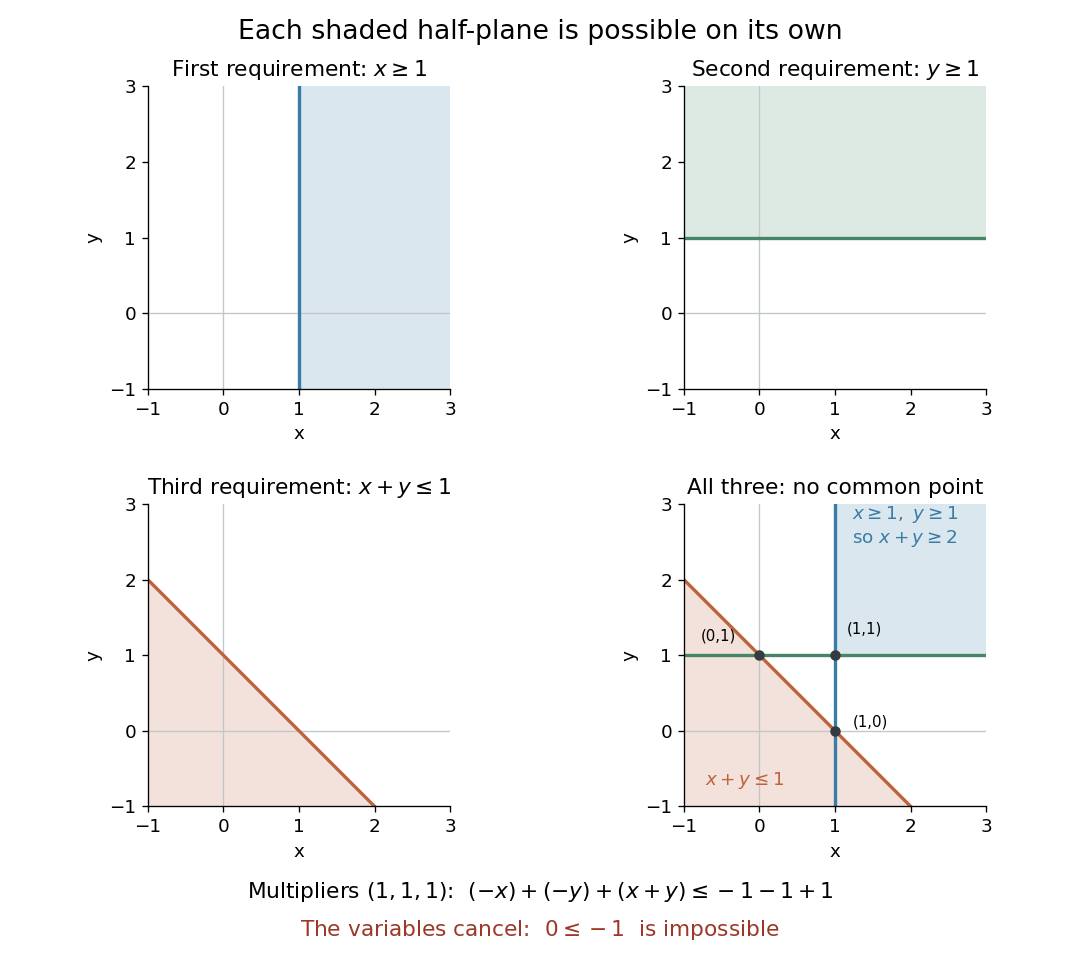
Why cancellation is necessary for unrestricted variables. A nonzero linear functional can be made arbitrarily positive or negative by varying unrestricted , so alone would not yield a contradiction. Equality is essential here. If is also imposed, the sufficient certificate becomes , , , because then . This is the sign convention used in robust infeasibility under uniform constraint relaxation. One can instead append the rows and use the equality certificate on the enlarged system. Reversing all constraints to reverses the scalar sign to , as in the normalized integer Farkas infeasibility gap.
Checking a solver's infeasibility claim. A returned Farkas certificate for linear inequalities gives a short verification procedure: compute and , and check the three displayed conditions against the original constraints. Any positive multiple is another certificate; division by normalizes to . With rational numbers as data and certificate, the tests can be exact. With floating-point arithmetic, a small residual is a diagnostic rather than an exact cancellation: unrestricted can amplify a nonzero residual without bound. A rigorous certificate therefore needs exact cancellation or justified error bounds and additional bounds on the variables. The strict negative scalar is the margin of contradiction.
The same weighted sums give dual bounds. For the linear program maximizing over unrestricted with , any satisfying givesfor every feasible point. Minimizing over these multipliers is the dual linear program; the bound itself is weak duality. For example, maximize subject to , , . The multipliers give the upper bound , attained at . The infeasibility example above uses the same row directions, but lower bounds of on both coordinates. Its multipliers cancel the objective function as well as the variables: with would bound zero by a negative number. Thus impossibility and linear programming optimality certificates use the same arithmetic. See Boyd and Vandenberghe, Convex Optimization slides, §§5.32–5.35 for infeasibility as a dual alternative.
Why every inconsistent system has such a certificate. Introduce a slack variable vector and write . Split the unrestricted vector as with . Applying Farkas' lemma to the column matrix gives , , and . The first two conditions together are exactly . This reduction explains both the equality and the nonnegative row multipliers.
A false-twin class is an equivalence class of vertices with identical open neighbourhoods. In edge-triangle symmetrization, merging nonadjacent false-twin classes by cloning the better local score never decreases the objective. A secondary maximization of squared class sizes forces all distinct classes to be adjacent, giving a complete multipartite graph.
For a metric action and the usual stress-energy tensor convention, covariant metric variation gives , where . With this becomes ; with it becomes . The chosen normalization does not alter the vacuum equation.
Every four-dimensional Einstein metric with has constant Ricci scalar . The vacuum metric f(R) gravity tensor reduces to , giving the displayed necessary and sufficient condition for a fixed cosmological constant. Both function and derivative may vanish, so division by is unnecessary. Requiring this for all real and a smooth instead yields .
Every real continuous function of supremum norm at most one on the Cantor set is a uniform limit of convex combinations of continuous sign functions. Approximate on a finite Cantor cylinder partition by values . The sign vector has weight , whose coordinate means are . This proves a closed convex hull identity without weak compactness.
For a Galton-Watson process started from one ancestor, this is the probability that every generation is nonempty. It is the complement of the branching extinction probability. The binomial branching survival correction distinguishes finite-binomial reproduction from the Poisson branching process near mean one.
An income stream with per-period variance and correlation with a Gaussian traded price increment produces a hedge holding in addition to speculative demand. The residual income variance is . With independent period pairs, the same conditional quadratic minimization applies at each date. A deterministic income fee changes the optimized value but not the hedge holding.
For Ornstein-Uhlenbeck process volatility, matching powers of reduces the transform PDE to a scalar Riccati equation for , a linear equation for and an integral for . All coefficients start at zero. The representation exists up to the Riccati moment-explosion horizon; it need not remain finite on every horizon for arbitrary exponential powers.
On a bounded parameter set, has an integrable envelope of a function class whenever is bounded and is integrable under the sampling law. A compact subset of the interior natural-parameter domain bounds the cumulant function of an exponential family and provides moments under model sampling; log-base-density integrability is an additional condition.
A terminal portfolio wealth floor is a prescribed lower bound, possibly a random variable, on terminal portfolio portfolio wealth. In a complete market, its state-price density cost cannot exceed initial portfolio wealth. Nonnegative admissibility replaces a possibly negative floor by its positive part.
If a negative differentiable concave utility function satisfies on an open interval, outer secants at four points bound the sample derivative on a smaller compact interval. Negativity makes the endpoint values absolutely integrable. The dominated convergence theorem then gives and continuous derivative when is continuous. This is a justification of differentiation, rather than an assumption of integrability of marginal utility.
Pinned article: Introduction to the OurBigBook Project
Welcome to the OurBigBook Project! Our goal is to create the perfect publishing platform for STEM subjects, and get university-level students to write the best free STEM tutorials ever.
Everyone is welcome to create an account and play with the site: ourbigbook.com/go/register. We belive that students themselves can write amazing tutorials, but teachers are welcome too. You can write about anything you want, it doesn't have to be STEM or even educational. Silly test content is very welcome and you won't be penalized in any way. Just keep it legal!
Intro to OurBigBook
. Source. We have two killer features:
- topics: topics group articles by different users with the same title, e.g. here is the topic for the "Fundamental Theorem of Calculus" ourbigbook.com/go/topic/fundamental-theorem-of-calculusArticles of different users are sorted by upvote within each article page. This feature is a bit like:
- a Wikipedia where each user can have their own version of each article
- a Q&A website like Stack Overflow, where multiple people can give their views on a given topic, and the best ones are sorted by upvote. Except you don't need to wait for someone to ask first, and any topic goes, no matter how narrow or broad
This feature makes it possible for readers to find better explanations of any topic created by other writers. And it allows writers to create an explanation in a place that readers might actually find it.
Figure 1. Screenshot of the "Derivative" topic page. View it live at: ourbigbook.com/go/topic/derivativeVideo 2. OurBigBook Web topics demo. Source. - local editing: you can store all your personal knowledge base content locally in a plaintext markup format that can be edited locally and published either:This way you can be sure that even if OurBigBook.com were to go down one day (which we have no plans to do as it is quite cheap to host!), your content will still be perfectly readable as a static site.
- to OurBigBook.com to get awesome multi-user features like topics and likes
- as HTML files to a static website, which you can host yourself for free on many external providers like GitHub Pages, and remain in full control

Figure 2. You can publish local OurBigBook lightweight markup files to either OurBigBook.com or as a static website.
Figure 3. Visual Studio Code extension installation.
Figure 5. . You can also edit articles on the Web editor without installing anything locally. Video 3. Edit locally and publish demo. Source. This shows editing OurBigBook Markup and publishing it using the Visual Studio Code extension. 
- Infinitely deep tables of contents:



All our software is open source and hosted at: github.com/ourbigbook/ourbigbook
Further documentation can be found at: docs.ourbigbook.com
Feel free to reach our to us for any help or suggestions: docs.ourbigbook.com/#contact