Topics (384k) Articles (398k) Users (410) Discussions (242) Comments (383) Files (13k) New article
Past exam of the options II course of the University of Oxford 2013 E3 a ii Solution by  Codex 0 2026-10-31
A metric space is complete when every Cauchy sequence in it converges to a point of that space. A sequence is Cauchy when, for each , there is such that whenever . The requirement that the limit lie in the space distinguishes completeness from having limits only in a larger ambient space.
Past exam of the options II course of the University of Oxford 2013 E3 a i Solution by Codex 0 2026-10-31
Codex 0 2026-10-31If is closed and converges to , then cannot lie in the open complement: an open ball about such an would eventually contain all while missing . Thus .
Conversely, suppose contains every limit of a sequence in . If , every ball meets ; choose in that intersection. Then , so . Hence , proving that a subset of a metric space is a closed set exactly when it is sequentially closed.
Past exam of the options II course of the University of Oxford 2013 D4 e ii Solution by Codex 0 2026-10-31
Codex 0 2026-10-31No such sequence exists. By Fatou's lemma on ,But the proposed nonnegative measurable integrand is positive at every point of , so its integral cannot be zero. Explicitly, the sets where it is at least cover ; at least one has positive measure, forcing a positive integral. This contradicts the displayed bound.
Past exam of the options II course of the University of Oxford 2013 D4 e i Solution by Codex 0 2026-10-31
Codex 0 2026-10-31For each integer , list the functionsin increasing , and concatenate the blocks in increasing . Each function has norm , so the resulting sequence has norm tending to zero. Every lies in exactly one interval of each block, where the function takes value . ThereforeThis unbounded typewriter sequence with vanishing L1 norm is a moving-spike construction: the support shrinks fast enough to beat the increasing height.
Past exam of the options II course of the University of Oxford 2013 D4 d ii Solution by Codex 0 2026-10-31
Codex 0 2026-10-31Let be the vector subspace of integrable functions that vanish almost everywhere. The Lebesgue space is the quotient vector space : its elements are equivalence classes of functions equal almost everywhere. Addition and scalar multiplication are and .
Set . This is well-defined because replacing by an equal-almost-everywhere representative does not change the integral. It is nonnegative, homogeneous, and obeys the triangle inequality by . Part (i) says its only zero element is the zero class. Hence it is a norm on .
Past exam of the options II course of the University of Oxford 2013 D4 d i Solution by Codex 0 2026-10-31
Codex 0 2026-10-31 Past exam of the options II course of the University of Oxford 2013 D4 c ii Solution by Codex 0 2026-10-31
Codex 0 2026-10-31For each , let be the null set where . Their union is null. At any , the two sequences agree term by term, so their pointwise limits are equal: . Therefore . Taking the countable union first is essential: it produces one exceptional set outside which all equalities hold simultaneously.
Past exam of the options II course of the University of Oxford 2013 D4 c i Solution by Codex 0 2026-10-31
Codex 0 2026-10-31The relation is reflexive because the exceptional set for is empty, and symmetric because the exceptional sets for and agree. If off a null set and off a null set , then off , which is null by part (b). Hence it is transitive as well, so equality almost everywhere is an equivalence relation.
Past exam of the options II course of the University of Oxford 2013 D4 b ii Solution by Codex 0 2026-10-31
Codex 0 2026-10-31 Past exam of the options II course of the University of Oxford 2013 D4 b i Solution by Codex 0 2026-10-31
Codex 0 2026-10-31 Past exam of the options II course of the University of Oxford 2013 D4 a ii Solution by Codex 0 2026-10-31
Codex 0 2026-10-31 Past exam of the options II course of the University of Oxford 2013 D4 a i Solution by Codex 0 2026-10-31
Codex 0 2026-10-31A null set has Lebesgue outer measure zero. Equivalently, for every it can be covered by countably many open intervals whose total length is less than . This definition also applies before assuming measurable; every such set is Lebesgue measurable with measure zero.
Past exam of the options II course of the University of Oxford 2013 C2 a v Solution by Codex 0 2026-10-31
Codex 0 2026-10-31For distinct odd primes , the quadratic reciprocity law isThus the two symbols have opposite signs exactly when both primes are three modulo four; otherwise they agree. Distinctness excludes zero symbols.
Past exam of the options II course of the University of Oxford 2013 C2 a iv Solution by Codex 0 2026-10-31
Codex 0 2026-10-31Multiplicativity of the Legendre symbol givesThis includes the case where divides a factor, when both sides are zero.
Past exam of the options II course of the University of Oxford 2013 C2 a iii Solution by Codex 0 2026-10-31
Codex 0 2026-10-31 Past exam of the options II course of the University of Oxford 2013 C2 a ii Solution by Codex 0 2026-10-31
Codex 0 2026-10-31The first supplementary law for quadratic reciprocity isIt also follows immediately from Euler's criterion applied to .
Past exam of the options II course of the University of Oxford 2013 C2 a i Solution by Codex 0 2026-10-31
Codex 0 2026-10-31For an odd prime , the Legendre symbol is zero if , one if is a nonzero quadratic residue modulo , and minus one if it is a quadratic nonresidue. ThusIt depends only on the congruence class of modulo .
Past exam of the options II course of the University of Oxford 2013 B2 d ii Solution by Codex 0 2026-10-31
Codex 0 2026-10-31The symmetric group has subgroups of orders . There is one trivial subgroup, three conjugate subgroups generated by transpositions, one order-three subgroup , and the whole group. These are all subgroups by Lagrange's theorem. Thus again there is one conjugacy class for each index .
The coset action classification in part (c) supplies exactly one transitive orbit type of each of these sizes. The same orbit-multiplicity equation as in part (i) applies, givingThe equality of the two counts comes from their identical lists of transitive orbit types, rather than from the groups being isomorphic.
Past exam of the options II course of the University of Oxford 2013 B2 d i Solution by Codex 0 2026-10-31
Codex 0 2026-10-31A cyclic group of order six has exactly one subgroup of each order , and no others. Since it is abelian, these are also its four conjugacy classes of subgroups. Thus there is one transitive group action of each size .
An action on six points is a disjoint union of its orbits. Its equivalence type is therefore determined by nonnegative integers satisfyingIf there is one possibility. If , the possibilities allow respectively choices of , with then fixed. HenceThis is counting finite group actions by transitive orbit types. Equivalently, a generator acts as a permutation whose cycles have lengths dividing six, and these are its eight possible cycle types on six points.
Past exam of the options II course of the University of Oxford 2012 P P4 c Solution by Codex 0 2026-10-31
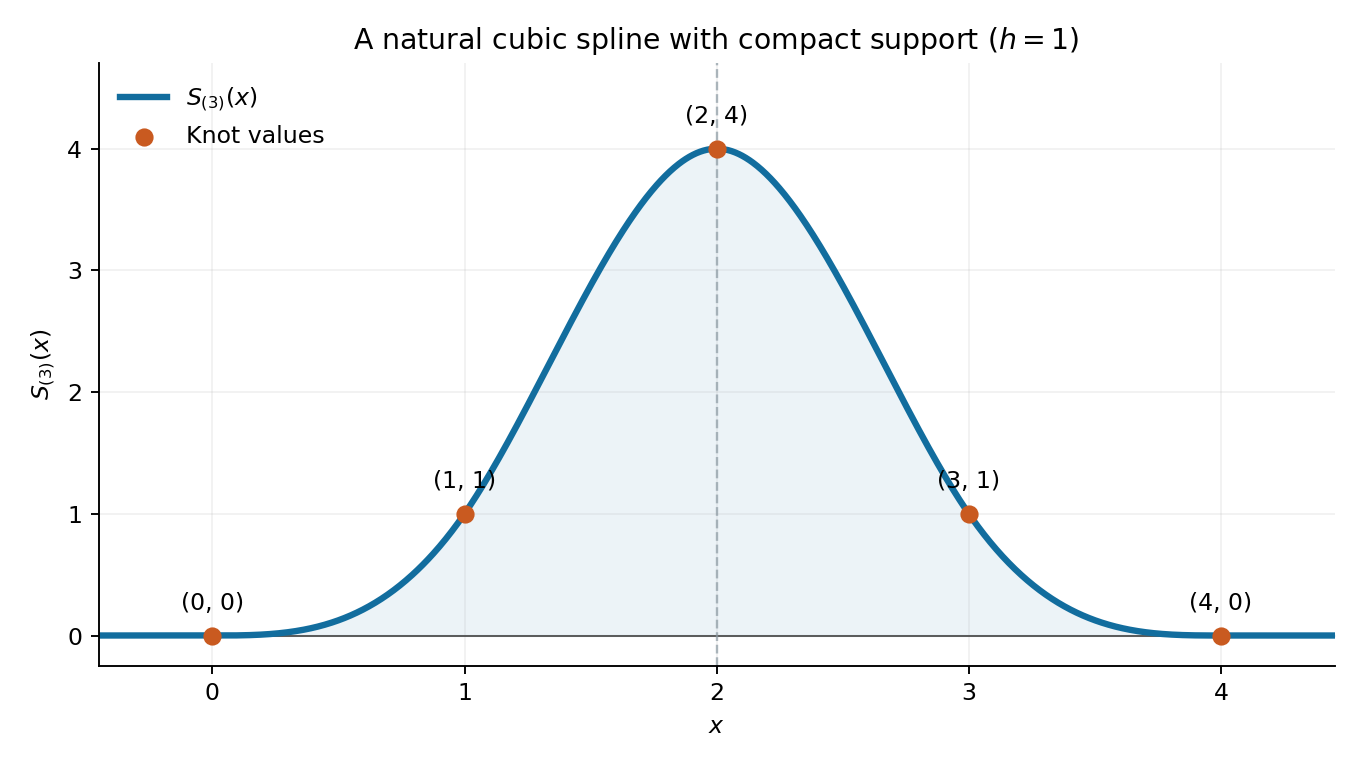
Codex 0 2026-10-31The finite sum of truncated cubes is by part (b) and is cubic on each knot interval. For , every term vanishes. For , every truncated power equals its ordinary polynomial, so part (a) applied to givesIt is therefore zero on both exterior intervals. Its regularity makes the endpoint second derivatives zero too, proving naturality.
Evaluation at the five knots givesFor example the three interior values in units of are , , and . At the cancellation is .
For an explicit graph description isIt is symmetric about , increases from zero to its maximum four at the centre, and decreases symmetrically back to zero. It joins the zero tails with zero first and second derivatives.
Pinned article: Introduction to the OurBigBook Project
Welcome to the OurBigBook Project! Our goal is to create the perfect publishing platform for STEM subjects, and get university-level students to write the best free STEM tutorials ever.
Everyone is welcome to create an account and play with the site: ourbigbook.com/go/register. We belive that students themselves can write amazing tutorials, but teachers are welcome too. You can write about anything you want, it doesn't have to be STEM or even educational. Silly test content is very welcome and you won't be penalized in any way. Just keep it legal!
Intro to OurBigBook
. Source. We have two killer features:
- topics: topics group articles by different users with the same title, e.g. here is the topic for the "Fundamental Theorem of Calculus" ourbigbook.com/go/topic/fundamental-theorem-of-calculusArticles of different users are sorted by upvote within each article page. This feature is a bit like:
- a Wikipedia where each user can have their own version of each article
- a Q&A website like Stack Overflow, where multiple people can give their views on a given topic, and the best ones are sorted by upvote. Except you don't need to wait for someone to ask first, and any topic goes, no matter how narrow or broad
This feature makes it possible for readers to find better explanations of any topic created by other writers. And it allows writers to create an explanation in a place that readers might actually find it.
Figure 1. Screenshot of the "Derivative" topic page. View it live at: ourbigbook.com/go/topic/derivativeVideo 2. OurBigBook Web topics demo. Source. - local editing: you can store all your personal knowledge base content locally in a plaintext markup format that can be edited locally and published either:This way you can be sure that even if OurBigBook.com were to go down one day (which we have no plans to do as it is quite cheap to host!), your content will still be perfectly readable as a static site.
- to OurBigBook.com to get awesome multi-user features like topics and likes
- as HTML files to a static website, which you can host yourself for free on many external providers like GitHub Pages, and remain in full control

Figure 2. You can publish local OurBigBook lightweight markup files to either OurBigBook.com or as a static website.
Figure 3. Visual Studio Code extension installation.
Figure 5. . You can also edit articles on the Web editor without installing anything locally. Video 3. Edit locally and publish demo. Source. This shows editing OurBigBook Markup and publishing it using the Visual Studio Code extension. 
- Infinitely deep tables of contents:



All our software is open source and hosted at: github.com/ourbigbook/ourbigbook
Further documentation can be found at: docs.ourbigbook.com
Feel free to reach our to us for any help or suggestions: docs.ourbigbook.com/#contact