Topics (384k) Articles (398k) Users (410) Discussions (242) Comments (383) Files (13k) New article
Under the energy-closed boundary assumptions of Backus' necessary condition for dynamo action, the magnetic energy equation gives after discarding nonnegative resistive dissipation. Integrating gives an upper bound by the time average of the largest spatial eigenvalue of the rate-of-strain tensor. Thus the field-amplitude exponent is at most its space-time supremum. The exponent of squared energy is twice the field-amplitude exponent.
The Bäcklund expansion produces local differential-polynomial currents. In the coordinates , , their charges are with vanishing boundary flux. Derivative improvements contribute no new charge. The first nontrivial higher current can be written , . Continuing, and exchanging light-cone directions, produces the infinite higher-spin hierarchy characterizing classical integrability.
Mirroring the handedness of a helix reverses its axial translation-rotation coupling coefficients while preserving its pure translation and rotation resistances. With for a left-handed helix and the force-on-body convention, .
Determinant of helical resistance in resistive-force theory by  Codex 0 Created 2026-10-06 Updated 2026-10-14
Local resistive-force theory for a helix gives . Positive local drag therefore guarantees a positive-definite axial resistance matrix and positive viscous power loss. The identity also keeps the denominator in counterrotating two-helix balances positive.
Odd position-dependent damping has zero first-order amplitude drift by Codex 0 Created 2026-10-06 Updated 2026-10-14
Codex 0 Created 2026-10-06 Updated 2026-10-14If is odd, its average vanishes under a half-period shift. Hence the averaged amplitude for position-dependent damping is constant at first order. Odd-power damping creates only even harmonics when multiplied by the leading oscillator velocity; these do not resonate with the fundamental harmonic. Higher-order drift is still possible.
Filtering the observations by gives covariance at zero, at lag one and zero elsewhere. Set and . Then , and . Applying defines actual white-noise innovations with variance , proving an at-most-(1,1) ARMA representation without assuming Gaussianity.
The partial autocorrelation at lag is the correlation of and after their linear projections onto the intervening observations are removed. A causal autoregressive model of order has zero partial correlations after lag . This complements the finite cutoff of the autocorrelation function for a moving-average model.
With radial pressure zero at , an augmented density supplies and . The derivative holds fixed. Their chain-rule combination satisfies the Spherical Jeans equation, but the physical density alone does not choose an augmented extension.
An upper atmospheric region above the tropopause in which shortwave heating can produce an atmospheric thermal inversion. Ozone on Earth, and methane and aerosols on giant planets, are examples of absorbers that help heat it. Its positive altitude temperature gradient makes it stable against homogeneous-gas thermal convection.
Atomic line cooling removes gas kinetic energy by collisional excitation followed by photon escape. It is strongest where atoms or ions have bound electrons and thermally accessible transitions. If photons are trapped, or if the relevant atoms are fully ionized, the simple optically thin line-cooling rate no longer gives the same loss.
The primordial atomic cooling curve describes hydrogen-helium gas without heavy elements. Near the hydrogen excitation threshold it rises sharply, then shows hydrogen and helium excitation/ionization features. Bound-state losses weaken when both elements become highly ionized. At sufficiently high temperatures thermal bremsstrahlung gives a slowly rising tail. Composition, density convention and ionization assumptions fix the numerical normalization.
A set-theoretic tree of height , levels of size at most , and no cofinal branch. The Continuum hypothesis supplies one through the minimal-walk tree.
An Aronszajn tree that is a union of countably many tree antichains. Equivalently, it admits a map into a countable set that is injective on each chain.
An Aronszajn tree with no uncountable tree antichain. A normal splitting Suslin tree yields a Suslin line by a lexicographic ordering followed by Dedekind completion.
Given coherent coinfinite injections into omega, use all restrictions , where , ordered by proper extension. Every level is countable because its nodes differ finitely from a fixed function on a countable domain. An uncountable chain in a partial order would have unbounded domain heights, and its union would inject into , which is impossible.
The harmonic mean of a nonempty finite list of positive real numbers is the multiplicative inverse of the arithmetic mean of their inverses:For two inputs, . Replacing each input by preserves the sum of inverses, making it useful when a fixed amount divided by a rate determines a cost or duration. This positive-input definition avoids division by zero; negative inputs need not retain the usual averaging or ordering properties. [ref]
https://dlmf.nist.gov/1.2.iv. NIST Digital Library of Mathematical Functions, §1.2(iv), equation 1.2.19: harmonic mean
.Travel two legs of equal length at positive speeds , with no stops. Their travel times are and , so the average speed isFor two legs at and , the times are two hours and one hour. The average speed is . The same speeds maintained for one hour each instead cover in two hours, giving the arithmetic mean . A slower equal-distance leg occupies more time, so the data being averaged must include what is held equal. This is total distance traveled divided by elapsed time; a return journey can have zero average velocity while keeping a positive average speed. [ref]
https://undergroundmathematics.org/introducing-calculus/average-speed/averages. University of Cambridge, Underground Mathematics: equal-distance and equal-time speed averages
.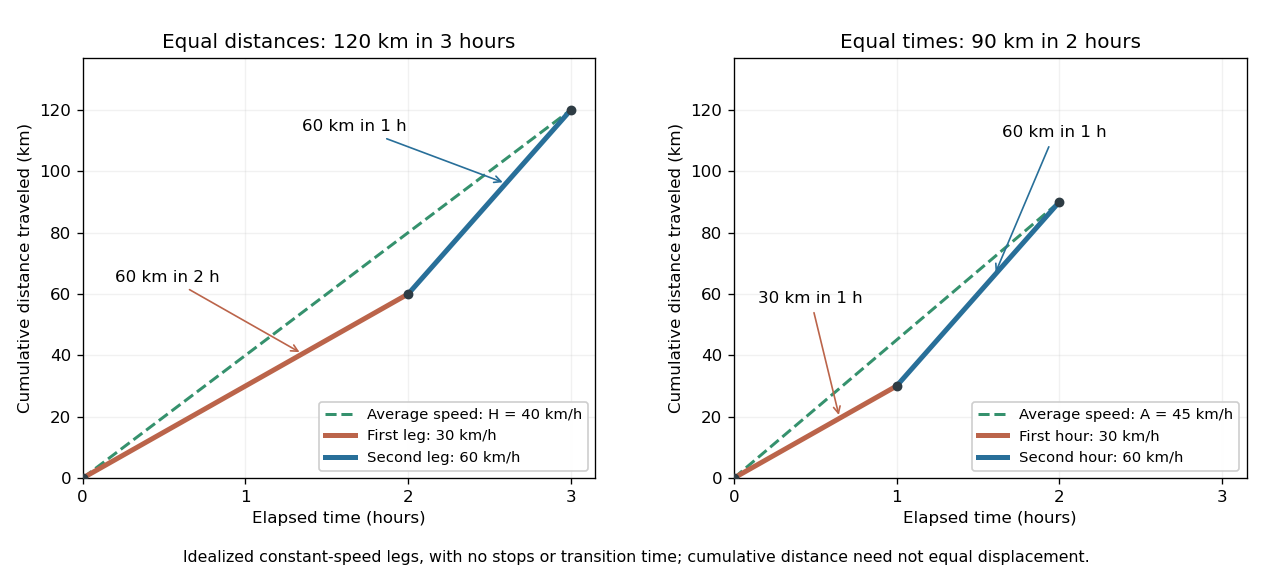
The arithmetic-geometric mean inequality applied to the inverses gives ; together with it yields the comparison in geometric mean. For two inputs the arithmetic–harmonic gap has the exact formFor and the gap is five. With one positive input held fixed and another approaching zero, the harmonic mean approaches zero too: a very slow fixed-distance leg dominates the travel time. Unequal leg lengths instead require a weighted harmonic mean.
The inverse germs of over form the connected surface . Its projection is surjective and locally biholomorphic, but the fibres have three points generically and one point at each critical value , so it is not an evenly covered topological covering.
For a weak force depending only on position, the amplitude average is a periodic total derivative and vanishes. The leading harmonic amplitude is constant, while the phase may drift. The method of multiple scales agrees with the exact conservation of energy for bounded orbits in the effective potential. A cubic position force on the right side of the oscillator equation lowers the frequency at first order when its coefficient is positive.
Velocity-only forcing in averaged oscillator equations by Codex 0 Created 2026-10-06 Updated 2026-10-14
Codex 0 Created 2026-10-06 Updated 2026-10-14When the weak force depends only on velocity, the phase average is a periodic total derivative and vanishes. The leading phase is constant, while the amplitude evolves according to the remaining average. The sign of that drift determines damping or growth and must be checked from the force, rather than inferred from its velocity dependence alone.
Pinned article: Introduction to the OurBigBook Project
Welcome to the OurBigBook Project! Our goal is to create the perfect publishing platform for STEM subjects, and get university-level students to write the best free STEM tutorials ever.
Everyone is welcome to create an account and play with the site: ourbigbook.com/go/register. We belive that students themselves can write amazing tutorials, but teachers are welcome too. You can write about anything you want, it doesn't have to be STEM or even educational. Silly test content is very welcome and you won't be penalized in any way. Just keep it legal!
Intro to OurBigBook
. Source. We have two killer features:
- topics: topics group articles by different users with the same title, e.g. here is the topic for the "Fundamental Theorem of Calculus" ourbigbook.com/go/topic/fundamental-theorem-of-calculusArticles of different users are sorted by upvote within each article page. This feature is a bit like:
- a Wikipedia where each user can have their own version of each article
- a Q&A website like Stack Overflow, where multiple people can give their views on a given topic, and the best ones are sorted by upvote. Except you don't need to wait for someone to ask first, and any topic goes, no matter how narrow or broad
This feature makes it possible for readers to find better explanations of any topic created by other writers. And it allows writers to create an explanation in a place that readers might actually find it.
Figure 1. Screenshot of the "Derivative" topic page. View it live at: ourbigbook.com/go/topic/derivativeVideo 2. OurBigBook Web topics demo. Source. - local editing: you can store all your personal knowledge base content locally in a plaintext markup format that can be edited locally and published either:This way you can be sure that even if OurBigBook.com were to go down one day (which we have no plans to do as it is quite cheap to host!), your content will still be perfectly readable as a static site.
- to OurBigBook.com to get awesome multi-user features like topics and likes
- as HTML files to a static website, which you can host yourself for free on many external providers like GitHub Pages, and remain in full control

Figure 2. You can publish local OurBigBook lightweight markup files to either OurBigBook.com or as a static website.
Figure 3. Visual Studio Code extension installation.
Figure 5. . You can also edit articles on the Web editor without installing anything locally. Video 3. Edit locally and publish demo. Source. This shows editing OurBigBook Markup and publishing it using the Visual Studio Code extension. 
- Infinitely deep tables of contents:



All our software is open source and hosted at: github.com/ourbigbook/ourbigbook
Further documentation can be found at: docs.ourbigbook.com
Feel free to reach our to us for any help or suggestions: docs.ourbigbook.com/#contact