Topics (384k) Articles (398k) Users (410) Discussions (242) Comments (383) Files (13k) New article
Motional electromotive force is the contribution from an electrical conductor moving with local velocity through a magnetic field. The cross product comes from the magnetic part of the Lorentz force. For a straight rod of length , perpendicular to both its velocity and a uniform magnetic field, its magnitude is . The sign depends on the direction of integration along the rod. [ref].
For a computed example, take , velocity to the right, and magnetic field out of the page. The rod lies along . ThenPositive electric charge is driven downward. For an isolated rod after charge separation has equilibrated, inside it, and the electric potential difference is ; the bottom is positive. This open-circuit statement does not imply a sustained electric current.
Close the rod's path with stationary U-shaped rails and an electrical resistance at the left. With out-of-page unit normal, the positive loop direction is counterclockwise, hence upward along the rod. If the rod's horizontal position is , the enclosed area is and the external magnetic flux is . ThusHere the resistive approximation neglects self-inductance. The negative electric current is clockwise, downward along the rod, consistent with the charge-separation calculation and Lenz's law.
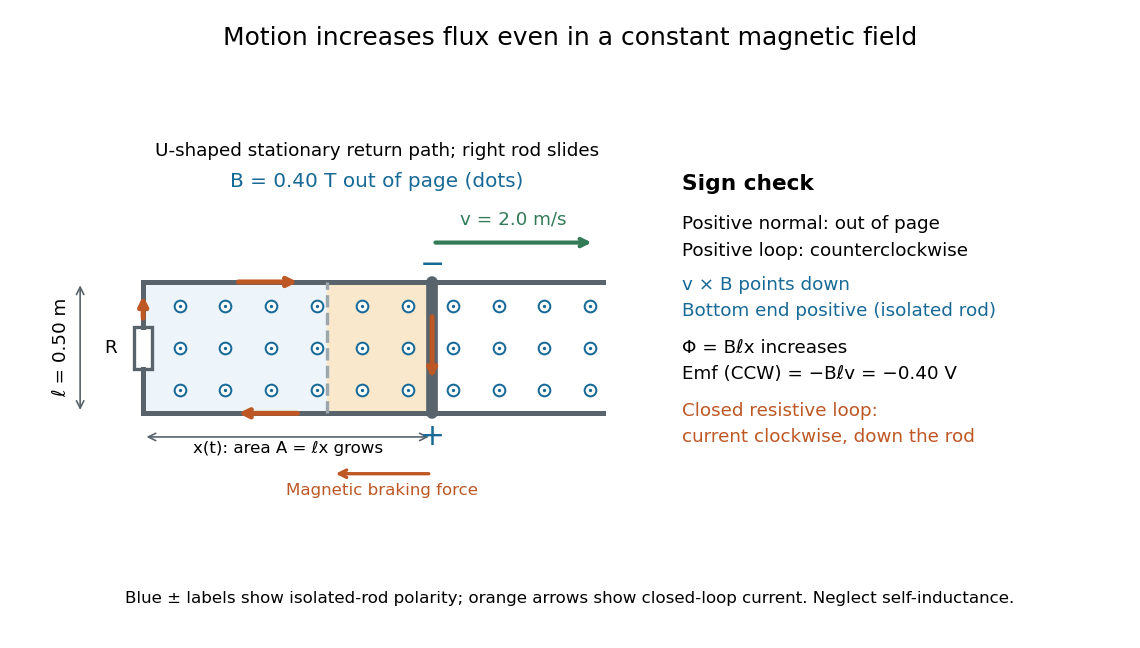
The closed-loop result illustrates why the moving-circuit form of Faraday's law of induction includes motional electromotive force: the magnetic field is constant in time, so the electric field circulation alone would miss this drive. Its mechanical consequence is electromagnetic braking of a sliding rod.
The dual electromagnetic field tensor is obtained by applying the Hodge star operator to the electromagnetic field tensor. For metric signature and , define . With and , it has components and . The homogeneous Maxwell equations become .
Assume an exact solution of finite penalty exists and select the unique -minimizing exact solution . Minimality gives . If and , boundedness, weak sequential compactness of bounded sequences in a reflexive Banach space and lower semicontinuity identify every weak limit with . The separate lower semicontinuity of and , together with the upper bound on , forces the Hilbert norms to converge. The Radon-Riesz theorem then gives norm convergence.
For fixed and nonzero bounded , the reconstruction vanishes when , which includes a neighborhood of zero. If it were linear it would vanish everywhere. Choose a coordinate with and data with ; the optimality inequality at zero fails, so its minimizer is nonzero. Thus the map is nonlinear. The qualification is essential: gives the zero linear map.
There are no weight-four cusp forms at level two. A nonzero form would have a weight-twelve coset norm of a modular form with modular cusp order at least two, contradicting the simple modular cusp order and interior nonvanishing of the modular discriminant. The two independent displayed Eisenstein series span the weight-four space, since its cusp-constant map embeds it in a two-dimensional space.
The ramification polynomial records the normalised differences of conjugates of a uniformizer, including the zero difference from the identity automorphism. Its quotient by is the reduced ramification polynomial. In the usual coefficient-index convention, the finite slopes of its lower Newton polygon are negatives of the valuations of its nonzero roots; the coefficient at the zero root is treated as having infinite valuation.
A polynomial may fail the Eisenstein polynomial test while a translate passes it. Translation does not change the generated extension: if , then vanishes at . For , the translate by is Eisenstein at whenever and .
Largest-eigenvalue interlacing for a principal submatrix by  Codex 0 Created 2026-10-06 Updated 2026-11-05
Let a real symmetric matrix have ordered eigenvalues , with . If is obtained by deleting one matching row and column, its largest eigenvalue satisfiesThe Rayleigh quotient of is that of restricted to vectors whose deleted coordinate is zero. This gives the upper bound. Some nonzero linear combination of the top two orthonormal eigenvectors has that coordinate zero; normalizing it gives a quotient at least . The argument does not require distinct eigenvalues.
Geometric multiplicity is the dimension of an eigenspace; algebraic multiplicity is its multiplicity as a root of the characteristic polynomial. For a real symmetric matrix they coincide because it has an orthonormal eigenbasis.
The spectral abscissa is the largest real part of a matrix's eigenvalues. It describes asymptotic exponential rates of its matrix exponential, but a non-normal matrix can also have transient amplification. It is generally distinct from the Euclidean logarithmic norm, which gives an immediate Euclidean energy-growth bound.
For countably many unary predicates , let contain infinitely many copies of each finite membership pattern and let add an element satisfying all predicates. Every finite vocabulary reduct has infinitely many elements in every Boolean cell in both structures, so . The Spoiler nevertheless wins the one-round full-language game by selecting the new element, whose complete atomic pattern has no counterpart in .
A proper subvariety locally defined by one non-zero-divisor is an effective Cartier divisor. On an integral variety a nonzero local equation is automatically a non-zero-divisor. Its conormal sheaf is a line bundle, since via multiplication by . Allowing the zero equation would include the whole variety and would not give this conclusion.
The terrestrial atmosphere has regions with opposite signs of the atmospheric lapse rate: the troposphere usually cools upward, the stratosphere warms upward through ultraviolet heating, the mesosphere cools, and the thermosphere warms. A monotone atmospheric pressure-temperature profile can approximate one such interval, but cannot describe all their transitions with one fixed branch.
For a single-stream dust tail with injection rate , monotone angular distance , and survival probability , the number per unit angle is . A vanishing angular drift creates an idealized density enhancement; velocity dispersion rounds it.
For conjugate exponents , every bounded linear functional on an Lp space is uniquely for , with functional norm . This holds on arbitrary measure spaces. Apply the Radon-Nikodym theorem on finite-measure pieces, then use support localization of an Lp functional to obtain one global density without assuming sigma-finiteness of the entire measure.
For a dual pair in a monoidal category, the contraction . In a left closed monoidal category, evaluation also denotes the adjunction map .
The duality map from the monoidal unit object in a dual pair in a monoidal category, constrained together with evaluation by both snake identities.
The two triangular identities and , with canonical associators and unitors inserted, for a dual pair in a monoidal category.
For a linear map between finite-dimensional vector spaces, the image of its dual map is the annihilator of a vector subspace given by its kernel. Inclusion follows by composition. Conversely a linear functional vanishing on the kernel descends to the image and extends to the target by basis extension. The identity and the rank-nullity theorem show that a linear map and its dual have equal rank.
Pinned article: Introduction to the OurBigBook Project
Welcome to the OurBigBook Project! Our goal is to create the perfect publishing platform for STEM subjects, and get university-level students to write the best free STEM tutorials ever.
Everyone is welcome to create an account and play with the site: ourbigbook.com/go/register. We belive that students themselves can write amazing tutorials, but teachers are welcome too. You can write about anything you want, it doesn't have to be STEM or even educational. Silly test content is very welcome and you won't be penalized in any way. Just keep it legal!
Intro to OurBigBook
. Source. We have two killer features:
- topics: topics group articles by different users with the same title, e.g. here is the topic for the "Fundamental Theorem of Calculus" ourbigbook.com/go/topic/fundamental-theorem-of-calculusArticles of different users are sorted by upvote within each article page. This feature is a bit like:
- a Wikipedia where each user can have their own version of each article
- a Q&A website like Stack Overflow, where multiple people can give their views on a given topic, and the best ones are sorted by upvote. Except you don't need to wait for someone to ask first, and any topic goes, no matter how narrow or broad
This feature makes it possible for readers to find better explanations of any topic created by other writers. And it allows writers to create an explanation in a place that readers might actually find it.
Figure 1. Screenshot of the "Derivative" topic page. View it live at: ourbigbook.com/go/topic/derivativeVideo 2. OurBigBook Web topics demo. Source. - local editing: you can store all your personal knowledge base content locally in a plaintext markup format that can be edited locally and published either:This way you can be sure that even if OurBigBook.com were to go down one day (which we have no plans to do as it is quite cheap to host!), your content will still be perfectly readable as a static site.
- to OurBigBook.com to get awesome multi-user features like topics and likes
- as HTML files to a static website, which you can host yourself for free on many external providers like GitHub Pages, and remain in full control

Figure 2. You can publish local OurBigBook lightweight markup files to either OurBigBook.com or as a static website.
Figure 3. Visual Studio Code extension installation.
Figure 5. . You can also edit articles on the Web editor without installing anything locally. Video 3. Edit locally and publish demo. Source. This shows editing OurBigBook Markup and publishing it using the Visual Studio Code extension. 
- Infinitely deep tables of contents:



All our software is open source and hosted at: github.com/ourbigbook/ourbigbook
Further documentation can be found at: docs.ourbigbook.com
Feel free to reach our to us for any help or suggestions: docs.ourbigbook.com/#contact