Topics (384k) Articles (398k) Users (410) Discussions (242) Comments (383) Files (13k) New article

The input penalty of a history Hamiltonian tests prescribed ancilla qubits at clock time zero while leaving the quantum witness unrestricted. A zero ancilla qubit is tested by the bad-state projector ; a plus ancilla qubit is tested by .
Let , where each tests a different ancilla qubit. These orthogonal projections commute because they act on separate tensor product factors. Thus is a positive operator with integer eigenvalues between zero and . Zero is essential: its kernel contains exactly the valid ancillary input subspace, tensored with arbitrary quantum witness states. Only the nonzero eigenvalues are positive integers.
The clock-conditioned term is . For a normalized computational history state with clock labels forming an orthonormal basis,Together with correct propagation, zero input penalty selects histories with valid initial data. The displayed expectation concerns this fixed history state; a bound on the full Hamiltonian's lowest eigenvalue also has to account for propagation penalties.
After undoing quantum circuit propagation, the Hamiltonian without output penalty is . The common kernel is the valid input space times the uniform clock vector. On its orthogonal complement, the smallest angle between two subspaces obeys . The Kitaev geometrical lemma and path gap give . Degenerate valid quantum witnesses must be removed together when computing this angle.
The three quark generations pair , and , each containing one charge- and one charge- quark. The number of generations controls the number of physical mixing angles and CP-violating phases in the CKM matrix.
For a left-handed incoming neutrino, unpolarized electrons, and electron vector/axial couplings , the four-fermion interaction gives . Integrating massless two-body Lorentz-invariant phase space yields . The electron spin average is included, while no sterile neutrino helicity is averaged in.
Neglecting interactions and thermal pairs, the Fermi-Dirac distribution with kinetic energy determines the electron contribution to a stellar equation of state. The kinetic chemical potential is fixed by the electron number density, not an independently chosen pressure fraction:The electron kinetic internal energy per volume is . In the nondegenerate limit ; at zero temperature the integrals become the equation of state of a cold electron gas. These are limits of one component and must not be added together as independent electron pressures. When electron-positron thermal pair abundance matters, both charge species must be included, with charge neutrality fixing their net density.
For a bounded source region and fixed positive wavenumber, expand . In the outgoing Green function for the three-dimensional Helmholtz equation, this gives . Volume integration gives the outgoing field's far-field pattern with an remainder. The estimate is an asymptotic statement for fixed source size and frequency.
If a uniform index has possibilities and every proposed success neighbourhood contains at most possibilities, then any estimator has failure probability at least the displayed expression. Condition on its success indicator: conditional entropy is at most . Subtract this from to bound the mutual information and rearrange. A metric Hamming ball gives approximate recovery rather than exact index decoding.
Under the hypotheses of Fano's inequality, let , , and let be the indicator random variable of an error. Its probability of being one is . The in the displayed bound denotes binary entropy in bits. Since is a deterministic function of , . Applying the chain rule for conditional entropy in both orders gives the exact decompositionThe first term is bounded by , because conditioning reduces entropy. For the second term, fix a report : if , then is known; if , then lies among at most other symbols. Maximum entropy on a finite alphabet bounds the latter uncertainty by . Averaging over the reports and the error flag givesThis proves Fano's inequality. Events of zero probability contribute zero to this average, so the proof also covers without assigning a conditional distribution to an impossible event.[ref]
https://web.stanford.edu/class/ee376a/files/lecture_notes.pdf. Weissman, Ochoa and Tatwawadi, EE376A course notes, Section 5.7, proof of Theorem 46
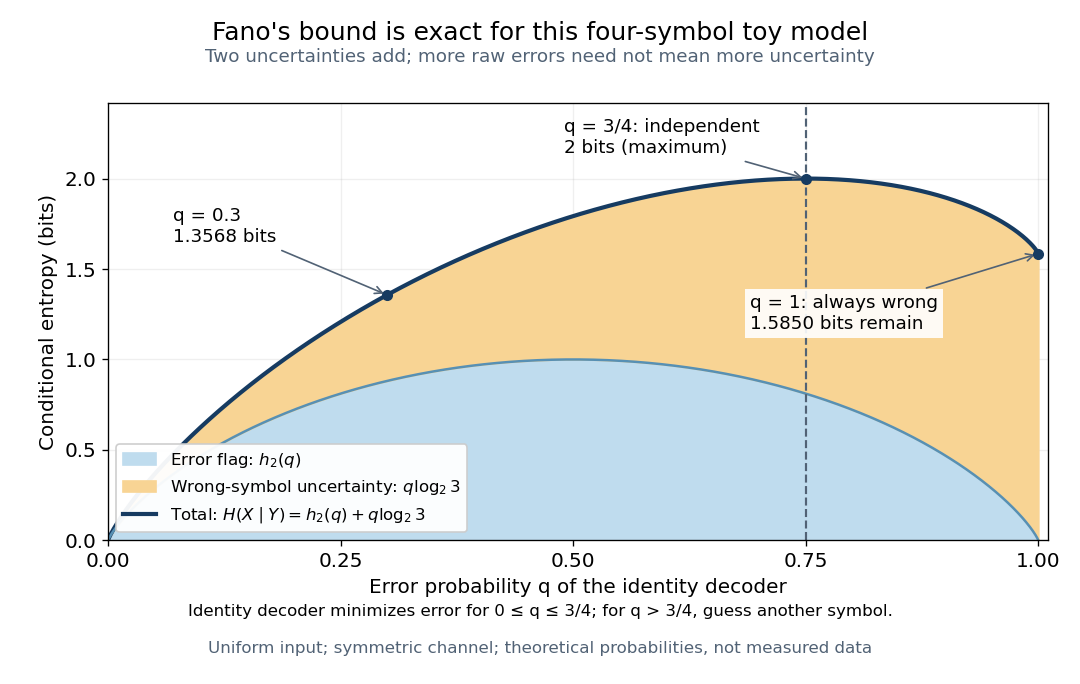
The four-symbol entropy budget peaks at chance-level error and separates the error flag from the three alternatives
. Details. The decomposition also explains equality. The first bound is exact when the indicator random variable and are independent random variables: knowing the report does not change the error probability. The second is exact when, for every report with positive error probability, the wrong-symbol conditional distribution is uniform on all alternatives. Both conditions hold in the four-symbol toy channel of Fano's inequality. At , the second condition is vacuous; at , the flag is constant but three alternatives remain, giving . For , there is just one alternative after an error, so the second term vanishes: all remaining uncertainty is whether the single alternative must replace the guess.
Starting with three ordered rapidities, the adjacent-exchange sequences and must give identical coefficients for every final species word in the Faddeev-Zamolodchikov algebra. The exchange parameters are , and because rapidity differences add. These coefficient identities express the spectral Yang-Baxter equation. One scalar identity is necessary but generally does not exhaust all the constraints.
If and a convex polytope satisfies , then it has at least facets. Its outward facet normals define spherical caps covering the unit sphere; the spherical cap area upper bound supplies the estimate.
Unit normalization gives . Hence . Set . Frobenius theorem for a hypersurface normal gives . Contracting with leaves , precisely the vanishing antisymmetric part of the extrinsic curvature of a spatial hypersurface.
With signature , future unit normal and , the Gauss–Codazzi equations become and , where in the second expression only the first three indices are projected. The intrinsic curvature and spatial covariant derivative use the spatial induced metric. The normal is timelike, so the normal-sign convention differs from a spacelike normal in a positive-definite ambient metric.
For and the future unit normal, the convention gives . Lower the shift vector with . The sign of the shift terms changes when the opposite threading convention is used.
In a 3+1 decomposition of spacetime with , contract the metric evolution with and use the Jacobi determinant derivative formula. Here , , is the lapse function, and is the shift vector. The identity separates spatial transport and coordinate compression from the geometric volume change caused by extrinsic curvature.
For a fixed -uniform forbidden hypergraph , its Turán density is the limit of . Averaging over smaller vertex subsets shows these normalized extremal numbers are nonincreasing, so the limit exists. For ordinary graphs, the Erdős-Stone theorem determines it from the chromatic number.
With balanced cyclically ordered vertex classes and , include an -set if some start has at least vertices in its first classes for every . The cycle lemma implies every -set contains an edge. Its asymptotic density is ; taking the hypergraph complement gives a lower bound for the Turán density of a complete uniform hypergraph.
For a single-component equilibrium system with extensive internal energy , scaling its entropy, volume and particle number together gives . The Euler theorem for homogeneous functions therefore gives . The first law of thermodynamics identifies these derivatives as , respectively, proving . Dividing by volume yields the entropy density formula . This step fixes the entropy normalization rather than merely identifying its differential. Differentiating the Euler relation and subtracting gives the Gibbs-Duhem equation . The argument requires extensivity; it is not an assumption about arbitrary nonadditive systems.
For a commutative ring that is a Noetherian ring and a multiplicatively closed set , a finitely generated module has a free resolution with every term finitely generated. Hom from a finite free module commutes with localization, and exactness of localization commutes with cohomology. Thus the displayed isomorphism holds for every and arbitrary . The finiteness condition is on the first argument; the second need not be finitely generated.
An extension group is a value of an Ext functor. In degree one it classifies short exact sequences up to isomorphisms fixing the endpoints. The zero class is the split extension; its addition is the Baer sum. Higher degrees can be represented by longer exact extensions, or computed from a projective resolution.
Pinned article: Introduction to the OurBigBook Project
Welcome to the OurBigBook Project! Our goal is to create the perfect publishing platform for STEM subjects, and get university-level students to write the best free STEM tutorials ever.
Everyone is welcome to create an account and play with the site: ourbigbook.com/go/register. We belive that students themselves can write amazing tutorials, but teachers are welcome too. You can write about anything you want, it doesn't have to be STEM or even educational. Silly test content is very welcome and you won't be penalized in any way. Just keep it legal!
Intro to OurBigBook
. Source. We have two killer features:
- topics: topics group articles by different users with the same title, e.g. here is the topic for the "Fundamental Theorem of Calculus" ourbigbook.com/go/topic/fundamental-theorem-of-calculusArticles of different users are sorted by upvote within each article page. This feature is a bit like:
- a Wikipedia where each user can have their own version of each article
- a Q&A website like Stack Overflow, where multiple people can give their views on a given topic, and the best ones are sorted by upvote. Except you don't need to wait for someone to ask first, and any topic goes, no matter how narrow or broad
This feature makes it possible for readers to find better explanations of any topic created by other writers. And it allows writers to create an explanation in a place that readers might actually find it.
Figure 1. Screenshot of the "Derivative" topic page. View it live at: ourbigbook.com/go/topic/derivativeVideo 2. OurBigBook Web topics demo. Source. - local editing: you can store all your personal knowledge base content locally in a plaintext markup format that can be edited locally and published either:This way you can be sure that even if OurBigBook.com were to go down one day (which we have no plans to do as it is quite cheap to host!), your content will still be perfectly readable as a static site.
- to OurBigBook.com to get awesome multi-user features like topics and likes
- as HTML files to a static website, which you can host yourself for free on many external providers like GitHub Pages, and remain in full control

Figure 2. You can publish local OurBigBook lightweight markup files to either OurBigBook.com or as a static website.
Figure 3. Visual Studio Code extension installation.
Figure 5. . You can also edit articles on the Web editor without installing anything locally. Video 3. Edit locally and publish demo. Source. This shows editing OurBigBook Markup and publishing it using the Visual Studio Code extension. 
- Infinitely deep tables of contents:



All our software is open source and hosted at: github.com/ourbigbook/ourbigbook
Further documentation can be found at: docs.ourbigbook.com
Feel free to reach our to us for any help or suggestions: docs.ourbigbook.com/#contact