Topics (384k) Articles (398k) Users (410) Discussions (242) Comments (383) Files (13k) New article

A real symmetric matrix whose quadratic form is positive at every nonzero vector in the nonnegative orthant. By compactness of the nonnegative unit sphere, this is equivalent to a positive uniform lower bound on that orthant. It need not be a positive-definite matrix.
The interior consists exactly of strictly copositive matrices. If has positive minimum on the compact nonnegative unit sphere, perturbations of operator norm less than preserve this positive lower bound there. Conversely, if a unit nonnegative vector has zero quadratic form, leaves the copositive cone for every . Thus such a matrix is not interior. The identity matrix is a convenient interior point.
Under the nonnegative-pairing convention for the dual cone, follows from . Conversely, if , separation from a closed convex cone gives a separating nonnegative on all generators and negative on . That is a copositive matrix, so . This proves the displayed equality using closedness of the completely positive cone.
A sequence of real numbers has limit of a sequence , written , precisely whenThe absolute value measures the error. The tolerance is chosen first; may depend on it, but must control every later term. Infinitely many accurate terms alone do not suffice. For example, repeatedly equals one but also repeatedly differs from one by two. The definition and uniqueness of the limit of a sequence are discussed in MIT 18.100A, Lecture 6, definitions 13 and theorem 15.
For a worked error estimate, let . Then , so any positive integer works. With , choose ; every later error is at most . The strict inequality matters: would give equality at its first term. A limit of a sequence turns the informal instruction “take enough terms” into an explicit accuracy guarantee.
The limit of a sequence is unique: two distinct proposed answers cannot both be within arbitrarily small error of every late term, by the triangle inequality. Changing finitely many initial terms does not change it. For an extended real number, means ; convergence to similarly requires . These describe escape rather than a finite answer. The extended-real Fekete lemma is an example where the limit of a sequence need not be finite.
A finite filtration of a cochain complex produces a convergent spectral sequence. The induced abutment filtration is the image of . Finiteness in each degree suffices; a bounded range of cochain degrees is not required.
Uniform convergence in probability means that the supremum of the absolute discrepancy on the entire index set tends to zero in probability. It controls evaluation at random indices in that set, unlike pointwise convergence in probability. On a fixed compact index set it is a special case of uniform convergence on compacts in probability.
A nonnegative continuous multiplier defines a contraction semigroup on the space of continuous functions vanishing at infinity and on by . Strong continuity follows from uniform convergence on compact sets and small tails in , or the dominated convergence theorem in . The multiplier itself may be unbounded.
The one-dimensional semigroup associated with the standard Ornstein-Uhlenbeck process has invariant standard Gaussian measure and generator . Its Mehler formula for the Ornstein-Uhlenbeck semigroup makes positivity and invariance explicit. The normalized Probabilists' Hermite polynomials diagonalize it, with . It has spectral gap one and satisfies the sharp Gaussian Poincaré inequality.
On a compact metric space, a conservative Feller semigroup is a strongly continuous semigroup of positive unital operators on . The Riesz-Markov-Kakutani representation theorem associates a Markov kernel to each operator. On noncompact spaces the standard definition uses ; conservativity then refers to the corresponding kernels having mass one, even when .
A continuous martingale is a continuous-time martingale whose paths are continuous outside one null event. Continuity does not remove the integrability or conditional-expectation requirements in the martingale definition.
A càdlàg martingale is a continuous-time martingale represented by a càdlàg process: its paths are right-continuous and have finite left limits at positive times, on one common probability-one event. This path regularity permits approximation of stopping times from above.
A martingale whose values over its whole time interval form a uniformly integrable family has an integrable terminal limit and is closed by that limit. Conversely, conditional expectations of an integrable terminal variable form a uniformly integrable martingale, by uniform integrability of conditional expectations. For continuous martingales, one may equivalently use uniform integrability of the family stopped at finite stopping times.
The Rayleigh distribution is the probability distribution of the Euclidean norm of a two-dimensional random vector with independent zero-mean normal random variables of equal variance as components. If are independent, thenHere is the standard deviation of each component, not of the radius . At this gives the unit-scale probability density function .[ref]
The Rayleigh Distribution. Random: Probability, Mathematical Statistics, Stochastic Processes by Kyle Siegrist; The General Rayleigh Distribution, Definition and Distribution Functions: independent equal-scale centered normal components and radial density
This geometry turns two signed errors into one nonnegative distance. For example, suppose horizontal and vertical positioning errors are independent random variables. Their means both vanish, but the distance from the intended point is usually positive. The Rayleigh distribution with gives the probability of landing inside any centered disk. These are chosen model assumptions, rather than measurements of a particular instrument.
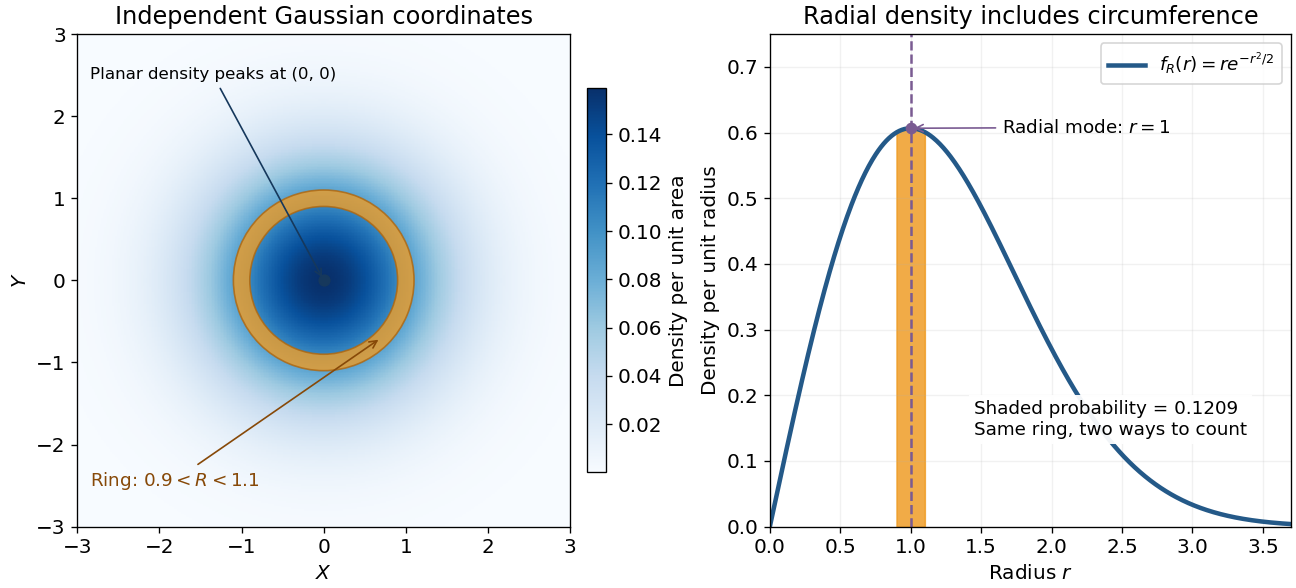
An apparently paradoxical feature is that the most likely location per unit area is the origin, while the radial mode is . A narrow annulus farther out has more area. Near zero that growing circumference outweighs the falling planar density; farther out the exponential function wins. Distinguishing densities measured against different elements of area or length resolves the paradox.
A bounded linear operator between normed spaces is contractive if its operator norm is at most one. This norm property is distinct from a strict contraction mapping, whose Lipschitz constant must be less than one.
A linear map is positive when implies . This is positivity for the pointwise order, not positivity of a quadratic form. On a compact space, , so . This makes positive maps especially useful for uniform approximation.
A contingent claim is replicated when an admissible self-financing portfolio has exactly its terminal payoff. In the absence of arbitrage, two replicating strategies for the same payoff have the same initial cost.
The payout is a concave stock payoff. Its conditional expected value has a discount-like dependence on future variance. The square-root stock supermartingale explains the negative variance drift.
The image of a morphism of algebraic varieties is constructible. This replaces the generally false assertion that all morphisms have closed image. Group structure adds the fact that a constructible subgroup is closed.
The equality can fail even at . Inside the constructible universe, is countable, so its definable power set is countable. The constructible power set of is uncountable there by the Cantor theorem. A real outside remains a constructible subset of , hence belongs to . The cardinal comparison must be made inside , since its reals can be externally countable.
Pinned article: Introduction to the OurBigBook Project
Welcome to the OurBigBook Project! Our goal is to create the perfect publishing platform for STEM subjects, and get university-level students to write the best free STEM tutorials ever.
Everyone is welcome to create an account and play with the site: ourbigbook.com/go/register. We belive that students themselves can write amazing tutorials, but teachers are welcome too. You can write about anything you want, it doesn't have to be STEM or even educational. Silly test content is very welcome and you won't be penalized in any way. Just keep it legal!
Intro to OurBigBook
. Source. We have two killer features:
- topics: topics group articles by different users with the same title, e.g. here is the topic for the "Fundamental Theorem of Calculus" ourbigbook.com/go/topic/fundamental-theorem-of-calculusArticles of different users are sorted by upvote within each article page. This feature is a bit like:
- a Wikipedia where each user can have their own version of each article
- a Q&A website like Stack Overflow, where multiple people can give their views on a given topic, and the best ones are sorted by upvote. Except you don't need to wait for someone to ask first, and any topic goes, no matter how narrow or broad
This feature makes it possible for readers to find better explanations of any topic created by other writers. And it allows writers to create an explanation in a place that readers might actually find it.
Figure 1. Screenshot of the "Derivative" topic page. View it live at: ourbigbook.com/go/topic/derivativeVideo 2. OurBigBook Web topics demo. Source. - local editing: you can store all your personal knowledge base content locally in a plaintext markup format that can be edited locally and published either:This way you can be sure that even if OurBigBook.com were to go down one day (which we have no plans to do as it is quite cheap to host!), your content will still be perfectly readable as a static site.
- to OurBigBook.com to get awesome multi-user features like topics and likes
- as HTML files to a static website, which you can host yourself for free on many external providers like GitHub Pages, and remain in full control

Figure 2. You can publish local OurBigBook lightweight markup files to either OurBigBook.com or as a static website.
Figure 3. Visual Studio Code extension installation.
Figure 5. . You can also edit articles on the Web editor without installing anything locally. Video 3. Edit locally and publish demo. Source. This shows editing OurBigBook Markup and publishing it using the Visual Studio Code extension. 
- Infinitely deep tables of contents:



All our software is open source and hosted at: github.com/ourbigbook/ourbigbook
Further documentation can be found at: docs.ourbigbook.com
Feel free to reach our to us for any help or suggestions: docs.ourbigbook.com/#contact