Topics (384k) Articles (398k) Users (410) Discussions (242) Comments (383) Files (13k) New article

Helium burning is stellar nuclear fusion in which helium nuclei are converted into heavier nuclei. The Triple-alpha process combines three helium-4 nuclei through an unstable beryllium-8 intermediate to form carbon-12; capture of another alpha particle can produce oxygen-16.
The strong temperature dependence and sensitivity to density make ignition conditions important for stellar evolution. In a degenerate core, expansion may initially provide little temperature regulation, permitting a helium flash. Burning means nuclear energy release here, rather than chemical combustion with oxygen.
A coronal mass ejection is an expulsion of plasma and embedded magnetic field from the solar corona into interplanetary space. It carries matter as well as magnetic structure. A solar flare instead denotes a rapid atmospheric energy-release event observed through enhanced radiation; the two phenomena can accompany the same eruption without being interchangeable.[ref]
Coronal Mass Ejections by NOAA Space Weather Prediction Center. Definition and distinction between expelled plasma/field and associated solar activity
A coronagraph suppresses the bright solar disc so that much fainter coronal structures can be followed outward. A sequence of images gives projected size, motion and morphology. SOHO's LASCO observations provide an important example of the instrument-based diagnosis used in space-weather analysis.[ref]
Coronal Mass Ejections by NOAA Space Weather Prediction Center. Coronagraph imagery, LASCO observations and inferred size, speed and direction
For an illustrative measurement, suppose an apparent front moves from projected radius to in one hour. Using givesThis is a plane-of-sky speed, not automatically the true radial speed. Projection, the choice of visible front and evolution between frames affect the inference. Motion mainly towards the observer can produce a surrounding halo in projection rather than a simple sideward trajectory.
A passing interplanetary disturbance can also be studied through local solar wind density, velocity and magnetic-field measurements. A leading shock wave and the magnetized ejecta are different parts of that disturbance. Combining remote imaging with local measurements is more informative than treating brightness or apparent speed alone as a complete description of the eruption.
A sampling frame is the operational list or other device identifying the units from which a statistical sample can be selected. The intended statistical population, the sampling frame and the responding units can differ. A register of residential addresses, for example, can serve as a sampling frame for a household survey, but may miss newly built homes and include demolished buildings.
If 100 of 1000 target households are absent from the sampling frame, randomly selecting 90 of the 900 listed households gives each listed household inclusion probability and each omitted household inclusion probability zero. Increasing the sample among listed households cannot by itself correct that lack of coverage. Duplicate entries create a different problem: units with more entries can be more likely to be selected. A sound design therefore documents how frame units map to population units and distinguishes coverage errors from sampling variability.
Unequal filling times in apparent lung compliance occur when different communicating lung regions have different resistance-compliance time constants. An observation made before all regions equilibrate can measure less volume response than the equilibrium elastic relation predicts. This provides a concrete mechanism for an observation-time dependence of apparent compliance without changing the underlying component compliances.
Consider an original passive model with parallel compartments exposed to one imposed pressure step . In compartment , let added volume be , airway resistance and elastic lung compliance . The equation and initially unfilled solution areThe apparent finite-time response per unit pressure is thereforeFor positive component values it rises toward . This is a pressure-step response, not a definition that replaces every breathing-cycle compliance convention.
Take , s and s. At s, the fast region has filled about 91.8% of its eventual increment, while the slow region has filled only 22.1%. The summed apparent compliance is about 0.114, compared with the equilibrium value 0.20 in the same units. After 2 s it is about 0.163. If both time constants were 0.2 s, the 0.5-s value would instead be about 0.184, despite the same equilibrium compliance.
Early and late observations constrain different combinations. The initial volume slope is , whereas the final volume change is . A sum of exponentials also need not have one fixed decay time: a single fitted time constant depends on the fitted interval.
A primary pilot study comparing static and dynamic respiratory-system measurements discusses expiration-based estimates and the possibility of multiple time constants.[ref]
Static and Dynamic Measurements of Compliance and Driving Pressure: A Pilot Study by Pierre Tawfik and others. Introduction, Method D; Study Procedures, two measured expiratory time constants
The constructed compartment example explains why measurement duration and model form belong with the reported value. Distinguishing lung-only from total respiratory-system mechanics still requires the appropriate internal pressure reference.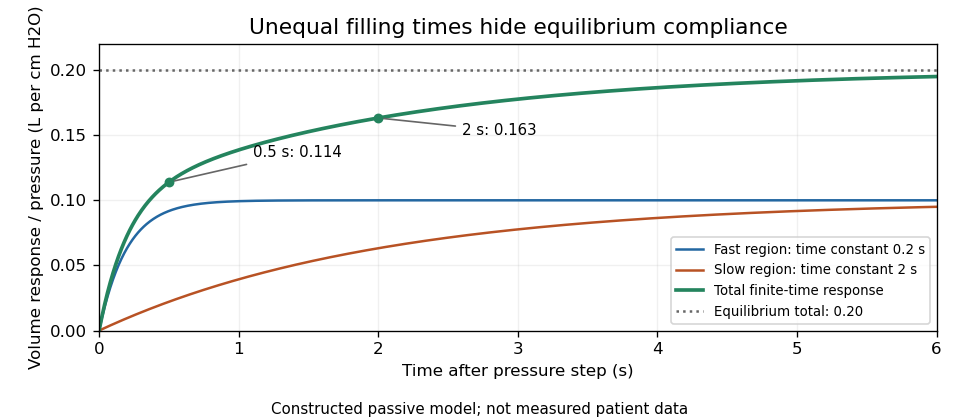
Original two-compartment pressure-step model: unequal time constants produce an observation-time dependence of apparent lung compliance
. Details. 51 Pegasi is a Sun-like star whose radial-velocity variations led Michel Mayor and Didier Queloz to infer a close planetary companion in 1995. The discovery of 51 Pegasi b showed that a giant planet can orbit much closer to a normal star than the giant planets of the Solar System do.
The measured signal was the star's changing line-of-sight velocity, inferred from shifts in its spectrum. The planet was inferred through the star's reflex motion, rather than seen as a resolved bright point. Orbital inclination enters the mass inference, so a radial-velocity amplitude alone generally constrains a minimum mass.[ref]
Given a topological spectrum , its localization of spectra sends to an -local topological spectrum through a map inducing an isomorphism on -homology. Here -local means that every map from an -acyclic topological spectrum to is nullhomotopic; is -acyclic when is trivial. This is Bousfield localization.[ref]
The map is universal for maps from to -local objects. For rational homology, localization rationalizes homotopy groups: . Thus the sphere spectrum loses its finite torsion information and retains in degree zero. Localization deliberately preserves the information seen by a chosen generalized homology theory while discarding information invisible to it.
A topological stabilizer code is a quantum stabilizer code whose local commuting checks are arranged on a spatial lattice and whose logical information is encoded in global structure. Local errors create detectable syndrome patterns; a nontrivial logical operator typically requires a sufficiently extended chain or surface.
The toric code is a central example: products of Pauli operators around vertices and faces define the stabilizers, while noncontractible loops act on encoded qubits. Protection depends on code distance and an appropriate decoder, not on topology alone guaranteeing error-free storage.
For a one-step method applied to , write . Its absolute stability region is the set of complex where the stability function is defined and , using the bounded-iteration convention.
Explicit Euler has , giving the closed disk centered at with radius one. For real , boundedness requires , while strict inequality gives decay. At the boundary , the numerical solution alternates with unchanged magnitude even though the exact solution decays. Some definitions use the strict region ; stating the convention separates boundedness from asymptotic damping.
An idler photon is the partner of a signal photon in a specified nonlinear optical process. In spontaneous parametric down-conversion, one pump photon supplies the energy of the pair, .
The idler can be measured to herald a signal photon or to condition a correlation measurement. It is not a physically expendable photon: losses in its channel reduce heralding rates and can bias an uncorrected coincidence sample. When the two output modes have the same frequency, the signal/idler distinction comes from their assigned spatial, polarization or experimental roles rather than from energy ordering.
A signal photon is the photon assigned to a designated signal mode in a photon-pair process such as spontaneous parametric down-conversion. Its partner is called the idler photon. The labels identify modes or experimental roles; they do not universally mean the higher-energy and lower-energy photon.
For a narrowband pump, pair production obeys . Spatial and polarization correlations also depend on the phase matching arrangement. Detecting the idler can herald the presence of the signal, but heralding efficiency depends on collection and loss. At degeneracy, signal and idler can have equal frequencies while remaining distinguishable by propagation direction or another mode label.
Phonological competition occurs when speech forms with overlapping sounds are simultaneously plausible candidates during spoken word recognition and influence the eventual selection. For example, hearing the beginning of “candle” can make “candy” temporarily relevant as well. Later acoustic evidence can resolve the ambiguity even though the alternative has already affected processing.
In a 2005 experiment, a listener saw two pictures and used a mouse to select the named object. When the competing picture had a similar-sounding name, such as “candy” beside “candle”, the movement toward the correct object was drawn farther toward that competitor than toward an unrelated alternative. The comparison demonstrated an effect of phonological competition on the path of the response, beyond whether the final click was correct.[ref]
Continuous attraction toward phonological competitors by Michael Spivey and others. PNAS 102, pp. 10393–10398; cohort/control conditions and Figure 1
This suggests a useful experimental distinction: accuracy measures the final choice, while reaction time and mouse tracking can reveal costs and intermediate influences. Similarity alone does not establish competition; a controlled manipulation must show that the alternative changes processing or behaviour.
A lexical cohort is a set of candidate words compatible with an initial stretch of speech during spoken word recognition. In a cohort model, new acoustic information changes which candidates remain plausible. The term describes candidates in recognition, rather than a group of people followed in a longitudinal study.[ref]
For an English example, an initial “cap” can fit “captain”, “captive” and “capsule”; later sounds distinguish them. The example assumes a particular vocabulary and pronunciation: spelling alone does not specify an acoustic cohort.
The 1978 experiments compared repeating ongoing speech with detecting altered pronunciations while following a written passage. Effects of where a mispronunciation occurred, and differences in the influence of context across tasks, constrained accounts of how incoming speech and prior expectations interact.[ref]
Processing interactions and lexical access during word recognition in continuous speech by William D. Marslen-Wilson and Alan Welsh. Abstract; shadowing and mispronunciation-detection tasks
A candidate set is a model construct; behaviour supplies evidence about its time course rather than a literal inventory of consciously considered words.A cohort model explains spoken word recognition through an evolving set of candidate words, the lexical cohort. An initial stretch of speech activates plausible candidates; later acoustic evidence and, depending on the model version, contextual information constrain recognition. William D. Marslen-Wilson and Alan Welsh's 1978 study connected this account with experimental manipulations of continuous speech.[ref]
Processing interactions and lexical access during word recognition in continuous speech by William D. Marslen-Wilson and Alan Welsh. Introduction and Abstract; cohort framework and task comparisons
For an illustrative English vocabulary, the opening sounds of “candle”, “candy” and “canister” initially overlap. Hearing the next consonant can remove “canister” while leaving the other two plausible; later sounds separate them. The candidates depend on pronunciation and the listener's vocabulary, not merely on matching written letters.
A deliberately simplified noise-free rule isHere is the candidate set after the evidence available at step . This filtering illustration is not a fitted psychological model: noisy speech, graded activation and recovery from misleading evidence require additional assumptions. A uniqueness point concerns when the remaining acoustic prefix distinguishes a word within a specified vocabulary; it need not coincide with the listener's measured response time.
The original task comparisons motivate testing a model on intermediate behaviour and contextual effects, not just final accuracy.[ref]
Processing interactions and lexical access during word recognition in continuous speech by William D. Marslen-Wilson and Alan Welsh. Abstract; distinct effects in shadowing and mispronunciation detection
A shadowing task asks a participant to repeat incoming speech aloud while continuing to listen. The delay and accuracy of repetition provide behavioural measures of processing an unfolding speech stream. The task differs from repeating a whole sentence only after the speaker has finished.
William D. Marslen-Wilson and Alan Welsh used shadowing with altered pronunciations in continuous speech. Whether listeners repeated a changed form or fluently restored the expected word depended on aspects of the input and context. Comparison with a mispronunciation detection task helped show that task instructions change which influences appear in the measured response.[ref]
Processing interactions and lexical access during word recognition in continuous speech by William D. Marslen-Wilson and Alan Welsh. Abstract; fluent restorations, syllable position and contextual constraints
A restoration is an observation about the spoken response. It does not alone establish that a listener consciously heard the original sound correctly, nor that every intervening processing stage had the same representation. This makes shadowing useful for testing the time course of spoken word recognition while keeping response production part of the explanation.
A mispronunciation detection task asks listeners to report an altered pronunciation in speech. The manipulation can vary where a change occurs within a word or how strongly the surrounding context predicts the word; responses can be scored for detection and reaction time.
In the 1978 spoken word recognition experiments, listeners in the detection condition saw the original passage while hearing it. The study compared this with a shadowing task, in which listeners repeated ongoing speech. Effects of syllable position appeared in detection, while contextual effects differed between the tasks.[ref]
Processing interactions and lexical access during word recognition in continuous speech by William D. Marslen-Wilson and Alan Welsh. Abstract; written-passage detection and shadowing comparison
The written version supplies information unavailable to an ordinary listener without a transcript. Thus a quick correct response can reflect comparison with that text as well as processing of the incoming sounds. Keeping the altered sound, context and instructions explicit makes the task interpretable rather than treating detection accuracy as a pure measure of one isolated cognitive stage.
A word's uniqueness point is the earliest point in its spoken form at which the sounds heard so far distinguish it from all competing words in a specified vocabulary. It connects a cohort model of spoken word recognition to the changing size of the lexical cohort.[ref]
For an invented vocabulary, let three word forms be the phoneme sequences , and , with spaces ignored and each symbol representing one phoneme. The third word becomes unique after , while the first two remain ambiguous after and diverge at the following consonant. Uniqueness can therefore precede the end of a word.
This is a property of the chosen vocabulary and transcription, not a universal timestamp attached to a spelling. Adding another word beginning changes the example. A word that is a complete prefix of another may require an end-of-word cue. Measured reaction time also includes perceptual, decision and motor processes, so it need not equal the lexical uniqueness time.
A floating pinion has mounting freedom that permits a limited position adjustment between its mating meshes. The resulting force balance can improve load division in a split-torque transmission. Floating does not mean unsupported: bearing and shaft constraints still transmit loads, and the allowed displacement must match the intended balancing direction.
An original symmetric scalar model illustrates the mechanism. Let two opposed mesh reactions bewhere sets mean compression, represents an initial mismatch and is the pinion's balancing displacement. Assume both contacts remain compressed. Let floating-pinion centering stiffness provide support reaction , with the reaction sign chosen so that equilibrium is . ThenWith negligible centering restraint, and the reactions become equal. In the rigid-centering limit, and the original imbalance remains.
For stipulated , and , rigid centering gives forces and . Free adjustment gives and . At , displacement is and forces are and . These describe the chosen scalar model, rather than a complete face-gear support design.
The primary 2002 rig slow-rolled pinions between two face gears, applied loads through hanging masses, pulleys and cables, and used tooth-root strain gauges. Its cantilevered pinion mount allowed a balancing displacement.[ref]
Development of Face Gear Technology for Industrial and Aerospace Power Transmission by Gregory F. Heath and others. Summary, printed p. iii; Introduction, printed p. 1; Section VIII, torque calibration and split determination
The report's modified fixed-pinion comparison sent nearly all its load to one face-gear mesh, illustrating the effect of constraint in that tested assembly.[ref]Development of Face Gear Technology for Industrial and Aerospace Power Transmission by Gregory F. Heath and others. Conclusions, printed p. 84, fixed modified-idler comparison
Finite travel, friction, backlash or loss of one contact can prevent the ideal balancing solution. At low load, the condition that both model forces are nonnegative must be checked; a gear tooth engagement threshold can change the equations. Position freedom can help sharing without guaranteeing identical tooth stress or a perfectly equal torque split at every operating condition.
Pinned article: Introduction to the OurBigBook Project
Welcome to the OurBigBook Project! Our goal is to create the perfect publishing platform for STEM subjects, and get university-level students to write the best free STEM tutorials ever.
Everyone is welcome to create an account and play with the site: ourbigbook.com/go/register. We belive that students themselves can write amazing tutorials, but teachers are welcome too. You can write about anything you want, it doesn't have to be STEM or even educational. Silly test content is very welcome and you won't be penalized in any way. Just keep it legal!
Intro to OurBigBook
. Source. We have two killer features:
- topics: topics group articles by different users with the same title, e.g. here is the topic for the "Fundamental Theorem of Calculus" ourbigbook.com/go/topic/fundamental-theorem-of-calculusArticles of different users are sorted by upvote within each article page. This feature is a bit like:
- a Wikipedia where each user can have their own version of each article
- a Q&A website like Stack Overflow, where multiple people can give their views on a given topic, and the best ones are sorted by upvote. Except you don't need to wait for someone to ask first, and any topic goes, no matter how narrow or broad
This feature makes it possible for readers to find better explanations of any topic created by other writers. And it allows writers to create an explanation in a place that readers might actually find it.
Figure 1. Screenshot of the "Derivative" topic page. View it live at: ourbigbook.com/go/topic/derivativeVideo 2. OurBigBook Web topics demo. Source. - local editing: you can store all your personal knowledge base content locally in a plaintext markup format that can be edited locally and published either:This way you can be sure that even if OurBigBook.com were to go down one day (which we have no plans to do as it is quite cheap to host!), your content will still be perfectly readable as a static site.
- to OurBigBook.com to get awesome multi-user features like topics and likes
- as HTML files to a static website, which you can host yourself for free on many external providers like GitHub Pages, and remain in full control

Figure 2. You can publish local OurBigBook lightweight markup files to either OurBigBook.com or as a static website.
Figure 3. Visual Studio Code extension installation.
Figure 5. . You can also edit articles on the Web editor without installing anything locally. Video 3. Edit locally and publish demo. Source. This shows editing OurBigBook Markup and publishing it using the Visual Studio Code extension. 
- Infinitely deep tables of contents:



All our software is open source and hosted at: github.com/ourbigbook/ourbigbook
Further documentation can be found at: docs.ourbigbook.com
Feel free to reach our to us for any help or suggestions: docs.ourbigbook.com/#contact