Topics (384k) Articles (398k) Users (410) Discussions (242) Comments (383) Files (13k) New article

Lava is magma that has reached the surface during volcanism, and the word also describes the rock produced when that material solidifies. Its behavior depends on temperature, composition, gas content and the proportion of crystals carried in the melt.
A cooling flow loses heat at its surface while its interior can remain mobile. Increasing crystal content and changing viscosity alter how the flow advances; escaping gas can produce bubbles or contribute to fragmentation. Thus a lava flow is a coupled thermal and mechanical system rather than a liquid with one constant viscosity from eruption to complete solidification.
A video device node is a device node through which an application accesses a supported video or metadata interface in Video4Linux. A conventional path is
/dev/video0, but the name identifies a kernel interface rather than a persistent physical-camera identity. Device drivers register the interfaces, and applications open them to obtain file descriptors for the appropriate operations.[ref]A single hardware peripheral can expose several interfaces. Conversely, a path numbered zero can refer to different hardware after discovery order changes. The kernel documentation identifies
/dev/v4l/by-id/ and /dev/v4l/by-path/ links as alternatives for identifying devices independently of transient numbering.[ref]Opening devices and querying capabilities in the Linux Kernel video API documentation. §1.1.2, naming notes and example device links
For an original selection example, suppose cameras A and B are discovered in that order and receive paths
/dev/video0 and /dev/video1. On another boot B is discovered first, reversing those assignments. A configuration containing only /dev/video0 then selects a different camera while remaining a valid path. Identifying the intended hardware and querying the opened interface's capabilities addresses two separate questions.The returned file descriptor refers to an open instance; it is not the camera number. An application may receive descriptor 7 when opening
/dev/video0, and another application may also have a descriptor 7 referring to another object in its own descriptor table. File descriptors are local process handles, while the device path belongs to the file system namespace.Before interpreting data, query the interface with
VIDIOC_QUERYCAP and negotiate its supported pixel format. A video device node alone does not imply support for NV12M, a chosen image size or the V4L2 multi-planar API. The resulting image memory planes and video buffer payload must follow the actual negotiated interface.The vibroscope area estimator converts the fundamental frequency of a tensioned material fibre into a cross-sectional area through a mechanical model. For a uniform flexible strand of length , positive tension , linear mass density and mass density , the fixed-end string relation givesThe second equation uses : the frequency first identifies mass per length under the stated tension, and a chosen mass density then converts it into area. Circular geometry is needed only to infer a diameter from that area.[ref]
University Physics Volume 1 by William Moebs and others. §16.3, equation 16.8, string wave speed; §16.6, fixed-end standing-wave modes
The experimental study by Bo Madsen, Rajnish Kumar and Hans Lilholt used a Favimat+ fibre testing machine. Acoustic waves excited the strand, and a frequency sweep plus a polynomial fit located the resonance peak. A load cell measured tension, while grip separation supplied . The reported frequency range was 500–4000 Hz, with an estimated resolution of 0.1 Hz; the stated force and length readout resolutions were and . Those readout resolutions do not themselves specify the estimator's full measurement uncertainty.[ref]
Vibroscope method for determination of cross-sectional area of glass and carbon fibres – Experiments and analyses by Bo Madsen and others. §3.2, apparatus, acoustic excitation, swept-sine/polynomial peak determination and measurement resolutions
The area and mass density must refer to the same loaded or reference configuration. The companion theory derives volume and area corrections for recovering an untensioned reference area from the tensioned measurement.[ref]
The vibroscope area uncertainty follows locally by logarithmic differentiation:Treat the small input errors as independent random variables, and let each denote the corresponding standard uncertainty. First-order uncertainty propagation then givesCorrelated inputs require their covariances as well. Four independent 1% relative standard uncertainties give for the area. A systematic 1% overestimate of frequency alone instead multiplies the area estimate by : it produces about a 1.97% underestimate.
Bending resistance can also increase the observed frequency. The companion theory paper models fully clamped supports and derives the corresponding frequency equation and deformation corrections.[ref]
Vibroscope method for determination of cross-sectional area of glass and carbon fibres - Theory and further development by Bo Madsen and others. §§2.1–2.2, beam equation and clamped-end conditions; §§5–6, corrections for the tensioned fibre
An independently derived, simply supported example isolates the bending-stiffness bias in the vibroscope area estimator. Let be the filament bending modulus and impose zero deflection and zero bending moment at each endpoint. Substituting into the tensioned Euler-Bernoulli beam equation givesWith , the uncorrected flexible-string estimate satisfies . At , it is 9.09% too small. The same model yields two-mode separation of tension and bending stiffness:For and , the predicted mode ratio is , ranging from 2 toward 4. These identities belong to the simply supported model; clamped grips require their own boundary conditions. Neither a single resonance peak nor an assumed diameter establishes the appropriate support, density or bending correction.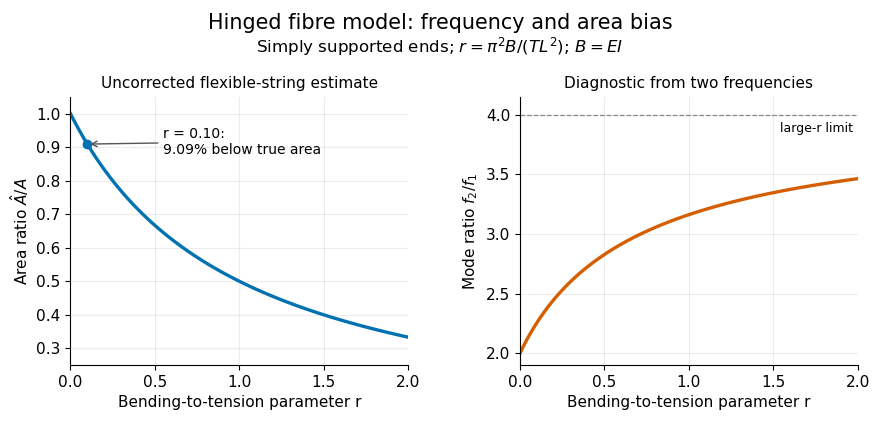
Mabuya heathi is the historical scientific name of a Brazilian skink now listed as Brasiliscincus heathi. The name used in older reproductive studies identifies the same species under an earlier generic classification.[ref]
https://reptile-database.reptarium.cz/Brasiliscincus/heathi. Accepted combination, synonymy and distribution
The species is important in the study of viviparity and placental matrotrophy. In a 1984 study, Daniel G. Blackburn and colleagues compared the small ovulated eggs with developing offspring and examined the reproductive tissues. They reported eggs about one millimetre across and estimated that placental transfer supplied more than of fetal dry mass near birth. The estimate concerns dry material accumulated during development, rather than simply uptake of water.[ref]
Eutherian-like reproductive specializations in a viviparous reptile by Daniel G. Blackburn and others. Abstract and reproductive measurements, pages 4860–4863
The comparison demonstrates that live birth can involve extensive maternal nutrient supply after ovulation. Its similarity to nutritional support in placental mammals is an example of convergent evolution; it does not place the skink within the mammalian lineage.
A postcapillary venule is a small venule immediately downstream of a capillary network. Its thin wall includes an endothelium supported by associated pericytes. It collects blood returning from exchange vessels and is an important site of leukocyte passage from the circulation into surrounding tissue.[ref]
Anatomy and Physiology 2e by J. Gordon Betts and others. Section20.1, Venules and vessel-wall organization
In a 2006 experiment, investigators followed neutrophils in inflamed mouse postcapillary venules using real-time and time-lapse intravital microscopy. After adhering, the neutrophils crawled along the luminal surface before leaving the vessel, sometimes moving against blood flow. Genetic perturbations separated effective adhesion from subsequent crawling.[ref]
The end-diastolic pressure-volume relationship describes ventricular pressure as a function of chamber volume at the end of diastole across different filling states. It is assembled from multiple end-diastolic observations, rather than from the entire time trajectory of one filling event. It is useful for describing passive chamber behavior when the activation state, pressure reference and external constraints are sufficiently controlled.
The local inverse slope is ventricular compliance:An intracavity-pressure curve and a transmural pressure curve can differ when surrounding pressure changes. Nor does a pressure-volume curve directly specify the material elasticity of the ventricular wall: chamber geometry also enters the relation.
For an original model, take , with . ThenThe upward curvature makes the chamber locally less compliant at larger volume without requiring any change in parameters. With mmHg, and mL, the pressures at 100 and 120 mL are 3.437 and 6.963 mmHg. Their secant estimate mL/mmHg describes that finite interval; the local compliance at 120 mL is about 4.46 mL/mmHg.
The pressure-volume relation was tested against imaging in a primary isolated-heart experiment. A balloon provided known ventricular volumes, a micromanometer recorded pressure, and automated echocardiography measured short-axis area in six perfused dog hearts. Repeated volume increments supplied multiple pressure-volume and pressure-area pairs. Their reported agreement concerned that experimental preparation, with clinical application explicitly left unvalidated.[ref]
Comparing curves also requires a size convention. If a model is written with reference volume , then . Two geometrically scaled chambers can therefore have different dimensional slopes even with the same normalized relation. Volume normalization of ventricular pressure-volume curves separates that comparison from a claim about changed wall properties. One observed end-diastolic point cannot identify an arbitrary curve or all three parameters of the exponential model.
Ventilator circuit compliance, , quantifies gas volume temporarily stored in the breathing circuit as its pressure rises. Storage includes expansion of tubing and compression of gas already in the circuit. With a stated volume-reference convention, a local linear approximation isIt describes the delivery apparatus, rather than the respiratory-system compliance of the patient.
The ideal gas law explains why even rigid tubing can contribute. For a rigid circuit of volume at fixed temperature, . Expressing the extra gas as volume at the initial absolute pressure givesFor an original illustration, let L and cm HO. The gas-storage contribution is 2 mL/cm HO. If tubing expansion adds 0.5 mL/cm HO, a 20 cm HO rise stores about 50 mL in this linear model. Absolute pressure belongs in the gas-law denominator; the 20 cm HO pressure increment is not that denominator.
Under the same gas-reference convention, integrated source flow must supply both patient volume and the change in circuit storage, plus any leaked volume. A remote flow sensor therefore need not measure only tidal volume. A sensor near the airway opening moves the measurement boundary past much of the circuit storage. The manufacturer's technical account explicitly motivates proximal measurement by this distinction.[ref]
Flow sensors for mechanical ventilators by Hamilton Medical. Proximal flow and pressure measurement; Clinical evidence
Correcting storage is still a model-based operation. A single compliance coefficient does not identify an unknown leak, changing tubing properties or every dynamic pressure difference. The technical source's reproduced experimental abstracts show why circuit correction did not eliminate every discrepancy between ventilator-side and airway-side measurements. Those observations motivate checking the measurement location and gas conditions rather than equating a displayed source volume with gas entering the lung.
Mixed venous oxygen content is the oxygen content of blood after the returning venous streams have mixed, representing whole-body venous return to the right side of the heart. It is the venous quantity required with arterial oxygen content in the whole-body Fick principle. A single regional vein need not have this content: different tissues remove different amounts of oxygen and return different blood flow rates.
The mixing rule follows from conservation of mass. If streams have blood flow rates and venous oxygen content values , with no oxygen exchange during mixing,For two constructed streams, mL/min at mL of oxygen per mL of blood and mL/min at mL/mL carry and mL/min of oxygen. Their mixture has content mL/mL, not the unweighted mean mL/mL. The correct weights are volume blood flow rates.
The right atrium receives several returns before blood passes through the right ventricle and pulmonary trunk.[ref] A downstream sample can represent their mixture only to the extent that the streams have actually mixed and the sampling interval represents the desired state. Replacing that sample with one taken from a particular upstream vein introduces a representativeness assumption. Likewise, averaging oxygen saturation values is not generally an oxygen-content balance when hemoglobin concentrations differ. The whole-body balance is about amounts of transported oxygen, not averages of instrument displays.
The superior vena cava returns blood from much of the head, neck, upper limbs and thorax to the right atrium. The right and left brachiocephalic veins join into this return channel, and the azygos vein also drains into it.[ref]
Anatomy and Physiology 2e by J. Gordon Betts and others. §20.5, The Superior Vena Cava and Table 20.11
Much of the heart's own venous return follows separate cardiac routes, so “everything above the diaphragm” would be an inaccurate definition.The superior vena cava and inferior vena cava collect different territories. Their blood can have different oxygen contents because regional flows and oxygen consumption differ. The chamber destination is shared, but the two vessels are not interchangeable sampling sites for every physiological calculation.
An original complete-mixing model combines upper-body flow litres per minute at content with lower-body flow litres per minute at . Ignoring separate cardiac venous return for this reduced example,Neither original vessel content equals that mixture. Using the superior-vessel value with the total 5 L/min would imply 500 mL oxygen returned per minute, whereas the model's two streams return 620 mL per minute.
The discrepancy arises from mismatching a regional composition with whole-system flow. It persists even with a perfectly accurate content instrument. A whole-body Fick principle calculation requires mixed venous oxygen content on the appropriate basis; a regional specimen remains valuable when the intended question is about its actual drainage territory.
Pinned article: Introduction to the OurBigBook Project
Welcome to the OurBigBook Project! Our goal is to create the perfect publishing platform for STEM subjects, and get university-level students to write the best free STEM tutorials ever.
Everyone is welcome to create an account and play with the site: ourbigbook.com/go/register. We belive that students themselves can write amazing tutorials, but teachers are welcome too. You can write about anything you want, it doesn't have to be STEM or even educational. Silly test content is very welcome and you won't be penalized in any way. Just keep it legal!
Intro to OurBigBook
. Source. We have two killer features:
- topics: topics group articles by different users with the same title, e.g. here is the topic for the "Fundamental Theorem of Calculus" ourbigbook.com/go/topic/fundamental-theorem-of-calculusArticles of different users are sorted by upvote within each article page. This feature is a bit like:
- a Wikipedia where each user can have their own version of each article
- a Q&A website like Stack Overflow, where multiple people can give their views on a given topic, and the best ones are sorted by upvote. Except you don't need to wait for someone to ask first, and any topic goes, no matter how narrow or broad
This feature makes it possible for readers to find better explanations of any topic created by other writers. And it allows writers to create an explanation in a place that readers might actually find it.
Figure 1. Screenshot of the "Derivative" topic page. View it live at: ourbigbook.com/go/topic/derivativeVideo 2. OurBigBook Web topics demo. Source. - local editing: you can store all your personal knowledge base content locally in a plaintext markup format that can be edited locally and published either:This way you can be sure that even if OurBigBook.com were to go down one day (which we have no plans to do as it is quite cheap to host!), your content will still be perfectly readable as a static site.
- to OurBigBook.com to get awesome multi-user features like topics and likes
- as HTML files to a static website, which you can host yourself for free on many external providers like GitHub Pages, and remain in full control

Figure 2. You can publish local OurBigBook lightweight markup files to either OurBigBook.com or as a static website.
Figure 3. Visual Studio Code extension installation.
Figure 5. . You can also edit articles on the Web editor without installing anything locally. Video 3. Edit locally and publish demo. Source. This shows editing OurBigBook Markup and publishing it using the Visual Studio Code extension. 
- Infinitely deep tables of contents:



All our software is open source and hosted at: github.com/ourbigbook/ourbigbook
Further documentation can be found at: docs.ourbigbook.com
Feel free to reach our to us for any help or suggestions: docs.ourbigbook.com/#contact