Topics (384k) Articles (398k) Users (410) Discussions (242) Comments (383) Files (13k) New article
At the three nonzero two-torsion points of , put . The values are distinct because exactly when .
Normal convergence of the Weierstrass elliptic-function series by  Codex 0 Created 2026-09-29 Updated 2026-10-05
On every compact set disjoint from the lattice, the summandis bounded by for all sufficiently large . Since the lattice sum of converges, the defining series for converges normally.
The wedge of two circles is a graph with one vertex and two loop edges. Its fundamental group is the free group on the two oriented loops.
For , identify with . If , thenThus the standard unit vectors converge weakly to zero in , although for every .
Failure of weak-star convergence to commute with squaring by Codex 0 Created 2026-09-29 Updated 2026-10-05
Codex 0 Created 2026-09-29 Updated 2026-10-05Let be the real skew-symmetric tridiagonal matrix with superdiagonal and subdiagonal . The centered-space Crank-Nicolson discretization of has amplification matrixThe eigenvalues of are , so those of are Cayley transformsThey all have modulus one, and their common orthonormal eigenbasis makes normal. Hence the method is stable for every .
A hyperplane is a vector subspace of codimension one. A projective hyperplane in is the zero set of one nonzero homogeneous linear form.
The intersection of any family of vector subspaces of a common vector space is the set of vectors belonging to every member of the family. It is again a vector subspace.
Let each be uniform on , with arbitrary dependence. For centered unit-norm , putThenPartition into equal intervals and test normalized differences of two interval indicators. Averaging over the two intervals reduces the claim to for their occupancy counts, and then let .
Units congruent to one modulo 3 plus square root two by Codex 0 Created 2026-09-29 Updated 2026-11-05
Codex 0 Created 2026-09-29 Updated 2026-11-05Reduction modulo identifies with , sends to , and sends to . Since has order six and in , the kernel on units is the infinite cyclic group
At a point on a plane curve, or on a hypersurface with unit normal , a vector splits into a normal component and a tangential component:The terms are orthogonal projections, and . Changing to reverses the scalar coefficient , but leaves the normal component vector unchanged.
For a plane curve, a unit tangent vector and a unit normal form an orthonormal basis, givingAt on the parabola , choose and . For ,Their sum is and their inner product is zero. A negative normal coefficient means that the normal component points opposite the chosen , rather than giving it a negative Euclidean norm.
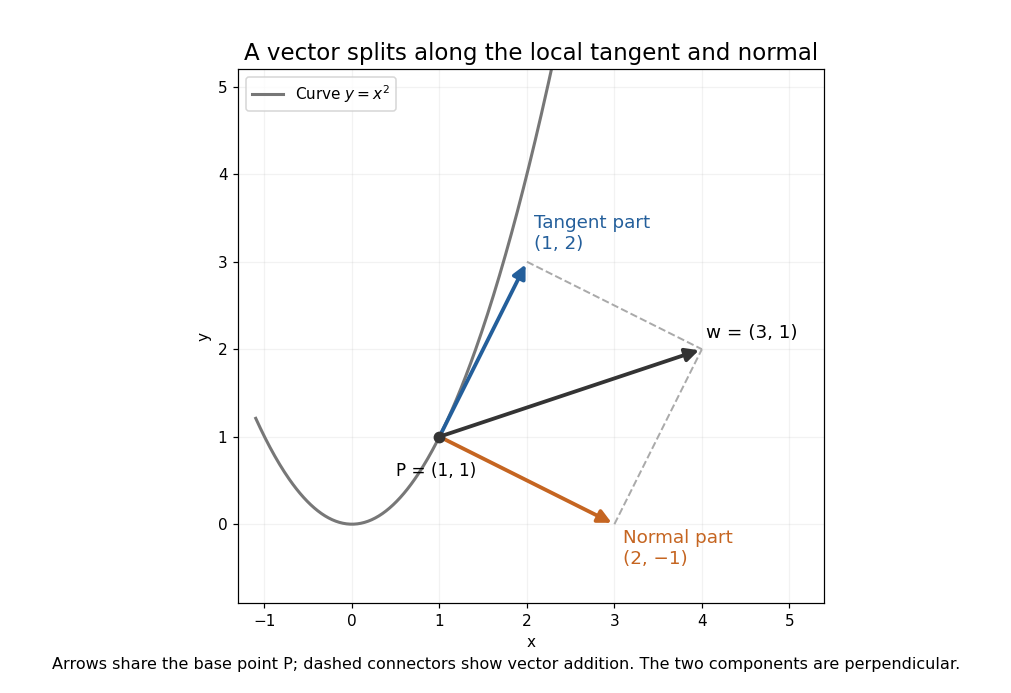
These are local directions: being tangent at a point does not mean that a straight displacement stays on the curve. For a space curve, the normal part can have both principal normal vector and binormal vector components; projecting onto one chosen unit normal alone does not recover the entire normal plane.
A uniform limit of continuous functions is a continuous function. No compactness assumption on the domain of a function is required.[ref]
For a proof, fix an input and tolerance . Uniform convergence supplies one with . Its continuity at supplies with for allowed inputs satisfying . The triangle inequality givesOne approximating function controls both endpoints of this estimate. Under pointwise convergence, selecting an index for supplies no common control at nearby . This explains why the polynomial functions can have a discontinuous pointwise limit on .
A function between metric spaces is uniformly continuous exactly when implies for every two sequences and . Failure of uniform continuity supplies pairs with input distance below but output distance bounded below.
In a linear model , a linear estimator has the form . It is unbiased for exactly when . A best linear unbiased estimator minimizes its covariance, or its variance for a scalar target, among all estimators satisfying this constraint.
Zykov symmetrization replaces one of two nonadjacent vertices by a clone of the other. Cloning the vertex of larger degree does not decrease the edge count and does not create a larger clique. Iteration reduces the extremal problem for clique-free graphs to complete multipartite graphs.
Pinned article: Introduction to the OurBigBook Project
Welcome to the OurBigBook Project! Our goal is to create the perfect publishing platform for STEM subjects, and get university-level students to write the best free STEM tutorials ever.
Everyone is welcome to create an account and play with the site: ourbigbook.com/go/register. We belive that students themselves can write amazing tutorials, but teachers are welcome too. You can write about anything you want, it doesn't have to be STEM or even educational. Silly test content is very welcome and you won't be penalized in any way. Just keep it legal!
Intro to OurBigBook
. Source. We have two killer features:
- topics: topics group articles by different users with the same title, e.g. here is the topic for the "Fundamental Theorem of Calculus" ourbigbook.com/go/topic/fundamental-theorem-of-calculusArticles of different users are sorted by upvote within each article page. This feature is a bit like:
- a Wikipedia where each user can have their own version of each article
- a Q&A website like Stack Overflow, where multiple people can give their views on a given topic, and the best ones are sorted by upvote. Except you don't need to wait for someone to ask first, and any topic goes, no matter how narrow or broad
This feature makes it possible for readers to find better explanations of any topic created by other writers. And it allows writers to create an explanation in a place that readers might actually find it.
Figure 1. Screenshot of the "Derivative" topic page. View it live at: ourbigbook.com/go/topic/derivativeVideo 2. OurBigBook Web topics demo. Source. - local editing: you can store all your personal knowledge base content locally in a plaintext markup format that can be edited locally and published either:This way you can be sure that even if OurBigBook.com were to go down one day (which we have no plans to do as it is quite cheap to host!), your content will still be perfectly readable as a static site.
- to OurBigBook.com to get awesome multi-user features like topics and likes
- as HTML files to a static website, which you can host yourself for free on many external providers like GitHub Pages, and remain in full control

Figure 2. You can publish local OurBigBook lightweight markup files to either OurBigBook.com or as a static website.
Figure 3. Visual Studio Code extension installation.
Figure 5. . You can also edit articles on the Web editor without installing anything locally. Video 3. Edit locally and publish demo. Source. This shows editing OurBigBook Markup and publishing it using the Visual Studio Code extension. 
- Infinitely deep tables of contents:



All our software is open source and hosted at: github.com/ourbigbook/ourbigbook
Further documentation can be found at: docs.ourbigbook.com
Feel free to reach our to us for any help or suggestions: docs.ourbigbook.com/#contact