Topics (384k) Articles (398k) Users (410) Discussions (242) Comments (383) Files (13k) New article
Hele–Shaw flow is slow flow between closely spaced parallel plates. Averaging across a gap of thickness gives the Darcy-type lawrelative to stationary plates.
The orthochronous Lorentz group consists of Lorentz transformations preserving the future sheet of the unit timelike hyperboloid. Equivalently, . This is an open subgroup of and hence a full-dimensional submanifold.
For ,Every such matrix has the block formso the Lie algebra and the Lorentz group have dimension six. At , the tangent space is .
The Lipschitz constant is the least nonnegative number that works in the defining Lipschitz bound, equivalently the displayed supremum of distance ratios. A constant function has constant zero; for a domain with at most one point we also set it to zero. An infinite supremum means there is no finite Lipschitz bound. The least constant need not be attained by one pair of inputs.
For on the real line, every distinct pair has ratio , so the Lipschitz constant is . For on , with ,Pairs , have ratio , approaching . Thus the Lipschitz constant is , although no distinct pair realizes that exact value. Reporting the domain is essential: the same function has no finite global Lipschitz constant on .
For every odd prime , the Legendre symbol correlation satisfiesThe small negative value measures an exact dependence between neighboring square tests; it is not obtained by treating them as independent.
Count the pairs satisfying . For each , their number is : it is one for zero, two for a nonzero quadratic residue and zero for a quadratic nonresidue. The total is therefore plus the desired sum.
Set and . Since is invertible in this finite field, this is a bijection onto the solutions ofChoose any . Then , uniquely determining and . There are exactly choices of . Hence , proving the correlation identity.
For an odd prime , the complete sum of the Legendre symbol isChoose a quadratic nonresidue . Multiplication by permutes the finite field , while multiplicativity of the Legendre symbol gives . The sum is therefore equal to its own negative, and is zero. Equivalently, among the nonzero residue classes, exactly half are quadratic residues and half are quadratic nonresidues; the zero term contributes zero.
For an odd prime and any integers , the Legendre symbol obeysIn particular, if , then , where is a modular multiplicative inverse. Multiplication by a nonzero square also leaves the Legendre symbol unchanged: for .[ref]
Quadratic Residues by Ben Lynn. Ben Lynn, Quadratic Residues, The Legendre Symbol: multiplicativity and invariance under a nonzero square factor
The subgroup and coset arguments under quadratic residue and quadratic nonresidue prove the sign rule without computing a large power: square times square is square, square times nonsquare is nonsquare, and nonsquare times nonsquare is square. If either factor is zero modulo , both sides of the identity vanish. On , the Legendre symbol is thus a group homomorphism to whose kernel of a group homomorphism is the quadratic residue subgroup. Viewed on all integers, it is a completely multiplicative function and a Dirichlet character modulo .
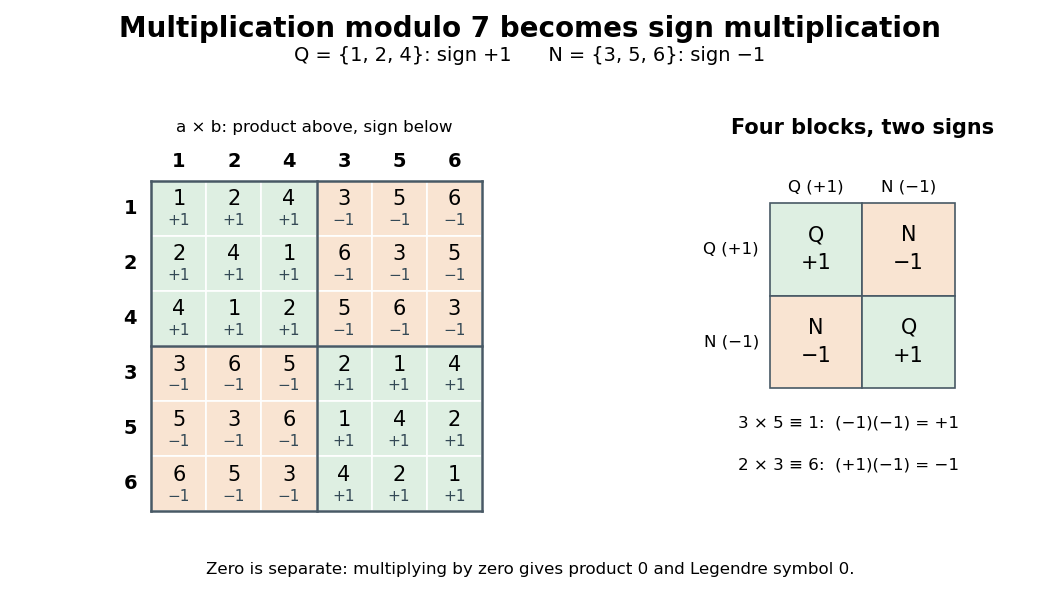
For an original calculation, factor the numerator . Modulo seven, , agreeing with . Modulo eleven, the signs are instead , giving , agreeing with . The same factorization can therefore certify different square behavior at different prime numbers.
Alternatively, Euler's criterion gives modulo . For nonzero factors both sides correspond to signs in . Since is odd, these signs are distinct modulo , so the modular congruence proves the asserted equality of integers, not merely an equality of representatives.
Terms singular at in a Laplace transform encode persistent late-time behaviour. In particular,contributes to the inverse transform; singularities farther into the left half-plane contribute decaying terms under the usual analyticity and growth assumptions.
Let be of exponential order , piecewise continuously differentiable on finite intervals of nonnegative time, and let be its unilateral Laplace transform. For and at a point of continuity,At a jump the symmetric integral recovers . The vertical line must lie in the defining region of absolute convergence of a Laplace transform; saying only that it avoids singularities of an analytic continuation does not supply that condition.[ref]
1 Algebraic and Analytic Methods. §1.14(iii), Laplace inversion and bounded-variation sufficient conditions
To see the inversion mechanism, extend by zero to negative time. Its Fourier transform at angular frequency is . The Fourier inversion theorem, followed by multiplication by and the substitution , gives the displayed formula. Contour deformation is a subsequent step that needs separate growth estimates.
If a Laplace integral has finitely many separated nondegenerate global maxima with the same phase value, its leading term is the sum of their local Gaussian contributions. An interior maximum contributes a full Gaussian integral, while a stationary endpoint maximum contributes half of one.
Laplace's method at a nondegenerate stationary endpoint by  Codex 0 Created 2026-09-29 Updated 2026-11-05
 Electric-field splitting of a Landau level in a rectangle by Codex 0 Created 2026-09-29 Updated 2026-11-05
Codex 0 Created 2026-09-29 Updated 2026-11-05In Landau gauge with periodic boundary conditions of length , adjacent guiding centres differ by . A perpendicular electric field tilts the energy by , so adjacent states formerly in one degenerate Landau level are separated by .
In the nonrelativistic Lorentz force model, uniform perpendicular electric field and magnetic field give the guiding-centre velocity , independent of electric charge and mass. For and , the drift component is .
The electric drift in crossed uniform fields derivation separates force-cancelling drift from the remaining cyclotron motion and states the nonrelativistic speed restriction and the relativistic magnetic-dominated condition. These conditions matter when using the drift to describe Landau levels in crossed electric and magnetic fields.
Suppose is prime to the characteristic of a field and contains all th roots of unity. For , adjoining a root of gives a Kummer extension. Every conjugate of a chosen root is with , so the extension is a cyclic Galois extension of degree dividing .
Adjoining several such radicals gives the finite abelian extensions of exponent dividing described by Kummer theory. The characteristic restriction is essential: in characteristic , adjoining a th root of an element that is not a th power produces a purely inseparable extension, with no nonidentity automorphisms. Cyclic extensions of degree in that characteristic are described instead by Artin–Schreier theory.
For a Killing vector field and the curvature convention ,The identity follows by combining the Ricci identity, Killing equation, and first Bianchi identity.
For a rapidly decaying KdV potential, the scattering data consist of the continuous reflection coefficient, the negative discrete eigenvalues , and a positive norming constant for each bound state.
Pinned article: Introduction to the OurBigBook Project
Welcome to the OurBigBook Project! Our goal is to create the perfect publishing platform for STEM subjects, and get university-level students to write the best free STEM tutorials ever.
Everyone is welcome to create an account and play with the site: ourbigbook.com/go/register. We belive that students themselves can write amazing tutorials, but teachers are welcome too. You can write about anything you want, it doesn't have to be STEM or even educational. Silly test content is very welcome and you won't be penalized in any way. Just keep it legal!
Intro to OurBigBook
. Source. We have two killer features:
- topics: topics group articles by different users with the same title, e.g. here is the topic for the "Fundamental Theorem of Calculus" ourbigbook.com/go/topic/fundamental-theorem-of-calculusArticles of different users are sorted by upvote within each article page. This feature is a bit like:
- a Wikipedia where each user can have their own version of each article
- a Q&A website like Stack Overflow, where multiple people can give their views on a given topic, and the best ones are sorted by upvote. Except you don't need to wait for someone to ask first, and any topic goes, no matter how narrow or broad
This feature makes it possible for readers to find better explanations of any topic created by other writers. And it allows writers to create an explanation in a place that readers might actually find it.
Figure 1. Screenshot of the "Derivative" topic page. View it live at: ourbigbook.com/go/topic/derivativeVideo 2. OurBigBook Web topics demo. Source. - local editing: you can store all your personal knowledge base content locally in a plaintext markup format that can be edited locally and published either:This way you can be sure that even if OurBigBook.com were to go down one day (which we have no plans to do as it is quite cheap to host!), your content will still be perfectly readable as a static site.
- to OurBigBook.com to get awesome multi-user features like topics and likes
- as HTML files to a static website, which you can host yourself for free on many external providers like GitHub Pages, and remain in full control

Figure 2. You can publish local OurBigBook lightweight markup files to either OurBigBook.com or as a static website.
Figure 3. Visual Studio Code extension installation.
Figure 5. . You can also edit articles on the Web editor without installing anything locally. Video 3. Edit locally and publish demo. Source. This shows editing OurBigBook Markup and publishing it using the Visual Studio Code extension. 
- Infinitely deep tables of contents:



All our software is open source and hosted at: github.com/ourbigbook/ourbigbook
Further documentation can be found at: docs.ourbigbook.com
Feel free to reach our to us for any help or suggestions: docs.ourbigbook.com/#contact