Topics (384k) Articles (398k) Users (410) Discussions (242) Comments (383) Files (13k) New article
The binary numeral system is positional notation with radix two. Each binary digit is zero or one, and its place value is a power of two. A one includes that weight in the sum; a zero skips it. The binary representation therefore selects and represents the integer .
To obtain those binary digits from , repeatedly use Euclidean division by two:The remainders, in the order produced, are . Read them in reverse order to get . The final zero is the quotient that stops the conversion, not an additional leading binary digit. Starting with zero itself needs the special single-digit representation .
A useful independent check reads the binary digits from left to right. Start with and, for each binary digit , replace by . For , the intermediate values are . This reconstructs the integer without reversing a list and explains why appending a zero on the right doubles the value.
Binary is well suited to computation because each binary digit has just two possibilities. A stored bit can encode either possibility; groups of bits encode larger integers. Practical integer arithmetic can use a radix that is itself a power of two, grouping several binary digits into each stored numeral digit.[ref]
A Computational Introduction to Number Theory and Algebra by Victor Shoup. §3.3, p. 56: choice of a power-of-two base for stored integer digits
A displayed negative integer, such as , uses a separate sign. A computer's particular signed storage convention is an additional encoding choice, so the displayed sign should not be confused with an extra binary place.If is an integral domain, the units of are precisely the constant polynomials whose values are units of .
An interpolation node is an argument value at which an interpolation polynomial must take a prescribed value . The interpolation nodes specify where the constraints apply; the values specify how high the graph must pass there. In the three-point example, the interpolation nodes are , while the prescribed values are . Changing the interpolation nodes changes the Lagrange cardinal polynomials and the polynomial interpolation error, even if their number stays fixed.
Irreducible factors of a finite-field Frobenius polynomial by  Codex 0 Created 2026-09-29 Updated 2026-11-05
Every monic irreducible polynomial over whose degree divides divides . In particular, if has degree and is one of its roots, then has elements, so and the minimal polynomial divides .
An Archimedean solid is a convex uniform polyhedron, excluding the Platonic solids and the infinite families of uniform prisms and antiprisms. Here uniform means that every face is a regular polygon and that the symmetry group acts transitively on the vertices of a polyhedron: a symmetry of the entire solid carries any chosen vertex of a polyhedron to any other. Merely having equal numbers of faces of each type at every vertex of a polyhedron is a weaker local condition.[ref]
There are thirteen types under this convention, counting a mirror-image pair as one type. The infinite prism and antiprism families are excluded by convention even though their uniform members satisfy the same regular-face and global vertex-equivalence conditions.[ref]
For example, the truncated octahedron has six square faces and eight regular hexagon faces. Counting face-edge incidences gives edge of a polyhedron; Euler characteristic then gives vertices of a polyhedron. At each vertex of a polyhedron, one square and two regular hexagons meet. The icosidodecahedron, with twenty equilateral triangles and twelve regular pentagons, gives a different regular-face combination.
A Platonic solid is a convex polyhedron whose faces are congruent regular polygons and whose vertex figures are all alike.
A tetrahedron is the three-dimensional simplex, with four vertices, six edges, and four triangular faces.
The polarization of an electromagnetic wave describes the path traced by its transverse electric-field vector at a fixed point. A monochromatic wave may be linearly, circularly, or elliptically polarized; in vacuum it has two independent transverse polarization states.
The circumcenter of a nondegenerate triangle is the common intersection of its three perpendicular bisectors. It is equidistant from the three vertices and is the center of the triangle's circumcircle.
For a central potential and the convention , the scattering amplitude isThe identity is equivalent to .
An S wave is the rotationally invariant angular-momentum channel . At sufficiently low energy it normally dominates short-range scattering because higher partial waves are suppressed by their centrifugal barriers.
For elastic scattering by a real central potential, the phase shift measures the phase difference between the asymptotic radial wave in angular-momentum channel and the corresponding free wave. Its channel Partial-wave S-matrix is .
The phase shift parametrizes elastic partial-wave scattering, rather than general scattering phenomena.
An improper orthogonal transformation has determinant . In three dimensions it may be a plane reflection or a rotation composed with a reflection perpendicular to the rotation axis.
An orientable surface admits a consistent choice of local orientation. Choosing one makes it an oriented surface.
Let be an open set, , and a continuous function. Through every there is a local solution of a differential equation: a continuously differentiable function on an open interval containing , satisfying the displayed initial value problem pointwise. No Lipschitz condition is assumed.[ref]
Ordinary Differential Equations and Dynamical Systems by Gerald Teschl. Gerald Teschl, Ordinary Differential Equations and Dynamical Systems, §2.7, Theorem 2.19, printed p. 56: forward existence and the analogous backward result
Continuity of a proposed rate law therefore guarantees at least one trajectory for a short time. For a physical model, this is a first consistency check: can the stated rule and initial condition actually be followed? Prediction also needs uniqueness. The delayed solutions of a square-root differential equation below show how the same rule and initial condition can leave a departure time undetermined. The Picard-Lindelöf theorem supplies a sufficient additional hypothesis for uniqueness; failure of that hypothesis alone does not prove nonuniqueness.
For the initial value problem , , a forward solution of a differential equation can stay zero until any , then follow . The delayed solutions of a square-root differential equation verify this freedom exactly.
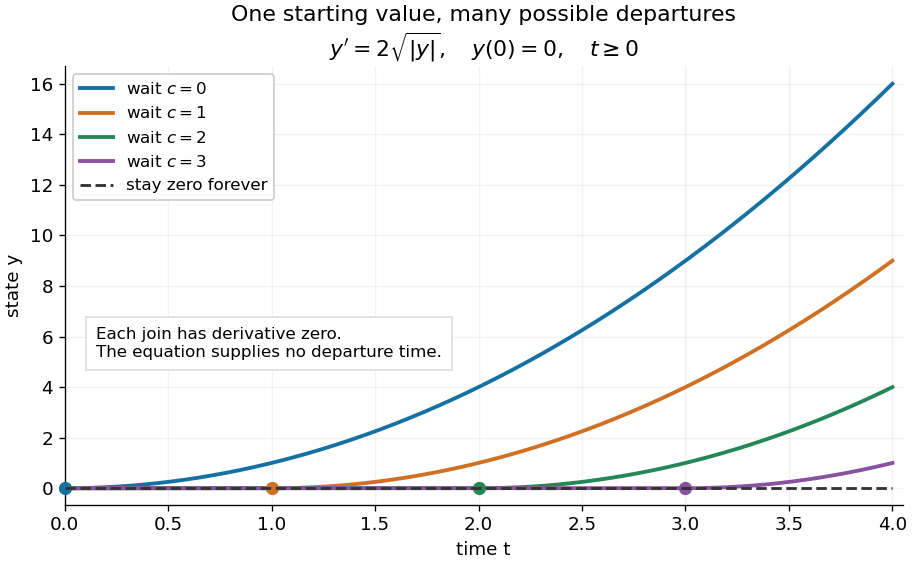
One initial condition admits an arbitrary forward waiting time
. Colored curves leave zero at the marked waits ; the dashed curve stays zero forever. Every curve satisfies the same original differential equation for . Details.Local existence gives neither a global solution of a differential equation nor a bound on all future values. The continuous function already permits finite-time blowup; the finite-dimensional continuation criterion explains the additional issue of extending a trajectory within its domain.
Proof outline: choose a compact set . By the extreme value theorem, . Take with . Forward Euler method polygons remain in the closed ball and satisfy . The Arzelà-Ascoli theorem yields a convergent subsequence with uniform convergence. Uniform continuity of on makes their integral equation defect tend uniformly to zero, so the limit satisfiesThe fundamental theorem of calculus gives a continuously differentiable function. Repeat backward and join at , where both derivatives equal .[ref]
The compact set here uses a finite-dimensional vector space; bounded closed balls in an arbitrary Banach space need not be compact. When , the constant solution of a differential equation works on the entire time interval in . In general the proof selects a subsequence, without asserting that all polygons converge to one unique trajectory.
A quench is a change of control parameters faster than the system can equilibrate. The subsequent relaxation can trap domains and topological defects.
A quench abruptly changes temperature or another control parameter and then studies the subsequent nonequilibrium relaxation of the order parameter.
Pinned article: Introduction to the OurBigBook Project
Welcome to the OurBigBook Project! Our goal is to create the perfect publishing platform for STEM subjects, and get university-level students to write the best free STEM tutorials ever.
Everyone is welcome to create an account and play with the site: ourbigbook.com/go/register. We belive that students themselves can write amazing tutorials, but teachers are welcome too. You can write about anything you want, it doesn't have to be STEM or even educational. Silly test content is very welcome and you won't be penalized in any way. Just keep it legal!
Intro to OurBigBook
. Source. We have two killer features:
- topics: topics group articles by different users with the same title, e.g. here is the topic for the "Fundamental Theorem of Calculus" ourbigbook.com/go/topic/fundamental-theorem-of-calculusArticles of different users are sorted by upvote within each article page. This feature is a bit like:
- a Wikipedia where each user can have their own version of each article
- a Q&A website like Stack Overflow, where multiple people can give their views on a given topic, and the best ones are sorted by upvote. Except you don't need to wait for someone to ask first, and any topic goes, no matter how narrow or broad
This feature makes it possible for readers to find better explanations of any topic created by other writers. And it allows writers to create an explanation in a place that readers might actually find it.
Figure 1. Screenshot of the "Derivative" topic page. View it live at: ourbigbook.com/go/topic/derivativeVideo 2. OurBigBook Web topics demo. Source. - local editing: you can store all your personal knowledge base content locally in a plaintext markup format that can be edited locally and published either:This way you can be sure that even if OurBigBook.com were to go down one day (which we have no plans to do as it is quite cheap to host!), your content will still be perfectly readable as a static site.
- to OurBigBook.com to get awesome multi-user features like topics and likes
- as HTML files to a static website, which you can host yourself for free on many external providers like GitHub Pages, and remain in full control

Figure 2. You can publish local OurBigBook lightweight markup files to either OurBigBook.com or as a static website.
Figure 3. Visual Studio Code extension installation.
Figure 5. . You can also edit articles on the Web editor without installing anything locally. Video 3. Edit locally and publish demo. Source. This shows editing OurBigBook Markup and publishing it using the Visual Studio Code extension. 
- Infinitely deep tables of contents:



All our software is open source and hosted at: github.com/ourbigbook/ourbigbook
Further documentation can be found at: docs.ourbigbook.com
Feel free to reach our to us for any help or suggestions: docs.ourbigbook.com/#contact