Topics (384k) Articles (398k) Users (410) Discussions (242) Comments (383) Files (13k) New article
A topological defect is a spatial configuration whose surrounding ordered field cannot be smoothly extended through a core while staying everywhere in its order-parameter space. The field may lose its order or leave that space inside the core. Winding around a phase vortex is a simple example.
The topology of a surrounding loop can protect a line defect in three dimensions; a surrounding sphere can characterize a point defect. A nematic disclination uses an unoriented director, whereas a phase vortex uses an angle defined modulo , so their possible charges differ. Protection prevents a local smooth removal under the stated conditions, but a defect can still annihilate with another defect, escape through a boundary or disappear when order is destroyed. Its core and long-range distortion also have an energy cost, which affects formation and motion.
A conserved order parameter is a field whose spatial integral remains fixed under the dynamics. A local composition difference in a closed mixture is a standard example.
If two plaintexts are encrypted by adding the same one-time-pad key, subtracting the ciphertexts cancels the key and reveals the difference of the plaintexts. Redundancy in natural language or another structured message space can then reveal both messages, so a one-time pad must never reuse key material.
For a parity-symmetric one-dimensional potential, the even and odd parity states diagonalize the One-dimensional S-matrix:For a real potential, unitarity further gives at real positive energy.
Starting from the Minkowski metric in oblate spheroidal coordinates, set , , and choose an azimuth satisfyingThenso the coordinate vector is null.
An LU decomposition writes a square matrix as , with a lower triangular matrix and an upper triangular matrix. We use a unit triangular matrix , meaning . The factors record Gaussian elimination: contains the reduced equations, while stores the elimination multipliers needed to reconstruct the original equations. This makes Reusing LU factors for multiple right-hand sides inexpensive.[ref]
For an invertible matrix, unpivoted LU decomposition requires nonzero pivot elements at every elimination step; invertibility alone does not guarantee this. In general use Pivoted LU decomposition, with the explicit convention and a permutation matrix . Once the factors exist, solving a linear system needs forward substitution followed by back substitution, rather than forming a matrix inverse.
Two norms on one vector space are equivalent when constants satisfyfor every vector. Equivalent norms define the same convergent sequences, open sets, and continuous linear functionals.
An isometric isomorphism between normed spaces is a bijective linear map satisfying for every vector .
Thixotropy is a reversible decrease of viscosity caused by sustained deformation, followed by recovery while the material rests. It requires an evolving microstructural state and therefore depends on shear history.
Noether conserved quantity for a mechanical point symmetry by  Codex 0 Created 2026-09-29 Updated 2026-10-07
If a time-independent Lagrangian is invariant under a one-parameter point transformation with infinitesimal generator , then every Euler-Lagrange trajectory conserves
For a point mass in a positive cosmological constant, the inward Newtonian acceleration balances the outward cosmological acceleration at the static radius .
Gravitational acceleration is the acceleration of a test particle in free fall in a Newtonian gravitational field. It is a vector pointing along that field; commonly denotes its positive magnitude. Near Earth's surface, the magnitude is approximately constant over shallow vertical scales. For a fixed spherical source it instead varies as , where is the standard gravitational parameter.
This is distinct from gravitational weight, the force , and from apparent weight, the support force a scale measures. An orbiting body can have substantial gravitational acceleration while its apparent weight is zero.
An Adams–Moulton method is an implicit linear multistep method obtained by interpolating derivative values including the new time level and integrating that interpolation polynomial over the next interval. For uniform step size , linear interpolation through gives the second-order trapezoidal ruleQuadratic interpolation through instead gives the third-order formulaBecause depends on the unknown , a nonlinear vector field generally requires a solve. Substituting a predicted new value only once defines a different composite numerical procedure; it should not automatically inherit the fully implicit method's absolute stability region.
The symmetric double-delta potentialseparates into even and odd parity channels. At either interaction, the wavefunction is continuous and its derivative has the jump
An alternating multilinear map vanishes whenever two arguments are equal. Swapping two arguments reverses its sign.
For a point and a nonempty closed set in a metric space, the distanceis a continuous function of . It vanishes exactly on .
For nonadjacent vertices of a graph , their local connectivity is the minimum size of an - vertex separator. By the Menger theorem, it also equals the maximum number of internally vertex-disjoint - paths.
For a nonnegative measurable function on a measure space, defineThe supremum may be infinite. A simple function assigns finitely many heights to measurable sets, so its integral is height times measure, summed over those pieces. This definition groups points by their values rather than requiring a partition into short intervals. See MIT lecture 11, Definition 108.
A real-valued function is Lebesgue integrable when . Its integral is , where is its positive part and . This finiteness requirement avoids subtracting two infinities. For functions taking values in the complex numbers, integrate the real part and imaginary part separately.
Consider the Dirichlet function on . It is a simple function, andIts Riemann integral does not exist. For every partition of an interval , each nondegenerate contains both rational numbers and irrational numbers, by their respective density of the rational numbers and density of the irrational numbers. Thus its infimum there is and its supremum is . The lower Darboux sum is , whereas the upper Darboux sum is . Refinement never closes this gap. A finite scatterplot cannot represent this behavior: the assertion concerns every subinterval and every partition of an interval.
Another view builds the Lebesgue integral from horizontal layers. For any nonnegative measurable function, the layer cake representation statesBoth sides may be infinite. The right side integrates the measure of a superlevel set against Lebesgue measure in the height variable . See Gautam Iyer's measure theory notes, Theorem 9.5.
For on with Lebesgue measure, the superlevel set at is , of Lebesgue measure ; for it is empty. ConsequentlyAt height , the layer extends from to , a width of . The picture shows why the same area can be accumulated vertically or horizontally. In a probability space, the identical formula expresses the expected value of a nonnegative random variable through its exceedance probabilities.
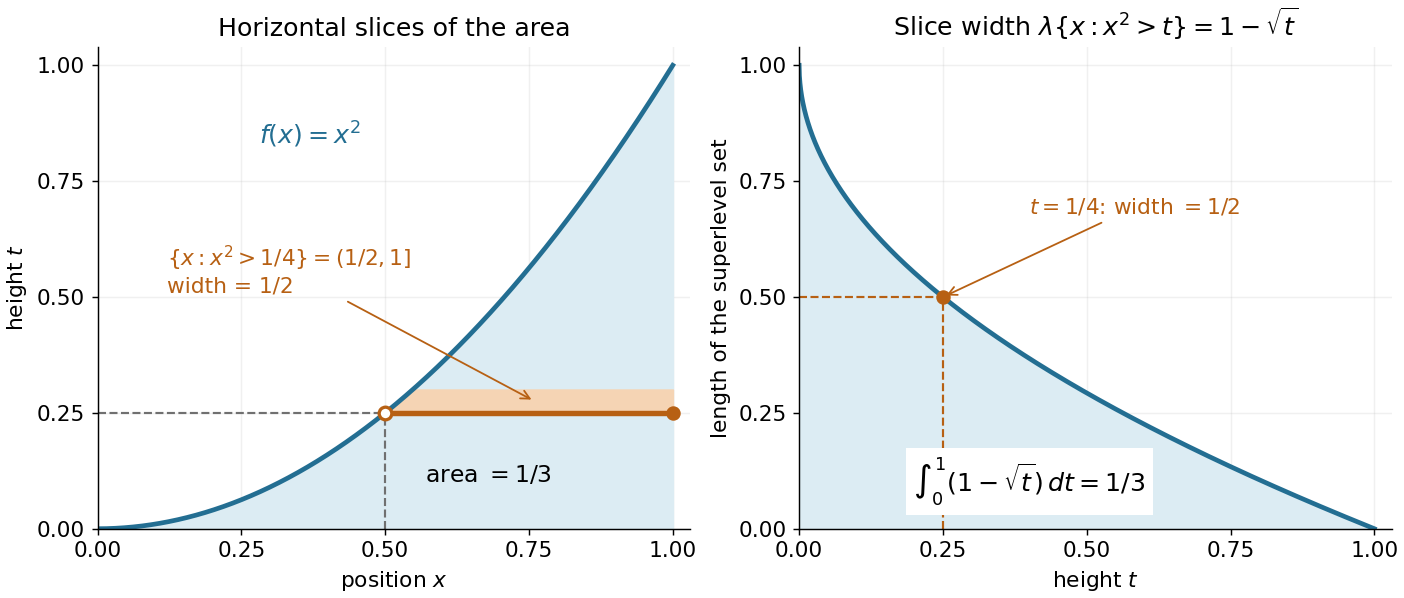
A proof outline avoids extra assumptions on the measure space. For a nonnegative simple function with disjoint measurable sets , the superlevel set has measure . Integrating this finite sum gives . Next use approximation by nonnegative simple functions . For every , the superlevel sets increase to . Continuity from below of a measure and the monotone convergence theorem on the height variable give the formula for .
Pinned article: Introduction to the OurBigBook Project
Welcome to the OurBigBook Project! Our goal is to create the perfect publishing platform for STEM subjects, and get university-level students to write the best free STEM tutorials ever.
Everyone is welcome to create an account and play with the site: ourbigbook.com/go/register. We belive that students themselves can write amazing tutorials, but teachers are welcome too. You can write about anything you want, it doesn't have to be STEM or even educational. Silly test content is very welcome and you won't be penalized in any way. Just keep it legal!
Intro to OurBigBook
. Source. We have two killer features:
- topics: topics group articles by different users with the same title, e.g. here is the topic for the "Fundamental Theorem of Calculus" ourbigbook.com/go/topic/fundamental-theorem-of-calculusArticles of different users are sorted by upvote within each article page. This feature is a bit like:
- a Wikipedia where each user can have their own version of each article
- a Q&A website like Stack Overflow, where multiple people can give their views on a given topic, and the best ones are sorted by upvote. Except you don't need to wait for someone to ask first, and any topic goes, no matter how narrow or broad
This feature makes it possible for readers to find better explanations of any topic created by other writers. And it allows writers to create an explanation in a place that readers might actually find it.
Figure 1. Screenshot of the "Derivative" topic page. View it live at: ourbigbook.com/go/topic/derivativeVideo 2. OurBigBook Web topics demo. Source. - local editing: you can store all your personal knowledge base content locally in a plaintext markup format that can be edited locally and published either:This way you can be sure that even if OurBigBook.com were to go down one day (which we have no plans to do as it is quite cheap to host!), your content will still be perfectly readable as a static site.
- to OurBigBook.com to get awesome multi-user features like topics and likes
- as HTML files to a static website, which you can host yourself for free on many external providers like GitHub Pages, and remain in full control

Figure 2. You can publish local OurBigBook lightweight markup files to either OurBigBook.com or as a static website.
Figure 3. Visual Studio Code extension installation.
Figure 5. . You can also edit articles on the Web editor without installing anything locally. Video 3. Edit locally and publish demo. Source. This shows editing OurBigBook Markup and publishing it using the Visual Studio Code extension. 
- Infinitely deep tables of contents:



All our software is open source and hosted at: github.com/ourbigbook/ourbigbook
Further documentation can be found at: docs.ourbigbook.com
Feel free to reach our to us for any help or suggestions: docs.ourbigbook.com/#contact