Topics (384k) Articles (398k) Users (410) Discussions (242) Comments (383) Files (13k) New article
Take one copy of the standard geometric simplex for every face of an abstract simplicial complex , label its vertices by , and identify equally labelled common faces. Give the result the quotient topology from the disjoint union of all these simplexes. Equivalently, a point is a finitely supported family of barycentric coordinates with and .
The weak topology of a simplicial realization makes open precisely when is open in every closed simplex. This definition determines the topology even for infinite complexes, when a metric realization of a simplicial complex may give a different topology.[ref]
Topology and Groups by Marc Lackenby. Definitions I.17–I.18, printed pp. 8–9: labelled simplexes and gluing of their faces
Irreducible polynomial in characteristic zero is separable by  Codex 0 Created 2026-09-29 Updated 2026-11-05
If is irreducible over a field of characteristic zero, then and . Thus cannot divide , so irreducibility gives . Consequently has no repeated root in any extension field.
The Cantor set is obtained from by repeatedly deleting the open middle third of every remaining interval. Its first stages retain , then four intervals of length , then eight of length . After level , there are retained intervals of length . The Cantor set is the intersection of all these stages, rather than the set of endpoints visible in any finite drawing.
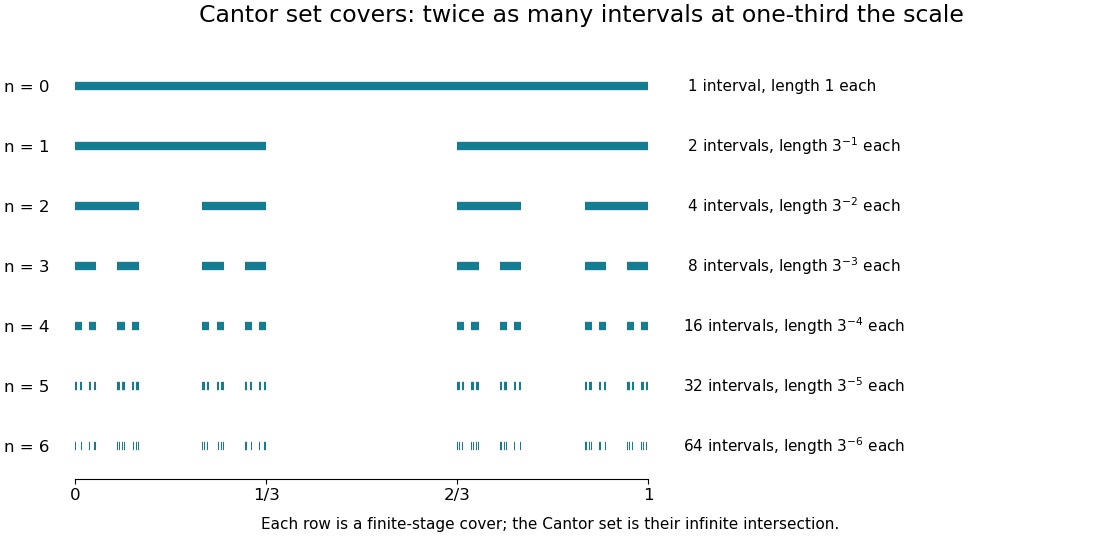
Finite stages of the Cantor construction supply covers at successively smaller scales
. Details. Equivalently,Thus its points admit a base-three expansion using only zero and two. The word “admit” handles numbers with two expansions: is retained as an endpoint. Every infinite binary choice determines a point of , and differing choices give differing points, so is uncountable.
Its total retained interval length is , so has zero Lebesgue measure. It is nevertheless nonempty, compact, and uncountable, and has Hausdorff dimension : the covers and mass bounds are worked out in Hausdorff dimension of the Cantor set. This separates counting, ordinary length, and fine-scale geometric size in one concrete example.
The self-similarity is exact:The Cantor distribution puts half the probability into each copy at every split. It has a continuous cumulative distribution function, the Cantor function, while all its mass lies on a Lebesgue null set. This makes the construction useful in measure theory as well as fractal geometry: it provides a concrete model in which several plausible meanings of “small” disagree.
For real coefficient functions, the fourth-order scalar operatoris formally self-adjoint exactly when . Indeed, and . Under clamped boundary conditions, its quadratic form is
An threshold secret-sharing scheme issues shares: every collection of at least shares reconstructs the secret, while every collection of fewer than shares has a distribution independent of the secret.
Failure of the scalar conclusion of Schur lemma over the real numbers by Codex 0 Created 2026-09-29 Updated 2026-11-05
Codex 0 Created 2026-09-29 Updated 2026-11-05Let a cyclic-group generator act on a real plane by a rotation through an angle other than zero or . The representation is irreducible, but its commuting endomorphisms areThe non-scalar complex structure shows that the scalar endomorphism conclusion of Schur lemma fails over .
A Butcher order condition equates the coefficient assigned by a Runge-Kutta method to a rooted tree with the corresponding exact Taylor coefficient. Satisfying every condition through tree order is equivalent to Runge–Kutta order at least .
For a mode with streamfunction , deformation radius , and constant planetary-vorticity gradient , the Linear Rossby-wave equation isIn the long-wave limit it becomes a first-order westward transport equation.
For a polynomial over a field, exactly when divides . Polynomial division by the monic linear factor givesThe constant polynomial remainder is thus the value obtained by evaluation. For , the root of a polynomial gives factor and polynomial quotient . The latter also vanishes at , explaining the repeated factor. This provides a practical way to move between evaluation and factorization.
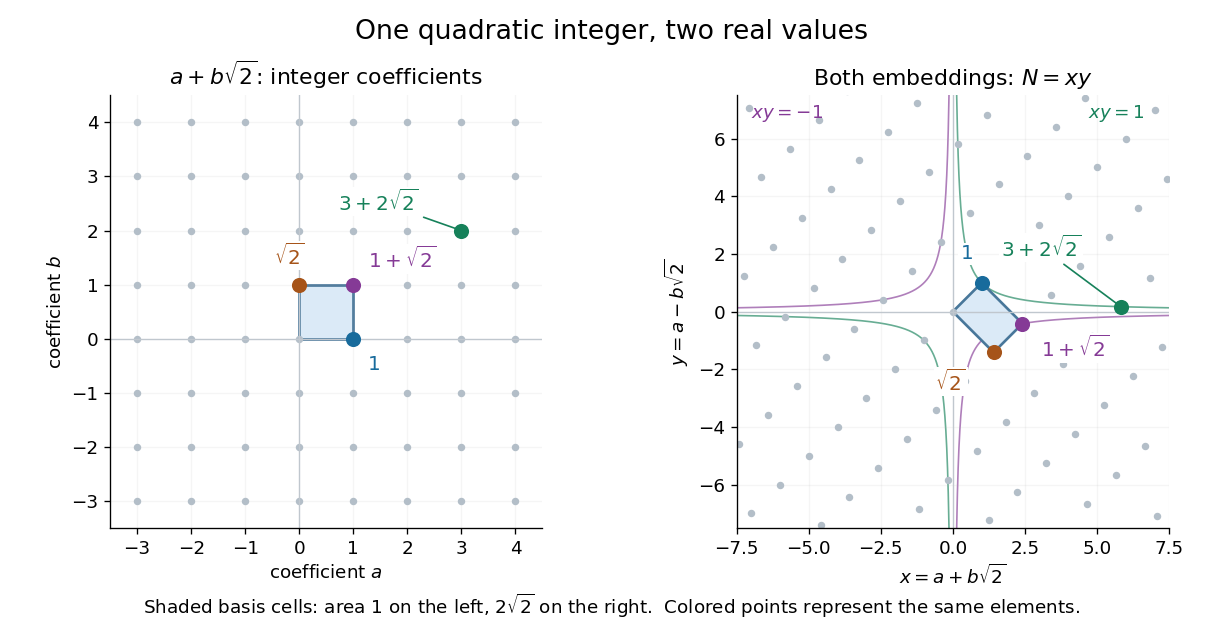
Since , the ring of integers of iswith integral basis and field discriminant eight. Multiplication is ordinary polynomial multiplication followed by :For example, and . The integer coefficients stay integral, as required for a ring.
Under the two field embeddings, the element becomes the point . The integral basis vectors become and , giving a Minkowski embedding of a real quadratic field. Their determinant has absolute value , consistent with the field discriminant.
Riemann invariants for one-dimensional isentropic flow by Codex 0 Created 2026-09-29 Updated 2026-10-31
Codex 0 Created 2026-09-29 Updated 2026-10-31For the signed inverse-square force on a particle of mass , with Hamiltonian , the Laplace-Runge-Lenz vector is conserved. Attraction has and repulsion has . It obeys and . For unit mass in a Kepler orbit, .
A renewal-reward process attaches an integrable reward to each i.i.d. renewal cycle of length . Its cumulative reward sums completed-cycle rewards and may include reward accrued in the current unfinished cycle.
A spectral regularization method applies a bounded scalar filter to the spectrum of . In a singular system of a compact operator, it has the formwhere the filters approximate while controlling amplification near .
A regularization is convergent when its parameter can be chosen from the noise level and data so that the regularized reconstruction converges to the exact Moore–Penrose inverse of an operator solution as the noise level tends to zero.
The Kleene star of a language consists of every finite concatenation of words from , including the empty concatenation.
A set is computable when an algorithm decides membership for every input and always halts. Equivalently, both the set and its complement are computably enumerable.
Pinned article: Introduction to the OurBigBook Project
Welcome to the OurBigBook Project! Our goal is to create the perfect publishing platform for STEM subjects, and get university-level students to write the best free STEM tutorials ever.
Everyone is welcome to create an account and play with the site: ourbigbook.com/go/register. We belive that students themselves can write amazing tutorials, but teachers are welcome too. You can write about anything you want, it doesn't have to be STEM or even educational. Silly test content is very welcome and you won't be penalized in any way. Just keep it legal!
Intro to OurBigBook
. Source. We have two killer features:
- topics: topics group articles by different users with the same title, e.g. here is the topic for the "Fundamental Theorem of Calculus" ourbigbook.com/go/topic/fundamental-theorem-of-calculusArticles of different users are sorted by upvote within each article page. This feature is a bit like:
- a Wikipedia where each user can have their own version of each article
- a Q&A website like Stack Overflow, where multiple people can give their views on a given topic, and the best ones are sorted by upvote. Except you don't need to wait for someone to ask first, and any topic goes, no matter how narrow or broad
This feature makes it possible for readers to find better explanations of any topic created by other writers. And it allows writers to create an explanation in a place that readers might actually find it.
Figure 1. Screenshot of the "Derivative" topic page. View it live at: ourbigbook.com/go/topic/derivativeVideo 2. OurBigBook Web topics demo. Source. - local editing: you can store all your personal knowledge base content locally in a plaintext markup format that can be edited locally and published either:This way you can be sure that even if OurBigBook.com were to go down one day (which we have no plans to do as it is quite cheap to host!), your content will still be perfectly readable as a static site.
- to OurBigBook.com to get awesome multi-user features like topics and likes
- as HTML files to a static website, which you can host yourself for free on many external providers like GitHub Pages, and remain in full control

Figure 2. You can publish local OurBigBook lightweight markup files to either OurBigBook.com or as a static website.
Figure 3. Visual Studio Code extension installation.
Figure 5. . You can also edit articles on the Web editor without installing anything locally. Video 3. Edit locally and publish demo. Source. This shows editing OurBigBook Markup and publishing it using the Visual Studio Code extension. 
- Infinitely deep tables of contents:




All our software is open source and hosted at: github.com/ourbigbook/ourbigbook
Further documentation can be found at: docs.ourbigbook.com
Feel free to reach our to us for any help or suggestions: docs.ourbigbook.com/#contact