Topics (384k) Articles (398k) Users (410) Discussions (242) Comments (383) Files (13k) New article
A loss function assigns a numerical penalty to a prediction and its observed outcome. Its expected value is the population risk optimized by a statistical learning procedure.
For distinct point charges at positions , the electrostatic potential energy isWhen some charges are fixed, the terms depending on a movable charge form its potential energy in their electric potential.
Electrostatic energy of a uniformly charged spherical shell by  Codex 0 Created 2026-09-29 Updated 2026-10-06
A thin spherical shell of radius carrying total charge has surface potentialand electrostatic self-energy
A point charge idealizes electric charge concentrated at one point. In vacuum, a charge at the origin has potential .
If an algebraic integer has a degree- minimal polynomial that is Eisenstein at , then has a unique prime ideal above it in , withThis conclusion concerns the full ring of integers of a number field and does not assume that it equals .
Angular velocity of a circular Schwarzschild geodesic by Codex 0 Created 2026-09-29 Updated 2026-10-07
Codex 0 Created 2026-09-29 Updated 2026-10-07A circular timelike geodesic of Schwarzschild radius has coordinate angular velocityIts coordinate period is .
A Hadamard finite-part integral removes explicit divergent terms from a truncated integral and retains the finite limit. For example, the one-sided finite part of can be defined byfor each test function . The logarithmic subtraction cancels the divergence at zero. The locally integrable function , interpreted as zero for , has exactly this distributional derivative: integrate by parts with lower cutoff .
This is distinct from the symmetric principal-value reciprocal distribution, which is the derivative of on the whole line. More singular reciprocal powers require additional Taylor polynomial subtractions. The subtraction and normalization must be specified, because distributions supported at the singular point can distinguish different extensions.
The order of a distribution on a compact set is the least nonnegative integer for which its action is bounded by a constant times the sup norms of test-function derivatives through order .
A Z-channel transmits one binary input without error while the other can change into the first. Unlike a binary symmetric channel, its errors are one-sided.
A binary erasure channel transmits each input bit correctly with probability and replaces it by an erasure symbol with probability . Its channel capacity is bits per use.
On a cyclic index set of length , the th discrete Fourier mode is the vector with th coordinate . Its real and imaginary parts are the corresponding cosine and sine modes.
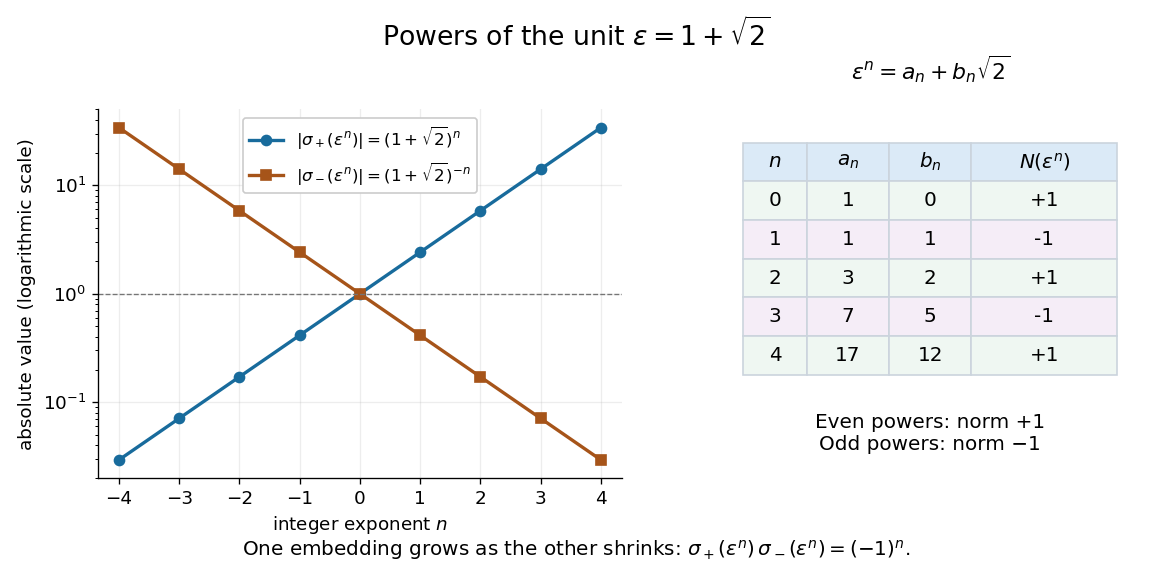
The unit has field norm minus one and is the least unit greater than one in the field embedding sending to its positive value. It is a fundamental unit. The Dirichlet unit theorem therefore gives
Writing , direct multiplication givesFor , the pairs are , andIn particular, has field norm one. Its powers start , , , , and give solutions of the Pell equation . This turns finding one unit into generating infinitely many exact integer solutions.
The two field embeddings show a striking balance:For positive , one value grows while the other approaches zero, and their product stays . Taking logarithms of their absolute values converts this multiplication into equally spaced points, the simplest example of the logarithmic embedding of number field units.[ref]
https://www.jmilne.org/math/CourseNotes/ANT.pdf. Milne, Algebraic Number Theory, Chapter 5, the unit theorem
The Identity for Dirichlet convolution is the arithmetic functionFor every arithmetic function , it satisfies . Indeed, in , only survives. For example,At the sole term is . This gives a useful way to check Dirichlet convolution calculations: inserting leaves every value unchanged. The three arithmetic functions , , and all take value at , but at the constant-one arithmetic function, the identity arithmetic function, and the Identity for Dirichlet convolution take values , , and , respectively. [ref]
Floor and arithmetic functions by Darij Grinberg. Darij Grinberg, MIT 18.781 lecture notes, Theorem 2.3.4
The Möbius function is the inverse of the constant-one arithmetic function under Dirichlet convolution, meaning . The Möbius divisor-sum identity gives a short proof: for the nonzero terms expand , while at the sum is . At , the computation isThe zeros occur because and are divisible by the square of the prime number . Consequently, if is a divisor sum, then associativity gives : this is Möbius inversion.
The derivative of the Dirac delta is the distributional derivative defined byfor every test function .
The Saffman–Taylor instability occurs when a more mobile fluid displaces a less mobile fluid in a porous medium or Hele–Shaw cell. Viscosity contrast amplifies interface corrugations, while surface tension suppresses sufficiently short wavelengths.
Pinned article: Introduction to the OurBigBook Project
Welcome to the OurBigBook Project! Our goal is to create the perfect publishing platform for STEM subjects, and get university-level students to write the best free STEM tutorials ever.
Everyone is welcome to create an account and play with the site: ourbigbook.com/go/register. We belive that students themselves can write amazing tutorials, but teachers are welcome too. You can write about anything you want, it doesn't have to be STEM or even educational. Silly test content is very welcome and you won't be penalized in any way. Just keep it legal!
Intro to OurBigBook
. Source. We have two killer features:
- topics: topics group articles by different users with the same title, e.g. here is the topic for the "Fundamental Theorem of Calculus" ourbigbook.com/go/topic/fundamental-theorem-of-calculusArticles of different users are sorted by upvote within each article page. This feature is a bit like:
- a Wikipedia where each user can have their own version of each article
- a Q&A website like Stack Overflow, where multiple people can give their views on a given topic, and the best ones are sorted by upvote. Except you don't need to wait for someone to ask first, and any topic goes, no matter how narrow or broad
This feature makes it possible for readers to find better explanations of any topic created by other writers. And it allows writers to create an explanation in a place that readers might actually find it.
Figure 1. Screenshot of the "Derivative" topic page. View it live at: ourbigbook.com/go/topic/derivativeVideo 2. OurBigBook Web topics demo. Source. - local editing: you can store all your personal knowledge base content locally in a plaintext markup format that can be edited locally and published either:This way you can be sure that even if OurBigBook.com were to go down one day (which we have no plans to do as it is quite cheap to host!), your content will still be perfectly readable as a static site.
- to OurBigBook.com to get awesome multi-user features like topics and likes
- as HTML files to a static website, which you can host yourself for free on many external providers like GitHub Pages, and remain in full control

Figure 2. You can publish local OurBigBook lightweight markup files to either OurBigBook.com or as a static website.
Figure 3. Visual Studio Code extension installation.
Figure 5. . You can also edit articles on the Web editor without installing anything locally. Video 3. Edit locally and publish demo. Source. This shows editing OurBigBook Markup and publishing it using the Visual Studio Code extension. 
- Infinitely deep tables of contents:



All our software is open source and hosted at: github.com/ourbigbook/ourbigbook
Further documentation can be found at: docs.ourbigbook.com
Feel free to reach our to us for any help or suggestions: docs.ourbigbook.com/#contact