Topics (384k) Articles (398k) Users (410) Discussions (242) Comments (383) Files (13k) New article
The interior of a subset of a topological space is the union of all open sets contained in , equivalently the largest open subset of . A point lies in exactly when it has an open neighbourhood contained in . In a metric space, this says that some open ball , with , is contained in . The interior therefore identifies the points with room to move locally while staying in . [ref]
For the half-open interval in the real line, . Every point strictly between the endpoints has a sufficiently small open ball inside , but every open ball about zero also contains negative points. Although , it is not in the interior; it is a boundary point instead. Together, the interior and closure bracket the original subset: .
The ambient topological space matters: for with its subspace topology, , whereas . The diagram accompanying boundary of a set illustrates the relative open ball at zero. A subset is open exactly when , and taking the interior twice has the same effect as taking it once. The complement identity links interior directly to closure.
The cofinite topology on a set declares the empty set and all cofinite subsets to be open sets: a nonempty open set may exclude only a finite set of points. There is no assumed metric. On an infinite set, this gives a particularly small collection of open sets while still making every singleton a closed set. On a finite set, every subset has finite complement, so the cofinite topology is the discrete topology.[ref]
For an original example, use and chooseBoth are open sets, and their intersection is . Thus are in both. Their finite exclusions cannot separate the infinite remainder. The finite intersection of any finite collection of nonempty open sets is again a nonempty open set, since its complement is a finite union of finite sets. An arbitrary nonempty union is open because its complement is contained in the finite complement of any one nonempty member.
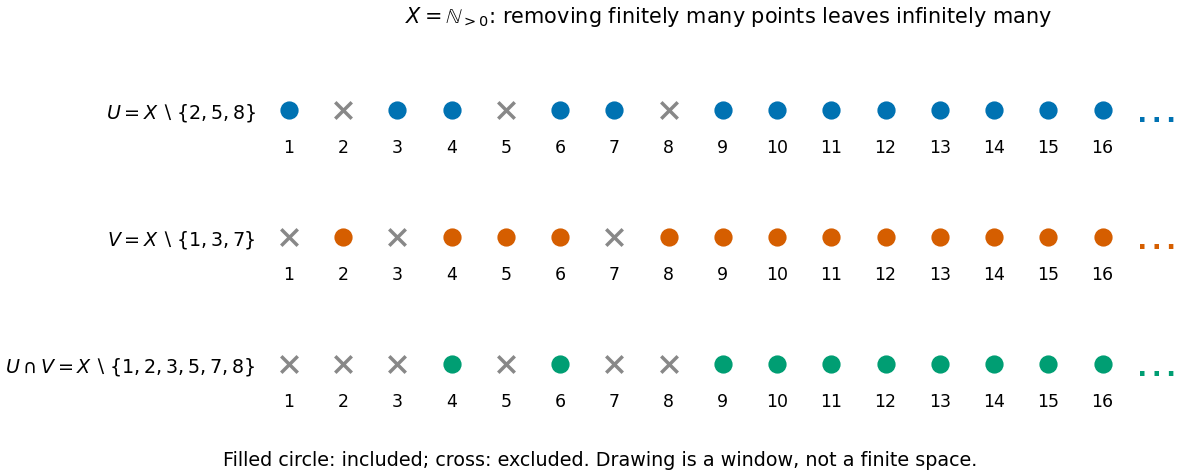
Two open sets with finite exclusions still overlap in an infinite cofinite topology
. Original sets on . Only the first sixteen labels are drawn; the dots continue indefinitely and are all included after the last excluded label. Spacing is for readability and defines no metric. Filled circles belong to the displayed set; crosses are excluded. Details.The cofinite topology is useful for separating hypotheses that familiar metric spaces package together. An infinite cofinite topological space is a T1 space, because its singletons are closed, but is not a Hausdorff space, because two nonempty open sets cannot be disjoint sets. It is a hyperconnected space and hence a connected space. Moreover, every subset of a cofinite space is compact, and sequence convergence in the cofinite topology can have many limits. These are compatible properties, rather than contradictions: the usual uniqueness and closedness results use the Hausdorff space hypothesis.[ref]
Chapter 1: Topological spaces. Example 1.5.10 and Proposition 1.5.11: closed points, overlapping neighbourhoods, non-repeating sequences and uniqueness in Hausdorff spaces
For the three-dimensional isotropic harmonic oscillator, substituting and into gives . On the first-excited Cartesian states , this is the three-dimensional vector representation and , so the whole first-excited level has orbital quantum number .
Cartesian number state of the three-dimensional isotropic harmonic oscillator by  Codex 0 Created 2026-09-29 Updated 2026-11-05
From the normalized ground state annihilated by every , the normalized Cartesian number states areThey have energy .
The Jaynes-Cummings model couples a two-level atom to one quantized oscillator mode throughThe first term excites the atom while annihilating one field quantum; the second performs the Hermitian-conjugate process.
A scalar second-order differential operator is in Sturm–Liouville form when it is written aspossibly together with a positive weight in an eigenvalue problem.
For , the Gegenbauer polynomials are normalized by the generating functionnear . This fixes the scale left undetermined by the Gegenbauer differential equation. The first examples are , and . They are orthogonal polynomials on for the weight . At they are the Legendre polynomials; at they give the Chebyshev polynomial of the second kind family.[ref]
18 Orthogonal Polynomials. §18.12, Gegenbauer generating function, and §18.3, standardization and orthogonality
A prediction interval is a random interval designed to contain a future observation with prescribed repeated-sampling probability. Unlike a confidence interval for a mean response, it includes both uncertainty in the fitted mean and the new observation's irreducible random variation.
The transformationsform a one-parameter Lie point symmetry of . The product is a similarity variable, and a group-invariant solution satisfies
When a reference frame has time-dependent angular velocity , a particle at position has apparent Euler acceleration .
If a frame rotates with angular velocity relative to an inertial frame, the derivatives of any vector satisfyApplying this formula twice to a position gives the Coriolis acceleration, Euler acceleration, and centrifugal acceleration terms.
For ,This finite geometric sum is the orthogonality relation underlying the discrete Fourier transform.
Precession is the turning of a rotating body's spin axis around another direction. A torque changes its angular momentum according to . If the torque is mainly perpendicular to a large spin angular momentum, it changes the direction of more rapidly than its magnitude, producing a turning motion rather than an immediate large fall.
For a rapidly spinning supported top with centre of mass a distance from the pivot, the slow steady-precession approximation gives when the tilt is fixed and the spin angular momentum dominates. Holding the same top at the same tilt while changing its spin tests the inverse dependence on .
Constant-field relativistic Lorentz-force solution by Codex 0 Created 2026-09-29 Updated 2026-11-05
Codex 0 Created 2026-09-29 Updated 2026-11-05For a constant electromagnetic field tensor, the relativistic Lorentz force is a constant-coefficient linear system on four-velocity, with solutionThe electric-type blocks of generate hyperbolic rotations, while magnetic-type blocks generate ordinary rotations.
For a unit vector and real ,multiplies the component parallel to by and fixes its orthogonal complement. The case is a reflection operator.
A reflection operator is a unitary involution that changes sign on one orthogonal subspace and fixes its orthogonal complement. For a unit vector , reflects in the hyperplane perpendicular to .
A Big Rip is a finite-future-time cosmological singularity at which the scale factor, Hubble parameter, and phantom energy density diverge.
Pinned article: Introduction to the OurBigBook Project
Welcome to the OurBigBook Project! Our goal is to create the perfect publishing platform for STEM subjects, and get university-level students to write the best free STEM tutorials ever.
Everyone is welcome to create an account and play with the site: ourbigbook.com/go/register. We belive that students themselves can write amazing tutorials, but teachers are welcome too. You can write about anything you want, it doesn't have to be STEM or even educational. Silly test content is very welcome and you won't be penalized in any way. Just keep it legal!
Intro to OurBigBook
. Source. We have two killer features:
- topics: topics group articles by different users with the same title, e.g. here is the topic for the "Fundamental Theorem of Calculus" ourbigbook.com/go/topic/fundamental-theorem-of-calculusArticles of different users are sorted by upvote within each article page. This feature is a bit like:
- a Wikipedia where each user can have their own version of each article
- a Q&A website like Stack Overflow, where multiple people can give their views on a given topic, and the best ones are sorted by upvote. Except you don't need to wait for someone to ask first, and any topic goes, no matter how narrow or broad
This feature makes it possible for readers to find better explanations of any topic created by other writers. And it allows writers to create an explanation in a place that readers might actually find it.
Figure 1. Screenshot of the "Derivative" topic page. View it live at: ourbigbook.com/go/topic/derivativeVideo 2. OurBigBook Web topics demo. Source. - local editing: you can store all your personal knowledge base content locally in a plaintext markup format that can be edited locally and published either:This way you can be sure that even if OurBigBook.com were to go down one day (which we have no plans to do as it is quite cheap to host!), your content will still be perfectly readable as a static site.
- to OurBigBook.com to get awesome multi-user features like topics and likes
- as HTML files to a static website, which you can host yourself for free on many external providers like GitHub Pages, and remain in full control

Figure 2. You can publish local OurBigBook lightweight markup files to either OurBigBook.com or as a static website.
Figure 3. Visual Studio Code extension installation.
Figure 5. . You can also edit articles on the Web editor without installing anything locally. Video 3. Edit locally and publish demo. Source. This shows editing OurBigBook Markup and publishing it using the Visual Studio Code extension. 
- Infinitely deep tables of contents:



All our software is open source and hosted at: github.com/ourbigbook/ourbigbook
Further documentation can be found at: docs.ourbigbook.com
Feel free to reach our to us for any help or suggestions: docs.ourbigbook.com/#contact