Topics (384k) Articles (398k) Users (410) Discussions (242) Comments (383) Files (13k) New article
A product of two transpositions is the identity when they coincide, a three-cycle when their supports meet in one letter, and a product of two disjoint permutation cycles when their supports are disjoint.
If one coordinate of every nonstationary trajectory is strictly monotone, the system has no periodic orbit: a periodic coordinate must return to its initial value. Any trajectory on which that coordinate is constant must be checked separately.
The viscous Burgers equation combines a nonlinear transport equation with diffusion with constant . On the infinite line, a bounded initial condition gives a smooth function solving the equation for every positive time; a jump in the initial condition is smoothed rather than retained as a discontinuity. Small can nevertheless produce a steep layer, as the Viscous Burgers travelling shock illustrates. The Cole-Hopf transformation , with positive , converts this equation to the heat equation .[ref]
Positive diffusion also explains the admissibility of the inviscid limit. For the entropy flux for a scalar conservation law associated with , direct multiplication by givesThe last term is nonpositive. With convergence sufficient to pass to the limit, the vanishing viscosity approximation therefore retains an entropy inequality rather than just the weak solution equation. For general bounded data, the full Kruzhkov entropy inequalities specify the entropy solution; the quadratic identity is a useful illustration of dissipation.[ref]
A hard-sphere gas is a classical model of identical impenetrable spheres, each of diameter and radius . Its pair potential is for centre separation and for ; the convention at exact contact has no effect on the integral. It isolates the effect of particle size without an attractive potential energy.
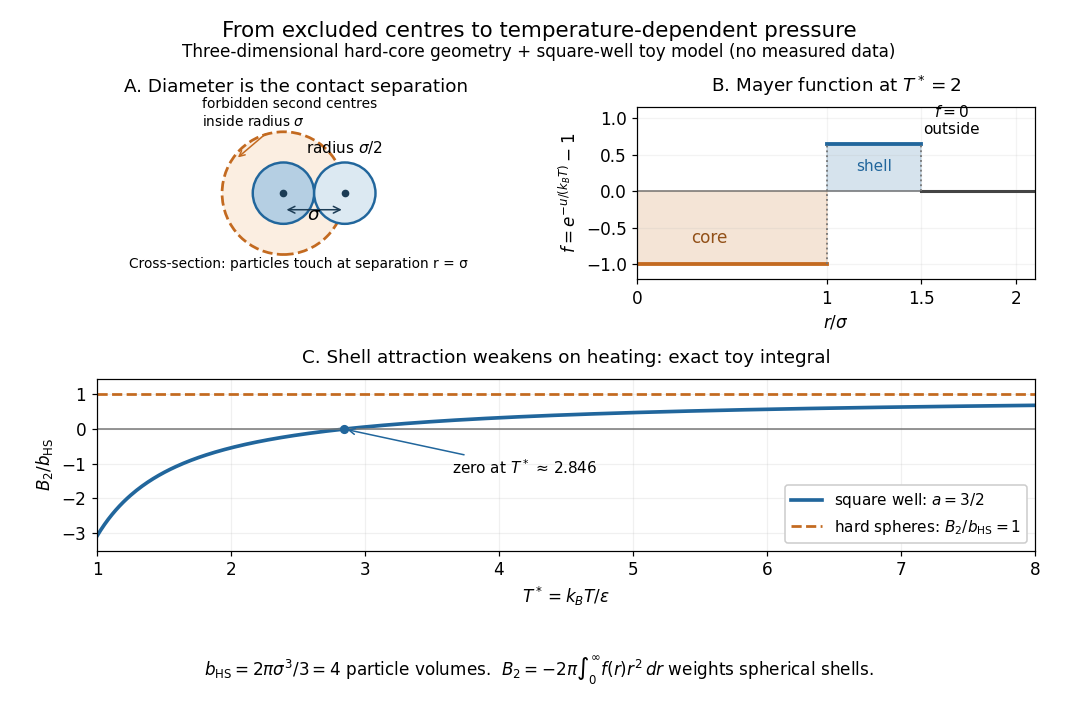
Hard-sphere centre exclusion, the square-well Mayer f-function, and the exact temperature dependence of the toy second virial coefficient
. Details. The upper-left panel is a cross-section of a three-dimensional forbidden region: the second centre cannot enter a sphere of radius around the first centre. The particles themselves have radius . Consequently, with particle volume and pair excluded volume ,The last equality follows directly from the Mayer f-function: throughout the forbidden volume and zero outside it. Confusing particle radius with contact separation changes the answer by a factor of eight; omitting the unordered-pair factor changes it by a further factor of two.
Define the packing fraction , where is number density. Then the virial expansion beginsFor example, at the toy value , the leading correction predicts ; the omitted terms still matter if accuracy beyond this approximation is needed. The classical second virial coefficient is independent of temperature because the geometry of forbidden configurations does not change when the gas is warmed. The pressure itself still scales with temperature at fixed number density.
This model makes the positive correction particularly clear: eliminating overlapping configurations changes the dependence of the available configuration space on volume, even though the allowed configurations all have zero interaction energy. The figure's other panels add a toy attractive shell and show how its Boltzmann factor competes with that geometry. The hard-sphere gas is a useful reference model, while a low-order virial expansion remains a dilute-gas approximation rather than a dense sphere packing formula.
The Mayer f-function measures how a pair potential changes a pair's Boltzmann factor relative to the noninteracting value one:It vanishes where , lies between and for repulsion, and is positive for attraction. Even an infinite hard-core potential energy produces the finite value . This is why expanding in Mayer f-functions handles a hard-sphere gas more naturally than a Taylor series in . [ref]
For pairwise-additive potential energy , the exact identityturns the configurational part of the canonical partition function into a sum of products associated with pairs. Drawing one edge for each chosen factor gives the graphs used in the cluster expansion. The second virial coefficient uses just one pair's relative-position integral, .
For the square-well toy pair potential in second virial coefficient, in the core, in the attractive shell, and beyond it. Its positive plateau need not be small: low number density, rather than small at every separation, controls the dilute-gas approximation. The integral weights each plateau by spherical-shell volume; equal-looking unweighted areas on a plot of versus need not cancel in .
A spectral method approximates an unknown function by a finite expansion in global basis functions, such as Fourier modes or orthogonal polynomials. A Galerkin method makes the residual orthogonal to the retained trial space; a collocation method instead makes it vanish at selected nodes. The expansion coefficients are the numerical unknowns.
For the -periodic heat equation, a Fourier series truncationgives under Fourier–Galerkin method projection. Each retained mode decays independently, and differentiation becomes multiplication of its coefficient by . This turns a partial differential equation into finitely many ordinary differential equations.
Rapid convergence comes from rapid coefficient decay. If with , the omitted tail has an exponentially small uniform norm bound by a geometric series. Limited smoothness or discontinuities can prevent that rate. A large number of retained modes cannot justify exponential convergence without the needed solution regularity.
Truncation error is introduced by replacing an exact operation with a finite approximation. It remains even when all arithmetic is exact. For , the forward finite difference for its derivative at givesThus the truncation error is exactly : gives and gives . In finite precision, however, the numerator subtracts nearly equal values, and their roundoff error can be amplified by division by . For smooth data with bounded evaluation errors of scale , a typical bound has competing terms . Smaller reduces the first term and increases the second; with fixed positive constants the balancing scale is . This is why blindly refining a finite difference eventually stops improving it.
For a positive integer modulus , a residue class is a unit when it has a modular multiplicative inverse: some integer satisfies . Modulo twelve, the units are exactlyIn particular, five is its own modular inverse, since . Multiplying all twelve residue classes by five gives a permutation; multiplying the outputs by five recovers the inputs. By contrast, multiplying by six gives only zero and six, with six inputs for each output. It cannot be reversed.
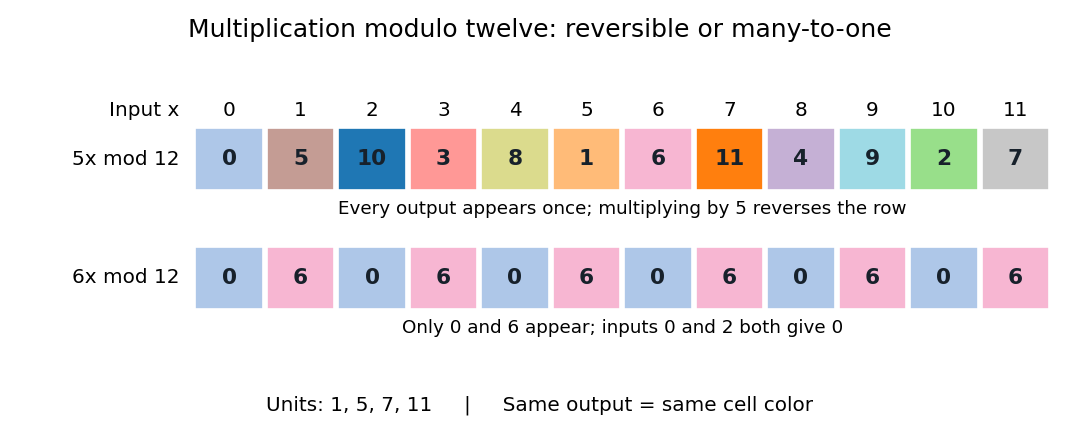
Multiplication by five permutes all twelve residue classes, whereas multiplication by six merges distinct inputs
. Details. In general, the exact criterion isFor the forward direction, implies every common divisor of divides one. Conversely, if their greatest common divisor is one, Bézout's identity supplies , so is a modular inverse. The extended Euclidean algorithm computes these coefficients. The units form the unit group under multiplication. [ref]
https://ocw.mit.edu/courses/18-200-principles-of-discrete-applied-mathematics-spring-2024/mit18_200_s24_lec15.pdf. Ankur Moitra, MIT 18.200, Lecture 15 (2024), pp. 3–4: inverses, coprimality and the unit group
Multiplicative cancellation while keeping the same integer modulus is valid for a unit modulo n: from , multiply by a modular inverse of to get . A nonunit cannot be cancelled as a general rule. For example, , yet . Thus division by six cannot undo this multiplication; solving a linear congruence instead keeps track of all possible classes.
This distinction marks the boundary between commutative rings and fields. Modulo a prime number , every nonzero residue class is a unit, so is a finite field. Modulo twelve it is a commutative ring with zero divisors, and is not a field. For , the sole class satisfies and is a unit; this one-element zero ring is not a field. [ref]
https://ocw.mit.edu/courses/18-200-principles-of-discrete-applied-mathematics-spring-2024/mit18_200_s24_lec15.pdf. Moitra, MIT 18.200, Lecture 15, pp. 8–9: the prime-modulus field criterion
A linear congruence asks for the integers satisfying , where are integers and . Let be their greatest common divisor. There are solutions exactly when divides . When solutions exist, there are exactly solution classes modulo , obtained from one solution byThe divisibility condition follows immediately from : every common divisor of must divide . Conversely, Bézout's identity constructs a solution when . Differences between any two solutions obey , equivalently , since and are coprime. This explains both the spacing and the number of solution classes.
For a complete example, solve . Here divides nine. Dividing the corresponding divisibility statement by three changes the integer modulus too:Because , multiplying by the modular inverse three gives . Lifting this class back to modulus fifteen yields . Direct substitution gives , and , each with remainder nine after division with remainder by fifteen. By contrast, has no solutions, because three does not divide ten.
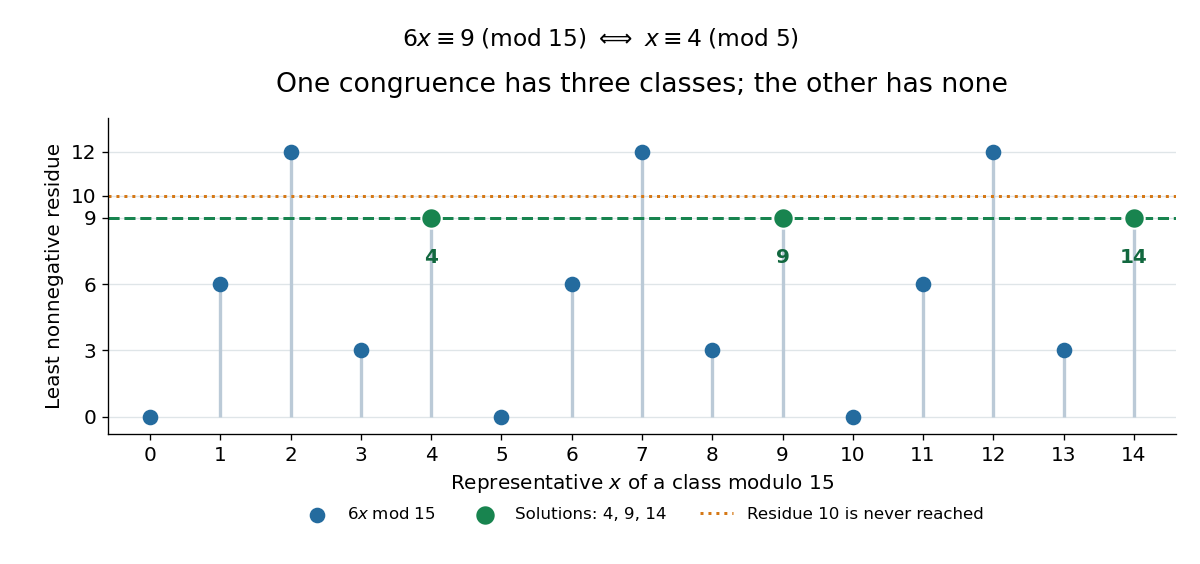
This is why ordinary-looking division cannot be performed blindly in modular arithmetic. Reducing the equation and its integer modulus together keeps all solutions; retaining modulus fifteen after dividing by three would lose valid classes. When , the modular inverse of exists and gives a unique class . The Euclidean algorithm computes the Bézout coefficients needed for this construction. [ref]
https://ocw.mit.edu/courses/18-200-principles-of-discrete-applied-mathematics-spring-2024/mit18_200_s24_lec15.pdf. Moitra, MIT 18.200, Lecture 15, modular inverses and the extended Euclidean algorithm
Radiation pressure on a perfectly absorbing surface by  Codex 0 Created 2026-09-29 Updated 2026-11-05
With the momentum-flux sign convention used for the Maxwell stress tensor, Maxwell's equations implywhere is the electromagnetic momentum density and is the Lorentz force density exerted by the field on matter. Thus total field-plus-matter momentum is locally conserved.
The electromagnetic momentum density in vacuum is . It equals the Poynting vector divided by , expressing the relativistic relation between energy flux and momentum density.
A Lyapunov function is positive definite at an equilibrium when and for nearby . Thus is a strict local minimum of .
The orbital derivative of a differentiable scalar along an autonomous differential equation isThe chain rule identifies it with . It measures change along a trajectory, rather than the size of the gradient alone.
For and the rotation field , it is even though the gradient is nonzero away from the origin. For the contracting field , the same function has orbital derivative . This directional distinction is what makes an orbital derivative useful in a Lyapunov function or a first integral.
If one clock measures a proper time interval while moving at constant speed in an inertial frame, that frame measures , where is the Lorentz factor. The two spacetime events must lie on that clock's world line.
Suppose a clock moving at advances by between two ticks. Set at the first tick. The laboratory's synchronized clocks assign . During that interval the clock travels , approximately . The Minkowski interval checks the result:Both frames therefore recover the same of proper time. This calculation is useful whenever a process is timed on a moving apparatus but described using laboratory clocks.
A light clock makes the mechanism visible. Two mirrors separated by perpendicular to the motion exchange a pulse; define one tick as its complete return to the lower mirror. In the clock's rest frame the tick takes . In the laboratory each half-tick lasts and the light traverses a diagonal, so the Pythagorean theorem givesFor and , each leg covers while the mirrors move . The return tick lasts instead of : the light has the same speed of light in both accounts. [ref].
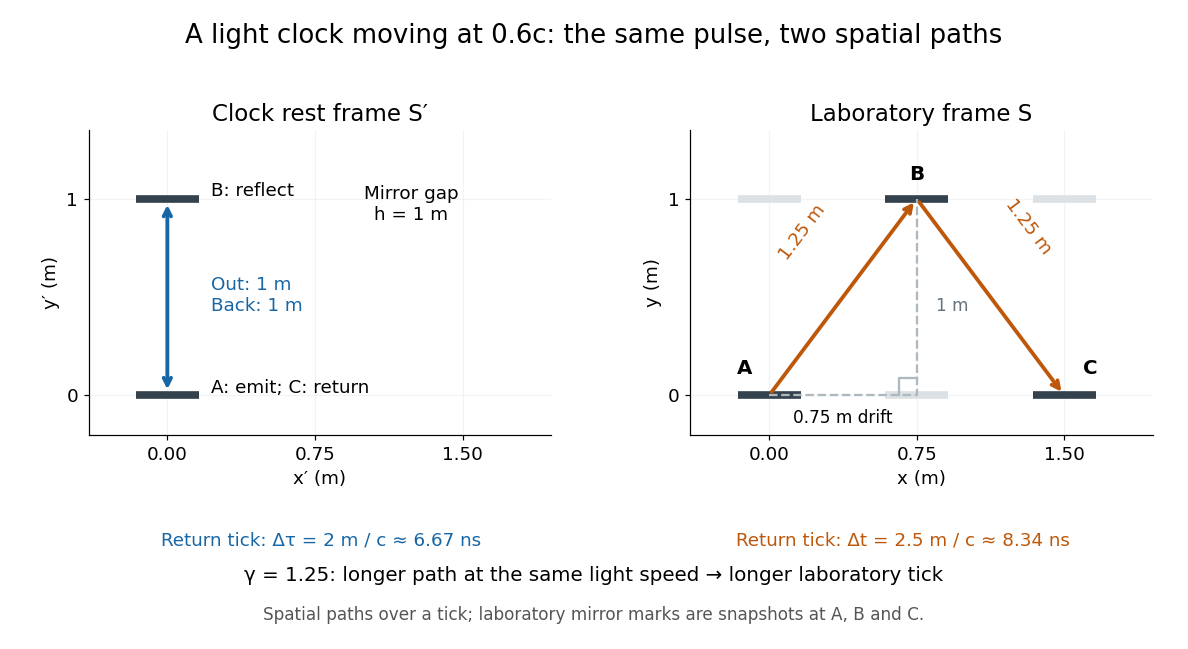
One return tick of a transverse light clock at rest and moving at 0.6c; the laboratory light path is longer
. Details. Reciprocal time dilation is consistent: each inertial frame times the other frame's single moving clock using its own synchronized clock network. These comparisons use different simultaneous spacetime events. Comparing reunited clocks instead requires their complete world lines, as in the twin paradox.
The weak-field approximation requires every dimensionless component of the metric perturbation to have magnitude much smaller than one, so terms quadratic in the perturbation may be neglected.
Pinned article: Introduction to the OurBigBook Project
Welcome to the OurBigBook Project! Our goal is to create the perfect publishing platform for STEM subjects, and get university-level students to write the best free STEM tutorials ever.
Everyone is welcome to create an account and play with the site: ourbigbook.com/go/register. We belive that students themselves can write amazing tutorials, but teachers are welcome too. You can write about anything you want, it doesn't have to be STEM or even educational. Silly test content is very welcome and you won't be penalized in any way. Just keep it legal!
Intro to OurBigBook
. Source. We have two killer features:
- topics: topics group articles by different users with the same title, e.g. here is the topic for the "Fundamental Theorem of Calculus" ourbigbook.com/go/topic/fundamental-theorem-of-calculusArticles of different users are sorted by upvote within each article page. This feature is a bit like:
- a Wikipedia where each user can have their own version of each article
- a Q&A website like Stack Overflow, where multiple people can give their views on a given topic, and the best ones are sorted by upvote. Except you don't need to wait for someone to ask first, and any topic goes, no matter how narrow or broad
This feature makes it possible for readers to find better explanations of any topic created by other writers. And it allows writers to create an explanation in a place that readers might actually find it.
Figure 1. Screenshot of the "Derivative" topic page. View it live at: ourbigbook.com/go/topic/derivativeVideo 2. OurBigBook Web topics demo. Source. - local editing: you can store all your personal knowledge base content locally in a plaintext markup format that can be edited locally and published either:This way you can be sure that even if OurBigBook.com were to go down one day (which we have no plans to do as it is quite cheap to host!), your content will still be perfectly readable as a static site.
- to OurBigBook.com to get awesome multi-user features like topics and likes
- as HTML files to a static website, which you can host yourself for free on many external providers like GitHub Pages, and remain in full control

Figure 2. You can publish local OurBigBook lightweight markup files to either OurBigBook.com or as a static website.
Figure 3. Visual Studio Code extension installation.
Figure 5. . You can also edit articles on the Web editor without installing anything locally. Video 3. Edit locally and publish demo. Source. This shows editing OurBigBook Markup and publishing it using the Visual Studio Code extension. 
- Infinitely deep tables of contents:




All our software is open source and hosted at: github.com/ourbigbook/ourbigbook
Further documentation can be found at: docs.ourbigbook.com
Feel free to reach our to us for any help or suggestions: docs.ourbigbook.com/#contact