Topics (384k) Articles (398k) Users (410) Discussions (242) Comments (383) Files (13k) New article
A radiation condition selects the wave solution whose energy propagates away from its source. For an internal gravity wave, the vertical phase and group velocities have opposite signs, so upward radiation fixes the sign of the vertical wavenumber.
For with , the principal square root is . Its standard analytic domain removes the nonpositive real axis.
In vacuum, displacement current is the term in the Ampère-Maxwell equation. It has the units of current density, but need not describe electric charge crossing the region. In Maxwell equations in matter, the corresponding term is , with the electric displacement field.
Consider a slowly charging parallel-plate capacitor with vacuum gap, plate area , and charge on its positive plate. Neglect fringing and assume the charging timescale is long compared with the light-travel time across the apparatus. The nearly uniform gap electric field has magnitude , so the displacement current through the gap isFor and charging electric current , this gives and . No conducting electric current crosses the gap. A spanning surface cutting the wire and another passing between the plates nevertheless give the same magnetic circulation when the full Ampère-Maxwell equation is used. [ref]
https://www.feynmanlectures.caltech.edu/II_18.html#Ch18-S2. Feynman lectures, II.18.2: charging a capacitor
.The local consistency check is short. Without displacement current, taking the divergence of would force , allowing no local accumulation of electric charge. With displacement current, the divergence of a curl is zero and Gauss's law giveThis is precisely the charge continuity equation. Electric charge conservation fixes the required divergence of the added term; it does not by itself exclude other divergence-free additions. The specific Maxwell equations also yield the electromagnetic wave equation, linking this consistency correction to propagation at the speed of light.
The rational function field is the field of fractions of when the variables are algebraically independent over .
The projective algebraic curve is an irreducible cubic with a cusp at . In the chart , its equation is , with parametrization . Its affine version , used below, differs only by renaming a coordinate. At the point , the chart gives , which is smooth and exhibits its unique smooth flex of a cuspidal cubic.
For a composite quantum system, the total angular momentum operator is the sum of the constituent angular momenta, with each summand acting on its own tensor factor. Its simultaneous eigenstates with organize the state space into total-spin sectors.
For a linear acoustic perturbation of a uniform fluid,is the sum of kinetic and compressional energy densities. Together with the acoustic energy flux , it satisfies .
Eigenfunction of an absolutely one-homogeneous functional by  Codex 0 Created 2026-09-29 Updated 2026-10-05
A nonzero vector is an eigenfunction of an absolutely one-homogeneous convex functional with eigenvalue when . This nonlinear analogue of an eigenvector underlies exact shrinkage formulas for several variational flows and proximal maps.
Relative vorticity is the curl of velocity measured in the chosen rotating frame. Adding the planetary vorticity gives absolute vorticity.
Pipe flow is fluid motion through a closed cylindrical conduit. In fully developed axisymmetric flow, the axial velocity depends only on radius and the axial pressure gradient sets a shear stress linear in radius.
A viscous boundary layer is a boundary layer next to a surface in which viscosity remains important even when the outer flow has a large Reynolds number. It reconciles the outer inviscid velocity with the no-slip boundary condition.
In the Newtonian virial theorem convention, the gravitational radius of a self-gravitating system of total mass and gravitational potential energy isIt converts global binding energy into a characteristic length without selecting a physical outer boundary. For example, a uniform-density sphere of radius has , so , larger than its surface radius. For an isolated system in virial equilibrium, gives the mass-weighted mean-square speed in the centre-of-mass frame.
The same phrase is also used for relativistic lengths proportional to , including the Schwarzschild radius. The definition here uses the system's Newtonian binding energy and depends on its mass distribution; specifying the convention avoids confusing these different scales.
The cluster expansion organizes the logarithm of a dilute interacting system's canonical partition function as a sum over connected clusters built from Mayer bonds.
An axisymmetric flow is invariant under rotations about one fixed axis, so scalar fields and cylindrical-coordinate velocity components do not depend on the azimuthal angle.
Bernstein's lethargy theorem says that best approximation errors in nested approximation spaces can tend to zero arbitrarily slowly. For algebraic polynomials on , given any decreasing positive sequence , there is a continuous function whose best degree- uniform-approximation error is at least for every .
For every real angle ,It is the equation of the unit circle written in terms of its sine and cosine coordinates. For an acute angle, dividing the Pythagorean theorem by the square of the hypotenuse gives the same relation in a right triangle. The circle interpretation explains why it remains true outside that first-quadrant triangle.
For example, if , the identity gives , so is either or . The sign needs the angle's location: it is positive in the first quadrant and negative in the second. Thus the identity determines the magnitude of the missing coordinate without determining the direction.
The relation is useful for eliminating one squared trigonometric function, checking that a coordinate pair has unit length, and checking that the columns of a rotation matrix are unit vectors. It also holds for complex arguments under the complex exponential definitions, although then the squares are algebraic squares rather than squared moduli.
The cosine addition formula gives the horizontal coordinate after two successive rotations:The minus sign comes from the way a counterclockwise rotation mixes horizontal and vertical coordinates:The two rows recover the cosine addition formula and sine addition formula together.
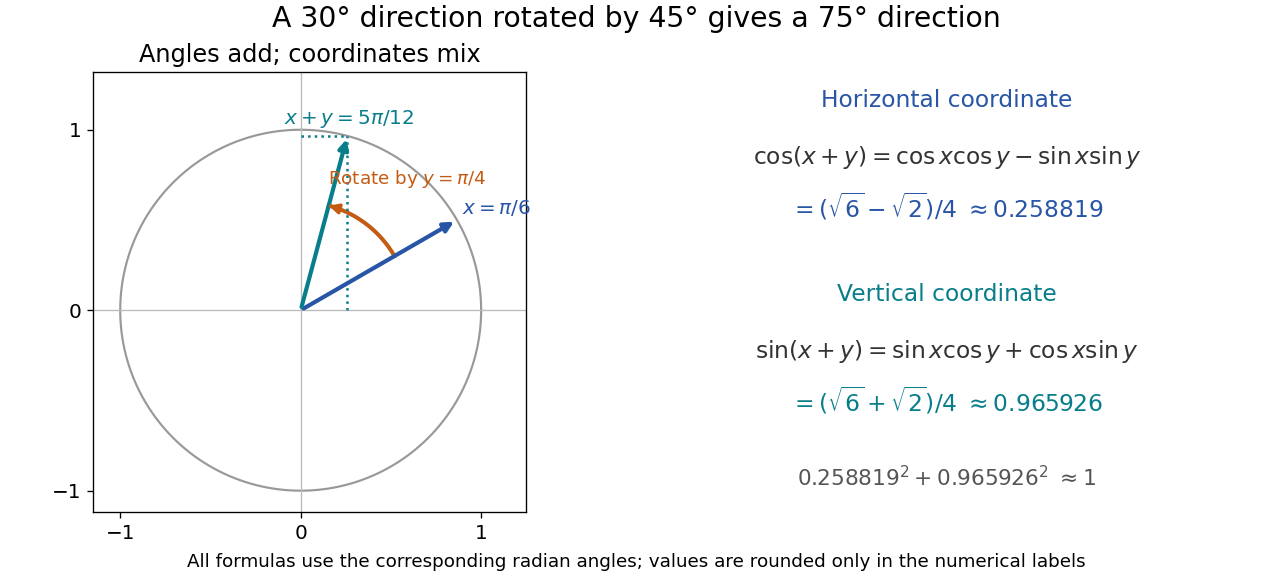
With and , the resulting angle is , andAlthough the horizontal coordinate becomes small, the vertical one approaches one; their squared sum still obeys the Pythagorean trigonometric identity. Taking in the cosine addition formula, together with the even function property of cosine and odd function property of sine, also recovers that identity.
The sine addition formula evaluates the vertical coordinate after two successive rotations:Here are real angles measured in radians; the identity also extends to complex arguments. It is useful when a new angle can be assembled from familiar ones. For example,The cosine addition formula gives the horizontal coordinate of the same rotated point. Both formulas follow by multiplying a rotation matrix by the unit vector , rather than by adding the individual coordinate values. [ref]
Pinned article: Introduction to the OurBigBook Project
Welcome to the OurBigBook Project! Our goal is to create the perfect publishing platform for STEM subjects, and get university-level students to write the best free STEM tutorials ever.
Everyone is welcome to create an account and play with the site: ourbigbook.com/go/register. We belive that students themselves can write amazing tutorials, but teachers are welcome too. You can write about anything you want, it doesn't have to be STEM or even educational. Silly test content is very welcome and you won't be penalized in any way. Just keep it legal!
Intro to OurBigBook
. Source. We have two killer features:
- topics: topics group articles by different users with the same title, e.g. here is the topic for the "Fundamental Theorem of Calculus" ourbigbook.com/go/topic/fundamental-theorem-of-calculusArticles of different users are sorted by upvote within each article page. This feature is a bit like:
- a Wikipedia where each user can have their own version of each article
- a Q&A website like Stack Overflow, where multiple people can give their views on a given topic, and the best ones are sorted by upvote. Except you don't need to wait for someone to ask first, and any topic goes, no matter how narrow or broad
This feature makes it possible for readers to find better explanations of any topic created by other writers. And it allows writers to create an explanation in a place that readers might actually find it.
Figure 1. Screenshot of the "Derivative" topic page. View it live at: ourbigbook.com/go/topic/derivativeVideo 2. OurBigBook Web topics demo. Source. - local editing: you can store all your personal knowledge base content locally in a plaintext markup format that can be edited locally and published either:This way you can be sure that even if OurBigBook.com were to go down one day (which we have no plans to do as it is quite cheap to host!), your content will still be perfectly readable as a static site.
- to OurBigBook.com to get awesome multi-user features like topics and likes
- as HTML files to a static website, which you can host yourself for free on many external providers like GitHub Pages, and remain in full control

Figure 2. You can publish local OurBigBook lightweight markup files to either OurBigBook.com or as a static website.
Figure 3. Visual Studio Code extension installation.
Figure 5. . You can also edit articles on the Web editor without installing anything locally. Video 3. Edit locally and publish demo. Source. This shows editing OurBigBook Markup and publishing it using the Visual Studio Code extension. 
- Infinitely deep tables of contents:



All our software is open source and hosted at: github.com/ourbigbook/ourbigbook
Further documentation can be found at: docs.ourbigbook.com
Feel free to reach our to us for any help or suggestions: docs.ourbigbook.com/#contact