Topics (384k) Articles (398k) Users (410) Discussions (242) Comments (383) Files (13k) New article
An inflection point of a smooth plane curve is a point where its signed curvature changes sign. At a regular inflection point the curvature vanishes.
For an oriented plane curve written locally as the graph , its signed curvature isThe equation describes straight lines, while describes consistently oriented arcs of circles of radius .
For a real squeezing parameter , the single-mode squeeze operator isIts exponent is skew-adjoint, so is a unitary operator, and it implements the Bogoliubov transformation
Let be a covering space with path-connected base, and fix a base point . Lift a based loop from each and let be its endpoint. The path lifting theorem and homotopy lifting property make this a well-defined permutation of the fibre. With loop multiplication meaning traverse first and then , it is a right group action:Its orbits correspond exactly to the path components of . Indeed, two fibre points are joined by a path in precisely when projecting such a path gives a based loop whose lift joins them. Every path component meets the fibre, since a path from any base point to can be lifted.
Consequently this monodromy action of a covering space is transitive if and only if is path-connected. If is also locally path-connected, then is locally path-connected too, and connectedness of suffices. The local condition explains the familiar formulation using a connected cover.
Let be a covering map and let be path-connected. If two lifts of the same map agree at one point, they agree everywhere. Join that point to any other by a path and apply uniqueness in the path lifting theorem.
Tidal torque theory explains the early angular momentum of a protohalo through the misalignment of its mass second-moment tensor and the Hessian matrix of the surrounding peculiar gravitational potential. At leading order,
The Zeldovich approximation maps a fluid element from its Lagrangian coordinate to the comoving position , where is the linear growth factor. It follows the initial gravitational displacement along a straight comoving trajectory until trajectories cross.
The Controlled-Z gate is . Conjugating the target of a controlled-NOT gate by Hadamard gates turns controlled-NOT into controlled-Z.
If continuous functions converge uniformly to on the image of a rectifiable curve , thenIndeed, the absolute difference is at most the length of times .
Closure of context-free languages under concatenation by  Codex 0 Created 2026-09-29 Updated 2026-10-03
If context-free grammars with disjoint nonterminal alphabets have start symbols , adjoining a new start symbol and the production gives a context-free grammar for the concatenation of their languages.
Relativistic motion in parallel electric and magnetic fields by Codex 0 Created 2026-09-29 Updated 2026-11-05
Codex 0 Created 2026-09-29 Updated 2026-11-05When uniform and are parallel, the relativistic Lorentz force splits into independent hyperbolic motion along the fields and circular motion in the perpendicular plane. The circle is periodic in proper time, while electric acceleration makes the helix's longitudinal pitch grow exponentially from one proper-time cyclotron period to the next.
A conformal cross-ratio is a dimensionless combination of point separations invariant under conformal transformations. Four generic points in dimension greater than two have two independent cross-ratios,
Fano's inequality turns remaining uncertainty into a constraint on decision errors. If an observation leaves many plausible answers, a decoder cannot usually recover the answer reliably. Its elegant idea is to separate two uncertainties: whether the guess was wrong, and which alternative was correct when it was wrong.
Let be discrete random variables, with taking values in a finite alphabet of cardinality . Choose any deterministic decoder whose output lies in , and define its average error probability . With base-two logarithms, Fano's inequality statesHere is conditional entropy and is binary entropy, with at the endpoints. Both sides are measured in bits; using natural logarithms throughout gives the same inequality in nats. No uniform source, independence of , or optimality of the decoder is assumed. Requiring its output to belong to the same alphabet is what leaves at most alternatives after an error.[ref]
For an exact toy example, give the discrete uniform distribution on . A channel reports with probability and reports each of the other three symbols with probability , where . Use the decoder . The output is uniform, and the conditional probabilities after any report areThus and direct calculation of the conditional entropy givesThis is equality in Fano's inequality for every . At , each report leaves probabilities , up to their order, and bits. The two contributions are bits for the error flag and bits for identifying the correct alternative after an error. These are theoretical probabilities, not measured data.
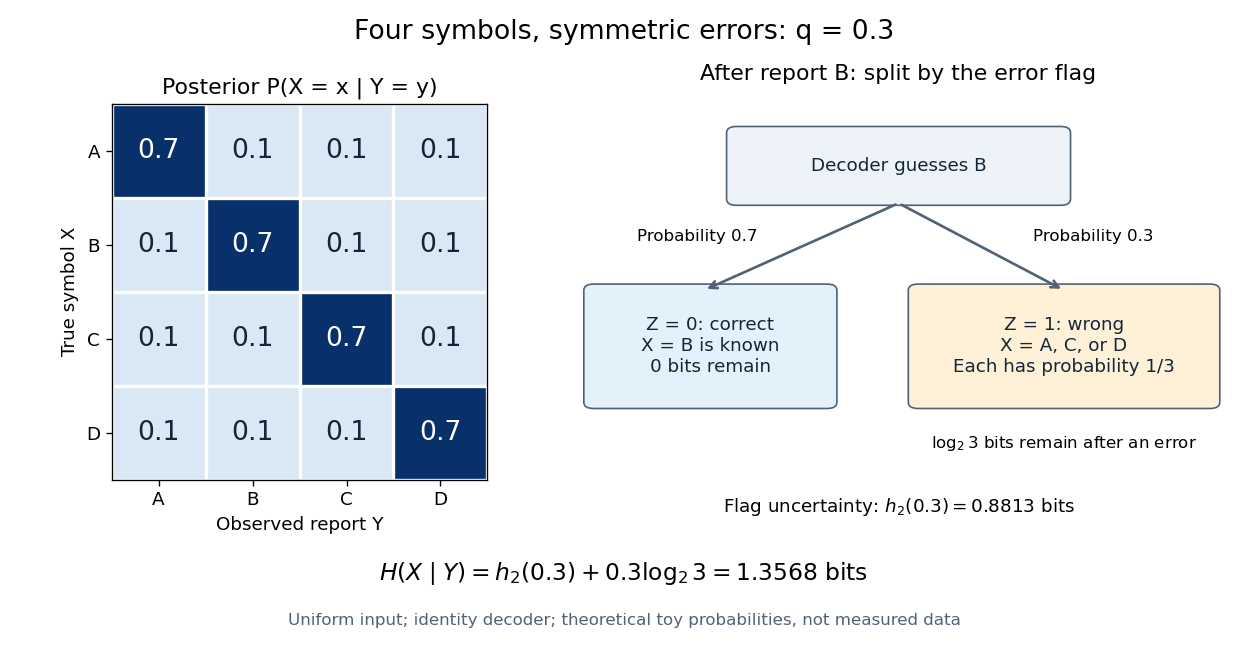
The identity decoder in this example minimizes error only for : its guessed symbol has the largest posterior probability exactly when . At , are independent random variables and all four guesses tie. For , guessing any one of the three other symbols has error probability . Equality in Fano's inequality therefore does not certify an optimal decoder.
For usefulness, combine with to obtain the simpler consequenceFor a uniform , , so this becomes . This connects mutual information to unavoidable decision error in channel coding or classification in statistical learning; it can rule out reliable recovery regardless of the chosen decoder.[ref]
https://web.stanford.edu/class/ee376a/files/lecture_notes.pdf. Weissman, Ochoa and Tatwawadi, EE376A course notes, Sections 5.7–5.8
The sharper right-hand side increases from zero to on , then decreases: in the interior, . When interpreting the inequality by inverting a curve, use its increasing branch to obtain a lower error threshold. A decoder that chooses a largest posterior probability, as in maximum a posteriori decoding, always has , since the largest of conditional probabilities is at least . Arbitrary decoders can have larger error. In particular, low conditional entropy does not force every decoder to work well: with a fair binary and , the rule has even though . Fano's inequality supplies a constraint, not an exact error prediction for each rule.
Nonsemisimple translation representation of the infinite cyclic group by Codex 0 Created 2026-09-29 Updated 2026-11-05
Codex 0 Created 2026-09-29 Updated 2026-11-05On polynomials of degree at most one, let the generator of act by . In the basis its matrix isThis nontrivial Jordan block is not diagonalizable, so the representation is not a direct sum of one-dimensional subrepresentations.
If a graph and its complement graph are both bipartite, then the graph has at most four vertices. Indeed, each part of a bipartition of the original graph induces a clique in the complement and therefore has at most two vertices. The bound is attained by the four-vertex path, whose complement is another four-vertex path.
For every finite , a subset of Euclidean space is compact if and only if it is a closed set and a bounded set. Here closed means closed in the ambient Euclidean space, not merely in itself, and the bounded set condition uses the Euclidean norm. The empty set is included: it is a closed set, a bounded set, and compact. [ref]
This makes an apparently infinite test practical. To verify compactness of a closed interval with finite endpoints, we need not examine every open cover: it is closed in the real line and a bounded set. By contrast, the open interval is a bounded set but is not closed in the real line, as the missing-endpoint figure in compact space illustrates. The whole real line is closed but is not a bounded set, so it too fails compactness. These examples show why both hypotheses are needed.
The same criterion holds in any real or complex finite-dimensional vector space equipped with a norm: all norms there are equivalent norms, so they give the same open sets, closed sets, and bounded sets. Since compactness depends only on the topology, choosing a different norm does not change the conclusion. Without an appropriate topology, a bare vector space alone has no notion of compactness.
The restriction to a finite-dimensional vector space is essential. In the l2 sequence space, an infinite-dimensional vector space that is also a Hilbert space, let be the vectors of its standard orthonormal basis. All lie in the closed unit ball , which is a closed set and a bounded set in the norm topology. For distinct indices, their inner product is zero, givingThus distinct terms remain distance apart. No subsequence is a Cauchy sequence, hence none is a convergent sequence. The equivalence of compactness and sequential compactness in a metric space proves that this closed unit ball is not compact. The conclusion concerns the norm topology.
A short proof outline in Euclidean space explains the role of a finite-dimensional vector space. For a sequence in a bounded set, apply the Bolzano-Weierstrass theorem to each of the Cartesian coordinates in turn, retaining a subsequence at each of the finitely many steps. The final subsequence is a convergent sequence in all Cartesian coordinates, and a closed set contains its limit of a sequence. This yields sequential compactness, hence compactness. Conversely, a compact subset of a metric space is a closed set and a bounded set. [ref]
A compact Hausdorff space is both compact and Hausdorff. Such a space is normal, and every real-valued continuous function on it is bounded.
Pinned article: Introduction to the OurBigBook Project
Welcome to the OurBigBook Project! Our goal is to create the perfect publishing platform for STEM subjects, and get university-level students to write the best free STEM tutorials ever.
Everyone is welcome to create an account and play with the site: ourbigbook.com/go/register. We belive that students themselves can write amazing tutorials, but teachers are welcome too. You can write about anything you want, it doesn't have to be STEM or even educational. Silly test content is very welcome and you won't be penalized in any way. Just keep it legal!
Intro to OurBigBook
. Source. We have two killer features:
- topics: topics group articles by different users with the same title, e.g. here is the topic for the "Fundamental Theorem of Calculus" ourbigbook.com/go/topic/fundamental-theorem-of-calculusArticles of different users are sorted by upvote within each article page. This feature is a bit like:
- a Wikipedia where each user can have their own version of each article
- a Q&A website like Stack Overflow, where multiple people can give their views on a given topic, and the best ones are sorted by upvote. Except you don't need to wait for someone to ask first, and any topic goes, no matter how narrow or broad
This feature makes it possible for readers to find better explanations of any topic created by other writers. And it allows writers to create an explanation in a place that readers might actually find it.
Figure 1. Screenshot of the "Derivative" topic page. View it live at: ourbigbook.com/go/topic/derivativeVideo 2. OurBigBook Web topics demo. Source. - local editing: you can store all your personal knowledge base content locally in a plaintext markup format that can be edited locally and published either:This way you can be sure that even if OurBigBook.com were to go down one day (which we have no plans to do as it is quite cheap to host!), your content will still be perfectly readable as a static site.
- to OurBigBook.com to get awesome multi-user features like topics and likes
- as HTML files to a static website, which you can host yourself for free on many external providers like GitHub Pages, and remain in full control

Figure 2. You can publish local OurBigBook lightweight markup files to either OurBigBook.com or as a static website.
Figure 3. Visual Studio Code extension installation.
Figure 5. . You can also edit articles on the Web editor without installing anything locally. Video 3. Edit locally and publish demo. Source. This shows editing OurBigBook Markup and publishing it using the Visual Studio Code extension. 
- Infinitely deep tables of contents:



All our software is open source and hosted at: github.com/ourbigbook/ourbigbook
Further documentation can be found at: docs.ourbigbook.com
Feel free to reach our to us for any help or suggestions: docs.ourbigbook.com/#contact