
Boyle's law states that a fixed amount of substance of an ideal gas at constant absolute thermodynamic temperature has constant product of absolute pressure and total volume:Here is measured relative to a vacuum, not relative to the surrounding atmospheric pressure. Halving the volume doubles the absolute pressure; doubling the volume halves it. A real gas approximately follows Boyle's law when it is sufficiently dilute and far from a phase transition.[ref]
2.1 Molecular Model of an Ideal Gas. §2.1, The Gas Laws, Figure 2.4, and equations 2.1–2.2: fixed temperature and particle number, absolute pressure, and the dilute-gas limit
For an original calculated example, suppose a sealed gas sample has and . After isothermal compression to ,Both states have , since . The volume ratio is dimensionless, so using the same volume units in numerator and denominator leaves the pressure in kilopascals. Although has units of energy, its value is not the compression work: isothermal ideal-gas work involves an integral along the path.
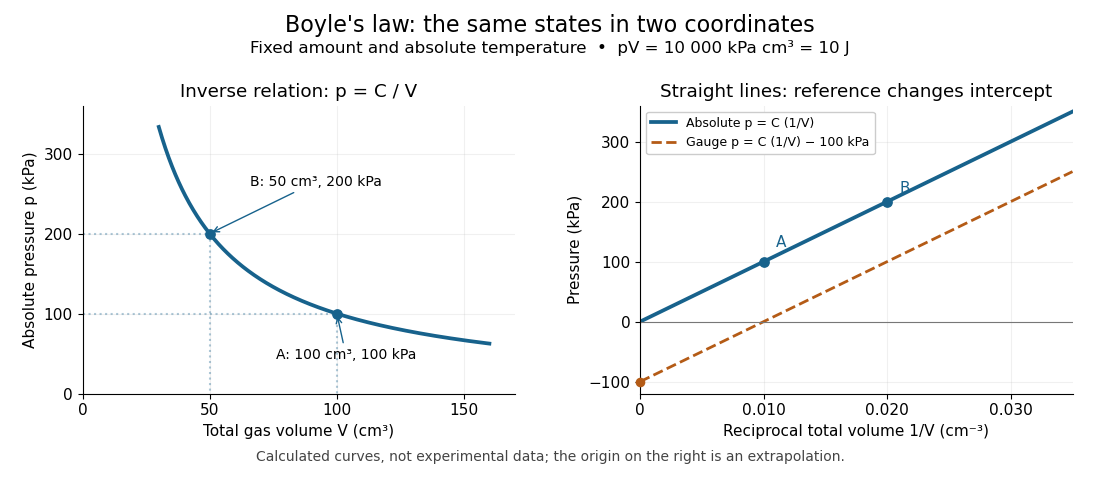

The blue curves show calculated ideal gas states, not measurements. The left panel is a branch of a hyperbola; the right panel plots exactly the same absolute pressures against . The dashed line uses gauge pressure with a stipulated constant atmospheric pressure of . Its displaced intercept explains why absolute pressure in Boyle's law matters.
A short derivation starts from the ideal gas law, . Fixing the amount of substance and absolute thermodynamic temperature fixes , where is the molar gas constant. The microscopic picture in ideal gas pressure from wall collisions is equally appealing: at fixed temperature, the typical particle kinetic energy stays fixed, while compression increases the number density and wall momentum transfer per unit surface area and time. A larger absolute pressure follows without requiring hotter particles.
The constraints are essential. A leak changes the amount of substance. Rapid compression can raise the temperature before heat transfer restores thermal equilibrium, as in the isothermal gas syringe experiment. Molecular size and interactions in a dense real gas invalidate the ideal gas approximation; the Van der Waals equation describes one such correction. Equal endpoint temperatures allow an endpoint test of Boyle's law, but do not establish that every intervening state lies on an isothermal process.
For fixed mass , mass density satisfies , so it is proportional to absolute pressure. In a dilute bubbly flow, Boyle's law allows bubble volume and its contribution to buoyancy to increase as hydrostatic pressure decreases, provided gas mass is retained, dissolution is negligible, and the temperature stays approximately fixed. Its usefulness is that a simple ratio predicts a substantial size change without tracking individual molecules.
New to topics? Read the docs here!