Hess's law calorimetry experiment
ID: hess-s-law-calorimetry-experiment

A practical test compares three transformations involving sodium hydroxide: dissolution of the solid, neutralization of its chemical solution by hydrochloric acid, and reaction of the solid directly with hydrochloric acid. In the ideal compatible-state notation, the hydrogen ion and hydroxide giveThe hydroxide cancels, whereas the newly formed water remains. Sodium and chloride spectator ions must still be included in the full material inventory when matching actual chemical solutions.
The teaching protocol Calorimetry: Heat of Neutralization Reaction & Hess's Law, Procedure A–C, uses nested insulated cups, a cardboard lid and a thermometer. It mixes each of hydrochloric acid and sodium hydroxide chemical solutions; separately it adds solid sodium hydroxide to diluted hydrochloric acid, or to water. It records initial temperatures, stirs, reads temperature every , repeats runs, and extrapolates cooling trends to mixing time. Rapid weighing limits moisture uptake. The Introduction neglects vessel heat capacity and room losses; these are approximations, not a measured calibration. The readout tests whether the inferred enthalpies add, rather than directly measuring a state function.[ref]
Calorimetry: Heat of Neutralization Reaction & Hess's Law, Chemistry 151LL. Introduction; Procedure A.1–8, B.1–5 and C.1–6; Additional Data Treatment: cup approximation, preparation, repeat runs and mixing-time extrapolation
Matching the chemical equations alone is insufficient. The direct-acid recipe uses hydrochloric acid, whereas the solution-mixing recipe uses . The dissolution run also does not automatically reproduce the water inventory of the mixed-solution run. Exact closure requires matching initial and final chemical solution compositions and adding any necessary mixing or dilution enthalpies. Agreement after approximate corrections is a limited test, rather than proof of exact cancellation for those recipes.
To improve the calorimetry, use calorimeter calibration for the participating hardware, and estimate calorimeter heat-loss correction under comparable conditions. With an approximately constant total receiving heat capacity , common initial temperature, constant external pressure, only expansion work, negligible escaping material and negligible bulk kinetic energy and potential energy changes, the balance isHere is the chemical solution mass, its specific heat capacity at constant pressure, the hardware heat capacity, and the signed outward heat loss. Different initial temperatures require separate warming terms. Calorimeter calibration and matching chemical solution compositions address different errors.
For an original constructed model, choose and . Neglect outward heat loss and other corrections. The receiving chemical solution and hardware gain , so . If the completed extent of reaction is for a unit-coefficient chemical equation, the inferred reaction enthalpy per mole of that reaction isThese chosen numbers illustrate the signs and normalization; they are not measured sodium hydroxide data and are independent of the abstract example.
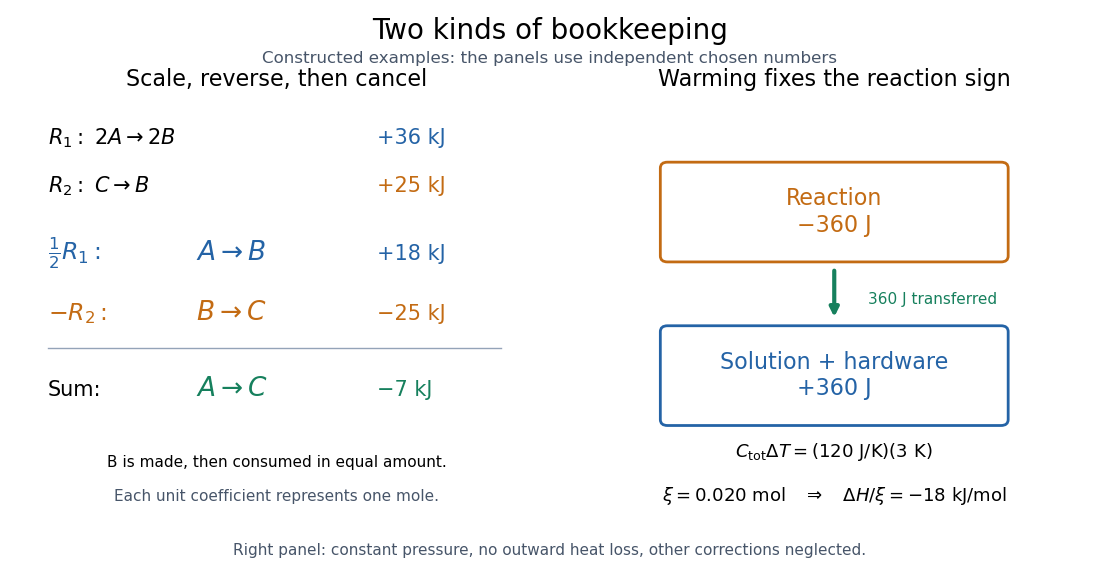
Stoichiometry cancels intermediate states; calorimetry converts warming into signed reaction enthalpy
. Left: original abstract chemical equations use to give and for one mole. Right: an independent chosen heat capacity model gives receiver gain and reaction change . Neither panel reports experimental measurements. Details.
A loss of heat to the room makes the uncorrected warming underestimate the magnitude of a heat-releasing reaction. Incomplete dissolution, incomplete reaction, uncertain amount of substance, or a slow thermometer response can also spoil closure. A useful experimental residual is after all changes have been placed on the same amount and state basis. Compare with the measurement uncertainty, accounting for shared calibration errors; averaging repeated runs reduces scatter without removing a common bias.
New to topics? Read the docs here!