
Past exam of the mathematics course of the University of Cambridge 2017 ii Paper 4 36D b Solution Created 2026-09-24 Updated 2026-10-05
Using the stipulated point-mass quadrupole, take and . The only nonzero components areSince , its third derivative is . Thereforeand the total outward radiated power isQuadrupole radiation oscillates at twice the motion frequency. The approximation assumes slow motion and a prescribed motion relative to the rest of the source. A lone freely moving point mass cannot execute this oscillation; a physical conserved source includes the accelerating apparatus or other matter, whose quadrupole would also need specification. The displayed value is the point-mass contribution requested by the supplied formula.
Past exam of the mathematics course of the University of Cambridge 2017 ii Paper 4 36D a Solution Created 2026-09-24 Updated 2026-10-05
Use and the physical real part of the printed plane wave. Its null wavevector obeys , so each component satisfies . Direct differentiation of the defined stress tensor givesThe trace is proportional to for a single plane wave and hence vanishes. ThereforeThis is local conservation of energy and momentum conservation; spatial integration gives conserved total charges when the boundary flux vanishes. For a finite-amplitude complex phasor, one takes the real field before quadratic products and may time-average: in transverse-traceless gauge. Its energy density is nonnegative and its flux travels in the positive direction.
Past exam of the mathematics course of the University of Cambridge 2017 ii Paper 4 34D iv Solution Created 2026-09-24 Updated 2026-10-05
The expansion about the liquid-gas critical point isDifferentiating at fixed gives the requested . At coexistence , so to leading nontrivial order keep the cubic odd part .
Let , for this leading cubic model. Equality of endpoint pressures gives . The Maxwell condition in pressure coordinates is . Since the endpoint pressures agree, its first term vanishes, leavingIf , these two equations would imply , contrary to distinct phases. Therefore , and the pressure equality gives . HenceThus the coexistence gap has exponent one half. The printed equality is a leading-order statement, not an exact identity for the full Van der Waals equation. Discarded asymmetric terms shift both phase volumes at higher order. This distinction is needed even though the leading cubic calculation has exact antisymmetry within its truncation.
Past exam of the mathematics course of the University of Cambridge 2017 ii Paper 4 34D iii Solution Created 2026-09-24 Updated 2026-10-05
Substitute , , and into the equation of state. After cancellation of the material parameters,This is the Van der Waals law of corresponding states: fluids described by this model share the same reduced equation, although real fluids need not obey it exactly.
Past exam of the mathematics course of the University of Cambridge 2017 ii Paper 4 34D ii Solution Created 2026-09-24 Updated 2026-10-05
The liquid-gas critical point is the endpoint of the gas-liquid coexistence curve where the distinct phases merge. For this equation of state it is the horizontal inflection of an isotherm, so :Dividing these conditions gives , then substitution givesAll lie in the physical domain .
Past exam of the mathematics course of the University of Cambridge 2017 ii Paper 4 34D i Solution Created 2026-09-24 Updated 2026-10-05
For a simple homogeneous thermodynamic system, internal energy is extensive: . Euler theorem for homogeneous functions and give , henceAlso , so at fixed ,At coexistence gas and liquid have the same temperature, pressure and chemical potential. Integrating along the intervening isotherm gives . Integration by parts, with endpoints at the same coexistence pressure , gives the Maxwell constructionThe horizontal line at replaces the mechanically unstable loop of the van der Waals isotherm. The extensivity argument presupposes the ordinary thermodynamic limit and neglects macroscopic interface contributions.
Past exam of the mathematics course of the University of Cambridge 2017 ii Paper 4 33C b iii Created 2026-09-24 Updated 2026-09-24
Past exam of the mathematics course of the University of Cambridge 2017 ii Paper 4 33C b ii Created 2026-09-24 Updated 2026-09-24
Past exam of the mathematics course of the University of Cambridge 2017 ii Paper 4 33C b i Created 2026-09-24 Updated 2026-09-24
Past exam of the mathematics course of the University of Cambridge 2017 ii Paper 4 33C a ii Created 2026-09-24 Updated 2026-09-24
Past exam of the mathematics course of the University of Cambridge 2017 ii Paper 4 33C a i Created 2026-09-24 Updated 2026-09-24
Past exam of the mathematics course of the University of Cambridge 2017 ii Paper 4 31A b Solution Created 2026-09-24 Updated 2026-10-14
For , the fixed points are zero for all and for . Their multipliers are respectively and , giving attraction for and respectively.
Remove these fixed points from the roots of . The factor gives the genuine two-cycleIts multiplier is , so it is always unstable. It collapses to zero at , the subcritical period-doubling bifurcation of zero.
The remaining equation is , whose positive roots in exist only for . At they give the fixed points , not genuine two-cycles. For , put . Since , and . There are exactly two further cycles,Their common multiplier is . They are attracting for and repelling for , with marginal multiplier at . Thus there are no cycles for , one for , and three for .
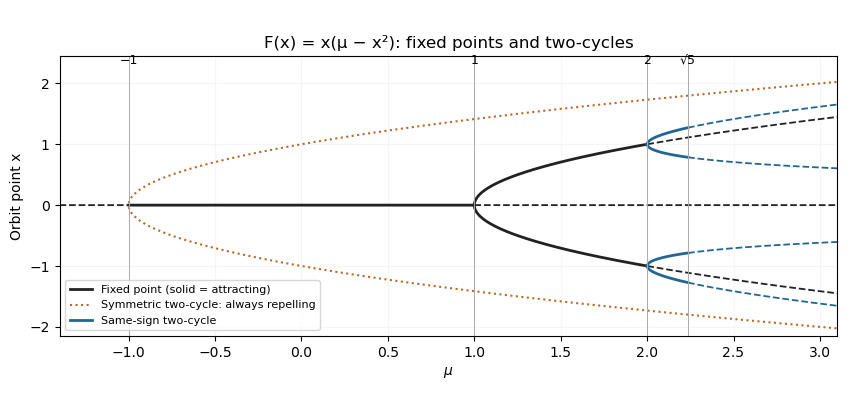
Fixed points and two-cycle points for the odd cubic map
. Details. 
The nonzero fixed points emerge in a supercritical pitchfork bifurcation at one and each flips to an attracting two-cycle at two. Beyond further period doubling to four-cycles is expected, followed by additional bifurcations and potentially chaotic dynamics. This local expectation does not assert chaos for every larger parameter; periodic windows and escape are possible.
Past exam of the mathematics course of the University of Cambridge 2017 ii Paper 4 31A a i Created 2026-09-24 Updated 2026-10-05
Past exam of the mathematics course of the University of Cambridge 2017 ii Paper 4 28J c Solution Created 2026-09-24 Updated 2026-10-05
Interpret and as trading dates in the discrete model; a payoff at nondates would require an interpolation convention absent from the question. Put . Under , the independent stock returns after giveThe ratio payoff is therefore independent of under , and its time-zero price isAt any date , its price is the same expectation discounted only for the remaining periods. The formula uses the ratio payoff actually specified; multiplying it by would define a different, conventional monetary forward-start call.
Past exam of the mathematics course of the University of Cambridge 2017 ii Paper 4 28J b Solution Created 2026-09-24 Updated 2026-10-05
For any finite contingent claim measurable at the final date in the natural binomial tree, backward induction givesAt a node with stock , let be its two successor values. Hold, during the next period,The stock and bank holdings reproduce both successor values and cost . Rebalancing at every node is self-financing, and terminal value is . Thus every such claim is replicated and the no-arbitrage price is unique.
Past exam of the mathematics course of the University of Cambridge 2017 ii Paper 4 28J a Solution Created 2026-09-24 Updated 2026-10-05
Use discrete dates , a bank account with , and a positive stock with each one-period gross return either or , where . On the natural tree assume both moves have positive physical probability. The Cox--Ross--Rubinstein model is arbitrage-free precisely whenOtherwise a stock/bank position gives nonnegative profit in both states and positive profit in at least one. Under the condition, the unique equivalent martingale measure has independent upward moves with conditional probabilityIndeed , making the discounted stock a martingale. Both branches have positive probability under this measure, ensuring equivalence. The uniqueness/completeness claim is for the stock-generated binomial tree; an enlarged filtration carrying additional untraded risk would change that claim.
Past exam of the mathematics course of the University of Cambridge 2017 ii Paper 4 27K d Solution Created 2026-09-24 Updated 2026-10-05
Use the convention that the likelihood ratio is maximized alternative likelihood divided by null likelihood. The alternative excludes zero, but its supremum agrees with the unrestricted maximum, even on the exceptional sample . Completing the square givesUnder the null, , so exactly for every . Equivalently is distributed as for . With the reciprocal likelihood-ratio convention the statistic is instead.
Wilks theorem predicts a limiting chi-squared distribution with degrees of freedom equal to the difference of parameter dimensions, here , under regularity and an interior null point of the unrestricted model. This example strengthens the asymptotic conclusion to an exact finite-sample identity.
Past exam of the mathematics course of the University of Cambridge 2017 ii Paper 4 27K c ii Created 2026-09-24 Updated 2026-09-24
Past exam of the mathematics course of the University of Cambridge 2017 ii Paper 4 27K c i Created 2026-09-24 Updated 2026-09-24
Past exam of the mathematics course of the University of Cambridge 2017 ii Paper 4 27K b Solution Created 2026-09-24 Updated 2026-10-05
The pivot has independent standard normal coordinates, so has the chi-squared distribution with degrees of freedom. Let be its quantile. The confidence ellipsoidtherefore has exactly coverage for every . No large-sample approximation is required when the covariance is known.
There are unlisted articles, also show them or only show them.