
Past exam of the mathematics course of the University of Cambridge 2016 ib Paper 2 17B c Solution Created 2026-09-24 Updated 2026-10-06
With the inner product , the assumed Hermiticity of and givesConsequently the adjoint relation isAs with the stated Hermiticity assumption, these identities concern wavefunctions in the appropriate operator domains. Square integrability alone does not guarantee that derivatives or multiplication by are square integrable; one may first work with smooth rapidly decaying wavefunctions, where integration by parts has no boundary term, and then use the operator domains.
Past exam of the mathematics course of the University of Cambridge 2016 ib Paper 2 17B b Solution Created 2026-09-24 Updated 2026-10-06
Part (a) implies . Since , it follows thatFor an eigenfunction of the Hamiltonian with eigenvalue ,Thus is a ladder operator lowering the energy by , provided . The zero function is not an eigenfunction; in particular the ground state is annihilated by this operator. This qualification is essential for the later argument.
Past exam of the mathematics course of the University of Cambridge 2016 ib Paper 2 17B a Solution Created 2026-09-24 Updated 2026-10-06
Retain the order of the noncommuting position operator and momentum operator. Using their commutator , expansion givesThus the two factorizations of the quantum harmonic oscillator are
Past exam of the mathematics course of the University of Cambridge 2016 ib Paper 2 16A b Solution Created 2026-09-24 Updated 2026-10-14
The method of images for the Neumann boundary conditions extends evenly through zero and then with period . Define the triangular waveThe formulas agree at their endpoints. It is even, -periodic, and agrees with on . Its Fourier cosine series has the coefficients in part (a). The cosine product identity then gives the D'Alembert formulaIt is the average of two oppositely traveling reflected waves. For , the sketch rises from zero at even multiples of to at odd multiples; for it is reflected vertically, and for it is zero.
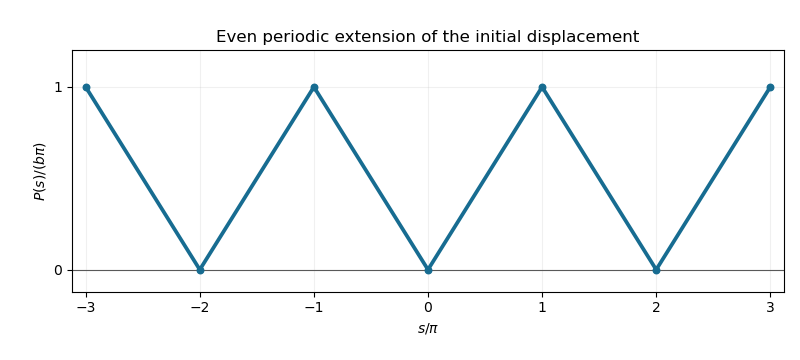
Even periodic extension of the initial displacement for the Neumann wave equation
. Details. 
Past exam of the mathematics course of the University of Cambridge 2016 ib Paper 2 16A a Solution Created 2026-09-24 Updated 2026-10-06
The Neumann boundary conditions select the spatial eigenfunctions , , of the separated wave equation. Indeed separation gives with . Integration by parts gives . The zero value yields the constant mode; for positive , the first boundary condition removes the sine term and the second requires . For , the temporal factor is : the sine factor vanishes because the initial velocity is zero. The zero mode has constant displacement, with no term linear in time for the same reason.
The constant Fourier cosine series coefficient is the mean . The remaining coefficients areOnly odd modes survive. Thus the displacement isThe series for displacement converges absolutely and uniformly. The initial velocity is zero in the finite-energy sense, and the initial displacement is . There is an endpoint compatibility qualification: when , the initial slope does not satisfy the Neumann boundary conditions at . The answer is therefore a finite-energy weak solution, piecewise classical between the propagating corners, rather than a globally twice continuously differentiable solution up to the initial endpoints. The mode expansion implements reflection at those endpoints.
Past exam of the mathematics course of the University of Cambridge 2016 ib Paper 2 15C c Solution Created 2026-09-24 Updated 2026-11-05
With unit constant bending coefficients and unit length, the quadratic elastic energy isTo find the first loss of positivity, put . The clamped conditions give and . Extend periodically with period one. The sharp periodic Wirtinger inequality gives . For completeness, expand the mean-zero periodic in its Fourier series . Parseval identity giveswhich proves the inequality and its equality condition. The same holds for . ConsequentlyFor , the straight filament is the unique minimum. Equality in the periodic Wirtinger inequality has ; the endpoint value eliminates . Integration and the position boundary conditions therefore give the first buckling load and modes:At this load every such pair has zero quadratic elastic energy and solves the Euler-Lagrange equations. For these modes give negative energy, signaling instability of the straight configuration. The quadratic small-slope model does not select a finite post-buckling amplitude; nonlinear terms would be needed for that. This is Euler buckling of an elastic filament.
Past exam of the mathematics course of the University of Cambridge 2016 ib Paper 2 15C b Solution Created 2026-09-24 Updated 2026-10-06
Vary by , where the clamped endpoint conditions require at both endpoints. The first variation of the quadratic elastic energy isBoth integrations by parts have zero boundary terms. Since the variation is arbitrary in the interior, the fundamental lemma of the calculus of variations gives the Euler-Lagrange equation. Varying independently gives the second equation:The clamped endpoint values accompany these equations. If or depends on , it must remain inside the derivatives.
Past exam of the mathematics course of the University of Cambridge 2016 ib Paper 2 15C a Solution Created 2026-09-24 Updated 2026-10-06
The arclength element is . For uniformly small slopes, the Taylor expansion givesThus to quadratic order in the slopes the excess length is . This is the small-slope approximation used in the subsequent elastic energy.
Past exam of the mathematics course of the University of Cambridge 2016 ib Paper 2 14F c Solution Created 2026-09-24 Updated 2026-10-06
Consider the filled hyperbolic triangle with vertices . Every point is on some geodesic segment with : for instance, in the Beltrami-Klein model these are the ordinary straight segments filling a convex triangle. For any other point of the triangle, apply part (b) first on and then on :Applying the same argument to , with each vertex held fixed, bounds every term on the right by the maximum of the three side lengths. The endpoints of a longest side attain that bound. Thus the diameter is exactly the longest side length:
Past exam of the mathematics course of the University of Cambridge 2016 ib Paper 2 14F b Solution Created 2026-09-24 Updated 2026-10-06
At an interior point of the geodesic segment from to , the two angles made with the segment toward add to . At least one is at least . In the corresponding hyperbolic triangle, part (a) says that its opposite side is at least the adjacent side . ThereforeIf is an endpoint the assertion is immediate. The same inequality also holds when lies on the complete geodesic through : parameterize that geodesic by arclength and use the elementary inequality for . This extension will allow repeated use of the result in part (c).
Past exam of the mathematics course of the University of Cambridge 2016 ib Paper 2 14F a Solution Created 2026-09-24 Updated 2026-10-06
In the hyperbolic law of cosines, the angle opposite being at least makes its cosine nonpositive. ThusSince is increasing on , the opposite side is longest: . For a nondegenerate hyperbolic triangle both comparisons are strict.
Past exam of the mathematics course of the University of Cambridge 2016 ib Paper 2 12G c Solution Created 2026-09-24 Updated 2026-10-06
The function is a polynomial in the matrix entries, hence continuous. Consequently is the inverse image of the open set and is an open set.
If and , then implies . This forces . The square matrix is therefore injective, hence an invertible matrix, soThe argument works with any of the induced operator norms in part (b).
Past exam of the mathematics course of the University of Cambridge 2016 ib Paper 2 12G b Solution Created 2026-09-24 Updated 2026-10-06
For a linear map , define the operator norm byIt is finite. To see this without assuming continuity of , write : the triangle inequality bounds by . Every norm in finite dimensions is equivalent to the Euclidean norm. One proof first uses this same coordinate bound to establish continuity of the norm on the Euclidean unit sphere; compactness then gives a strictly positive minimum there. Thus the coordinate bound above is at most a fixed multiple of .
Absolute homogeneity and the triangle inequality for this operator norm follow from those for and taking suprema. If , then for every , hence , and the converse is immediate. For any , the defining bound givesThis is submultiplicativity of the operator norm.
Past exam of the mathematics course of the University of Cambridge 2016 ib Paper 2 12G a Solution Created 2026-09-24 Updated 2026-10-06
A norm on a real or complex vector space is a function with exactly when , , and the triangle inequality . These are positivity, absolute homogeneity and the triangle inequality.
Past exam of the mathematics course of the University of Cambridge 2016 ib Paper 2 11E c Solution Created 2026-09-24 Updated 2026-10-06
For the general linear group over , choose a nonzero first column in ways and a second column outside its span in ways. ThusSince and , the residue has order three. The nine diagonal matrices , with , form a subgroup isomorphic to . It is an abelian group and a Sylow subgroup for . Every other Sylow subgroup for is conjugate to it by the Sylow theorems, hence is also Abelian.
Past exam of the mathematics course of the University of Cambridge 2016 ib Paper 2 11E b Solution Created 2026-09-24 Updated 2026-10-06
Since , the number of Sylow subgroups for divides and is modulo , hence is or . In the first case the unique subgroup is a nontrivial proper normal subgroup.
In the second case the subgroups of order have pairwise trivial intersection: two such subgroups sharing a nonidentity element would both be generated by it. They account for nonidentity elements of order . Exactly elements, including the identity, remain. Every Sylow subgroup for has order , and all its elements lie among these remaining elements, by Lagrange's theorem. It must therefore be precisely that set. The Sylow subgroup for is unique and hence normal. In either case is not a simple group.
Past exam of the mathematics course of the University of Cambridge 2016 ib Paper 2 11E a Solution Created 2026-09-24 Updated 2026-10-06
Write with prime and . The Sylow theorems assert that a subgroup of order exists; every p-group subgroup is contained in a conjugate of a Sylow subgroup; all Sylow subgroups are conjugate; and their number satisfies and .
For the containment and conjugacy assertions, fix a Sylow subgroup and let any p-group subgroup act by left multiplication on the left cosets . By the orbit-stabilizer theorem, every orbit has size a power of . Since , at least one orbit has size one. If is such a fixed point, then for all , equivalently . Thus . If too has order , this inclusion is equality, proving conjugacy. This is Sylow containment from a coset fixed point.
Past exam of the mathematics course of the University of Cambridge 2016 ib Paper 2 10F c Solution Created 2026-09-24 Updated 2026-10-06
If is a Hermitian matrix, then , so preserves . Addition and multiplication by real scalars commute with this operation, making a real linear map.
A real basis of consists of and, for , and . It has elements and is also a complex basis of all matrices. Indeed every matrix is uniquely with Hermitian matrices, by takingReal linear independence of the displayed basis therefore implies complex linear independence. Since its images under are Hermitian matrices, the matrix of in this complex basis has exactly the same real entries as the matrix of in the real basis. Their determinants are equal. There is no further squaring when passing to this real subspace:This is the determinant of Hermitian congruence, including the case of singular .
Past exam of the mathematics course of the University of Cambridge 2016 ib Paper 2 10F b Solution Created 2026-09-24 Updated 2026-10-06
Right multiplication by acts separately on the rows. After transposing each row its matrix is , so its determinant is . Composing this linear map with left multiplication and using part (a) givesHere the determinant is taken on the -dimensional complex vector space of matrices.
Past exam of the mathematics course of the University of Cambridge 2016 ib Paper 2 10F a Solution Created 2026-09-24 Updated 2026-10-06
Group the matrix entries by columns. Each column of is times the corresponding column of . In the column-ordered basis of matrix units, the linear map consequently has a block diagonal matrix with copies of . The determinant of a block diagonal matrix is the product of its block determinants, givingThis argument does not require to be an invertible matrix.
There are unlisted articles, also show them or only show them.