
Past exam of the mathematics course of the University of Cambridge 2011 ii Paper 3 11I i Solution Created 2026-09-24 Updated 2026-10-14
For , the Dirichlet series is absolutely convergent. A finite product over primes can be expanded into absolutely convergent geometric series. By unique prime factorization,The omitted integers are all greater than , so the difference from has modulus at most . ThusThis defines the infinite Euler product as the limit of finite products. Its absolute convergence also follows from , with for sufficiently large .
Past exam of the mathematics course of the University of Cambridge 2011 ii Paper 3 10E ii Solution Created 2026-09-24 Updated 2026-10-14
Electrical neutrality gives at the accuracy of the proposed estimate. With and , the degenerate electron gas result givesThe gravitational potential energy is . Both scale as , so in the strictly ultrarelativistic approximationFor sufficiently large mass the bracket is negative, and contraction lowers the energy without bound in this model: electron degeneracy pressure cannot halt collapse. Equating the scales gives the Chandrasekhar massBelow this scale, the strictly ultrarelativistic expression alone has no finite-radius energy minimum; including the transition to nonrelativistic electrons produces the stable white dwarf branch. Composition and the stellar density profile supply the numerical factors omitted by this scaling estimate.
Past exam of the mathematics course of the University of Cambridge 2011 ii Paper 3 10E i Solution Created 2026-09-24 Updated 2026-10-14
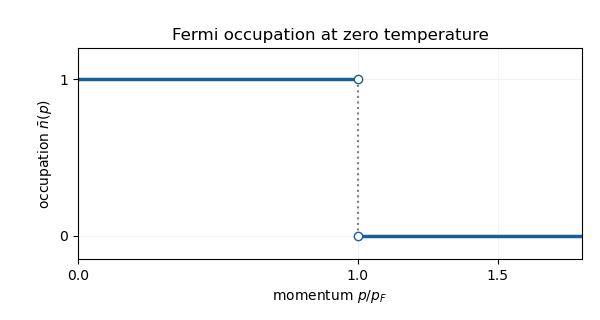
As , the Fermi-Dirac distribution tends to a step function: for , and for . The value at equality is immaterial to the integrals. The Fermi momentum is defined by : the Pauli exclusion principle fills the lowest available states and forbids multiple occupation of a state with a fixed spin. Thus the sketch is a horizontal line at one up to , followed by a jump to zero.
In the ultrarelativistic, , givingEliminate to obtainThe supplied expression for includes rest energy; in this limit its leading term is also the leading kinetic energy.

Past exam of the mathematics course of the University of Cambridge 2011 ii Paper 1 9C ii Solution Created 2026-09-24 Updated 2026-10-14
The specified vector potential gives . Put , retaining its sign. The Lorentz force law yields , and . For initial velocities and , integration givesThe transverse motion is a circle centred at with radius . Thus the full orbit is a helix around a line parallel to the magnetic field, with period and signed axial advance per turn. The charge sign determines the sense of rotation. If it is a circle, if it is a straight line parallel to the field, and if all motion is uniform rectilinear motion.
Past exam of the mathematics course of the University of Cambridge 2011 ii Paper 1 9C i Solution Created 2026-09-24 Updated 2026-10-14
The canonical momentum is . Its time derivative contains the total derivative along the trajectory: . The Euler-Lagrange equation therefore givesThe magnetic field is , so the last term is . With the electric field , this is precisely the Lorentz force law:
Past exam of the mathematics course of the University of Cambridge 2011 ii Paper 1 40A iii Solution Created 2026-09-24 Updated 2026-10-14
For , the Jacobi method iteration matrix has zero diagonal, nonnegative axial entries , and diagonal-neighbour entries . Its row sums are at most one; they are strictly below one at grid points next to the Dirichlet boundary. Its graph is connected by the positive axial entries.
To prove the strict spectral radius bound, let with and choose a component of maximum magnitude . Thenso . If equality held, every positive-weight neighbour of a maximal component would also have modulus , and that row would have sum one. Propagating along axial edges reaches a boundary-adjacent row, whose sum is strictly less than one, a contradiction. This also covers a one-point interior grid, for which . HenceThe standard convergence theorem for a stationary linear iteration says it converges from every initial vector exactly when its iteration matrix has spectral radius below one. Since is invertible by (i), the error satisfies andWeak row diagonal dominance alone would not prove convergence; the connection to a strictly deficient boundary row supplies the required strictness.
Past exam of the mathematics course of the University of Cambridge 2011 ii Paper 1 40A ii Solution Created 2026-09-24 Updated 2026-10-14
Let be the diagonal part of . The weighted Jacobi method isEquivalently it is . In grid form, all neighbours on the right are taken from the old iterate:The boundary values stay zero at every step. The iteration matrix is .
Past exam of the mathematics course of the University of Cambridge 2011 ii Paper 1 40A i Solution Created 2026-09-24 Updated 2026-10-14
Take to be the vector of and absorb into . Its diagonal entry is , each axial-neighbour entry is and each diagonal-neighbour entry is . Since these weights agree in both directions, is a symmetric matrix.
Extend a grid vector by zero to the whole integer lattice. Let contain unordered axial-neighbour pairs and unordered diagonal-neighbour pairs. Only finitely many differences involving nonzero values contribute. Each lattice vertex has total neighbour weight , so expanding the squared differences givesIt is nonpositive. If it vanishes, every axial difference vanishes. The axial lattice is connected and is zero outside the finite interior square, forcing . Thus for every nonzero : .
Reordering the grid replaces by for a permutation matrix . This preserves symmetry and the sign of the quadratic form, proving the assertion for any ordering. Multiplying the whole system by merely rescales by a positive number and has the same conclusions.
Past exam of the mathematics course of the University of Cambridge 2011 ii Paper 1 30A iv Solution Created 2026-09-24 Updated 2026-10-14
If , the characteristics have constant velocity variable and . This flow is globally defined for every finite at each . ThereforeDirect differentiation gives and the initial value at .
Past exam of the mathematics course of the University of Cambridge 2011 ii Paper 1 30A iii Solution Created 2026-09-24 Updated 2026-10-14
The characteristic vector field is a divergence-free vector field:The Jacobian determinant obeys , with . Thus the flow preserves phase-space volume, the Liouville theorem in Hamiltonian mechanics. Changing variables and using (i) givesThis applies on intervals where the flow is a diffeomorphism of the phase space and the integrals are defined; for finite conservation statements require integrability. For instance compactly supported initial data and give the usual setting. An arbitrary smooth need not make these integrals finite on infinite-volume space, and merely smooth does not exclude escape of characteristics to infinity. Equivalently , with no flux through infinity, proves the same Casimir invariant of a transport equation conservation.
Past exam of the mathematics course of the University of Cambridge 2011 ii Paper 1 30A ii Solution Created 2026-09-24 Updated 2026-10-14
Every value of the solution is transported unchanged from its initial characteristic endpoint. Therefore the formula from (i) immediately givesMore generally the Hamiltonian transport equation preserves the range of the initial values while its characteristic solution exists: it neither creates negative values nor changes values by a source term.
Past exam of the mathematics course of the University of Cambridge 2011 ii Paper 1 30A i Solution Created 2026-09-24 Updated 2026-10-14
In phase-space coordinates , the characteristic equations for a transport equation are the Hamilton equationsSmoothness of gives a unique local Hamiltonian flow . Along it the chain rule gives . ThusThe inverse is the backward autonomous flow, so this formula defines the unique local classical solution wherever the characteristic reaches the initial hypersurface. A smooth Hamiltonian on all of need not have a globally complete flow; the formula is understood on the interval and region where both flows exist. A common global time interval requires the corresponding completeness or growth assumption.
Past exam of the mathematics course of the University of Cambridge 2011 ii Paper 1 2F ii Solution Created 2026-09-24 Updated 2026-10-14
For each integer , put . Every derivative is an entire function and cannot be identically zero: otherwise repeated integration would make a polynomial. By the identity theorem for holomorphic functions, its zero set has empty interior, and continuity makes a closed set. Thus is nowhere dense.
The complex plane with its usual metric is a complete metric space, so the Baire category theorem gives . The Taylor series there has coefficients
Past exam of the mathematics course of the University of Cambridge 2011 ii Paper 1 2F i Solution Created 2026-09-24 Updated 2026-10-14
The closed-set version of the Baire category theorem says that if a nonempty complete metric space is a countable union of closed sets, then at least one has nonempty interior. Equivalently, a nonempty complete metric space cannot be a countable union of closed nowhere dense sets.
Past exam of the mathematics course of the University of Cambridge 2011 ii Paper 1 29J iii Solution Created 2026-09-24 Updated 2026-10-14
Assume and keep , . The constraint is . If the unrestricted optimum in (i) lies in this half-space, it remains optimal. Its cash holding isThus it has strictly positive cash precisely when . If , the free optimum violates the constraint, so strict concavity and the Karush-Kuhn-Tucker conditions put the optimum on the boundary, where it is the cash-free solution in (ii). At equality the two solutions coincide. ThereforeIn particular,The multiplier for the inequality is , explicitly checking the complementary-slackness condition.
Past exam of the mathematics course of the University of Cambridge 2011 ii Paper 1 29J ii Solution Created 2026-09-24 Updated 2026-10-14
With , the budget constraint is . On this hyperplane the riskless term is constant, so maximize . The Lagrange multiplier equation gives . If , let and impose the budget constraint:Positive definiteness makes the objective strictly concave on the hyperplane, proving this stationary point is the global constrained optimum. If , the cash-free constraint is feasible only when ; in that degenerate case the optimum is . The displayed quotient, including the one in the question, presupposes .
Past exam of the mathematics course of the University of Cambridge 2011 ii Paper 1 29J i Solution Created 2026-09-24 Updated 2026-10-14
Set , , and . The terminal wealth is , a normal random variable with mean and variance . Its moment-generating function givesMaximizing this expected exponential utility is equivalent to maximizing the strictly concave quadratic form . Since the nonsingular covariance is positive definite, the unique stationary point is the unique maximum:
Past exam of the mathematics course of the University of Cambridge 2011 ii Paper 1 27J v Solution Created 2026-09-24 Updated 2026-10-14
A path that reaches level from below does so while in state , because is continuous and has slope . At the first crossing time, the residual exponential holding time is memoryless and the Strong Markov property restarts the chain from . Conditional on ever reaching , the probability of subsequently exceeding is therefore exactly the original probability of exceeding . HenceThe zero-level limit is one because the initial holding time is positive almost surely. Also , and it is nonincreasing. Consequently is nondecreasing and additive. First is linear on positive rationals, then monotonicity gives the same result on all positive reals. ThusAbsorption can be viewed as killing at rate , independent of sign changes at rate ; this ensures the maximum is finite almost surely and makes the positive decay rate found in (iv) natural.
Past exam of the mathematics course of the University of Cambridge 2011 ii Paper 1 27J iv Solution Created 2026-09-24 Updated 2026-10-14
Past exam of the mathematics course of the University of Cambridge 2011 ii Paper 1 27J iii Solution Created 2026-09-24 Updated 2026-10-14
Starting from , the level reaches at time if the first holding time exceeds . This has probability ; surviving beyond also makes the level strictly greater than , as required by the strict event. A switch to at time has density , leaves level , and requires a later rise of . Absorption before reaching cannot succeed. ThereforeHolding times have continuous distributions, so the single endpoint has no effect on the formula.
There are unlisted articles, also show them or only show them.